The U.S. Constitution provides many opportunities to discuss animals. One case struck down a local ordinance regulating animal sacrifices. The Supreme Court held it was a discriminatory burden on the free exercise of religion.
Justice Blackmun (dropping a footnote citing multiple groups addressing the specific point) concurred, arguing for a broader view of free exercise that covered generally applicable laws. He added:
A harder case would be presented if petitioners were requesting an exemption from a generally applicable anticruelty law. The result in the case before the Court today, and the fact that every Member of the Court concurs in that result, does not necessarily reflect this Court's views of the strength of a State's interest in prohibiting cruelty to animals.
Sherry Colb, who later regularly wrote about animal rights, was one of his law clerks. Her future husband, Michael Dorf (who told me about the book addressed below), once noted that she encouraged him to include that reference.
Another issue would be the Fourth Amendment. Drug-sniffing dogs have popped up in multiple disputes. Another issue would be if dogs were included among the "effects" or in general among those matters protected by the amendment.
Is a companion animal simply property for constitutional purposes? See also the Due Process Clause. If the Fourth Amendment (see, e.g., Justice Harlan's opinion in Poe v. Ullman) partially protects "family life," why not also bring in family pets? Simon is not a chair.
Can animals themselves have constitutional rights? Justice Douglas once famously (infamously?) argued that nature can have standing. But, he spoke for humans all the same:
Those people who have a meaningful relation to that body of water -- whether it be a fisherman, a canoeist, a zoologist, or a logger -- must be able to speak for the values which the river represents, and which are threatened with destruction.
Should animals as animals have standing to sue? A few cases tried to obtain habeas corpus protection, including using state constitutions. Michael Dorf supports that move to some degree. I'm sympathetic, if not given the current law.
I'm not an originalist. The fact that "original understanding" opposes something is not a complete barrier. The term "person" need not only include humans. We can imagine extraterrestrial life, such as Vulcans, which are humanoid in some fashion. Or tie personhood to sentience.
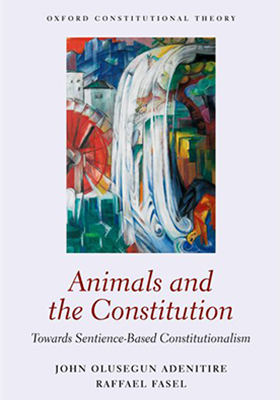
We come along with a long prologue to our book. The book is written in a scholarly fashion. I skimmed it myself. But it is not so unapproachable that I did not gain a general understanding of their arguments.
The book is not about the American Constitution. It concerns constitutionalism in general. Can animals be included? The authors argue in the affirmative.
It helpfully cites many constitutions worldwide, a few that, in some fashion, explicitly protect animal life and/or nature. Nonetheless, none of them goes as far as the thesis here.
(Another book that provides a means to protect nature overall also provides a few citations to foreign constitutions. A wildlife-centered approach might be Native American-centric.)
The book argues that sentience is a floor for constitutional rights. Merriam-Webster defines sentience as "capable of sensing or feeling: conscious of or responsive to the sensations of seeing, hearing, feeling, tasting, or smelling." An example given is "sentient beings."
The book offers various aspects of sentience to help explain why it should be the floor for rights. Sentient beings do not only feel pain, which is often cited as a line-drawing device. Thus, vegans often cite pain as a reason for not eating certain animals.
But is that the only reason? People generally don't want to consume their pets. There is something else involved. Why are we not cannibals, avoiding brains and other parts that might cause disease?
Sentient animals have experiences, thoughts, perceptions, and some sort of independent existence. They have a "self." They are in effect "persons." This provides a realistic floor for rights.
Constitutionalism involves:
- Fundamental rights
- Proportionality
- Rule of Law
- Democracy
Sentient animals warrant the protections that constitutions provide. There is a general agreement that animals deserve some basic security. We don't like cruelty to animals. The book offers more.
Fundamental rights that can be applied to non-human animals include life, freedom, and protection from torture or degrading treatment. The habeas appeals, for instance, include attempts to free an elephant from an allegedly harmful zoo. People have tried to protect primates from medical experiments.
And so on.
Rights are not absolute. Government is about balancing. A concept that is more often found in other constitutional systems (though Justice Breyer is a fan) is proportionality. Basic principles include legitimate regulations, suitability, necessity, and fair balancing.
Animals as constitutional persons (or even moral agents) change the balance. Food might be tasty. But if it causes harm to animals, mere pleasant taste is not (imho) enough to justify factory farming.
(The book is only about 200 pages long.
It is not about a bunch of case studies. So, we can debate line drawing. For instance, are seeing-eye dogs appropriate, or do some see them as a sort of involuntary servitude?
Plus, there are obvious degrees. Abusive horse racing and singular usage for riding for pleasure are different things. Proportionality is a sensible general principle.)
The rule of law is a basic constitutionality principle. It involves government by rules, not whim.
The authors provide multiple criteria to help flesh out the rule of law. Law should be public, clear, stable, prospective (no ex post facto law), realistic, and subject to judicial review. There should be the basic rules of procedural due process, including the right to be heard and an appeal. Non-humans included.
What about democracy? The United States Constitution begins with a reference to "We the People." Animals are governed. They are generally not seen as "the governed," as in "respect for the governed."
Nonetheless, we respect the interests of young children and others, including the severely mentally disabled, who do not actively govern or choose those who govern. Why are non-human animals so completely lacking as constitutional agents?
The book argues that non-human animals should have their interests represented. The authors offer the concept of a segment (30% is offered as realistic) of the legislature to be representatives for non-humans.
We can carp on details. I don't mean to handwave that. It is a seriously complicated issue. There are loads of non-human animals with competing interests. How do we select non-human representatives? Simply having them represent "animals" seems unrealistic.
At the very least, granting the premise that non-human animals (NHA) should have a role in democracy, it seems wrong to suggest they are interchangeable. That seems to violate the basic rule of moral respect.
Nonetheless, the general idea makes some degree of sense. People are chosen to defend the interests of children and others unable to adequately defend their legal interests. NHAs can have guardians, too.
Why not in other contexts? Justice Douglas (partially inspired by Christopher Stone) thought of nature in an instrumental fashion. His approach could be applied to protect nature (and/or animals) individually.
Agencies can assign people or groups to protect the interests of NHAs. So can legislatures. We can debate about how to select such people. Or how they would respect the interests of NHAs. For instance, the book offers a referendum-type process. We can debate it.
But it is our duty to address the matter overall if we are going to respect the sentient beings as constitutional persons. We should "listen" to our companion animals if we truly respect them.
The principle applies writ large. Our own constitution, to be local, can use some improvement. The baseline was set up in the 18th Century.
We might be proud that it is still going (strong?), if with some amendments. Still, the 21st Century is on the phone (or whatever), and it is not totally impressed. NHAs are one thing to factor in.


No comments:
Post a Comment
Thanks for your .02!