
About Me

My photo
This blog is the work of an educated civilian, not of an expert in the fields discussed.
Showing posts with label animals. Show all posts

Sunday, March 08, 2026

Some Books

I have had mixed experiences with books recently. I have had better luck lately. A variety of books with different subject matters are worth noting. 
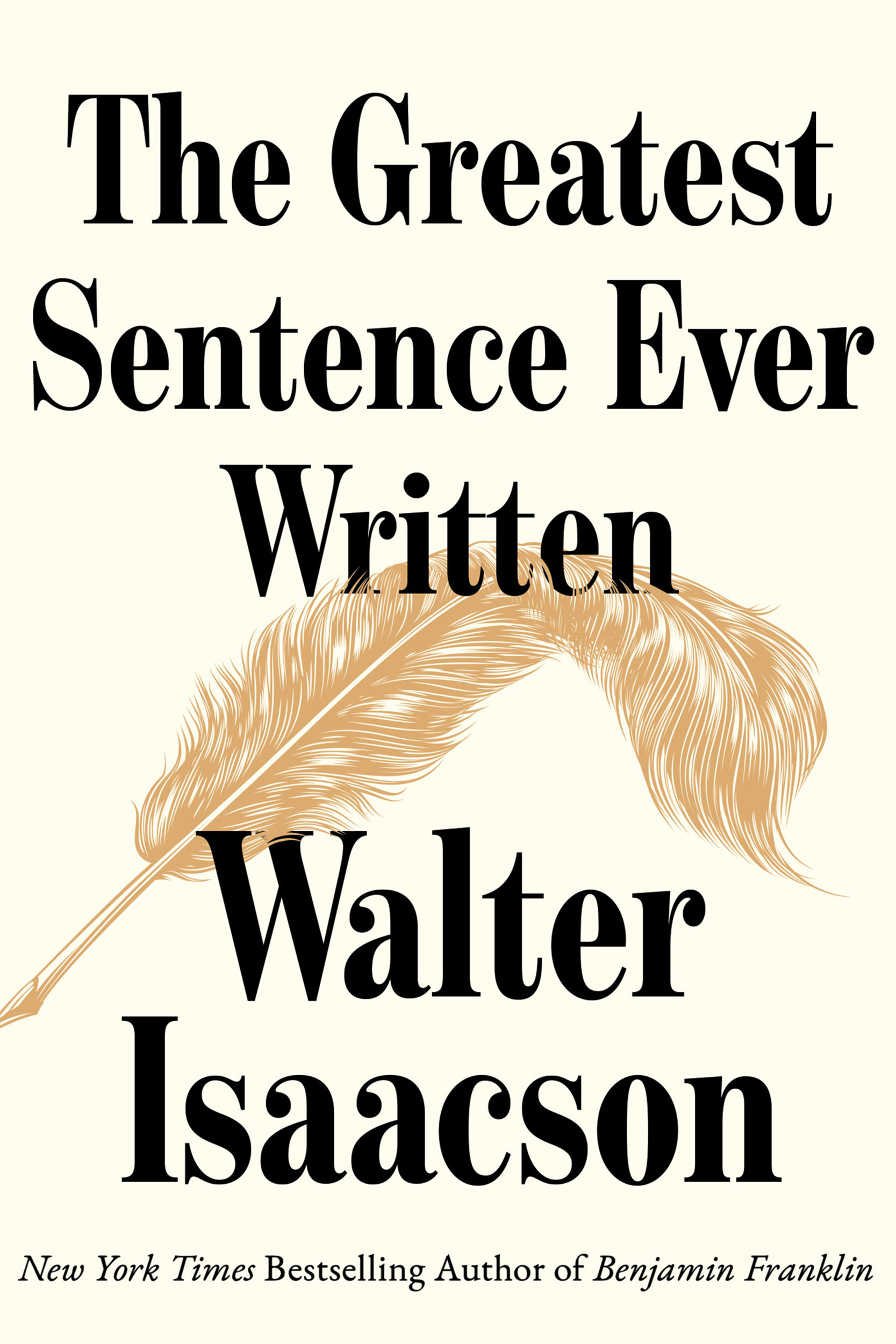
Walter Isaacson’s new book, “The Greatest Sentence Ever Written,” takes as its focal point the document’s second line: “We hold these truths to be self-evident, that all men are created equal, that they are endowed by their Creator with certain unalienable Rights, that among these are Life, Liberty and the Pursuit of Happiness.”

An apt entry for the 250th anniversary of our independence. The book is tiny -- it is around sixty-four pages -- and half of it isn't even directly about the sentence. He includes an essay about the importance of supporting the common good. He also includes multiple documents, including a first draft.

I also liked Edward Larson's, best known for his book on the Scopes Trial, book on 1776 overall. 


I found this author because she has a new book. This is an older one that was at the library. The "Jenna" book club references Bush43's daughter. 

It covers the life of its character from 7-18 (for whatever reason, the plot ends about a decade before the book was published) or thereabouts. It is not a young adult book, but it reads like one. It is in her voice. 

Her father is unreliable, her mother is trying to survive with two children from different fathers, and Sam likes to climb. We get some plot from when she is younger, but a chunk takes place when she is around 15-18. 

I liked it overall, though it probably went too long. 


I found a picture of this book and the next one, which were read over fifteen years ago. I listened to this one (don't recall doing so) while reading it this time. 

I did listen to The Devil in the Junior League, which is a summer read that I put on the side panel (btw, one image appears to not show up on some browsers). A good performance -- appropriate Southern accent (though one person said it wasn't Texan ... I didn't notice the difference -- IITW took place in Texas btw) with a nice sound effect simulating phone calls and use of a microphone. Got a kick out of it -- sometimes, it doesn't take much to amuse me.

The author had a bunch of romance novels. This one was inspired by her own life (she moved to NYC from Texas). It was a fun story of a twenty-something whose comfortable life falls to the wayside, but she manages to find a way. 

One thing that originally attracted me to the book was that I watched a LGBTQ film (It's In the Water) that took place in a similar milieu. That is, a junior leaguer stepped outside of her comfort zone, this time accepting her lesbianism. 


Blechman’s forte clearly is in his character studies of these and other pigeon enthusiasts. His account of the historical pigeon, on the other hand, is a bit mottled by his lack of footnotes or bibliography. One can neither check up on details nor expand one’s knowledge. The engaged reader, of course, wants to do both.

The book covers various subjects (including Darwin, beauty contests, food, and target practice) but emphasizes pigeon racing. It is well written. Pigeon enthusiasts might want a bit more about the birds themselves. 

The bird racing was familiar. My dad raced birds. He fit the m.o., coming from a working-class ethnic background. We had a coop on the roof. 

He had one of those clocks that were used to track when birds arrived. I'm not sure how he started. For whatever reason, he eventually stopped. 


Midaq Alley (Arabic: زقاق المدق, romanized: Zuqāq al-Midaqq) is a 1947 novel by Egyptian author Naguib Mahfouz, first published in English in 1966. The story is about Midaq Alley in Khan el-Khalili, a teeming back street in Cairo which is presented as a microcosm of the world.

I found out about this book because it was adapted into a film (taking place in Mexico). The book is a tad risqué (involving homosexuality, prostitution, and other mature topics) with various human dramas taking place. Good translation. 

Mahfouz was a leading Egyptian novelist who repeatedly used "alleys" in his works. I don't read much fiction, especially "classic" novels. Overall, I enjoyed it, though now and then the exposition went on a bit too long. 

I never saw the film. 


Ted Danson, during his appearance on Stephen Colbert, recently referenced that he has a podcast. There are lots of podcasts out there. 

I checked it out. He has some interesting interviews. 

I listen to a few podcasts. I often get bored with podcasts. Strict Scrutiny Podcast, concerning the Supreme Court, which is a prime interest of mine, often goes too long. 

But I listened to both parts (about two hours total) of the interview he had with his wife. They met while doing a film together. They acknowledged the film didn't do well. 

The marriage did. It has been around thirty years. 
Saturday, February 07, 2026

Developing A Scientific Temper

Gauhar Raza discussed his book, From Myths to Science: The Evolving Story of the Universe, on a recent Freedom From Religion Foundation podcast. It's a weekly broadcast on Thursday with one-half news, one-half usually some guest. 

He cited a quote from the Indian founding father, Nehru, in his book, Discovery of India.

The scientific approach, the adventurous and yet critical temper of science, the search for truth and new knowledge, the refusal to accept anything without testing and trial, the capacity to change previous conclusions in the face of new evidence, the reliance on observed fact and not on pre-conceived theory, the hard discipline of the mind, all this is necessary, not merely for the application of science but for life itself and the solution of its many problems.

The Indian Constitution has a section of "fundamental duties," which includes “to develop the scientific temper, humanism and the spirit of inquiry and reform.” Among the other duties are "to protect and improve the natural environment including forests, lakes, rivers and wild life, and to have compassion for living creatures."

The fundamental duties are civic guidelines that apparently are "not justiciable." That is, they are not rights and obligations that are legally binding. Still, they provide a vision to follow. If some legal dispute arises, it also would seem reasonable to apply the law, if reasonably possible, without violating such duties.

As always, it is interesting to consider other national constitutions and laws. How do they govern and apply principles with some universal appeal?  

We should take more careful attention to such things, especially for a country that now challenges China as the most populous in the world.  

National Prayer Breakfast 

It's that time again. 

The National Prayer Breakfast, which as Stephen Colbert notes, threatens the separation of church and breakfast. It also has other issues.

Various groups encouraged politicians to boycott the event. Trump took the occasion to be horrible himself, including bashing Democrats, and selling how he is helping bring God back to this country. 

A time for politicians to join together and pray can be a useful event. It can be a benign one where they humbly respect their religious beliefs. It's possible. 

Trump goes another way and underlines why it was a tragic day in our nation when the people elected him in 2024. His profaning of religion included. 

Tuesday, December 30, 2025

Animals and the Constitution

The U.S. Constitution provides many opportunities to discuss animals. One case struck down a local ordinance regulating animal sacrifices. The Supreme Court held it was a discriminatory burden on the free exercise of religion.  

Justice Blackmun (dropping a footnote citing multiple groups addressing the specific point) concurred, arguing for a broader view of free exercise that covered generally applicable laws. He added:

A harder case would be presented if petitioners were requesting an exemption from a generally applicable anticruelty law. The result in the case before the Court today, and the fact that every Member of the Court concurs in that result, does not necessarily reflect this Court's views of the strength of a State's interest in prohibiting cruelty to animals. 

Sherry Colb, who later regularly wrote about animal rights, was one of his law clerks. Her future husband, Michael Dorf (who told me about the book addressed below), once noted that she encouraged him to include that reference.  

Another issue would be the Fourth Amendment. Drug-sniffing dogs have popped up in multiple disputes. Another issue would be if dogs were included among the "effects" or in general among those matters protected by the amendment. 

Is a companion animal simply property for constitutional purposes? See also the Due Process Clause. If the Fourth Amendment (see, e.g., Justice Harlan's opinion in Poe v. Ullman) partially protects "family life," why not also bring in family pets? Simon is not a chair.

Can animals themselves have constitutional rights? Justice Douglas once famously (infamously?) argued that nature can have standing. But, he spoke for humans all the same:

Those people who have a meaningful relation to that body of water -- whether it be a fisherman, a canoeist, a zoologist, or a logger -- must be able to speak for the values which the river represents, and which are threatened with destruction.

Should animals as animals have standing to sue? A few cases tried to obtain habeas corpus protection, including using state constitutions. Michael Dorf supports that move to some degree. I'm sympathetic, if not given the current law.

I'm not an originalist. The fact that "original understanding" opposes something is not a complete barrier. The term "person" need not only include humans. We can imagine extraterrestrial life, such as Vulcans, which are humanoid in some fashion. Or tie personhood to sentience.

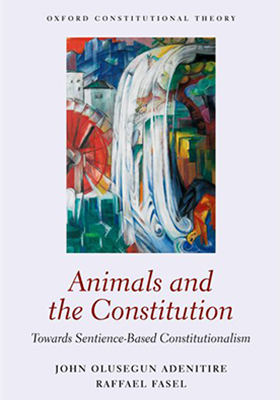
We come along with a long prologue to our book. The book is written in a scholarly fashion. I skimmed it myself. But it is not so unapproachable that I did not gain a general understanding of their arguments. 

The book is not about the American Constitution. It concerns constitutionalism in general. Can animals be included? The authors argue in the affirmative. 

It helpfully cites many constitutions worldwide, a few that, in some fashion, explicitly protect animal life and/or nature. Nonetheless, none of them goes as far as the thesis here. 

(Another book that provides a means to protect nature overall also provides a few citations to foreign constitutions. A wildlife-centered approach might be Native American-centric.) 

The book argues that sentience is a floor for constitutional rights. Merriam-Webster defines sentience as "capable of sensing or feeling: conscious of or responsive to the sensations of seeing, hearing, feeling, tasting, or smelling." An example given is "sentient beings."

The book offers various aspects of sentience to help explain why it should be the floor for rights. Sentient beings do not only feel pain, which is often cited as a line-drawing device. Thus, vegans often cite pain as a reason for not eating certain animals. 

But is that the only reason? People generally don't want to consume their pets. There is something else involved. Why are we not cannibals, avoiding brains and other parts that might cause disease? 

Sentient animals have experiences, thoughts, perceptions, and some sort of independent existence. They have a "self." They are in effect "persons." This provides a realistic floor for rights. 

Constitutionalism involves:

  • Fundamental rights
  • Proportionality
  • Rule of Law
  • Democracy
Sentient animals warrant the protections that constitutions provide. There is a general agreement that animals deserve some basic security. We don't like cruelty to animals. The book offers more.

Fundamental rights that can be applied to non-human animals include life, freedom, and protection from torture or degrading treatment. The habeas appeals, for instance, include attempts to free an elephant from an allegedly harmful zoo. People have tried to protect primates from medical experiments. 

And so on.

Rights are not absolute. Government is about balancing. A concept that is more often found in other constitutional systems (though Justice Breyer is a fan) is proportionality. Basic principles include legitimate regulations, suitability, necessity, and fair balancing.

Animals as constitutional persons (or even moral agents) change the balance. Food might be tasty. But if it causes harm to animals, mere pleasant taste is not (imho) enough to justify factory farming. 

(The book is only about 200 pages long. 

It is not about a bunch of case studies. So, we can debate line drawing. For instance, are seeing-eye dogs appropriate, or do some see them as a sort of involuntary servitude? 

Plus, there are obvious degrees. Abusive horse racing and singular usage for riding for pleasure are different things. Proportionality is a sensible general principle.) 

The rule of law is a basic constitutionality principle. It involves government by rules, not whim. 

The authors provide multiple criteria to help flesh out the rule of law. Law should be public, clear, stable, prospective (no ex post facto law), realistic, and subject to judicial review. There should be the basic rules of procedural due process, including the right to be heard and an appeal. Non-humans included. 

What about democracy? The United States Constitution begins with a reference to "We the People." Animals are governed. They are generally not seen as "the governed," as in "respect for the governed." 

Nonetheless, we respect the interests of young children and others, including the severely mentally disabled, who do not actively govern or choose those who govern. Why are non-human animals so completely lacking as constitutional agents?

The book argues that non-human animals should have their interests represented. The authors offer the concept of a segment (30% is offered as realistic) of the legislature to be representatives for non-humans.

We can carp on details. I don't mean to handwave that. It is a seriously complicated issue. There are loads of non-human animals with competing interests. How do we select non-human representatives? Simply having them represent "animals" seems unrealistic.

At the very least, granting the premise that non-human animals (NHA) should have a role in democracy, it seems wrong to suggest they are interchangeable. That seems to violate the basic rule of moral respect. 

Nonetheless, the general idea makes some degree of sense. People are chosen to defend the interests of children and others unable to adequately defend their legal interests. NHAs can have guardians, too.

Why not in other contexts? Justice Douglas (partially inspired by Christopher Stone) thought of nature in an instrumental fashion. His approach could be applied to protect nature (and/or animals) individually. 

Agencies can assign people or groups to protect the interests of NHAs. So can legislatures. We can debate about how to select such people. Or how they would respect the interests of NHAs. For instance, the book offers a referendum-type process. We can debate it. 

But it is our duty to address the matter overall if we are going to respect the sentient beings as constitutional persons. We should "listen" to our companion animals if we truly respect them.

The principle applies writ large. Our own constitution, to be local, can use some improvement. The baseline was set up in the 18th Century. 

We might be proud that it is still going (strong?), if with some amendments. Still, the 21st Century is on the phone (or whatever), and it is not totally impressed. NHAs are one thing to factor in. 

Wednesday, November 05, 2025

Democrats Have A Good Election Day

Tonight, the results came in. American voters have spoken.

They firmly supported Democrats. The most notable for me personally is the election of Zohran Mamdani as mayor of New York. As of this writing, he has received a bit over 50% of the vote

Cuomo received over 40% while Sliwa received around 7%, including via his Protect Animals line. Mamdani said that Cuomo didn't send the usual complimentary victory message, though Sliwa did. 

Fox News (local NYC channel) referenced that Cuomo couldn't even pronounce Mamdani's name correctly in his concession speech. Sliwa also ran on a "Protect Animals" line. Someone else ran on the Conservative Party line. Perhaps, Mamdani can find an animal-related position, including involving feral cats, one of Sliwa's causes. 

Women played a major role here. The new governors of New Jersey and Virginia (both with convincing wins) will be women. Also, along with the new Muslim mayor of NY:

Ghazala Hashmi wins Virginia lieutenant governor’s race, becoming first Muslim woman elected statewide

Zohran Mamdani voted "Yes" on ballot measures 1-5 that were on the ballot in NYC, and those won. The sixth ballot measure to change off-year elections lost. It would not have been final, anyway, since the state legislature has to do it. I was a bit wary about the housing measures, but that's fine.

Anti-trans messaging failed this time around. It might best be noted that it didn't change other trends. The message appears to be anti-Trump, supporting Democrats, and progressive policies. 

The messaging there was mixed. Mamdani stood out. But it does provide a lesson about enthusiasm. House Minority Leader Jeffries, at the end, endorsed Mamdani (yippe) while Schumer couldn't even do that. He didn't say who he voted for. Sheesh.

Mamdani is not a "literal communist," which is now the framing. He is a self-labeled socialist, which is not horrible. I look forward to seeing how he does and hope net his administration is positive. Eric Adams is not a high bar, even if he has some positive policies.

I worked at the polls, checking in voters. We have ten days of early voting. We still had a respectable turnout in our neighborhood polling place. The whole process continues to impress me and provide some civic pride. Many fulfilled their civic obligations

A Texan parental rights amendment passed. The text seems rather benign, though various liberal leaning groups opposed it. For instance, literally, the amendment seems to help parents of trans people. OTOH, trans groups also opposed the amendment.

After 13 years, Mississippi Democrats have broken the Republican Party’s supermajority in the Mississippi Senate. Voters elected Democrats to two seats previously held by Republicans, reducing the number of Republican senators in the upper chamber from 36 to 34—one fewer than necessary to constitute a supermajority.

I will end with this symbolic bit of good news. After all, it is not like the legislature would logically often need to overrule a veto or something. 

Still, supermajorities do have more power, and that might help limit the damage in some cases. For instance, supermajorities make it easier to propose constitutional amendments. Most significantly, it is a message against extremism and the ability of others to have a voice. 

Liberals have victories in places you least expect. For instance, criminal justice reform has occurred throughout the nation. The wins were often in places, though the breadth was particularly significant; you expect Democrats to win (but see Pennsylvania and Trump's wins there), so that's nice too. 

Back to New York City, for the second time in so many election cycles, my city council district switched political parties. I was concerned, I even sent them an email, about the lack of campaign signs in my neighborhood. They were available on Election Day to hand out literature near the polls. The Democrat won, however, perhaps some Mamdani coattails. 

One major issue for the Republican incumbent was opposition to a health program for former prisoners. I was particularly angry about that. Overall, she seemed to do okay, but I'm fine with her losing. Anyway, the already small Republican NYC City Council delegation will now be smaller.  

A couple of final comments. The personal factor played a significant role, in various degrees, in the Democrats' wins. They had impressive life stories. They ran good campaigns. They connected to the voters in ways Republicans often did not.

Finally, can the new Arizona congresswoman be sworn in already, please? 

Sunday, October 26, 2025

No Habeas For Chimps

An intermediate Michigan court unsurprisingly rejected a habeas appeal for chimpanzees. 

The claim was raised to obtain liberty for some chimpanzees allegedly being mistreated in a zoo. There are rules in place for the mistreatment of animals. Habeas protections provide a special level of protection against unjust detention. 

As part of the same framework, the common law treated animals as objects of property. Blackstone defined property as “that sole and despotic dominion which one man claims and exercises over the external things of the world, in total exclusion of the right of any other individual in the universe.” 

It is offensive that all animals, even chimpanzees, are treated as merely "property." Again, there are cruelty to animals laws that suggest they are at least a special species (ha) of property. This traditional despotic power is tempered somewhat in the modern day. 

I talked about this issue a few years ago when the highest court in New York rejected a similar claim as applied to an elephant. The Michigan Court of Appeals likewise worried about line-drawing for "intelligent" animals. 

Unlike the human species, which has the capacity to accept social responsibilities and legal duties, nonhuman animals cannot—neither individually nor collectively—be held legally accountable or required to fulfill obligations imposed by law.

And, noted non-humans are different in kind from women and slaves of all sexes (both are "persons" according to the Constitution). Such language can be pushed back upon. Babies are "persons" too, after all. But, generally speaking, yes, not the same, exactly.

[ETA: I am not sure how literally true the "legally accountable" bit is. Put aside that three-year-old human children are not held legally accountable. 

Dogs can be killed -- use the desired euphemism -- for vicious behavior. Non-human animals can be punished. They can be taught, like humans, to fulfill certain obligations and social responsibilities.

In return, we can have an obligation to treat them well. Before a dog is killed, there should be some due process. And, not just to protect an owner's "property." In medieval Europe, this was taken quite literally, with lawyers appointed and everything.]

Non-human animals, we can debate the line-drawing,* should not be treated as mere property. They have the intelligence, the ability to feel pain, and other aspects that warrant protection. Humans also have personal interests that warrant the protection of other animals. 

I don't know if a traditional habeas judicial proceeding is the best avenue to protect their interests. Yes, I would couch them in terms of "rights." But they should be protected. As with minors and others unable to adequately and independently defend their interests, special advocates can be appointed for this purpose. 

The legislature or the people, by constitutional change (some foreign nations protect animals in their organic law), would be the appropriate place to secure this protection. I hold to my earlier stance.

The current law warrants holding against the challengers. OTOH, two judges in NY did dissent. 

===

* Chimps are a somewhat easy case since higher primates are so closely related, including intellectually, to humans. Nonetheless, the earlier case involved elephants. I noted there that even birds, at least parrots, have shown special intelligence. 

Vegans and vegetarians draw their line in various places. Opponents will have a field day. One recent comment referenced jellyfish. Yeah. While you eat your veal, make a big deal about worms and such.

The line is going to be, at some point, somewhat arbitrary. Nonethless, like all "slippery slopes," some lines are reasonable. The general public does not think that cruelty to animals laws are stupid.

This remains so even if they step on bugs. 

Friday, August 22, 2025

Partisan Gerrymandering in the Texas and California

Donald Trump said Tuesday that he is pushing Texas Republicans to redraw the state’s congressional maps to create more House seats favorable to his party, part of a broader effort to help the GOP retain control of the chamber in next year’s midterm elections.

Trump wants to rig the system because he thinks the people will not otherwise support him. There is much opposition to the things he has done so far. He is trying this time to do a bunch of things without congressional approval (illegally, though the Supreme Court repeatedly has helped him out).

Partisan gerrymandering is a basic way for a political party to obtain and retain power without popular support. It is ultimately a violation of the republican form of government. "We the People" no longer govern by a fair expression of the vote. 

The Guarantee Clause has long been deemed (probably somewhat wrongly) non-justiciable. Nonetheless, other means can be used by the courts, including the Equal Protection Clause (see "one person, one vote").  States and Congress can also address the problem.

The Supreme Court in Rucho v. Common Cause (2019) conclusively (after Kennedy never bit the bullet) said partisan gerrymandering is not for the federal courts to handle. I question blaming John Roberts, full stop, here. 

Kavanaugh is probably the person directly to blame. He was the fifth vote. Likewise, Barrett is to blame for Dobbs (abortion). But Roberts is the Chief Justice. It is part of his decades-long conservative anti-voting rights campaign.* 

Texas is the second most populous state. It is standardly cited as a red state. Nonetheless, over forty percent of the voting population voted for Hillary Clinton in 2016. There is a significant Democratic presence. A fair map will provide many Democrats. Good luck with that. 

The campaign to make the map even more Republican-focused apparently cannot wait until the end of the decade. The Constitution sets forth once per decade apportionment tied to the census. Mid-decade apportionment, other than to fix disputed maps, should be traditionally disfavored. 

California, the most populous state (and state of mind), has stepped in to check Texas. They are using the amendment process and proposing a gerrymandered map. The people have to accept the amendment first. New York has a more extended process. We could not act as quickly.  

The amendment has language supporting federal reform, both legislatively and by constitutional amendment. Partisan gerrymandering ultimately requires a national solution. 

Strategically, unilateral disarmament is ill-advised. There will also be a "race to the bottom" problem. Now, Republicans control many more legislative halls and governors' mansions.

They see misrule as having short-term gains. 

==

* Roberts decided on Thursday, for once, to vote for the liberals during Trump 2.0 in a confusing 4-1-4 ruling. More shadow docket shenanigans. 

Jackson strongly speaks out, including accusing the Court of Calvinball. The case involving NIH funding, and in one bit, Jackson notes the result will include euthanizing animals used in research. 

Great. Now, SCOTUS is killing animals.

Saturday, August 09, 2025

They Only Kill Their Masters

This film was on TCM. 

Good group of character actors. Seriously. The film is almost like a Murder She Wrote episode regarding the number of classic film actors in supporting roles.

Garner (in his autobiography) once ranked his films. This received 2/5, but he didn't want to talk about it. That is likely to lead people to wonder why. 

I would probably rank it 3/5 on that scale for the cast, setting, and the plot for much of the film. It was an enjoyable, deliberate mystery taking part in a small town. It was a very good role for James Garner.

[The film does go in an annoying direction, so I might give it 2.5. OTOH, lots of 3/5 films have flaws. That sort of film is decent, taking everything into consideration. So, the bad stuff is averaged in.] 

The film, in a limited fashion, involves bisexuality/lesbianism, which is put in a bad light given the plot. Some people will be a bit shocked at who the killer turns out to be. At least given who plays the role. Garner's character, at one point, out of nowhere (really), references not being a "faggot" for some reason. I was a bit taken aback.

Anyway, the film was enjoyably moseying along [I was watching it late at night], and then it hit into stupid plot point territory. Garner's character not only made a misguided assumption (or three) but also did something dangerously stupid. 

It ruined things for me, and I shut it off. I checked Wikipedia to see what happened. The solution to the mystery was unpleasant and somewhat lame. Plus, there is the "small town has a dark side" flavor there. Finally, how many seems fine but has a creepy side roles has Hal Holbrook done?  

We also have another case of the gratuitous shooting of a guilty party. Television and film don't need the death penalty with all the people being shot dead. 

So, I enjoyed the movie until I didn't. James Garner was overall very good. Not sure why he didn't want to talk about it. Probably something personal, including conflict with a cast member or the like.  

There is a "title drop" (involving a dog) early in the film. As noted in Wikipedia, there were multiple (failed) attempts to use the general concept as the basis of a series (using different actors). I can see it. 

Wednesday, June 18, 2025

SCOTUS Watch: Anti-Pride Month Edition

Financial Disclosures 

The Supreme Court released financial disclosures, part of the ethical rules currently in place. The SCOTUSblog coverage notes (without adding "and he should have been impeached"):

Justice Clarence Thomas, whose failures to disclose (among other things) private jet and superyacht trips in prior years led to investigations by ProPublica and calls for ethics reform by the justices, did not list any non-investment income, any travel reimbursements, or any gifts for 2024.

Justice Alito delayed providing his probably because he has a lot of investments. It would be helpful if these things were cross-referenced to recusals. 

Opinion Days

If you go to the Supreme Court website, there is a calendar. Click such and such a day and see if anything is scheduled. Wednesday and (eventually) Friday were labeled as days when opinions might come down. They nearly always will be. 

There is no livestreaming of opinion announcements. Nonetheless, reporters live blog them, including at SCOTUSblog and Bluesky. So, for instance, we know how many boxes of opinions are out. Today it was three. That means a bunch of opinions. 

The opinions are released in reverse order of seniority (Jackson to Roberts; any unsigned per curiam comes last). The first was handed down by Kavanaugh, but then it was Thomas handing down a not too divisive case. The next opinion was either Thomas's or Roberts's. A big opinion was likely.  

The Others 

The justices (Gorsuch, with Alito and Thomas dissenting) found a way to avoid a tricky case involving the disposal of nuclear waste on standing grounds. Kavanaugh has done that before.

Thomas handled two environmental cases. Gorsuch (with Roberts, with a relatively rare dissent) disagreed with how he handled it, dissenting in one case and concurring in the other. 

After the big decision, Roberts had a good opinion that expanded access to a jury trial under the Prison Litigation Reform Act. Barrett wrote the dissent there for the other conservatives (minus Gorsuch).  

Some are sneering at the NYT article on maverick Barrett, but it also had multiple people warning "ignorant conservatives and wishful liberals" expecting too much. I did hope she would not be too bad on trans issues. Oh well. So did a trans activist.

Trans Medical Care  

Judge Sutton and the 6th Circuit ruled against same sex marriage, unlike nearly every other court. This led the Supreme Court to take up the issue ten years ago. Sutton was behind the anti-trans ruling, too.

We have a different Supreme Court now. It was risky to bring an appeal. This was not a statutory case involving employment. The regulation of medical care for minors would give the necessary justices more room for concern. Gorsuch, who wrote the Bostock opinion, didn't even open his mouth during the oral argument. The question was how bad it would be. 

Tennessee’s legislature passed the law, known as SB1, in 2023. SB1 emphasizes that the state has a “legitimate, substantial, and compelling interest in encouraging minors to appreciate their sex, particularly as they undergo puberty.” It prohibits (as relevant here) the use of puberty blockers and hormone therapy for transgender teens while allowing the use of the same treatments for other purposes. 

[The bold is from two linked articles.]

Not good, though it could have been worse. Roberts wrote the majority, though a lot of the 118 pages were concurrences and dissents (Sotomayor dissented from the bench; Kagan didn't join one part while Jackson joined all of Sotomayor's dissent).  

The opinion didn't go far enough for Barrett, Alito, and Thomas. They would have bluntly said that transgender people should not receive heightened scrutiny. Roberts claimed the case didn't bring up the question. Alito was more honest than that. 

Significantly, Tennessee’s law is also quite explicit that the purpose of this law is to ensure that young people do not depart from their sex assigned at birth. The law declares that its purpose is to “encourag[e] minors to appreciate their sex” and to prevent young people from becoming “disdainful of their sex.” That is an explicit sex-based classification. Patients who Roberts refers to as “biological women” are allowed to fully embrace femininity in Tennessee. But a child who is assigned male at birth may not.

Roberts could have done less than he did, given the limited question presented. Kagan separately talked about that. I had hoped perhaps someone like Barrett (not thinking she was so anti-trans) could write a minimalist opinion. Unfortunately, Barrett decided to instead reach out to belittle the risks of trans people.

Roberts didn't go as far as he could. It still is not good. For instance, "We have not yet considered whether Bostock’s reasoning reaches beyond the Title VII context, and we need not do so here." The Bostock author went along with this possibly "applying it to its facts" limitation without comment. 

The Bostock logic should apply to other federal and state legislation with similar "because of sex" language. The "Title VII context" isn't somehow unique. I'm worried about that possible poison pill. 

The opinion cites Dobbs and an old "pregnancy discrimination isn't sex discrimination" precedent to add insult to injury.  The opinion is sort of a bad Roberts special: it has a desired result, sounds reasonable, but the reasoning falls apart with scrutiny. 

Chris Geidner and Erin Reed have more. CG argues there are avenues left open, including when animus is shown. Some, however, (rightly) argue that it was present here. He notes the "disingenuous wordplay" involved. And, this was the better half of the majority.

Erin Reed speaks about how "devastating" the ruling is while also noting its limited reach: 

The case raised foundational constitutional questions: whether transgender people constitute a class triggering higher constitutional scrutiny, whether laws targeting them violate equal protection, and whether the Constitution guarantees their right to access medically necessary treatment. The Court sidestepped nearly all of those questions.

ER covers how the opinion is horrible and poorly argued within the context covered. This includes Orwellian language that uses the criteria of trans people to classify and says the state is not classifying by trans status. A big TBD:

The ruling effectively greenlights medical care bans across the country and may pave the way for broader restrictions, including for adults, while leaving lower court rulings on bathrooms, schools, sports, and employment remain intact—for now.

The opinion, overall, should not be exaggerated to some degree -- it covers a limited ground -- but it is true (to quote Blackmun) that an ill wind blows.  

(Sotomayor provides her dissent "in sadness" instead of "respectfully." She should say "in anger," which is expressed in various parts of her dissent.)  

On a related subject. I watched Newton's Law, an Australian show, on DVD. It had a trans healthcare storyline. Another episode of the enjoyable legal drama involved a property dispute over a dog. A good change that addresses the old "pets are just property" concept was recently put in place.

recent book about a German sex researcher provides a more open and liberal minded vision that apparently is still ahead of its time a hundred years later.  

Trump Checks In 

Meanwhile, the Trump Administration is continuing its anti-LGBTQ efforts:

President Trump’s administration has ordered a crisis service for LGBTQ youth to close within 30 days in a move that opponents have said will have dire consequences. 

Since federal spending is involved, the Substance Abuse and Mental Health Services Administration referenced "LGB+ youth," editing out trans people. 

To be continued ... 

Tuesday, April 15, 2025

How Could You Do It, Diane?

Kilmar Armando Abrego Garcia fled El Salvador and started a new life here. 

The Trump Administration wrongly sent him back and doesn't want to do anything to escape his current residence in a prison hellhole. 

I talk about Garcia's life some here and could have said more. Someone is likely to write a book, hopefully eventually with a better ending.

And, not too many book titles have two forms of punctuation. 

I noted a few years back that I first read this book as a teenager. Checking, that's true. The version I read the second time around, while being probably older than her mother (not by TOO much), was not the same copy since it was published a few years later.

The book concerns a teenage girl getting over her sister's suicide. The author died at close to a hundred years old when I reread it here. She was quoted as favoring (as suggested by the titles) different fare:

When Stella Pevsner reflected on the 18 children’s books she had written over her long career, she realized her later books always seemed to feature a girl around 10 years old — sassy but charming in her own way.

I'm not sure why she chose to write more serious fare in this case. Either way, it was a well-written down to earth account. No classic, but it touchingly shows how the death affected various members of the family. 

She wants to know 'why," but (spoiler) does not find out. And, it's okay. The book is about being able to move on while still (of course) never truly doing so since the loss is never gone. 

I was older than the character even when I first read it. She now can -- well, I'm notably older. It's a sign that (as I have said before) teen fiction can be enjoyed by adults. She's mainly fourteen in the novel though through her eyes we also see her parents.  

I must have first found it in the library. I know a "Diane," so that might have caught my eye. She's alive and all. The cover portrays "Diane." 

I also read the beloved Japanese international bestseller The Travelling Cat Chronicles

The book is narrated by a cat and has multiple sad things. Another spoiler (since no one reads this blog and it's an old book): the reason the owner needs to give away his precious cat (he travels to a few places to try) is that he's dying. And, that isn't the only sad thing in the novel! Still, it's a good book.

The episodic nature makes it effectually a series of short stories. The characters are well drawn.  

Sunday, March 30, 2025

Royal-ish

The current Hallmark Channel films premiering on Saturday are a collection of films involving different members of a foster family watched over by Mindy Cohn, who some best know from The Facts of Life

They don't interest me so far. Before them, there were multiple royal-themed films. I enjoyed The Royal We and Royal-ish. Nicole Sakura, who comes from a Japanese/American/Irish background, has an interesting voice. She is a somewhat atypical choice for a Hallmark film. The guy is more standard. 

The young daughter is cute and has a good performance with the typical posh-sounding European-y accent found in these royal films. The royals nearly always come from some imaginary West European location. Why not have some coming from other parts of the world? There are lots of Pacific islands, for instance, they can be from. 

Anyway, Royal-ish went pleasantly along and there was even the kiss (the "rule" usually is that it is at the very end, but not always). I was waiting for the "complication." And, there it came with about twenty minutes left. It was forced but obligatory. 

The Royal We handled things better. Still, I enjoyed Royal-ish, especially because of the lead actress. 

==

I also re-watched Robin Hood: Men In Tights. I saw the film but have not seen the whole thing for quite some time. The sheriff character is the best. There are many familiar faces, and it is easy to take like Spaceballs. Good for television viewings. 

Mel Brooks had a short-lived Robin Hood television show parody in the 1970s that is on Catchy Comedy Channel. Looks good, but I can see why it didn't last.  

("Looks good" means the sets and so on are good for a television series, but the scripts from the bits of a few episodes were lame comedy-wise.) 

==

Saving Hope was a Canadian medical drama. NBC ran the first season. I checked out the first season DVD from the library. Four episodes in, I enjoyed it, though I might get bored with it after a while. 

It starts with a male chief of surgery going into a coma (he came out of it later) and being able to see dead people while walking around in the hospital. His fiancée is the chief surgical resident and is the focus of the show at the beginning.  

One member of the supporting cast was in many Hallmark Channel movies (many Canadian actors pop up there). I like Julia Chan as a young doctor, too. 

Generally well acted with good stories. 

ETA: Breast milk ice cream? Seems animal friendly.

Thursday, March 13, 2025

Companions in Conflict

I re-read this rewarding book from five years ago that viewed the Palestinian experience through different animals who live in the region (donkeys, cows, camels, and so on). The author is an American who has lived in Palestine since the 1980s, staying after what was supposed to be a year-long sojourn. She married and started an extended academic career.

The author resides in the West Bank. Gaza had long been mainly off limits. The latest news:

Israel has clamped Gaza back under near-total siege, barring desperately needed humanitarian aid and other goods from entering the hungry and bomb-decimated enclave. Food, medicine, tents, fuel — for the past week and a half, supplies have not been permitted into Gaza, where some two million Palestinians are trying to survive in the wreckage.

Gaza has long been akin to a prison for the two million people in that godforsaken piece of land. 

Daniel Sokatch's Can We Talk About Israel, written from the perspective of a liberal Jew, is one helpful introduction to the region. This includes how the West Bank is confusingly split into three parts (A, B, C).

Just what our forefathers did envision, or would have envisioned had they foreseen modern conditions, must be divined from materials almost as enigmatic as the dreams Joseph was called upon to interpret for Pharaoh. 

Justice Jackson's warning about originalism can be applied to all predictions. I was named for my grandfather. I don't have the power to interpret dreams, which are not predictions of the future. I often can't even predict Family Feud answers. 

We are not in a prison in the United States akin to Gaza, but we are prisoners of our fates in some sense. I'm sorry. Is that a bad bridge? Oh well. I do think there are general lessons to be had here.

The immediate political issue is what to do with the continuing resolution. Should Senate Democrats not vote for "cloture" to allow it to come to a vote? Senate Republicans have a majority. If a vote is allowed, it will pass. Senate Democrats can have messaging votes, but that is all they will be.  

The biggest federal employee union, which would particularly be harmed by a shutdown [which is always threatened and never truly obtained], says "no." The House bill simply is that bad. 

The budget is a moral act. It tells us what we are as a country. What is paid for? What is cut? What do we care about? Will we just let Trump continue to burn through the federal government akin to Sherman marching through Georgia? 

Josh Marshall's analysis is convincing. No path is good here. We can't go on and on about how horrible Trump's actions are and think that responding to them by simply allowing them to continue is painless. 

If we are at a constitutional crisis moment, we have to do something scary to respond. I get it's scary. We are deep down conservative. Read the Declaration of Independence. We are inclined to suffer instead of boldly going into new paths. It's human nature.

Marshall discussed ongoing events without knowing for sure what would happen. He predicted what will happen next election in response to the Democrats "caving" here. A few people in the comments are convinced we won't even have an election. 

Again, I'm not a prophet. Twenty months is far away.  I do think we have to at least factor in the possibility of elections. We are continuously in election cycles. Next year's elections are already in the works in various respects. We have to think about how to win them, even while dealing with the here and now.

Some people are very angry at Chuck Schumer. Schumer has overseen a U.S. Senate that accomplished a lot with 50 or 51 votes in the last few years. Democrats are in a different position now that they are in the minority. They can do only so much.

I don't know exactly what people expect Schumer to do. There are Democrats who are very wary about going into the unknown of a shutdown. What magical power does he have to convince them otherwise? I think people have some magical thinking.

Who can lead them who will do something that would result in something else happening? Only a few Democrats have openly opposed voting for the continuing resolution. They don't seem to have convinced others in closed-door meetings. 

I asked what power he has. I was accused of "running cover" for the guy. No. I'm serious. Trying to be realistic. There is no savior here. It's a group effort. 

One person talked about committee assignments (he's not in the majority), leadership positions (voted by the caucus, not just him), and corporation board recommendations (seriously?). 

I'm open to him being a horrible leader in these times. Who should replace him? What power will they have and use? The strategy in the Senate won't be the same as in the House. And, surely, a part of this is that people want Schumer to be more vocal, more leading from the barricades, so to speak. But is that his role? 

Maybe I need to find a book about our companion animals in conflict. More than donkeys and elephants.

ETA: Schumer and Gillibrand decided to give in and support the continuing resolution. Uh-huh. 

Sunday, March 09, 2025

Women History's Month and Bianca

14-yr. old striker, Fola La Follette, and Rose Livingston Photo by Library of Congress on Unsplash

Women’s History Month had roots in socialist and communist celebrations. It then came back to the forefront during the women’s movement in the 1960s.

I discussed six significant women here. A summary: Abigail Adams reminded her husband “to remember the ladies.” Women have always demanded a voice. Sojourner Truth was inspired by God to preach against slavery and for women’s rights. Susan B. Anthony demanded the right to vote. Amelia Earhart showed women could soar the heavens. Eleanor Roosevelt and Shirley Chisholm represented the United States here and abroad. Betty Friedan reminded people of the fictional “feminine mystique” and demanded a truly equal place for women in society.

(There are also separate entries for each woman.)

I talked separately about “Constance Baker Motley: Pioneering the Path as America’s First African American Woman Federal Judge.” Also, women’s suffrage, with a somewhat depressing final comment about Vice President Kamala Harris.

The Constitution speaks of “We the People,” and like “persons” including everyone, including black people, women in principle should be included. 

Gerard Magliocca has a fascinating article about an early recognition of women's suffrage rights (by two white men) in the 1870s. Conservative originalism is not the only approach.

Dobbs v. Jackson was a gigantic step back regarding women’s rights. Women’s equality includes rights and access to health care, including abortion services. 

The blockage has many components, including conservative religious establishments and infringements on the free exercise of religion and conscience.

Women’s history includes trans history. Women include trans people. Attacks on trans people are repeatedly the promotion of conservative sexual politics.

The study of history concerns the whole human race. The study of prehistory involves learning about Fred and Wilma Flintstone (metaphorically speaking).

Sometimes, that involves some underexamined materials. For instance, the U.S. Constitution was influenced by various societal developments. How many accounts discuss how women specifically influenced things?


In the realms of women’s history, perhaps I might fairly include Miss Bianca, the eloquent, elegant, and brave mouse that repeatedly takes part in rescues.

I recently read the amusing Miss Bianca in the Antarctic by Margery Sharp. Sharp also wrote many popular adult novels before her Rescuers series of children's books. In that book, Bianca and Bernard spend most of the time trying to save themselves.

Who knew Emperor Penguins were so boorish? Or maybe it was just that one!

Sunday, February 16, 2025

Sssssss

This week's Svengoolie film sounds like a snake. The "B" side film, which I didn't realize was available, sounds like a Grade Z 1950s film about alien teenagers. The Svengoolie Squad handled that one. 

Missed it but did see this snake horror film. Strother Martin chews the scenery quite well as the mad scientist. "Face" from the A-Team is the naive college student he uses for his man-snake experiment (the last time didn't work well). 

His daughter is played by an actress who later married the actor Robert Urich (Spenser For Hire). A suspicious professor was in a Billy Joel video. He was in Slither too but that wasn't a snake film. Overall, a good cast though the college student is somewhat bland. I saw the whole film too.

The film occasionally had TV movie vibes. It also felt (well it was) like a 1970s film, including the role of the daughter. It had a somewhat deliberate pace with not that many scares. The finale was somewhat of a cheat. It was actually a cliffhanger!

There is also a hint of a possible sequel with talk of the daughter possibly getting pregnant. Do these people not use birth control? Plus, the film came out right after abortion was legalized nationwide. She knows the truth. If she got pregnant, she should clearly get an abortion. Anyway, none was made.

Overall, the film kept my interest, and the snakes and somewhat over-the-top snake scientist were fun. The daughter was cute. I suppose the uncut scene of her swimming in the nude might have shown more. Dirk Benedict was boring. The ending was unsatisfying.

Net positive. I saw most of it late at night, which is also a good time to watch these films. The current time slot is 8-10:30. It used to be two hours later (they expanded it to a half hour last year). If you want, just DVR and you can skip the commercials. 

Wednesday, February 12, 2025

Lincoln's Birthday


Some essays about Lincoln and Darwin too.

Friday, January 31, 2025

SCOTUS: Odds and Ends

Renovation 

The Supreme Court is in a mid-winter recess. As usual, however, various odds and ends occurred. There is a renovation project:

The Court will begin work next week to install additional lighting around the building and grounds, install a bird deterrent system around the ornate marble features of the West Portico, and perform a general cleaning to preserve the building’s exterior marble façade. The project, which will be completed in phases and during overnight hours, will continue for approximately eight months.

Orders

Two attorneys were appointed to defendant opinions below after the federal government did not do so. As noted here, this happened this term somewhat more than usual. The Court is reaching out to decide things.

Bowman Execution 

Marion Bowman's application for a stay of execution in South Carolina was denied. He flagged alleged racism and competency of counsel issues. 

It sounds like a fact-based matter that SCOTUS would not generally reach out to take. Granting his guilt, sounds like a horrible crime worthy of a long sentence.

He also said there is evidence the state's usage of lethal injection was problematic, including the secrecy of the details of the procedure. I have talked about this in the past and it's a serious problem overall as a matter of the First Amendment and due process. 

The conservative justices have never had much concern for usage reliability issues even though there were many issues. So, this too was a Hail Mary. 

He could have chosen the firing squad or electrocution. Those do not sound like great options though some experts think the firing squad is the "best" one for the person. 

He has been confined for almost twenty-five years (see Justice Breyer's dissent in Gloss v. Glossip) and proclaims his innocence in the murder of a friend. 

Bowman was the first person executed in 2025. He did not ask for clemency (suppose it was not likely to be granted), noting as an innocent person, life in prison was not something he could support. 

Other Stuff

Justice Jackson gave an interview, including talk about the necklace that she wore during the inauguration. 

Rev. Chloe Breyer (Justice Breyer's daughter) wrote an op-ed against the Trump Administration lifting a ban on immigration raids on "sensitive areas" which includes churches. 

Tuesday, January 28, 2025

SCOTUS and Dog Sniffs

I do not reference here John Oliver's amusing usage of dogs to challenge the lack of televised SCOTUS oral arguments. Each justice and advocate is portrayed by a dog. There are a lot of fun videos on YouTube. 

A daily SCOTUS history blog entry left it open for someone else to provide a list of cases decided that day. One entry of this commenter's popular series (he eventually put together a book) involved drug-sniffing dogs. This led me to examine the Supreme Court's various cases involving such animals.

The first case might have been a dissent by Justice Brennan involving a case not taken. A thirteen-year-old girl sued in a case arising from drug-sniffing dogs taken to a junior high school. 

A later SCOTUS case noted that specially treated drug-sniffing dogs began to be a thing in the 1970s The incident took place in 1979 and included the dog sniffing the girl's crotch. The dog "alerted," resulting in a body search at the nurse's office.  

Justice Brennan flagged here how drug-sniffing dogs can be a specific privacy concern, even more than something like a metal detector. Drug-sniffing dogs are large German Shepherd-type dogs. Some people also (this arose in GITMO, involving cultural taboos) might have a specific fear of dogs.  

The Supreme Court in U.S. v. Place, involving luggage at an airport, reached out to decide that drug-sniffing dogs are particularly benign for Fourth Amendment purposes. They only determine if there is contraband, which people do not have a reasonable expectation of privacy to avoid.

The challenger specifically did not challenge the dog sniff. He won on other grounds. Multiple justices, including Blackmun (a moderate on Fourth Amendment issues), flagged that the Court should not have decided the issue without careful briefing.

(The search of luggage at airports is also a special circumstance though the result of the case shows that even then there are limits.)  

The "no reasonable expectation of privacy" theme arose again in U.S. v. Jacobson. The case is far from a typical situation. A private courier handled a package and it broke open to expose powder that clearly appeared to be drugs. It was sealed and given to the government. They then reopened it and did a field test on a small portion of the powder. 

A challenge failed. Justice White concurred while also arguing the majority's reasoning went too far. Justice Brennan (and Marshall) dissented. However, even if they granted the intrusion was minimal given the facts. We are talking about a minor situation here. 

Their dissent made the important point that just because a search "only" determined contraband, it might still be unreasonable. A search is being performed. Your "effects" (in this case) are being interfered with in a way relevant to Fourth Amendment purposes. Your right to privacy, your legitimate expectation of privacy, does not go out the window because contraband is involved. 


The details will matter. A field test to test a bit of powder that was already exposed is getting close to a "pure" law school-type hypothetical. The luggage in the earlier case was seized for an extended period. Dogs sniffing children is next-level stuff.  

Illinois v. Cabelles involved drug-sniffing dogs used during a traffic stop. The two cases were cited to uphold the use of the dogs. The use of a field test for powder is not quite the same as the use of dogs. A dog sniffing luggage at the airport is also different. Justice Ginsburg's dissent emphasized the point. 

Justice Souter also dissented, noting that dogs are not infallible. He would have logically applied other cases involving the usage of general crime investigatory techniques during traffic stops. As he noted:

They are conducted to obtain information about the contents of private spaces beyond anything that human senses could perceive, even when conventionally enhanced. The information is not provided by independent third parties beyond the reach of constitutional limitations, but gathered by the government’s own officers in order to justify searches of the traditional sort, which may or may not reveal evidence of crime but will disclose anything meant to be kept private in the area searched. Thus in practice the government’s use of a trained narcotics dog functions as a limited search to reveal undisclosed facts about private enclosures, to be used to justify a further and complete search of the enclosed area.

Florida v. Jardines finally applied neutral principles to protect a person's privacy. The difference was that a dog was brought onto the "curtilage" (protected area) around a house. A house has special Fourth Amendment protection. Nonetheless, a person and the closed containers in a car (effects) do as well.  

Florida v. Harris is a reasonable opinion that puts forth a totality of the circumstances test to determine if a dog sniff was reasonable. Someone in the blog argued the opinion left open the possibility of the usage of unqualified dogs. I think that is overblown. 

The opinion held the dog's skills can be challenged. Also, as discussed here [the source of the photo], we should be careful about unreliable dogs. That, however, goes to the specific reasonableness of any information used in a search. The constitutional test more likely than not will have many false positives.  

Rodriguez v. U.S. set limits on the use of dogs. The Court held the traffic stop had ended, so the search and seizure was illegitimate. The dog sniff is granted as something separate from a normal traffic stop (license, registration, record check). 

But, now, it is clearly allowed as long as it is done within the time when that other stuff is done. The police, however, cannot extend the stop past the normal traffic-related mission to also do a dog sniff. 

I would have not established a precedent allowing the dog sniff as yet another add-on. Dog sniffs should be treated as a "search." Multiple cases show the potential for violation of privacy. They are not painless ways to find contraband. 

The "reasonableness" test of the Fourth Amendment can allow for some balancing test. The use of bomb-sniffing dogs, for instance, is not the same thing. Likewise, time, place, and manner rules are possible in a general sense. Drug sniffs in airports v. outside your home and yes during a traffic stop. 

A few justices were concerned about the widespread of using dogs. For instance, walking a drug-sniffing dog around the neighborhood as a roving (Rover?) search and seizure device. An alert would be a way to get a search warrant.  

Florida v. Jardines shows that the usage of a dog can itself be problematic. It is worse when a search and seizure exposes non-contraband such as when police enter a home. But, the sanctity of your person, home, papers, and effects is generally protected. 

The usage of specially trained animals and technology are helpful tools in crime control. They also have value for public safety in non-criminal contexts. 

Nonetheless, they are not magical things that lack privacy violation effects. At least, to use the old test, that is a legitimate expectation to have.