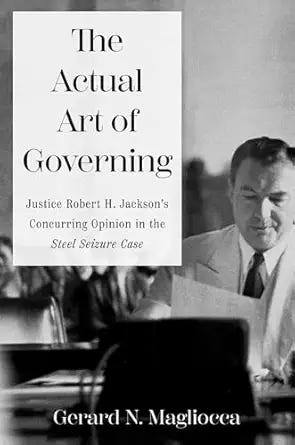
I discussed this book in the weekly SCOTUS news discussion linked in yesterday's entry. It is overall interesting and well-written, stuffing a lot of analysis into around 150 pages.
The concurrence provides the famous three-part summary of executive action (done with congressional approval, congressional silence/zone of twilight, with congressional opposition/based only on Art. II power).
It also has the famous putdown of the use of history ("originalism" wasn't firmly a thing yet) to determine constitutional matters as akin to Joseph parsing Pharaoh's dreams. Or interpreting animal entrails, you can say.
The title refers to this passage:
"While the Constitution diffuses power the better to secure liberty, it also contemplates that practice will integrate the dispersed powers into a workable government. It enjoins upon its branches separateness but interdependence, autonomy but reciprocity."
Justice Jackson was concerned about executive power, including their claims of emergency power. He was in the FDR Administration and was the lead Nuremberg prosecutor.
The Steel Seizure Case is a telling example. Truman lost, followed the opinion's dictates (he soon went to a barbecue or some such with Justice Black, famously disagreeing with his opinion but enjoying his bourbon), and nothing really bad happened. The feared emergency was overblown.
Jackson also wisely cautions the reader to "note the gap that exists between the President's paper powers and his real powers," especially as compared to the "eighteenth-century sketch of a government hoped for" in 1787.
A conservative scholar, a Trump supporter, is now writing entries about how "almost" all former presidents pushed back on limits on their removal power. Okay? Congress and the Supreme Court also have a high opinion of their power. Consistency in that regard is of limited note.
On the merits, I think Justice Kagan's partial dissent in Seila Law is correct. The Constitution leaves this matter generally to the political branches. Presidents don't have to go "meekly" along as Congress regulates. Each has significant power.
These days, as Justice Jackson noted in his famous concurrence, presidents have a special degree of power. The Supreme Court, now with a supermajority of former members of the executive department (five members of the conservative majority, including the Chief Justice, plus Kagan), adding more is not advisable.
Trump recently asserted to the NYT that the only limit to his power is his own morality. Jackson replies, quoting Kipling:
The essence of our free Government is "leave to live by no man's leave, underneath the law" -- to be governed by those impersonal forces which we call law.
Jackson refers to someone many of the founding generation (history has value, it just doesn't provide all the answers) followed including regarding judicial independence:
We follow the judicial tradition instituted on a memorable Sunday in 1612 when King James took offense at the independence of his judges and, in rage, declared: "Then I am to be under the law -- which it is treason to affirm." Chief Justice Coke replied to his King: "Thus, wrote Bracton, The King ought not to be under any man, but he is under God and the Law.'"
Jackson, whose clerk's clerk wrote the opinion (this is covered near the end of the book), would have probably agreed with his namesake in Trump v. United States. In dissent.
===
Note: The other opinions each have notable passages. Frankfurter, rambling as usual, included some words supporting a living constitution view of things.
That requires both a spacious view in applying an instrument of government "made for an undefined and expanding future."
He applied this rule in applying due process of law. The approach will lead some to worry about arbitrary, idiosyncratic judicial power.
An honest accounting, however, will show that is how judges operate. They apply the law case by case, over time, taking into consideration various things, including developing conditions.
There will also be a personal aspect in judging. Jackson's concurrence was a result of the biography of the writer. We need not ignore this reality, that AI does not write these things; AI has its own biases.
As Westley notes in The Princess Bride, we are people of action; lies don't become of us.
Black wrote the often forgotten opinion of the Court. Two justices "concurred," two explicitly said they also concurred with Black's opinion, while only one of the majority explicitly said they were only concurring in judgment. It's a somewhat curious way of doing it.
The Chief Justice (with two others) dissented. Truman's appointments split (2-2) while Jackson (who Truman appointed as Nuremberg prosecutor) also voted with the majority. All nine were either FDR or Trump nominees. All Democrats.
Black was second in seniority (after the Chief Justice) for around twenty-five years. Is that a record?

No comments:
Post a Comment
Thanks for your .02!