About Me

My photo
This blog is the work of an educated civilian, not of an expert in the fields discussed.
Showing posts with label Congress. Show all posts

Friday, July 17, 2026

SCOTUS Watch: Budget Edition

Kagan/Barrett Testimony

COVID and other things (that can't explain the much longer Senate lag time) ended the regular tag team (one liberal, one conservative justice) going up to Congress at budget time. 

The appearances not only provided a chance to discuss budget matters. Congress members could ask justices other questions, including diversity of court personnel and other matters. 

For instance, the "shadow docket" or ethics. To cite stuff covered this time. Likewise, an ethics code, which Kagan is open to having some enforcement mechanism. Leaks were also discussed. 

It is a useful, if not profound (hearings rarely are), dance. Some useful information is shared, and justices remember that they are not just above it all. 

One thing some sneered at was the justices' discussion of increased security concerns in recent years. "Yeah, threaten our liberty, you will get push back." 

Barrett being told by her security staff to wear a bulletproof vest is a bit more. Bluesky comments talked about gun drills in schools. Okay?

If people sent you pizzas in the name of a judge's murdered son or "swatted" (fake police reports) your house, it still would bother you, correct?  This is not a pissing contest. There are serious concerns here. 

It is not totally coincidental that the uptick overlaps with the Trump Era. Liberal and conservative judges have been affected. But Trump stands out. 

He played a significant role. Schumer once talking about "reaping the whirlwind" doesn't make it "both sides do it," when Trump regularly uses violent and delegitimizing rhetoric about the courts.  

Yes, Barrett is part of the problem. She supported Trump, significantly so she could get her job.

But security is still a concern. 

Dennis Sochor Execution

Florida continues to execute senior citizens. Sochor raped and murdered someone in 1981. 

These lengthy delays create two special constitutional difficulties. First, a lengthy delay in and of itself is especially cruel because it “subjects death row inmates to decades of especially severe, dehumanizing conditions of confinement.” Second, a lengthy delay undermines the death penalty’s penological rationale.

Yes, Justices Breyer, Ginsburg, and Stevens. 

The final appeal, rejected without comment, provided additional information regarding alleged evidence that Florida's execution method is cruel and unusual. 

His lawyers claimed Florida wrongly blocked an attempt to make such a claim. Various recent appeals in some fashion addressed this concern, including requests for information. 

Sotomayor once released a statement noting her concern. Otherwise, crickets. 

Kagan, during her testimony, challenged the use of the term "shadow docket" because the justices have explained things more. Well, that explanation is only a matter of degree. 

He was executed later in the day. The coverage does not suggest any issues. But I did not find any in-depth discussion of the overall claims, either. 

Two more at the end of the month.

Trump News

The Supreme Court has done much to help enable Trump. One thing they did not do was block this

They did delay it somewhat. The other civil judgment, involving much more money, is still pending. 

Carroll received the money more than three years after a jury found that the president was liable for sexually abusing her in a Manhattan department store in 1996, and then for defaming her on social media. Trump has repeatedly appealed the judgment to no avail — including petitioning the Supreme Court multiple times — and last week launched a last-ditch attempt to block her from getting the money.

But this is a start. 

Like the one successful prosecution, thank you, New York, for helping to obtain a modicum, a small modicum, of justice and consequences. 

Other Stuff

The first summer Order List, traditionally a short nothingburger, is due on Monday. 

Sunday, July 12, 2026

Senator Lindsey Graham Dies

He had his moments. He was lately a tired, pathetic Trump supporter. More here with an extended bit on Mitch McConnell. 

Friday, July 10, 2026

SCOTUS Watch

Justices Amy Coney Barrett and Elena Kagan will appear July 14 before the House Appropriations Subcommittee on Financial Services and General Government, which has jurisdiction over the annual spending measure that funds the Supreme Court, according to a scheduling announcement from House Appropriations Chair Tom Cole (R-Okla.).

The Supreme Court might be in recess, but it is still in session. Odds and ends still occur.* 

The most notable news, however, is that two justices will (for the first time since COVID) appear before Congress. Thomas, for some reason, stopped by recently. Not in an official capacity. 

The usual procedure was to have a liberal and a conservative justice, as we have here. The appearance provides members to ask justices non-budget related questions. 

“the right to have rights—to freely participate in our political community”

We will also have many term round-ups. 

Prof. Dorf discusses a controversial reference in the birthright citizenship opinion. I don't think he quite salvages the reference. Yes, noncitizenship is "less secure." Noncitizens still have rights.

Prof. Segall talks about Kavanaugh's de facto acceptance of living constitutionalism. Brett has to bow down to the originalist god, including talking about how constitutional "meanings" hold firm. 

As with the English language generally, however, meanings change over time, too. Sorry dude. 

==

Note: The summer is sometimes so lacking in SCOTUS news that I am left to cite the website providing a typo correction to one of its opinions. 

The Court used to fix typos silently as if there were editing elves doing so out of public view. Now, they openly cite even the smallest edits. 

They also provide the final "bound" version of the opinion, which in the past took years but now starts during the term itself, including any changes at the bottom of the page.  

Check out here. There are "revisions" with the date provided. You can also look down the page and see the first twenty or so opinions now have exact page locations. 

The changes, like the different versions of biblical verses (h/t Bart Ehrman), are often trivial. Nonetheless, it is a good bit of open government. 

ETA: Graham Platner finally formally removed himself from the Senate race. The new replacement of Senator "Kavanaugh Won't Overturn Roe!" will hopefully be picked later this month. 

Monday, June 29, 2026

SCOTUS Watch: Opinions/Orders

Orders

The Order List had some notable content, including multiple grants and no grant in the E.J. Carroll case. Maybe, just maybe, Trump will have to pay up for his sexual assault.

Gorsuch (with Alito and Thomas) returns to his concern about health workers not being able to obtain an exemption from vaccine mandates. NY, among other things, argues it is a bad "vehicle" for review. 

Thomas (with Gorsuch) wants to re-examine NYT v. Sullivan, citing original understanding (the case involves Alan Dershowitz suing CNN). If they want to quote original understanding, quite a few modern-day First Amendment cases should be decided the other way. A lot more limits were allowed back then. 

Sotomayor, for the liberals, dissented in a qualified immunity case involving a prisoner alleging mistreatment. There is a good originalist argument, ignored by conservative justices, that juries should have wide discretion to find government officials liable for wrongdoing. The Founding generation thought juries were the "palladium of liberty," even more than judges, who were creatures of the state.  

Each Trump nominee did not take part in a case without saying why. 

There should be another "clean-up" order, with perhaps more recusals, later in the week.

Opinions 

Barrett (with Roberts + the liberals) upholds a rule regarding mail-in ballots. Rick Hasen argues that "text,  history, and longstanding practice going back to the Civil War" back her up. A somewhat unhinged Alito opinion, however, still received four votes. 

Kagan continues the expansion of the reach of the Fourth Amendment to "geofence warrants," regarding the location of cellphone users. Alito, Thomas, and Barrett dissented. Gorsuch concurs but tosses in some cosplay about original understanding.

[Orin Kerr of Volokh Conspiracy is one resource for this topic.]

Roberts had the big two for the day involving agencies. The Federal Reserve, 5-4, can retain its "for cause" removal rules. The dissenters partially complain about the reach of the opinion, which broadly rules to bring clarity to the question.

(People are arguing that Roberts/Kavanaugh selectively exempt the Federal Reserve "to protect their stock portfolios." The special exemption is dubious. OTOH, various agencies regulate financial matters. They also affect stock portfolios.)

Not so for other agencies, overturning long practice (at least from the late 19th Century) and precedent (from the 1930s). The whole thing is bullshit, 6-3, Sotomayor (Kagan usually handles this issue) with the dissenting opinion for the liberals. 

(Her dissent, which she read from the bench, is very good. We should have audio/video.) 

The First Congress split various ways regarding the proper constitutional and policy rules for removal. It is a political question that should be left to congressional discretion. The dissent is correct that the majority forgets its "place." The voters need to secure a new Congress that reminds them. 

The 6-3 majority puts its thumb on one side. Perhaps, it is an ironic move to honor the 250th Anniversary of the Declaration of Independence (tyrannical king). 

Some more opinions tomorrow.

ETA: A discussion about them. 

Friday, June 26, 2026

Alito Day at SCOTUS

First Off ...

The first opinion handed down today [Th] was a preemption case. Kavanaugh spoke for seven (Thomas also concurred to turn back the clock on the Commerce Clause) while Jackson (and Gorsuch) dissented. The involved pesticide labels or such.

Alito Time 

The next three opinions were all by Alito. Okay. 

All were 6-3 the normal way. The conservatives disagreed somewhat in one case on the reasoning. Barrett added a "I'm so reasonable" concurrence in the Second Amendment case.

Kagan briefly dissented in the 2A case. Jackson provided much more discussion. 

Jake Charles ("Law prof, Pepperdine Law; Affiliated Scholar, Duke Center for Firearms Law. I write about constitutional law, especially the Second Amendment") on Bluesky notes various problems with Alito's history.

The case involved Hawaii having a law where property owners are presumptively not inclined to allow people to bring in guns. They could, mind you, give permission. 

Kagan flagged all the evidence that the Administration's policy on Haitians is racist. The majority was Mr. Magoo, this not being an affirmative action case where the "racism" of remedial policies will be flagged. 

Sotomayor dealt with a Mexican border dispute, announcing her dissent from the bench. Alito had a follow-up response on top of his opinion summary. It is not clear when this last (if ever) happened.

Dusty Ray Spencer Execution 

Meanwhile, a bit later, with no open dissents, the Supreme Court rejected (without comment) a final appeal before (after over 30 years) Florida executed Dusty Ray Spencer. He murdered his wife. 

The final claim raises an intellectual disability argument. I truly doubt, under normal rules, there is a compelling reason to take the case. He should not be executed on other grounds. 

Still, the order paved the way to taking a human life. A brief discussion, by someone, was warranted. 

Upcoming

The next opinion day is Monday.

The Supreme Court late Friday stayed an order that would have forced former Fox News reporter Catherine Herridge to either disclose a confidential source or pay $800 a day in court sanctions.

A response is due next week. 

Wednesday, June 24, 2026

SCOTUS Watch: First Opinion Day

The first opinion day of the week (yesterday) disposed of five cases, all somewhat also-rans. The opinions largely broke down 6-3. 

The oral argument didn't bode well for a prisoner trying to obtain damages against state prison officials for violating his religious liberty. The reason was not that the conservative justices only care about Christians. 

Holt v. Hobbs, for instance, protected the rights of a Muslim prisoner. The justices do somewhat selectively care about religious liberty. Nonetheless, the reason for the opinion here is likely somewhat different. Wrong all the same

Kagan and Jackson joined the result in a case about the Alien Tort Statute (the trend has been limited protections), but joined much of Sotomayor's dissent on why the majority went too far. 

The liberals fully disagreed with the conservatives in an immigration case. Thomas for the conservatives.

The one kumbaya moment was an overreach of a case involving the Takings Clause. Fair market value is fair enough when the government sells a property in a tax sale, as long as the whole thing is otherwise fair. 

Some libertarians might be upset, but I looked into the details (did so in response to an early response to this guy), and this was no great travesty or anything.  This is the case that it's okay to give to Alito. 

There will be more pain for the liberal side of things (and more hot-button cases) in the upcoming days. 

Tuesday, June 23, 2026

NY Primary

My district had two races: state comptroller and the House (Ritchie Torres).  The liberal challengers didn't do well. They did well in some other places, including Brad Lander, Mayor Mamdani's choice. 

It was a low turnout race in my polling place. I manned the only polling table (there are usually two). I appreciate those who showed up, a few with little children. Democracy is action.

Monday, June 15, 2026

NY Primary


My two options for early voting are the state comptroller (long-term Democrat) and the House (I'm represented by Rep. Ritchie Torres) races. Basically, protest votes.  

Torres has been a jerk at times and too pro-Israel (basically, they can do no wrong). He has strongly gone against Trump. Still, I'm glad I can vote against him in the primary. The other race? Some left-leaning groups endorsed the challenger. Okay. Eh.

Thursday, June 11, 2026

SCOTUS Watch: Opinions

The Supreme Court is running out of no-drama opinions. We had three today. One split 6-3, but it was not a major dispute.

Jackson had a unanimous bankruptcy ruling. Thomas (with Gorsuch) said, "Let's go big." Sotomayor said, "Let's not."

Kagan had a unanimous statutory ruling. Bluesky legal minds flagged a notable comment that might limit the Trump Administration's current activities somewhat:

We hold that a defendant charged with violating §1519 must be tried in the district where the falsification occurred; he cannot be tried in a different district where the investigation was located.

The third case was a 6-3 opinion (Barrett v. Jackson) with Jackson having an extended discussion about legislative history. She's big about that sort of thing.

Kagan got off the bus there:

Reliance on legislative history may be appropriate when statutory text in context remains, after careful review, stubbornly ambiguous.

Kagan thought "text, structure, and statutory history" did the trick here. She did not (unlike Sotomayor) join Jackson on the rest. A reasonable position, succinctly expressed. 

I don't know who's correct as to the merits. I do generally trust Kagan's judgment when there is a disagreement. But her overall reasonableness is a guide for us all.  

Constitutionalism 

David Strauss, about fifteen years ago, wrote a helpful little book discussing "living constitutionalism." 

He argues that a form of common law, restrained somewhat by text (especially about clear matters such as the number of senators), is the appropriate path. 

Strauss goes a bit too far on how the amendments overall have been of little consequence. They do repeatedly do less than one might think. 

For instance, the Sixteenth Amendment overruled a dubious 5-4 income tax opinion decided in the 1890s. The original Constitution, on its own, authorizes income taxes.

On the other hand, acknowledging Jim Crow, the Fifteenth Amendment did signficantly advance racial equality, especially in the North. It helped in the South, even then, at least for a few decades. 

Originalism is a dubious path. It is not some big restraint. The alternatives are not just "make stuff up." And, originalists do that too, in a fashion. 

One online comment accepted the approach for rights but not powers. Doesn't work. The two are connected. And, appeals to original understanding to apply the Commerce Clause or whatever is silly business. 

Monday, June 08, 2026

SCOTUS Watch: Order List

The Order List was fifteen pages, which suggested there was some sort of opinion. And, there was another (it is her thing) Sotomayor statement flagging a criminal justice issue:

Although I agree with the Court’s decision to deny certiorari for the reason explained below, I write separately to address the problematic standard the Mississippi Supreme Court applied to the claim petitioner Tony Terrell Clark raised under Batson v. Kentucky [racial discrimination in peremptory challenges], 476 U. S. 79 (1986), in the context of his ineffective-assistance-of-counsel claim.

Mark Joseph Stern also flags on Bluesky:

SCOTUS tosses out a 4th Circuit decision allowing compassionate release under the First Step Act when there are arbitrary sentencing disparities between a defendant and his co-conspirators. Orders reconsideration in light of Rutherford. KBJ and Sotomayor dissent.

This is a typical "GVR," where they "grant, vacate, remand" a case so that the lower court can apply a related opinion. Kagan dissented in Rutherford and joined the limited concurrence written by Sotomayor in the other case referenced in the GVR.

As Stern notes, it isn't fully clear what this means, but it is concerning since it appears to suggest the lower court should apply the (dubious) rulings even broader than necessary.  

Alito and Barrett didn't take part in cases without saying why. Only Kagan and Jackson consistently do so. I prefer that approach. 

One tidbit is that "The United States’ claims in this case are hereby dismissed with prejudice" in an interstate dispute. No reason provided. 

There will be opinions on Thursday. There is also an upcoming execution, which I will discuss separately. 

ETA: Amy Howe posted her summary.

One tidbit is the rare request for a reply to a request for a rehearing. The request is by Lisa Blatt,  superlawyer, and cites changing lower court precedent. Also, looking at the docket page, the Supreme Court posted a request earlier, but it was removed as a mistake. So, one big trivia question.

==

The error flagged here is not uncommon. 

I have repeatedly seen it assumed that the original First Amendment would require thousands of members. A case of not reading closely.

Checking, the House reached 200 members in the 1820s. The measure was bound to be out of date eventually. It was suitably not ratified as written. 

Sunday, May 31, 2026

Judges Behaving Badly

A black woman judge, appointed by a Democrat, behaved badly. The judicial self-regulation left something to be desired

Liberals, who are not hypocrites overall on the issue, flagged the problem. Judicial ethics and proper congressional oversight should be bipartisan. It is a good campaign issue.

Friday, May 29, 2026

John Quincy Adams

Crawford is a musician and podcaster. 

I'm not familiar with him in either case. I am enjoying this book, which focuses on his antislavery efforts, especially as a House member. It's a book geared to the general reader with some neat drawings.

Adams hated slavery, but like many people of the day, didn't care for abolitionists. Slavery was bad, but we were stuck with it.

Early on, when he was a senator, he voted against a limit on slavery. As a diplomat and executive official, national sovereignty was more important than opposing slavery. For instance, limiting the British power to search American ships on the high seas.

Plus, abolitionists, in his view, exaggerated how bad slaves had it. They seemed unreasonable extremists.

Adams became a hero of the antislavery movement after extremists on the slavery side went after the freedom of speech. The "gag rule" arose after abolitionists supposedly started to get a bit too pushy for their own good, flooding the mails and Congress with antislavery materials and petitions. 

Give an inch and all that.

Adams noted that not formally accepting petitions broadly endangered First Amendment rights, showing how suppression of liberty tends to spread. For instance, abolitionists were motivated largely by their religious beliefs. Religious liberty was at stake.

It also shows how change happens over time. Abolition seemed hopeless in the 1820s and 1830s.

Adams, with some foresight, noted in his diary that the only way it seemed possible was if the country broke apart and/or went to war. Congress then might have the power to abolish slavery as a war measure.

He died in 1848, though he lived long enough to see the Mexican War, which helped introduce the final chapter (chapters?) that led to that war. 

Good book overall. 

Monday, May 18, 2026

SCOTUS Watch: Order List

A ten-page Order List with various odds and ends.

Chris Geidner notes on Bluesky:

Also in today’s orders, SCOTUS sidesteps ruling on private enforcement of Section 2 of the Voting Rights Act, sending two cases back for post-Callais reconsideration. Jackson dissents, pointing out that Callais had nothing to do with private enforcement and saying she would have summarily reversed.

Rick Hasen summarized:

Justice Jackson dissented from the order, on the sensible grounds that Callais did not consider the right to sue question. Of course, the stakes are much lower now that Section 2 is essentially dead no matter who sues.

(His colleague was more sympathetic.) 

Also, a cert grant (per Geidner):

The Supreme Court takes up a case over whether employees of federally funded schools can sue to enforce Title IX’s sex discrimination bar. 

Kavanaugh, without comment, noted he would have granted cert. in another case. If you do a docket search (on another page since the Order page does not provide links):

Whether a multiemployer pension plan that terminated through mass withdrawal before the 2020 plan year is eligible for Special Financial Assistance under 29 U.S.C. 1432(b)(1)(A).

Alito and Barrett didn't take part in the examination of a couple of cases. Again, only Kagan and Jackson regularly explain why they do that. 

Sotomayor added a brief statement noting that she agreed with the court not taking a criminal case because the government admitted error and the defendant received all that was requested for. 

The next thing on the schedule is an opinion day on Thursday. Next week's orders will be on Tuesday because of the holiday. 

===

I agree with Steve Vladeck that justices should show up more in front of Congress. Court reform includes multiple things, including some that should have bipartisan support. This is one such proposal. 

Friday, April 17, 2026

Sotomayor Apologies

Justice Sotomayor publicly called out Kavanaugh for his Kavanaugh stop opinion, basically saying his privileged upbringing made him not understand the people involved. Some people handwaved it, but others acknowledged it was a significant comment

At a recent appearance at the University of Kansas School of Law, I referred to a disagreement with one of my colleagues in a prior case, but I made remarks that were inappropriate. I regret my hurtful comments. I have apologized to my colleague.

She had second thoughts. She publicly apologized via the public information office. 

It would be interesting to know what happened. Did Kavanaugh suggest his feelings were hurt? Did colleagues tell her she crossed the line? Did she realize Murc's Law (only Democrats have agency)? 

Chris Geidner, after some people pushed back, posted a discussion on why the apology made sense. Eh. Sure. Typical small group dynamics, even beyond the importance of his vote. 

Plus, it's the classy thing to do. You apologize sometimes when you deep down don't think you should have to do so. 

It reminds me of when there was talk that Sotomayor was bothered about Gorsuch not wearing a mask. He was sitting next to a senior citizen with diabetes. He apparently thought people were being too "woke" about COVID or something.

They released a treacly joint statement about how they were pals. She didn't ask him to wear a mask. It was one big misunderstanding. Sure.

Did a conservative justice ever apologize? Ginsburg apologized for publicly saying she didn't want Trump elected. Stevens, during the Kavanaugh confirmation, noted people told him he was too public about his opposition to Kavanaugh after his outburst. He seemed a bit embarrassed.

When did a conservative justice apologize? That's what rankles. She has to publicly apologize for that asshole? Well, that's what adults do, I guess. 

Thomas Speaks 

I have seen her remarks compared to Justice Thomas criticizing "progressives." 

Thomas has promoted his conservative values for years. He has strongly supported his wife, who is a big Trump supporter, including after the 2020 elections.

He was not specifically criticizing a colleague. I do not think some of his more overheated dogma should get a pass. Still, it is not really the same thing. 

OTOH, if the assumed problem is that Sotomayor is opining generally on ideological grounds, Thomas and other conservatives show that she is far from alone. 

Thomas Writes 

The single opinion released today:

Chevron has plausibly alleged a close relationship between its challenged crude-oil production and the performance of its federal avgas refining duties—not a tenuous, remote, or peripheral one—and has therefore satisfied the “relating to” requirement of the federal officer removal statute. 

Thomas, as he often does in these technical cases, wrote the opinion. Jackson disagreed in part. 

Her concurrence includes her concern about legislative intent and the message that judges should follow legislative will. She separately criticized the use of the shadow/interim/emergency/whatever docket. Even a "minor" case has some bit of interest.

On that front, this was the case that Alito belatedly decided to recuse himself. His recusals generally involve financial conflicts. Sometimes, honestly, a judge doesn't catch a possible conflict early enough.

Recusals often do not change the result of the case. The case here was largely unanimous. Sometimes, a recusal might matter more. The principle of even the appearance of impropriety matters the most. 

It is rarely a compelling matter to take a specific case. The specific legal question is likely to arise again, if it's worth worrying about.  

There is more flexibility in lower courts, including a district judge sitting my assignment on a panel. There should be a way to do that with the Supreme Court.

OTOH, as noted, it rarely matters too much. 

ETA: A housekeeping order was released. One tidbit: "The motion of petitioners for leave to file the joint appendix in an 8½- by 11-inch format is granted."

The motion noted that since the Court sped things along, it would be difficult to use the usual format within time constraints. Okay. 

Monday, April 06, 2026

SCOTUS Watch: Order List [And Other Stuff]

The Supreme Court handed down a short Order List before going on a little mid-April break. One grant:

Issue: Whether the Veterans’ Judicial Review Act stripped district courts of the jurisdiction, recognized by this court in Johnson v. Robison, to hear challenges to the constitutionality of acts of Congress affecting veterans’ benefits.

A bit of lay-up since both sides agreed they should take the case. The solicitor general also argued that the court below was correct. He also suggested the plaintiff sued the wrong person, helping to explain the curious "U.S. Congress" part of this case. 

Meanwhile, among the orders is one in which Gorsuch did not take part. Only Kagan and Jackson explain themselves when such a recusal happens. They are right to do so. 

Again, nothing is scheduled until next week, on Friday (conference/non-argument session, likely to swear in people), but something might come up. 

Steve Bannon

SCOTUSBlog provides more details that show that even a brief, bland-looking Order List can have some interesting details. More Trump news, too:

The justices also sent the case of Stephen Bannon, a former adviser to President Donald Trump who was convicted of contempt of Congress, back to the lower court, where the Department of Justice has filed a motion to dismiss his indictment.

Bannon served his brief sentence. This has a symbolic quality. After an extended -- ridiculously so -- process, which must be reformed, Bannon actually was punished for obstruction of Congress.

This, of course, has to be discouraged. I am being sarcastic. Anyway, this seems to have a gratuitous feel to it. The United States provided a brief reply that it was dismissing the indictment "in the interests of justice." Yes. Justice for Trump stooges.

They had the prosecutorial discretion to do this, though in this case, it is horribly applied. Once they do so, the argument is made that the procedure applied here in this order is appropriate. 

Iowa decided to supply an amicus as part of its Republican/Trump support role. It is laughable that Iowa felt it necessary to get involved here. 

The procedural move here does not appear improper. The ultimate problem is that Trump yet again finds a way to remove even the bare minimum justice for the past wrongs he and his minions inflicted. 

I'm open to being proven wrong. It does seem wrong that the Justice Department can step in at this point. But if the prosecution was actually improper, a later action of this sort might be sensible. 

So, again, it does seem like it turns on discretion. 

ETA: On the odds and ends front, some more rules (Appellate/Bankruptcy/Evidence) were released. 

SCOTUS doesn't intervene in an election dispute. Sounds like a blatant case, even if you don't like the law. Might have line drawing issues. Easy case here.

I say more here including about Sotomayor stuff. 

Friday, February 20, 2026

SCOTUS v. Trump: Tariffs

Congress should have handled this. 

But, since they are led by chickenshits, a 6-3 Supreme Court opinion blocked Trump's patently illegal (and financially stupid) usage of tariffs.

People wondered why they were taking so long. The 170 pages of opinions help explain why. 

Roberts handled the majority and did so in twenty pages. Kavanaugh (for Thomas and Alito) wrote a dissent three times as long. 

Gorsuch wrote a "combative" (to cite one comment), quotable concurrence twice as long.

Gorsuch, essentially thinks virtually everyone else is wrong, hypocritical, or both. He, virtually alone, is pure.

Right you are, Law Dork. Gorsuch is a prick and remains one even if he sometimes is on the right side.  He took over for Scalia and has improved his writing. 

Still a prick. People are loving some of his concurrence. Kagan and Barrett show that some of it is hot air. Dude goes too far. Keep that in mind. 

Both Barrett and Kagan, in different ways, basically told him to stop mansplaining. Kagan, for the liberals, didn't use the "so-called major questions doctrine." 

Kavanaugh and Thomas (adding some other originalist invention that many originalists aren't aware of) found a way to avoid it. Some are surprised at Kavanaugh's vote, but other than Alito and Thomas, he has been the most Trump-friendly. He did go the extra mile here. Give that man a beer. 

Jackson, arguing that it is what many legislators use more than bare citation of text, appealed to legislative history. She will be fighting the young Trump appointees for years to come. You go, girl! 

When Congress tells us why it has included certain language in a statute, the limited role of the courts in our democratic system of government—as interpreters, not lawmakers—demands that we give effect to the will of the people.

Barrett's opinion (a few pages, since she's not a blowhard) specifically answered Gorsuch, tossing (as required) a couple of citations of her former boss (Scalia). She noted:

Textualists—like all those who use language to communicate—do not interpret words in a vacuum. Instead, we use context, including background legal conventions, common sense, and constitutional structure, to ascertain a text's most natural meaning. (cleaned up)

Which is fine. Just to be clear, those terms are rather flexible. Again, that is fine, since any interpretative method will be, especially in hard cases. 

It is just that when Scalia or Gorsuch claims their method is special while the other side is lawless or something, they are full of themselves. 

I wrote something about originalism and Richard Hasen's book (not new) about Scalia here. More here ("Joe from the Bronx"). 

He has a chapter about "word games," arguing that textualism sometimes is just that. Like Jackson, Hasen also cites others who have found that Congress expects its laws to be handled differently. 

The majority opinion argues that there is no "foreign policy exception" to the major questions doctrine, especially when it involves taxation, a basic congressional power. Reminds me of the Steel Seizure Cases and the Supreme Court's citation of domestic powers. 

Roberts left open the possibility that Trump has the power to apply tariffs using some other legislative authority. Such authority has various limitations. It won't let him do his unhinged, power-hungry routine against various nations. Well, as badly. 

The law is crystal clear; conservatives are wary about tariffs, and it is a way for the Supreme Court to show they are not a potted plant. 

TPM is correct that the Supreme Court took too long. This has been going on for around a year. The tariffs are lawless. They caused lots of problems. 

Let's not exaggerate. The Supreme Court should have restrained Trump much more. And, the result is messy, since it does not handle the relief for taking money illegally. More litigation will follow. 

But you take the wins when they come. Trump reportedly was cursing when he found out about the opinion. He later said at a press conference:

Trump praises Alito, Kavanaugh and Thomas for dissenting on the tariffs ruling before, calling the other justices "a frankly disgrace to our nation" who are "very unpatriotic and disloyal to our constitution" and are "just being fools and lapdogs for the RINOs and the radical left Democrats."

Justin Baragona on BlueSky also flagged that he still welcomes three of the justices to his speech to Congress, while others are "barely" invited. Barrett and Gorsuch are embarrassments to their families. 

Yeah. I'm still with the House Minority Leader.

"Fuck Donald Trump and his vile, racist, and malignant behavior

“This guy is an unhinged bottom feeder,” Jeffries added. “Every Republican sycophant who continues to stand by their cult leader should be run out of office.”

Let's end where we began. Congress could and should have handled this. They still can. 

A Democratic Congress would have had a better shot.

ETA: The law here should not cloud the policy. 

The very reason this lawsuit could be brought is that it brings financial harm to the challengers.

My reference to Congress touches upon this. Democrats are already highlighting the economic harm and demanding refunds for ill-gotten funds. 

Trump promoted tariffs as a fundamental aspect of his economic policy in the 2024 elections, to much scorn from reasonable people. Reason, however, did not win out. Many still realize the policy was stupid and (contra to his lies) mostly paid by Americans. 

Other Stuff

They also changed the rules to help flag financial conflicts. The public information office posted an explanation (sometimes just notify the press). 

It would be even better if Roberts and Alito (well, he might be gone soon) sold their stocks. Also, be nice if all of them, not just Kagan and Jackson, explained why they recuse from cases. 

There was also a housekeeping order. More orders on Monday. Two opinion days next week. They are back hearing oral arguments. So busy, busy. 

They will also have (in March) an event in honor of Sandra Day O’Connor. 

Wednesday, February 04, 2026

SCOTUS Watch (Reform Edition)

(I forgot about the NYT article that dropped about Roberts having people sign non-disclosure agreements. But that was a voluntary policy already and there still will be leaks. 

How much really does that change things? We are concerned about other stuff, aren't we? On that, Vladeck is correct in his Thursday Substack.) 

Term Limits

Rep. Tom Barrett (R-MI), a first term Republican, proposed a Supreme Court term limit amendment as part of a wider reform package. The overall package sounds dubious but I'm okay with people seriously trying to reform the government.

The term limit amendment would set a twenty-year limit. A term limited judge could still be confirmed for another level of the judiciary. Sotomayor was both a district and court of appeals judge. A person could theoretically serve sixty years.

The amendment, as all realistic reforms are likely to be, only applies in the future. No current judge or justice would be term limited. This underlines how a term limit, however fine it is, and I support them, will not by itself be enough

Barrett wants to tie this with a set nine on the Supreme Court. Why should the Supreme Court, which has gone up and down from a 5-10 justice range (five never came to pass and ten was short lived) be set at some specific number? 

Republicans repeatedly are expanding state courts. This doesn't make it ideal. They do multiple bad things. But stopping any chance of expansion has to bring with it something worth the candle. 

Term limits aren't enough.

I am open to a compromise but one where the Democratic supported reform kicks in over twenty years from now (twenty years after the amendment is ratified) is not enough. For instance, we need an ethics bill. Any reform package is likely to have something I dislike. But need more. 

He also wants a supermajority amendment (2/3) to add new states. A bill banning mid-term restricting is fine. See below. This part is unconstitutional:

The bill would also require that only U.S. citizens are counted toward district apportionment and electoral votes. The census would still count all persons for other purposes.

(14A, sec. 2 says "persons" should be counted for apportionment purposes. That includes "district" apportionment. This rule would result in different districts being treated differently depending on the types of persons they have. No good.) 

Overall, it should be part of a wider voting rights bill. The three-year sunset funding idea seems too overinclusive. I am, however, game in having a debate to have Congress truly control the power of the purse. Trump has stolen it. 

Partisan Gerrymandering 

The Supreme Court (5-4) in Rucho v. Common Cause (2019) finally bit the bullet. 

After years of Justice Kennedy hemming and hawing, his successor provided the fifth vote. Federal courts will not try to determine unconstitutional partisan gerrymandering. State courts can use state constitutional provisions. And some have. 

Justice Kagan for the liberals had a strong dissent. And I understand. What truly annoyed me was that the conservatives were not consistent. 

They took away congressional power in Shelby County v. Holder to enforce the Fifteenth Amendment using vibes. If you want judicial restraint, do so consistently, please.

Federal courts can still determine that districting involves illegitimate racial gerrymandering. A lower court determined that was involved in Texas. The justices by a partisan vote overturned

Texas clearly had a partisan gerrymander. But that is functionally acceptable now when federal judges address the matter. Justice Alito has moved the goalposts and suggested they are generally acceptable. That, however, is not what Rucho said. 

The state, pushed by the Trump Administration which the lower court (written by a Trump nominee) found motivated by race, also redistricted mid-decade. The Constitution sets districting every ten years. 

It is not explicitly barred to do so mid-decade, but a case can be made. The whole thing has a race to the bottom feel. And Democrats, using the realistic motto that unilateral disarmament is for wussies, respond tit-for-tat. California for Texas. And so on.

If you allow Texas to redistrict to help Republicans win the midterms, there is no good reason to stop California from doing so to help the Democrats. People cynically figured SCOTUS would find a way.

They, without comment, did not grant a request to do so. Rick Hasen is happy and not too surprised. (Maybe, he is that no justice said anything.) SCOTUSblog has more on the details. 

Ultimately, this is depressing. We need nationwide election reform, including something that addresses partisan gerrymandering and mid-term redistricting. A national rule is necessary to avoid a race to the bottom. That is typical national rule dynamics.

We can debate the details, including what the current Supreme Court will deem appropriate under Shelby v. Holder. But this is not a good way to run a railroad.

Everything can be on the table. For instance, perhaps it is a good idea to expand the size of the House, which was set in place over a hundred years ago. Or some form of multimember districting is a good idea. 

Voting rights and overall republican principles should be something we can establish in a bipartisan fashion. Yes, I know, insert sarcastic metaphor here.

The point still holds. Rep. Barrett's package might not be my cup of tea. But young Republicans who will be around a long time, perhaps, willing to think creatively with some room for compromise are welcomed.

If sane people (Democrats at the moment) gain control, they very well might have a chance to be part of the solution. I'm serious. 

Any major change realistically needs some sort of bipartisan support to have staying power. A supermajority (see PPACA) might provide some chance, but when we are talking things like SCOTUS reform, we probably need more. 

Saturday, January 10, 2026

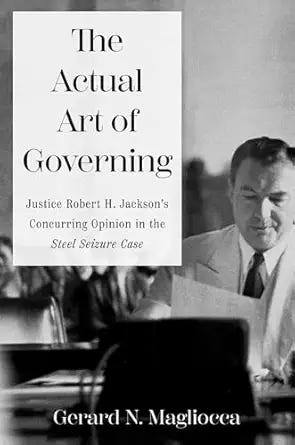
The Actual Art of Governing

I discussed this book in the weekly SCOTUS news discussion linked in yesterday's entry. It is overall interesting and well-written, stuffing a lot of analysis into around 150 pages. 

The concurrence provides the famous three-part summary of executive action (done with congressional approval, congressional silence/zone of twilight, with congressional opposition/based only on Art. II power). 

It also has the famous putdown of the use of history ("originalism" wasn't firmly a thing yet) to determine constitutional matters as akin to Joseph parsing Pharaoh's dreams. Or interpreting animal entrails, you can say.

The title refers to this passage:

"While the Constitution diffuses power the better to secure liberty, it also contemplates that practice will integrate the dispersed powers into a workable government. It enjoins upon its branches separateness but interdependence, autonomy but reciprocity."

Justice Jackson was concerned about executive power, including their claims of emergency power. He was in the FDR Administration and was the lead Nuremberg prosecutor. 

The Steel Seizure Case is a telling example. Truman lost, followed the opinion's dictates (he soon went to a barbecue or some such with Justice Black, famously disagreeing with his opinion but enjoying his bourbon), and nothing really bad happened. The feared emergency was overblown.

Jackson also wisely cautions the reader to "note the gap that exists between the President's paper powers and his real powers," especially as compared to the "eighteenth-century sketch of a government hoped for" in 1787. 

A conservative scholar, a Trump supporter, is now writing entries about how "almost" all former presidents pushed back on limits on their removal power. Okay? Congress and the Supreme Court also have a high opinion of their power. Consistency in that regard is of limited note. 

On the merits, I think Justice Kagan's partial dissent in Seila Law is correct. The Constitution leaves this matter generally to the political branches. Presidents don't have to go "meekly" along as Congress regulates. Each has significant power.

These days, as Justice Jackson noted in his famous concurrence, presidents have a special degree of power. The Supreme Court, now with a supermajority of former members of the executive department (five members of the conservative majority, including the Chief Justice, plus Kagan), adding more is not advisable.

Trump recently asserted to the NYT that the only limit to his power is his own morality. Jackson replies, quoting Kipling:

The essence of our free Government is "leave to live by no man's leave, underneath the law" -- to be governed by those impersonal forces which we call law.

Jackson refers to someone many of the founding generation (history has value, it just doesn't provide all the answers) followed including regarding judicial independence:

We follow the judicial tradition instituted on a memorable Sunday in 1612 when King James took offense at the independence of his judges and, in rage, declared: "Then I am to be under the law -- which it is treason to affirm." Chief Justice Coke replied to his King: "Thus, wrote Bracton, The King ought not to be under any man, but he is under God and the Law.'" 

Jackson, whose clerk's clerk wrote the opinion (this is covered near the end of the book), would have probably agreed with his namesake in Trump v. United States. In dissent. 

===

Note: The other opinions each have notable passages. Frankfurter, rambling as usual, included some words supporting a living constitution view of things.

That requires both a spacious view in applying an instrument of government "made for an undefined and expanding future."

He applied this rule in applying due process of law. The approach will lead some to worry about arbitrary, idiosyncratic judicial power. 

An honest accounting, however, will show that is how judges operate. They apply the law case by case, over time, taking into consideration various things, including developing conditions. 

There will also be a personal aspect in judging. Jackson's concurrence was a result of the biography of the writer. We need not ignore this reality, that AI does not write these things; AI has its own biases. 

As Westley notes in The Princess Bride, we are people of action; lies don't become of us. 

Black wrote the often forgotten opinion of the Court. Two justices "concurred," two explicitly said they also concurred with Black's opinion, while only one of the majority explicitly said they were only concurring in judgment. It's a somewhat curious way of doing it. 

The Chief Justice (with two others) dissented. Truman's appointments split (2-2) while Jackson (who Truman appointed as Nuremberg prosecutor) also voted with the majority. All nine were either FDR or Trump nominees. All Democrats.  

Black was second in seniority (after the Chief Justice) for around twenty-five years. Is that a record? 

SCOTUS Watch: First Opinion

 I covered the first opinion of the term and other matters here.