About Me

- Joe
- This blog is the work of an educated civilian, not of an expert in the fields discussed.
Friday, May 31, 2013
Thursday, May 30, 2013
Mets Sweep Yanks
Yes, the Yanks "B" team finally is starting to bite them, but the Mets don't exactly have murderers' row out there either. Gee sealed the deal, after being particularly lackluster this season. And, the Yanks 'B' team won before. The METS are the one who swept them in four, getting thru Rivera to do it. Still an uphill battle to .500, but nice job.
Loving Leah (Reprise)
This Hallmark film was on over the weekend and it's a favorite of mine. One lesson in this charming love story is that faith and religion can still have power even if the literal doctrine is not followed. The spirit over the letter. Each realizes this, including the Orthodox mother, adapting it to the reality of their 21st Century lives.
Wednesday, May 29, 2013
CAC Brief Supporting NLRB Recess Appointments
The brief [update] is a crisp convincing argument that at the very least provides a reasonable enough grounds to uphold the executive's actions here, which is enough to handle something that should w/o special or clear and convincing reason be entrusted to political checks and ebbs/flows of the means used there to check and balance each other.
"Henry Morgentaler, 90, Dies; Abortion Defender in Canada"
“I decided to break the law to provide a necessary medical service because women were dying at the hands of butchers and incompetent quacks, and there was no one there to help them,” Ms. Dunphy quoted him as saying. “The law was barbarous, cruel and unjust. I had been in a concentration camp, and I knew what suffering was. If I can ease suffering, I feel perfectly justified in doing so.”R.I.P.
And More
The Slave Trade and the Origins of International Human Rights Law is currently on the side panel and some further reading and analysis (just started to read) is here. In other news, I concur that it was great that/how Mets won last night (and Monday) but that there needs to be a shake-up. My man Daniel Murphy, however, is one of the few bright spots.
Tuesday, May 28, 2013
Religious Worship in NYC Schools, Endorsement etc.
[Mirror of Justice blog cited below covered the upcoming legislative prayer case as did liberal leaning Dorf on Law]
I did not read the cited book, but without more, it is simply misleading to cite what they thought in 1791 on the matter. Public schools were in their infancy and the the public school movement that led to big city schools like the one here was some time in the future. It is readily granted that public buildings, even the Capitol, partially given a limited availability of public spaces at the time. But, that is quite different from what is accepted today, particularly telling New York that it has to let religious institutions have religious services on public schools, schools there to join everyone together.
The resolution addresses legislation that can affect extended litigation which in the developments went against the church in question. The basic subject matter was covered in The Good News Club, more from me at the link. Suffice to say, it probably is a close case, which might explain why the justices did not grant cert when given the chance. I am with the NYT and the minority of the City Council (including Christine Quinn, frontrunner to replace Mayor Bloomberg) that it is a bad idea to change the law, especially if the result is to uphold the practice at issue. The limited nature of the holding, especially given current case law:
The link provided in the blog also cited language in the Bronx Household of Faith case concerned with appearances, not violations of the clause itself. Seems like a play on words. If the policy is struck, it has to be in some fashion on the grounds of constitutional violation. This is so even if it is sort of a "penumbra" violation, that is, not a direct violation, but a violation of its spirit. The activity "advances religion" in a particular way that violates the Constitution, including by sending the message that the government is endorsing religion, particularly certain kinds, given that only certain religious groups will take advantage of the policy.
If the appellate court used the wrong language to make the point, fine, but so what at the end of the day? It is truly curious and wrongheaded to think the matter "utterly bogus." There is something quite important in taking the effort to not appear to be doing something wrong. The appearance of impropriety can by itself cause problems. Here, it involves the government making an effort not to do things that will help or hurt certain religions over others. Why is this not part of what the religion clauses are all about? At worse, it is a debatable application. This is even more true if some reference is not used in a vacuum, but in the context of the question as a whole, which is how the endorsement test as a whole should be so applied. Something like that also arose elsewhere.**
Finally, I find it somewhat curious for a Catholic leaning blog to be supportive of the measure as a whole. Jesus instructed people to pray in private. Having certain church groups take over public schools to hold religious ceremonies seems to violate that sentiment (more so the legislative prayer case granted cert.). Such things should be done privately or at least in the proper places such as churches or the like. Treating a public school like any old public forum akin to a park or something to me is not required by constitutional law or Christian practice. Anyway, if endorsement rules bother you, use the Lemon Test unadorned though you might like the possibly more strict result.
---
* A major issue here has been requirements under PPACA for employers to provide contraceptive coverage as part of the insurance package required under the terms of the law. The NYT had a helpful article explaining how various Catholic institutions provided such coverage to many of their employees (here pursuant to union rules and state law), a means to address the half-truths provided by critics that act like the PPACA mandate somehow is this novel menace to religious liberty.
A useful comment by Justice Douglas in his concurring opinion to Lemon v. Kurtman, citing a 1899 case:
** I think missing the forest for the tree is seen here, where a comment by me led to a rather tedious targeting of a passing comment -- made worse by merely quoting a short excerpt -- in a separate decision by Stevens. Meanwhile, in comments, he shows more respect to application of the "activity/inactivity" rule by CJ Roberts in a discussion that seems to now be the law of the land. At most, Stevens took one form of "respecting" too far, but it was just a passing comment. And, as I noted in comments, even there, the OP goes too far in its criticism.
I learn that the New York City Council passed a resolution on Wednesday calling for the granting of equal access to churches and houses of worship to public school property (it calls for new legislation to amend the New York State Education Law in this respect).The post reports the matter, takes time to criticize the endorsement test as resulting in an "infinite regress of subjectivity" and noting that a statement that "the Founders did not intend the First Amendment to deny churches the right to pay money to rent public school properties" is correct.
I did not read the cited book, but without more, it is simply misleading to cite what they thought in 1791 on the matter. Public schools were in their infancy and the the public school movement that led to big city schools like the one here was some time in the future. It is readily granted that public buildings, even the Capitol, partially given a limited availability of public spaces at the time. But, that is quite different from what is accepted today, particularly telling New York that it has to let religious institutions have religious services on public schools, schools there to join everyone together.
The resolution addresses legislation that can affect extended litigation which in the developments went against the church in question. The basic subject matter was covered in The Good News Club, more from me at the link. Suffice to say, it probably is a close case, which might explain why the justices did not grant cert when given the chance. I am with the NYT and the minority of the City Council (including Christine Quinn, frontrunner to replace Mayor Bloomberg) that it is a bad idea to change the law, especially if the result is to uphold the practice at issue. The limited nature of the holding, especially given current case law:
The Bronx Household of Faith, a small congregation with about 50 members, has been meeting in P.S. 15 rent free for almost a decade as the result of the lower court’s order in the case. Many other churches have similarly taken over New York City schools on Sundays long-term. Church members post church signs, distribute flyers and proselytize outside school buildings. Under the terms of the policy, community groups, including religious ones, could still use the schools for lectures, meetings and other events on religious topics.This is not simply about religious clubs or afterschool activities, but letting certain religious groups take over school grounds to hold religious ceremonies, which is not surprisingly seen as a ripe for controversy by the Board of Education. This leads me to the comment about how the Endorsement Test has led to "a kind of infinite regress of subjectivity which enables courts to bloat the Establishment Clause without going to the trouble of ruling that a particular activity actually violates the Establishment Clause." This really annoyed me, especially on a blog that seems to be full of people who are fine with such expansion of the Free Exercise Clause so that even general laws against discrimination are problematic.* The endorsement test was created by Justice O'Connor:
The Establishment Clause prohibits government from making adherence to a religion relevant in any way to a person's standing in the political community. Government can run afoul of that prohibition in two principal ways. One is excessive entanglement with religious institutions, which may interfere with the independence of the institutions, give the institutions access to government or governmental powers not fully shared by nonadherents of the religion, and foster the creation of political constituencies defined along religious lines. The second and more direct infringement is government endorsement or disapproval of religion. Endorsement sends a message to nonadherents that they are outsiders, not full members of the political community, and an accompanying message to adherents that they are insiders, favored members of the political community. Disapproval sends the opposite message.[citations removed] This was a gloss on the Lemon test:
First, the statute must have a secular legislative purpose; second, its principal or primary effect must be one that neither advances nor inhibits religion; finally, the statute must not foster "an excessive government entanglement with religion."The "endorsement test" therefore is a means to put a gloss on the first two parts of the test and in O'Connor's hands repeatedly has resulted in acceptance of some things that many supporters of Lemon would oppose (her test itself was expressed in a case upholding a creche display, 5-4) though she took a middle position that would disallow more things than its strongest critics on the conservative side (e.g., she was on the dissenting side in one Ten Commandments case, while Breyer was the fifth vote). The test is at times criticized, like many of her tests, as subjective. Personally, I think such concerns arising from her pragmatism are a tad unrealistic -- these controversial cases over the years repeatedly turn on close issues that often involve such swing justices relying on what appears to be subjective grounds.
The link provided in the blog also cited language in the Bronx Household of Faith case concerned with appearances, not violations of the clause itself. Seems like a play on words. If the policy is struck, it has to be in some fashion on the grounds of constitutional violation. This is so even if it is sort of a "penumbra" violation, that is, not a direct violation, but a violation of its spirit. The activity "advances religion" in a particular way that violates the Constitution, including by sending the message that the government is endorsing religion, particularly certain kinds, given that only certain religious groups will take advantage of the policy.
If the appellate court used the wrong language to make the point, fine, but so what at the end of the day? It is truly curious and wrongheaded to think the matter "utterly bogus." There is something quite important in taking the effort to not appear to be doing something wrong. The appearance of impropriety can by itself cause problems. Here, it involves the government making an effort not to do things that will help or hurt certain religions over others. Why is this not part of what the religion clauses are all about? At worse, it is a debatable application. This is even more true if some reference is not used in a vacuum, but in the context of the question as a whole, which is how the endorsement test as a whole should be so applied. Something like that also arose elsewhere.**
Finally, I find it somewhat curious for a Catholic leaning blog to be supportive of the measure as a whole. Jesus instructed people to pray in private. Having certain church groups take over public schools to hold religious ceremonies seems to violate that sentiment (more so the legislative prayer case granted cert.). Such things should be done privately or at least in the proper places such as churches or the like. Treating a public school like any old public forum akin to a park or something to me is not required by constitutional law or Christian practice. Anyway, if endorsement rules bother you, use the Lemon Test unadorned though you might like the possibly more strict result.
---
* A major issue here has been requirements under PPACA for employers to provide contraceptive coverage as part of the insurance package required under the terms of the law. The NYT had a helpful article explaining how various Catholic institutions provided such coverage to many of their employees (here pursuant to union rules and state law), a means to address the half-truths provided by critics that act like the PPACA mandate somehow is this novel menace to religious liberty.
A useful comment by Justice Douglas in his concurring opinion to Lemon v. Kurtman, citing a 1899 case:
The government may, of course, finance a hospital though it is run by a religious order, provided it is open to people of all races and creeds. [cite] The government itself could enter the hospital business, and it would, of course, make no difference if its agents who ran its hospitals were Catholics, Methodists, agnostics, or whatnot. For the hospital is not indulging in religious instruction or guidance or indoctrination.This is basically what is involved in the PPACA -- the government is regulating health care via public accommodations and the tax power. Religions do not just want to join with others and not be singled out, but they want to single out, burdening the rights of employees and customs in the process. And, not just for ministers or the like. People like nurses or janitors, who would normally have basic benefits elsewhere.
** I think missing the forest for the tree is seen here, where a comment by me led to a rather tedious targeting of a passing comment -- made worse by merely quoting a short excerpt -- in a separate decision by Stevens. Meanwhile, in comments, he shows more respect to application of the "activity/inactivity" rule by CJ Roberts in a discussion that seems to now be the law of the land. At most, Stevens took one form of "respecting" too far, but it was just a passing comment. And, as I noted in comments, even there, the OP goes too far in its criticism.

China's One Child Policy
Given "the right of the individual, married or single, to be free from unwarranted governmental intrusion into matters so fundamentally affecting a person as the decision whether to bear or beget a child," the "one child" policy is wrong, especially as applied. But, the right goes both ways, and a place like China can burden big families in some ways. [Update: This is the problem with the other extreme.]
Rev. Joe: The Centurion: A Novel of the Ministry and Passion of Christ
[And Also: Lawrence O'Donnell had a good segment about the pope, Arizona and atheism last week. One of the more gentle stabs of religion on his show.]
The book's first third focuses on the title character, a middle-aged veteran world weary but ultimately a fair man, one who never married,* basically agnostic on matters of faith. We also learn about his servant, not the young man perhaps hinted by the text, but an old chieftain that he came across during his time in Britain. The book then mainly shifts to Jesus' ministry, seen through the eyes of a few apostles, particularly Peter and John (assumed here to be the beloved disciple, which is to my understanding deemed fairly unlikely). It all is crafted into a fairly compelling narrative from Peter (whose wife here has died) and the others fishing to the crucifixion itself. It ends on a wry note.
Some intrigue involving Pilate and the high priest (and, this guy named Saul from Tarsus!) is mixed in. Takes the gospels (including the infant narratives, which even Pilate knows something about!) at face value, but mixes in other stuff. The centurion is a sympathetic character with just the right amount of doubt and realism for even a non-Christian to root for. Strangely, the book has him witness the end, but not voice one of the lines the gospels has him say (Matthew ala John Wayne's portrayal has him declare Jesus is the Son of God, but some versions of Luke just has him say that he is surely innocent). It also leaves Judas hanging, especially after raising a generally sympathetic rationale for him.
The side panel currently has a book told through the perspective of a person of the Muslim faith and am reading another by the author. [didn't like it as much] Christians can do much worse than works like the one here.
---
* Hint, hint? The centurion shoots down an implication of this sort at one point while also noting that he now and then has a chance to indulge in good old fashion heterosexuality with those around not quite as doctrinaire about things as the faith of the people demanded. It's a good story, however you play it, and if there is no actual homosexual action involved (male friendship is not only of the sexual kind), it has value in that direction in any sense. After all, he still helped a non-Jew.
The servant at one point noted that some of the Jews were sinful since they did not honor the present, which to him was a gift, damning it for some future state of happiness. Many Jews in fact do honor the present, like Muslims, more concerned about living their life as a whole following the law of their God than some who see religion as more of a special occasion sort of thing. Enjoying the present is important though some then and now find it hard, since it has so much hardship.
When Jesus had entered Capernaum, a centurion came to him, asking for help. "Lord," he said, "my servant lies at home paralyzed, suffering terribly." Jesus said to him, "Shall I come and heal him?" The centurion replied, "Lord, I do not deserve to have you come under my roof. But just say the word, and my servant will be healed. For I myself am a man under authority, with soldiers under me. I tell this one, 'Go,' and he goes; and that one, 'Come,' and he comes. I say to my servant, 'Do this,' and he does it." When Jesus heard this, he was amazed and said to those following him, "Truly I tell you, I have not found anyone in Israel with such great faith. I say to you that many will come from the east and the west, and will take their places at the feast with Abraham, Isaac and Jacob in the kingdom of heaven. But the subjects of the kingdom will be thrown outside, into the darkness, where there will be weeping and gnashing of teeth." Then Jesus said to the centurion, "Go! Let it be done just as you believed it would." And his servant was healed at that very hour.I recently discovered that there was another book in the "Mouse That Roared" series after the last one about Wall Street (itself a bit weak as compared to the others). Looking for a copy, which might exist in a library near a relative, found this book. Leonard Wibberley wrote many books, but some might be surprised about this addition. It, however, is as enjoyable and human as a reader of the 'mouse' series might expect. His Jesus is a gentle man, humorous, loving nature and sympathetic; his more tragic side comes out later, but not his more angry side.
The book's first third focuses on the title character, a middle-aged veteran world weary but ultimately a fair man, one who never married,* basically agnostic on matters of faith. We also learn about his servant, not the young man perhaps hinted by the text, but an old chieftain that he came across during his time in Britain. The book then mainly shifts to Jesus' ministry, seen through the eyes of a few apostles, particularly Peter and John (assumed here to be the beloved disciple, which is to my understanding deemed fairly unlikely). It all is crafted into a fairly compelling narrative from Peter (whose wife here has died) and the others fishing to the crucifixion itself. It ends on a wry note.
Some intrigue involving Pilate and the high priest (and, this guy named Saul from Tarsus!) is mixed in. Takes the gospels (including the infant narratives, which even Pilate knows something about!) at face value, but mixes in other stuff. The centurion is a sympathetic character with just the right amount of doubt and realism for even a non-Christian to root for. Strangely, the book has him witness the end, but not voice one of the lines the gospels has him say (Matthew ala John Wayne's portrayal has him declare Jesus is the Son of God, but some versions of Luke just has him say that he is surely innocent). It also leaves Judas hanging, especially after raising a generally sympathetic rationale for him.
The side panel currently has a book told through the perspective of a person of the Muslim faith and am reading another by the author. [didn't like it as much] Christians can do much worse than works like the one here.
---
* Hint, hint? The centurion shoots down an implication of this sort at one point while also noting that he now and then has a chance to indulge in good old fashion heterosexuality with those around not quite as doctrinaire about things as the faith of the people demanded. It's a good story, however you play it, and if there is no actual homosexual action involved (male friendship is not only of the sexual kind), it has value in that direction in any sense. After all, he still helped a non-Jew.
The servant at one point noted that some of the Jews were sinful since they did not honor the present, which to him was a gift, damning it for some future state of happiness. Many Jews in fact do honor the present, like Muslims, more concerned about living their life as a whole following the law of their God than some who see religion as more of a special occasion sort of thing. Enjoying the present is important though some then and now find it hard, since it has so much hardship.
Friday, May 24, 2013
Soldier's Girl
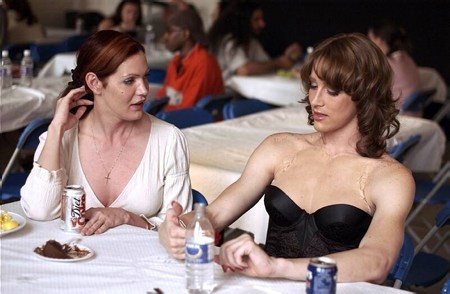
I commented about this movie in the past, but whenever it is on television (tends to be on pretty late), never seem to catch the ending. To repeat:
Later on in the night, Soldier's Girl was on cable, a true story about a solider who falls in love with a transsexual dancer with a military past herself. It is a good (and tragic) based on true life affair that both concerns their relationship as well the soldier's company, the sergeant who wants to leave sleeping dogs lie, another who wants to find the gay guy rumored, two troubled fellow soldiers and others who just want to have fun and do their job. Each part is well done, including Calpernia Addams [in white], who wrote a book about her own story. The book is well written but was not in the frame of mind to appreciate its somewhat flowery tone.Taped the last hour or so to ensure that I saw the ending this time: the brutal nature of the crime is done with the same skill as the rest of the film. I noted earlier that a striking thing is that the person who portrayed Addams later played an anti-13A member of Congress in the film Lincoln. Thus, one can imagine the skillful job required both on his (sic) part and that of those who made him into a convincing transsexual, including quite realistic looking breasts (which are exposed).
The film is so powerful and one for repeat viewings because it has so many layers. On a basic level, it is a simple love story. She is truly his "girl" and as noted in an excellent extended article not too long after the murder, him treating her as such meant a lot. Finding someone who cares for you and treats you right is something anyone would find perhaps a one in the lifetime thing. The gender issues only makes it more so here. And, that boat ride in the lake reminds me a lot of The Notebook.
The film also is about Barry Winchell, someone who we see early on as someone any woman might find a nice guy when he drives up to the base in a cool car and the woman at the gate basically flirts with him. Something of a troubled soul, even without the added bit of the romance, there is a lot of story and nuance there. It also has other stuff involving the people at the base -- as I said -- and to me at least, it all looks pretty realistic. Andre Braugher as the sympathetic sergeant is just one of those supporting characters that adds to a good film.
And, it is about the -- this is not meant to be a cliche -- troubled souls that ultimately led to the murder in question. The person who first took Barry et. al. to the club where Calpernia performed clearly had issues from the first we saw him, including those pills he took. His own conflicted sexuality is thinly veiled. He is but an example of one of those dark forces out there that cause society problems, people we cannot just sign off as evil or something. Not into that sort of thing. Possession of evil is a useful metaphor, but we are dealing with people here.
And, the film's refusal to show him and the younger guy who actually killed Barry as simple monsters is part of the skill here. The film overall is rich enough that I can imagine it being but part of a wider story, each character (down to a few minor ones) having additional stories of their own. There clearly is at least one -- that book by Addams that speaks of her life, some aspects hinted in the film here. That sergeant with his dogs, Addams' friend and mentor, the girlfriend of another solider who once worked in a gay club etc. all seem to have their own stories too.
Such is the sign of a good story -- so much there. Sexuality is clearly a theme here though as noted the film has various components that go beyond that. It is striking really -- we take such things for granted. That we are a certain sex. It seems strange to many that some might think they are the "wrong sex," but sex is not merely secondary characteristics. It is on some level something we feel. We take it for granted. It's useful sometimes to think outside the box here. Step outside a bit, so to speak.
I shall take a long weekend, blogging-wise, but come to think of it, this is a good film as any for Memorial Day. They both were military (she too) and the film is "in memoriam" to both, in a fashion. A nod to all others and if the latest speech will be path or nod in the direction of policy, however small, to reduce the killing of our own and others, it will honor them too. One of the best ways to remember is to reduce more war dead.
Wednesday, May 22, 2013
Shelter
A young guy with various issues (the uncle/nephew stuff was particularly well done) finds love with a guy in this touching film that does have a tendency to drag. Good performances and story overall though with Kate Walder (those eyes made me say, "hey, I know her!") and others providing good support. Decent commentary. Good scenery.
The viability line
John Hart Ely in Democracy and Distrust was wary about judges having the responsibility to determine substantive questions of fundamental rights. But, within the area they are appropriately deciding, Ely was supportive of clear lines that helped to avoid arbitrariness. One such example was the "one person, one vote" rule that held that different districts in a state should have basically the same number of people. A few justices accepted some differential if the rules set were reasonable, but this raised questions of line drawing. A clear rule seemed best.
This principle was held to be a core reason for the viability rule in Casey, even after the other two parts of the "trimester" test was removed as too restrictive. Undue burden was not exactly a clear line, but the plurality was still worried about setting some clarity here, especially for a line set forth by a court, not a legislature. Thus, they followed precedent as to the line (other than when necessary for the health or life of the pregnant person) where abortions can be banned. Viability was a sound line too:
Blackmun also in time had a firmer grasp on things:
So, I'm not sure what other line is to be used here. As Stevens noted:
Most abortions occur long before viability, but as noted, there is a small number that are close to or after the line (we are speaking something like 1% here over twenty weeks). This is not a trivial number in a raw sense, given the millions of abortions over the years. Just to keep that in mind. Still, some do arise and the viability line works. If fetal pain is an issue, and it will not unduly interfere with legal abortions, it might be warranted to use anesthesia. Twenty weeks, as the article cited above notes, is a dubious line even in that respect. And, a ban even less so. It isn't even necessary granting the premise. Amounts to be bad for various reasons.
Troublesome abortion regulations often are a question of special rules where neutral medical rules would work just as well, except as a bias against abortion choices. The concern here for the fetus is clear, but even on that level, a ban is not necessary. Depending on your goal.
This principle was held to be a core reason for the viability rule in Casey, even after the other two parts of the "trimester" test was removed as too restrictive. Undue burden was not exactly a clear line, but the plurality was still worried about setting some clarity here, especially for a line set forth by a court, not a legislature. Thus, they followed precedent as to the line (other than when necessary for the health or life of the pregnant person) where abortions can be banned. Viability was a sound line too:
the time at which there is a realistic possibility of maintaining and nourishing a life outside the womb, so that the independent existence of the second life can in reason and all fairness be the object of state protection that now overrides the rights of the woman. ... The viability line also has, as a practical matter, an element of fairness. In some broad sense it might be said that a woman who fails to act before viability has consented to the State's intervention on behalf of the developing child.Roe was subject more opaque (note the hedge):
With respect to the State's important and legitimate interest in potential life, the "compelling" point is at viability. This is so because the fetus then presumably has the capability of meaningful life outside the mother's womb. State regulation protective of fetal life after viability thus has both logical and biological justifications.In effect, it seems like the Court decided it was a medical question to be decided by the woman and her doctor, viability the line that was the norm in that area. Quickening was the traditional line, but that was largely practical -- it was when a life could be felt. Roe discussed the point, including the positions of various religious sects, such as forty or eighty days being the moment when the soul enters, arguably a sign of "personhood." A few years later, the Court reaffirmed that viability was a medical question, not a set legislatively set date. Such flexibility troubles some, in part since it is in part a matter of local resources, and would change as medical science does. But, it only changed a bit in over forty years. When it drops to let's under twenty weeks, we might have to talk.
Blackmun also in time had a firmer grasp on things:
The viability line reflects the biological facts and truths of fetal development; it marks that threshold moment prior to which a fetus cannot survive separate from the woman and cannot reasonably and objectively be regarded as a subject of rights or interests distinct from, or paramount to, those of the pregnant woman. At the same time, the viability standard takes account of the undeniable fact that, as the fetus evolves into its postnatal form, and as it loses its dependence on the uterine environment, the State's interest in the fetus' potential human life, and in fostering a regard for human life in general, becomes compelling. As a practical matter, because viability follows "quickening" -- the point at which a woman feels movement in her womb -- and because viability occurs no earlier than 23 weeks gestational age, it establishes an easily applicable standard for regulating abortion while [p554] providing a pregnant woman ample time to exercise her fundamental right with her responsible physician to terminate her pregnancy.See, both Webster and his separate opinion in Casey. What other line should we use? The issue here is fetal pain, but as noted by the article just cited, if anything, that happens in a true sense after viability. And, if the embryo or fetus cannot survive, what, the woman has an obligation to serve as a holding device until survival is possible? Some suggest sentience is proper line, but not only is it harder to tell when that occurs, that too very well might occur around this time or later. To me, there is a practical value to draw the line where there is meaningful chance for survival, even if the fetus has to grow a bit more in an incubator to survive on its own. As the article notes, there is going to be close cases where survival is very slim, and if at all, major abnormalities will occur. The word "meaningful" is somewhat tricky. But, viability still works.
So, I'm not sure what other line is to be used here. As Stevens noted:
I should think it obvious that the State's interest in the protection of an embryo -- even if that interest is defined as "protecting those who will be citizens," ibid. -- increases progressively and dramatically as the organism's capacity to feel pain, to experience pleasure, to survive, and to react to its surroundings increases day by day. The development of a fetus -- and pregnancy itself -- are not static conditions, and the assertion that the government's interest is static simply ignores this reality.This also is partially a matter of social judgment: there is a reasonable debate among people over the proper lines here, a plurality at least supporting abortions for various reasons in the first trimester, and leaving open later ones for special occasions, "special" often likely to be "mine." Doesn't mean they think embryos and fetuses aren't in some fashion "human" or even (though less so early on) "unborn children," but not in a full sense of human personhood. If the embryos or fetuses in some fashion had brain activity, this wouldn't likely change -- it won't be enough. Also, there is an understanding that there needs to be some time here to choose an abortion, including later on in cases of fetal abnormality or limited other reasons. A line too early clashes with this.
Most abortions occur long before viability, but as noted, there is a small number that are close to or after the line (we are speaking something like 1% here over twenty weeks). This is not a trivial number in a raw sense, given the millions of abortions over the years. Just to keep that in mind. Still, some do arise and the viability line works. If fetal pain is an issue, and it will not unduly interfere with legal abortions, it might be warranted to use anesthesia. Twenty weeks, as the article cited above notes, is a dubious line even in that respect. And, a ban even less so. It isn't even necessary granting the premise. Amounts to be bad for various reasons.
Troublesome abortion regulations often are a question of special rules where neutral medical rules would work just as well, except as a bias against abortion choices. The concern here for the fetus is clear, but even on that level, a ban is not necessary. Depending on your goal.
"Federal Appeals Court Permanently Blocks Arizona 20-Week Abortion Ban"
"Fetal pain" laws that try to elide past the viability rule is part of the "get Kennedy to stretch Casey" strategy. The 9th Cir. followed precedent and overturned a ban, it not their role to criticize the line or suggest alternatives. IF fetal pain did exist, the path might be anesthesia, not banning all abortions at that point. A bit blunt there anti-choicers.
Ike Davis Has To Be Sent Down
Really, this is too much. Can't hit or field, though now and then walks. Harvey was human, some struggling extra person getting three hits to add insult. Yesterday, Captain Wright flubbed a ball to help lead to three unearned. Today, Mets offense showed a bit of life. Found another way to lose, with a touch of embarrassment. One might say "again."
"U.S. Formally Admits Killing 4 Americans In Drone Strikes"
President Obama is due to make a big national security speech and useful letter by AG Holder was provided to Congress, including officially stating four Americans (only one "specifically targeted") were killed by drone attacks. The letter makes some good points, including limits and previous explanations. One name on list is news to me. Meanwhile, on GITMO.
The Other Typist
This time a review that made me want to read the book was worth it. A twisty look at a police typist in 1920s NYC with enough period detail to really imagine the possible film adaption. Its sharp protagonist, who early on hints at trouble, makes for an impressive narrator. Lost me somewhat late and not a big fan of the ending, but very good overall.
Tuesday, May 21, 2013
Metrish v. Lancaster (not that one)
The very last case heard already brought forth a (unanimous) opinion, suggesting a per curiam reversal might have been appropriate. It does teach a lesson about the development of case law (and conclusive rulings by the highest court) as well as how a reasonable position might not be enough to warrant federal habeas relief. A reminder to lower courts, perhaps.