About Me

My photo
This blog is the work of an educated civilian, not of an expert in the fields discussed.
Showing posts with label religion. Show all posts

Friday, August 07, 2026

SCOTUS Watch

On Tuesday, the Supreme Court released its calendar for the October argument session, which lasts from Monday, Oct. 5, to Wednesday, Oct. 14. 

The beat goes on. A notable environmental case is one of the first big cases. 

The link goes to a conservative who signed a letter in 2016 explaining why it was essential for conservatives to be against the election of Trump. 

He has been praised as a fair conservative mind. 

I have found him generally so (he had his bad moments), though I am annoyed at how little he responds to Trump shenanigans. 

This is a theme on that website, which has a few Trump loyalists (Josh Blackman), but many who don't care for him much. Other than one person (and one person who sometimes pops up), they rarely say anything.

This is not an appropriate response to the times. 

==

BJC has a podcast discussing religion and the Supreme Court. It was on hiatus until the new term. They had a special SCOTUS preview and announced a co-host is leaving.

==

Precedent and Personnel: When the Justices Change so Does the Constitution

Prof. Eric Segall is a liberal law professor. 

I disagree with him from time to time, including on some of his hobbyhorses. This one, which he has been on for decades, is rather tedious.

He LOVES the Legal Tender Cases example. It's not a normal one. The Chief Justice ill-advisedly decided a significant case on a short bench. 

He was on notice and did so anyway. When two new justices joined, the cases went the other way.  

Compare this to what John Marshall and Warren Burger did. Marshall held cases over in the 1830s when the justices divided, and a new membership might change the result. 

The Burger Court had a special committee when they had seven justices to decide what to hold over if the two might change the result. 

What does ES want? Abraham Lincoln in his first presidential inaugural address argued:

At the same time, the candid citizen must confess that if the policy of the Government upon vital questions affecting the whole people is to be irrevocably fixed by decisions of the Supreme Court, the instant they are made in ordinary litigation between parties in personal actions the people will have ceased to be their own rulers, having to that extent practically resigned their Government into the hands of that eminent tribunal. Nor is there in this view any assault upon the court or the judges. It is a duty from which they may not shrink to decide cases properly brought before them, and it is no fault of theirs if others seek to turn their decisions to political purposes.

The justices on a short bench by a closely divided vote held one way. The majority arguably was quite off base on an important constitutional issue. 

A single case should not be the immediate end of the line. Stare decisis is important. But the issue wasn't firmly established. New justices, selected by people we elect (if indirectly, especially pre-17th Amendment), will factor into this equation.

This case is a rather incomplete example to examine the wider question. It might have been wrong. It might have been right. It still is a special case.

New justices over time do change the law. It is a significant way the law changes over time. Likewise, legislatures and executives change over time. Their view of what the Constitution means also changes. 

Justices, even the current bunch, also don't simply ignore precedent. It would be tedious to list the number of things, including some things of importance, that are basically the same now.

We can also list a bunch of things the current majority has done that significantly disrespect precedent. I find many of these cases dead wrong. 

Nonetheless, the fact they are making new law alone isn't the problem. The way they are doing it, both procedurally and substantively, is the problem. The problem here is the merits. 

What happens, imagine with me, if the Supreme Court eventually is ideologically reasonable? Liberals and moderates have a supermajority. This happens because of new membership. Look at the early 1960s.

A nuanced approach can result in liberals cautioning courts to be conservative. At some point, a conservative approach is ill-advised. But that would at least make more sense than this simplistic take. 

The law is not obtained by looking at the sky, entrails, or original understanding. I repeat myself. It is a value judgment that significantly depends on the judges.

We should be open about this. We should carefully handle the situation. Judges should still act like judges. And, yes, ES, life tenure and so forth give the justices much more power to act arbitrarily.

This warrants special attention. I still don't accept simplistic cant. With respect, #JustSaying. 

===

On my Substack ... comments on a pending Massachusetts abortion bill. 

Wednesday, July 29, 2026

Missionary, Birthright Citizenship, Gay USA

I cover various topics on Substack, including how the Trump Administration is honoring a Catholic martyr while violating all he stood for. Also, co-host of Gay USA retires after thirty years. 

I recently watched Once and Again on YouTube. I vaguely recall watching at least some of it. It was first on before this blog began (mid-2003). I found one passing reference on the blog. 

Monday, June 29, 2026

SCOTUS Watch: Opinions/Orders

Orders

The Order List had some notable content, including multiple grants and no grant in the E.J. Carroll case. Maybe, just maybe, Trump will have to pay up for his sexual assault.

Gorsuch (with Alito and Thomas) returns to his concern about health workers not being able to obtain an exemption from vaccine mandates. NY, among other things, argues it is a bad "vehicle" for review. 

Thomas (with Gorsuch) wants to re-examine NYT v. Sullivan, citing original understanding (the case involves Alan Dershowitz suing CNN). If they want to quote original understanding, quite a few modern-day First Amendment cases should be decided the other way. A lot more limits were allowed back then. 

Sotomayor, for the liberals, dissented in a qualified immunity case involving a prisoner alleging mistreatment. There is a good originalist argument, ignored by conservative justices, that juries should have wide discretion to find government officials liable for wrongdoing. The Founding generation thought juries were the "palladium of liberty," even more than judges, who were creatures of the state.  

Each Trump nominee did not take part in a case without saying why. 

There should be another "clean-up" order, with perhaps more recusals, later in the week.

Opinions 

Barrett (with Roberts + the liberals) upholds a rule regarding mail-in ballots. Rick Hasen argues that "text,  history, and longstanding practice going back to the Civil War" back her up. A somewhat unhinged Alito opinion, however, still received four votes. 

Kagan continues the expansion of the reach of the Fourth Amendment to "geofence warrants," regarding the location of cellphone users. Alito, Thomas, and Barrett dissented. Gorsuch concurs but tosses in some cosplay about original understanding.

[Orin Kerr of Volokh Conspiracy is one resource for this topic.]

Roberts had the big two for the day involving agencies. The Federal Reserve, 5-4, can retain its "for cause" removal rules. The dissenters partially complain about the reach of the opinion, which broadly rules to bring clarity to the question.

(People are arguing that Roberts/Kavanaugh selectively exempt the Federal Reserve "to protect their stock portfolios." The special exemption is dubious. OTOH, various agencies regulate financial matters. They also affect stock portfolios.)

Not so for other agencies, overturning long practice (at least from the late 19th Century) and precedent (from the 1930s). The whole thing is bullshit, 6-3, Sotomayor (Kagan usually handles this issue) with the dissenting opinion for the liberals. 

(Her dissent, which she read from the bench, is very good. We should have audio/video.) 

The First Congress split various ways regarding the proper constitutional and policy rules for removal. It is a political question that should be left to congressional discretion. The dissent is correct that the majority forgets its "place." The voters need to secure a new Congress that reminds them. 

The 6-3 majority puts its thumb on one side. Perhaps, it is an ironic move to honor the 250th Anniversary of the Declaration of Independence (tyrannical king). 

Some more opinions tomorrow.

ETA: A discussion about them. 

Sunday, June 28, 2026

Texas Bible Reading List

I discuss Texas putting out a new reading list for schools that includes biblical stories. One theme is that we should think about such things, including the meaning of the Ten Commandments. Also, yes, this has a feel of an illegitimate sectarian establishment of religion. But let's go deeper. It's for 2030. We have time.

Wednesday, June 24, 2026

SCOTUS Watch: First Opinion Day

The first opinion day of the week (yesterday) disposed of five cases, all somewhat also-rans. The opinions largely broke down 6-3. 

The oral argument didn't bode well for a prisoner trying to obtain damages against state prison officials for violating his religious liberty. The reason was not that the conservative justices only care about Christians. 

Holt v. Hobbs, for instance, protected the rights of a Muslim prisoner. The justices do somewhat selectively care about religious liberty. Nonetheless, the reason for the opinion here is likely somewhat different. Wrong all the same

Kagan and Jackson joined the result in a case about the Alien Tort Statute (the trend has been limited protections), but joined much of Sotomayor's dissent on why the majority went too far. 

The liberals fully disagreed with the conservatives in an immigration case. Thomas for the conservatives.

The one kumbaya moment was an overreach of a case involving the Takings Clause. Fair market value is fair enough when the government sells a property in a tax sale, as long as the whole thing is otherwise fair. 

Some libertarians might be upset, but I looked into the details (did so in response to an early response to this guy), and this was no great travesty or anything.  This is the case that it's okay to give to Alito. 

There will be more pain for the liberal side of things (and more hot-button cases) in the upcoming days. 

Sunday, June 21, 2026

Pot and Guns

This morning, the Court issued its decision in United States v. Hemani. The Justices unanimously agreed that 18 U.S.C. 922(g)(3), as applied to Mr. Hemani, violated his Second Amendment rights. 

I talked about U.S. v. Hemani on my Substack; one entry linked in my last SCOTUS entry. It was a 9-0 opinion with multiple concurrences. It received support from both liberals and conservatives. Just what it decided is unclear. 

The link argues it is a limited decision. People should, on some level, carefully remember that it decided a limited question. It did not broadly, in all ways, allow users of marijuana (and other controlled substances) to own firearms. 

Gorsuch wrote the opinion of the Court. He summarizes the facts in a way that particularly favors the defendant. The government thought the guy was a terrorist. He was not. 

(There are implications that he and his family -- he is a dual Pakistani and U.S. citizen -- were profiled in some fashion.) 

He cooperated. He lived with his parents and had a stable job. He ultimately was charged merely with owning a gun while being an "unlawful user." It wasn't related to drug trafficking or "anything like that." 

He was just someone who used marijuana "every other day."  Oh. He had cocaine, too. But, hey, he said he didn't use it recently, or anything.  

The justices, including Jackson (with Sotomayor), who concurred to say it was stupid, granted that Bruen was good law. "All Americans" (what does that mean? are longstanding residents who are not citizens, "Americans"?) have an individual right to keep and bear arms for self-defense. 

The opinion didn't provide a whole quote from that opinion. For instance, Bruen opens with a basic statement that "ordinary, law-abiding citizens have a similar right to carry handguns publicly for their self-defense." 

Marijuana possession is a federal crime. Hemani was not a "law-abiding" citizen. He admitted it. Note also that this opinion doesn't say "citizen." It speaks of "All Americans." 

We should, however, look at what the Court specifically decided. That often requires some nuance. Reporting and a quick read often lead to wider assumptions.

The opinion reminds that regulations need to be “consistent with the Nation’s historical tradition of firearm regulation." The federal government said that the specific provision involved matches up with "habitual drunkard" laws.

Gorsuch argues the "how" and "why" of such laws don't match the current provision. Again, framing things Hemani's way, he notes that otherwise the law in question allows for "prison for up to 15 years and disarmed for life." 

The opinion notes the government "seeks to prosecute" Hemani. It is unlikely they will seek a term anywhere near that length. The lifetime disarmament fears are also somewhat premature. 

Habitual drunkard laws generally disarmed people who were typically so drunk that they could not go about their normal business. That is not what is involved here. Unlawful use regularly doesn't involve people being drugged out of their minds daily. 

(The provision also could apply to something like Adderall. People regularly use that, including to "cram for exams." They aren't like "habitual drunkards.") 

The opinion reminds us that at the time of the Founding, people drank a lot of alcohol. Yes. 

For various reasons, including the fact that it was safer than most beverages. Our drinking habits are different now. We are also a much more populated society, with more dangerous guns, and more ways they are liable to cause harm. Also, in time, we determined that drugs could cause various harms, leading to regulation.

The specific focus on "habitual drunkard" laws, which are cited by the government to satisfy the Court's own rules, leads to a limited result. The provision here is a bad fit, yes, but the forcing is the Court's fault.

The Court flags that many drug users would not be violent. The law in question does not provide a hearing before disarming. Okay? 

Congress determined that certain drugs were dangerous enough as such. These developments happened later. Appeals to original history are of limited value here. 

Sometimes, the drugs involved are regulated for health reasons. This is not the same as being "categorically" dangerous. Recent events regarding rescheduling marijuana only emphasize this. 

The opinion ends by underlining that various types of firearm bans still might be acceptable. For instance, those that cover people actually intoxicated. Hemani regularly is intoxicated. 

Thomas references the Commerce Clause, which the majority notes wasn't involved here. The link to interstate commerce depends on the situation, including how the gun was obtained. 

Jackson cites the problem with Bruen. She favors "means-ends" scrutiny instead of so much focus on "contested historical questions." 

Scrutinizing the fit between a challenged law’s justification and its operation is an essential part of any sensible framework for Second Amendment adjudication.

Alito adds more on how marijuana is generally accepted today in his concurrence with Kagan. It's a reasonable-sounding opinion, though, having a "living constitutionalist" flavor. Not that I find that problematic. It cites how current practices are like original ones, but don't know how much that adds. 

The question presented directly addressed the Second Amendment. It probably would have been better if the opinion had simply, perhaps as a matter of constitutional avoidance, found the provision too vague and arbitrary. It said as much in a fashion.

The law literally would cover everyone who uses the covered substances. It might result in extreme results. See also, prosecutorial discretion, and its usage in this case, arising from an apparently mistaken investigation. "Morals" legislation, including drugs, regularly leads to such arbitrary results. 

[Underlining the value of careful scrutiny.]

The government, however, provided a narrower application. Just what that entails, however, is vague and open to arbitrary application. Since constitutional rights are at stake, it would be best to avoid that, including by raising procedural due process red flags. 

(A law that threatens free speech might be held to be overbroad even if the specific speech involved can be criminalized. The citation of Adderall fits in here.)

If we grant a constitutional right to own a firearm, it is reasonable to require a careful process to be in place before criminalization. The law here, like the reference to Adderall suggests, is not just about marijuana. I understand the result.

Nonetheless, the appeal to "habitual drunkard" laws was the road to confusion. Yes, the law isn't really like that. It was just cited to try to fit things into Bruen

The specific person here was a regular user of marijuana. It is an intoxicant. I think marijuana should be legal, and I appreciate the move to reschedule (which was done after Hemani's possession). But Hemani was an "unlawful" user of a drug, which (rarely unenforced, it might be) had serious penalties.

Again, this raises due process concerns, like other morals crimes. So, the result here is sound, on some level. The details, however, turn me off.

For instance, the overall logic of the opinion suggests you really don't have to be a "law-abiding citizen" to have RKBA. People can possess and even regularly use illegal substances. The government has to provide a careful process to show that the usage is dangerous enough not to own a firearm. 

And, what of other law-breakers? One lower court addressed people who commit welfare fraud. What level of law-breaking warrants disarmament? And, is a "lifetime ban" particularly a problem? 

The Supreme Court in the past referenced 14A, sec. 2, to allow felony disenfranchisement. Is gun possession different? The militia and voting are likely connected. See also jury service. The opinion not referencing the "law-abiding" language ... is that notable? 

Anyway, I doubt the Hawaii decision will be unanimous. We are likely to see it later this week. They should have decided the two opinions together. Show how the Court "reasonably" disagrees, with one gun case unanimous, the other likely 6-3. 

Finally, will marijuana usage now show up as polite in other cases? Some people claim marijuana has religious uses. The arguments tended to fail, but now litigants have a supportive opinion, especially if selectively quoted. 

Will federal RFRA claims work now? Time will tell.  

Tuesday, June 09, 2026

Military Chaplain Updates

Military chaplains are a usual example of when we can have government support of religion.

Granting that, religion, especially mixed with government, remains a sensitive subject. The streamlining of "faith codes" underlines the point with controversy from various quarters. 

The so-called Department of War [still not a thing] posted on Twitter (blah) the general goal:

In order to clarify the work of chaplains and simplify the work of commanders, the Pentagon has consolidated and simplified the list to roughly thirty codes — using the previously used labels for faiths.

The Pentagon’s job is not to adjudicate theological debates, but instead to ensure sincerely-held faith is respected and encouraged in our ranks.

I'm not sure if its job is to "encourage" faith, sincerely-held or not, either. But, okay, let's go with that.

There was a major hiccup when Mormons were not labeled "Christians." Many Republicans (and Trump supporters) are Mormons. That caused a flare-up.

The new codes did not designate specific Christian denominations as such. Catholics were just "Catholics," not "Catholics (Christian)."

People were still upset that many other religions were left out. We just have a catchall "Other Religions" category.

Also, we have a single "Judaism" category, which includes multiple major groups, and a bunch of separate, relatively small (Church of the Nazarene?) Christian groups. 

Secretary of Defense Hegseth, who wears his specific Christian beliefs on his sleeve and promotes them in his official capacity, also made other changes

Hegseth has not earned much respect as someone to trust with such things.

Before the change, a chaplain’s uniform carried their rank insignia along with a symbol denoting their religion.

The policy, he said, “speaks to the difficult balance of the duality of a military chaplain. A chaplain is first and foremost a chaplain and an officer second. This change is a visual representation of that fact.”

Hegseth also said that removing rank allowed chaplains to “be seen among the highest ranks because of their divine calling.”

The person is a military chaplain. Rank is important to the military. They were seen as chaplains before. I'm unsure why this move is necessary. I would like to know how chaplains overall feel about it. 

The directive follows a broader effort by Hegseth to reshape the military’s Chaplain Corps. In a December message, he said he wanted to restore chaplains’ focus on ministry and argued that the role had shifted toward counseling and support functions in recent years.

What "ministry" entails depends on the person. For many, it would include "counseling and support functions." This seems like an idiosyncratic view of what the appropriate role of a chaplain is. Did he think the old way was too "woke"?

The good faith of this Administration, with its Christian Nationalism overtones, on this issue is already questionable. Hegseth has also shown to be racist and sexist, including regarding firings. 

We can move on from that. The general issue is sensitive. It is a good thing that it is getting some attention. Perhaps, more kinks will be worked out. 

==

Note: Religion is one of those subjects that will sometimes lead people to jump to first principles, including rejecting special rules for religions at all. Some will make some snide references.

So it goes. "Religion" is referenced in the First Amendment and is a general legal category, including in human rights law. It's a thing. 

Wednesday, June 03, 2026

Indiana and Tennessee Declare June as Nuclear Family Month

I discuss the various problems with this here. I toss in a link to an amusing "drag comedy" that is also a satire of teenage films. 

Tuesday, June 02, 2026

Andrew Lukehart Execution

Andrew Lukehart, after previously being found guilty of child abuse, was sentenced to die by Florida for the death of a five-month-old child. He first made up a kidnapping story.

That was thirty years ago. Breyer explained why it is constitutionally and otherwise problematic to execute someone after all that time. Florida is making it a habit.

The first article suggests it is still somewhat unclear what exactly happened. Why did he murder the child? Child abuse, including lethal child abuse, arises for various reasons.

The crime is horrible, especially when you look at the picture of the child. The news article starts with a trigger warning. Still, thirty years in prison is a very serious punishment. 

The final appeal, rejected by the Supreme Court the day before without comment, was a standard red flag about Florida execution procedures. Old ground

It also added a novel argument that forcing him to choose an alternative means of execution (you must do so if you challenge the method) is a violation of his religious liberty. There is a federal statute protecting the religious liberty of prisoners. 

His execution doesn't provide much value, in my opinion, to the public welfare. Safeguarding children is precious. An arbitrary execution does little to advance it. 

Saturday, May 30, 2026

Ken Paxton Attacks Opponent's Religious Beliefs

I discussed a book that argues that religious beliefs will sometimes be relevant when determining who is fit for public office. Racist religious beliefs do not get a pass. It is touchy.

The dig is an anti-trans epithet. MAGA selectively cares about religious liberty. Anti-trans rhetoric is here insulting the beliefs of millions of Christians. Among other things, yes, that is disqualifying. 

Friday, May 29, 2026

John Quincy Adams

Crawford is a musician and podcaster. 

I'm not familiar with him in either case. I am enjoying this book, which focuses on his antislavery efforts, especially as a House member. It's a book geared to the general reader with some neat drawings.

Adams hated slavery, but like many people of the day, didn't care for abolitionists. Slavery was bad, but we were stuck with it.

Early on, when he was a senator, he voted against a limit on slavery. As a diplomat and executive official, national sovereignty was more important than opposing slavery. For instance, limiting the British power to search American ships on the high seas.

Plus, abolitionists, in his view, exaggerated how bad slaves had it. They seemed unreasonable extremists.

Adams became a hero of the antislavery movement after extremists on the slavery side went after the freedom of speech. The "gag rule" arose after abolitionists supposedly started to get a bit too pushy for their own good, flooding the mails and Congress with antislavery materials and petitions. 

Give an inch and all that.

Adams noted that not formally accepting petitions broadly endangered First Amendment rights, showing how suppression of liberty tends to spread. For instance, abolitionists were motivated largely by their religious beliefs. Religious liberty was at stake.

It also shows how change happens over time. Abolition seemed hopeless in the 1820s and 1830s.

Adams, with some foresight, noted in his diary that the only way it seemed possible was if the country broke apart and/or went to war. Congress then might have the power to abolish slavery as a war measure.

He died in 1848, though he lived long enough to see the Mexican War, which helped introduce the final chapter (chapters?) that led to that war. 

Good book overall. 

Monday, May 25, 2026

Pope v. AI

The Catholic Church, in various ways, is just plain a problem (understand if some will just say "no!"), but the last two popes were admirable in various ways. The latest from the pope shows why. 

Sunday, May 17, 2026

“Rededicate 250"

The “Rededicate 250: A National Jubilee of Prayer, Praise & Thanksgiving” event in D.C. today had a Christian Nationalism feel. 

The Washington Post article's title:


It was not merely a private event:

A crowd of thousands transformed a block of the National Mall into an evangelical-style worship service Sunday at an event backed by President Donald Trump and funded with millions of taxpayer dollars.

Trump didn't show up. They played a video of his reading a Christian Nationalism-friendly biblical quote from a different event. A few signs of religious diversity (including the usual Judeo-Christian touches with Judaism as a the clearly junior party) aside, the dominating force was apparent:

People described a variety of reasons for coming — to bring awareness to what they see as harassment of or disfavor toward conservative Christians, to pray for the country to repent for its sins, or to fortify what they call the Christian roots of the country — in particular against Islam or other faiths outside Christianity or Judaism. 

Pete Hegseth referencing the mythical story of General Washington kneeling to pray story is the flavor of "history" we will see here. An honest accounting of our nation's religious story would be helpful. 

This bunch, with Trump as their false god, won't give it to you.  It is more likely to be blasphemous, including to many Christian believers. And, to our overall values.  

Wednesday, May 13, 2026

In-Lawfully Yours

I referenced this film about six years ago. The video I used is blocked. I summarized:

Up Channel has "new" films on Sunday nights at 7/11 that are actually not new but promoted as new. For a few weeks now, the picks have been overall pretty good. 

This week, we had a city girl, not much into God, come to help her old mother-in-law (as in ex -- the hubby cheated on her) move after the father-in-law died. She falls for the new minister, whose deceased wife was her sister-in-law. 

Thus, the punny title. Various familiar faces, including two people in current shows and two from old shows. It has light touches mixed with a lot of serious content. 

Well-acted, with the story pretty well paced too. Sorta topical.

The film was a Regents University production. The DVD behind-the-scenes extra talks about that, including how film students were involved. 

Its website offers:

Experience the difference of America’s Premier Christian University that offers over 150 areas of study online and on campus in Virginia Beach, Virginia.

"Christian" means a variety of things. The film promotes an open-minded view. After all, the minister might be a widower, but the other love interest is a divorcee. 

At one point, her ex comes back pretending to want to reunite. He claims to be reformed. It is a trick. Some Christians would find that troublesome. Why not make it a redemption story and save her from the evils of divorce?!

She asks a lot of questions about the Bible and religion in the film. The film cheats a bit by not providing too many answers to her questions. 

Yes, how do you know you chose the right religion? Yes, how did Job getting a new family really help him after his old one all died?  

The film does know that a "message" film should first be a good film. The Bible is filled with stories that teach us. They are also enjoyable stories. They were passed down for more than their moral lessons.

I re-watched the film (at least for a third time) and still enjoyed it. The husband's coming back is a bit heavy-handed, but it is an understandable plot device. Got to earn that nice ending. 

Still, I want to get past that and back to the pastor and his sister-in-law building a relationship. They are a good couple. And both are well-rounded, complex characters. 

Thursday, May 07, 2026

National Day of Prayer

I agree with the Freedom From Religion Foundation, whose lawsuit was successful at the district court level before losing on standing, that this is unconstitutional. (Link to litigation at that linked discussion.) Good luck doing so these days.

The President shall issue each year a proclamation designating the first Thursday in May as a National Day of Prayer on which the people of the United States may turn to God in prayer and meditation at churches, in groups, and as individuals.

Congress should not be selectively advising people, especially the president [though this one is quite willing to do so without being pushed], to pray. The district court opinion from the before times referenced Justice Blackmun's opinion in a creche case (Allegheny):

It is worth noting that just because Marsh sustained the validity of legislative prayer, it does not necessarily follow that practices like proclaiming a National Day of Prayer are constitutional. Legislative prayer does not urge citizens to engage in religious practices, and on that basis could well be distinguishable from an exhortation from government to the people that they engage in religious conduct. But, as this practice is not before us, we express no judgment about its constitutionality.

The dissent acknowledged that the legislation “is a straightforward endorsement of the concept of turning to God in prayer." [cleaned up] These days, that sort of thing is more and more allowed. It still is bad under the First Amendment.

The word "may" aside, the legislation has the purpose and effect of promoting prayer. It is a "National Day of Prayer." Baptists who respect the separation of church and state see the problem while realizing there are worse breaches.

(There is a reference to meditation, but it remains a day of prayer. And not everyone does that either.) 

I again note that -- though prayer is something many religions do -- the language favors Christianity. There is a reference to "churches," not places of worship. 

Religious liberty warrants a separation of church and state. It also warrants avoiding favoritism, including selectively instructing the president to proclaim about certain religious activities. 

Saturday, May 02, 2026

Trump Supports Anti-Christian Bias

Religion Clause Blog reports

Yesterday, the President's Task Force to Eradicate anti-Christian Bias issued a report (full text) titled Eradicating Anti-Christian Bias within the Federal Government. The 197-page Report (with an additional 368 pages of Exhibits) focuses on policies of the Biden Administration.

The report has the usual Trump anti-Biden bullshit. Biden, whose expression of religious beliefs was much more honest than Trump's, supposedly is "anti-Christian." 

Biden regularly wore his religion on his sleeve and did so a lot more credibly than the current occupant. His Administration also respected equality, including the diversity of Christian beliefs. 

Trump's Administration selectively weaponizes Christian beliefs, promoting Christian nationalism, while disrespecting many Christians. This includes changing long in place policy regarding ICE enforcement at places of worship.

Where is this so-called anti-Christian bias? For instance, people who blocked clinics, motivated partially by religious beliefs, were not allowed merely to continue to do so. Laws protecting clinics were enforced. So, people could freely obtain health care, pursuant to their (often Christian) moral beliefs.

Vaccine mandates were also enforced. First, the average Christian doesn't find vaccines problematic. Second, requiring workers, including health care workers, to vaccinate or use alternative methods to protect others, is not "anti-Christian bias."  

There are rules in place respecting non-profits with tax breaks. Religions and religious organizations, whatever the religion, don't deserve a special exemption from the rules here. 

And so, it goes on and on. The Trump Administration promotes a selective form of Christian nationalism. The Baptist Joint Committee for Religious Liberty has flagged the problems of Christian Nationalism. But then, they aren't the "Christians" the Administration is concerned about.

Religious liberty is a fundamental aspect of freedom, not just in the promotion of some favored ones. It is too precious to let such special pleading go on without comment. See also, Justice Thomas and his confused and biased take on how "they" ignore the true meaning of the Declaration of Independence. 

"Christianity" is not just a conservative form of it. "The left" are alleged to be anti-Christian and anti-religious. This is a vicious slander. 

Monday, April 20, 2026

SCOTUS Watch: Order List and Other News

Order List

Today's Order List was long enough that it suggested additional writings. It also had some notable developments, including a case that might further weaken Oregon v. Smith (general applicable laws are generally acceptable for religious liberty purposes).

One case on the "shadow docket":

By a 6–3 vote, and with no opinion, the Supreme Court throws out a lower court decision denying qualified immunity who killed an unarmed, mentally ill man by using "bodyweight force" to restrain him. All three liberals dissented.

A per curiam error corrects a lower court Fourth Amendment decision. Sotomayor, without comment, wouldn't provide relief. Jackson dissents with an opinion. 

Sotomayor, in a statement, discusses a dispute involving a child abduction measure. She agrees it is something they should eventually address. 

This specific lawsuit, however, is procedurally inappropriate to take. Nonetheless, she argues it was at least partially a self-inflicted wound by the Court.

Sotomayor, without comment, also noted she would have granted a case alleging evidence was not properly supplied in a criminal case. 

Justices Alito, Kavanaugh, and Barrett didn't take part in some decisions without saying why. Only Kagan and Jackson consistently provide their reasons. 

Shadow Docket Story

Steve Vladeck addresses a NYT article, with internal documents, discussing a major change in the shadow/emergency/interim docket in 2016. I agree with his overall analysis. The articles provide sunlight on issues of special concern. The actions are troubling.

Fix the Court suggests a proper response would be congressional legislation requiring transparency. If they abuse the process, jurisdiction stripping and budget cuts would be some possible consequences. 

(This was suggested in an email I received via a subscription.)

Or we can go the route of certain conservatives who think the leak is the biggest problem. The overall comments there, as I noted in a comment, ignore that internal deliberations are regularly leaked. Full documents are a step beyond that, but that might be appropriate (e.g., Pentagon Papers).

Thomas vs. Progressives

Prof. Segall focuses on his corruption -- Harlan Crow -- but also links to a wider discussion, how his usual "just so" historical account is garbled. This is who conservatives deem their model judge. 

Happy Birthday, Justice John Paul Stevens. And Adolf Hitler, apparently, going by Justice Thomas. 

Meanwhile ...

Some good news in a lower state court in Pennsylvania, which, on state constitutional grounds, struck down a Hyde Amendment. A concurring opinion also cited religious liberty. 

Some state courts went this route in the past. The principle should be applied nationwide. 

ETA: Two non-ideological opinions were handed down on Wednesday. Sotomayor had the unanimous opinion for one. Thomas had the other opinion, with a dissent by Alito, Roberts (relatively rare dissenter), and Kavanaugh. Sometimes, disagreements aren't always along the expected lines. But 6-3 is still a thing. 

Saturday, April 18, 2026

Bible Reading Marathon

Trump Will Participate in a Marathon Bible Reading

He will read a passage from the Old Testament that his Christian supporters cite as a call to national repentance and divine blessing.

I have long had an interest in the Bible. I listen to Bart Ehrman's weekly podcast. I took a New Testament course a long time ago. I have read a lot about the subject. I once read the whole Bible. 

I am reading this book by Rachel Held Evans' sister. It works both as a general discussion of grief and grief rituals as well as a Christian discussion. She comes from that tradition. She's a good writer. 

People will have a cynical reaction to this effort. Trump surely doesn't seem like an honest broker here. The verse he read is somewhat ironic if read honestly:

If my people, which are called by my name, shall humble themselves, and pray, and seek my face, and turn from their wicked ways; then will I hear from heaven, and will forgive their sin, and will heal their land.

Certain evangelicals read some biblical quotes in a Christian Nationalist way. The original context was the Jewish people in ancient times. The current meaning should not be inferred to be a statement of Trump triumphalism. 

I think, quite honestly, our nation should humble itself and seek forgiveness for its wicked ways. It has supported Trump and committed much damage beyond that. It needs to accept what it did. It has to work toward healing.

Susie Wiles, the White House chief of staff, will read Proverbs 31, which includes a wide-ranging list of qualities of “a wife of noble character” that has become a touchstone for many Christian women.

This is another somewhat ironic choice. How would the original author feel about her position? How noble is it to be Trump's chief of staff?

Rachel Held Evans spoke repeatedly about that chapter, about "women of valor." Rachel did not just read the Bible. She studied it in depth. That is the best way. Also, it's a good thing to discuss. 

I suppose when the whole "Bible" is read, it will be the Protestant Bible. I was taught using the Catholic Bible, which has additional material. 

Congress, some time back, read the whole Constitution. Well, not really. They edited it somewhat, skipping over amended parts. That allowed them to skip over the slavery stuff. Did they read the whole thing when they did it again more recently? They should read the whole thing.

The Bible can get tedious, especially all those genealogies and rules and regulations. A few of the prophets go on for quite a long time. But it's okay if they want to read the whole thing. Should be done humbly and not as a partisan thing.

We see the world through a glass, darkly

ETA: I liked the book on grief. The chapters sometimes went too long. 

It is significantly a personal narrative, since she had multiple miscarriages and her sister died. (Her grandmother also died, but that is fairly typical for someone her age.) She is a bit privileged.

She has a husband, family, friends, and a rewarding career. Lots of people don't have all of that to fall back on. Toss in faith, no matter how she noted she sometimes struggled with it.

I respect her overall, helped by an overall liberal outlook. Still, that got to be a bit much after a while, especially with all the talk of rituals involving the community. Not everyone has "a community."

I also am not a Christian. Christianity can be fine. Stephen Colbert is a Christian and all that. 

This addendum is not about my disagreement with the basics of Christian doctrine. Still, the whole died for sins business. Such a great sacrifice!!!!!

That has long annoyed me. Many people suffer and die for a whole lot less. They often don't even know if their death will mean much. They might sacrifice for one person. Imagine dying to save humanity?

(I'll grant the premise! Still dubious!) 

And, sorry to bring this up, why did they need to be saved in the first place? Oh well.

Wednesday, April 15, 2026

Religious Liberty Commission Follies

At a Monday (April 13) hearing at the Museum of the Bible in Washington, D.C., Texas Lt. Gov. Dan Patrick, a Republican and the chair of the commission, asked, “Would it not be a good recommendation that every school, every university, every business, has to have that one sheet on the bulletin board about protecting people’s religious liberty, and that the separation of church and state is the biggest lie that’s been told in America since our founding?”

The Trump Religious Liberty Commission meeting at the Museum of the Bible (book) is fitting. The museum is an evangelical enterprise significantly funded by Hobby Lobby. 

The chair argued that "the anti-God left has used ["separation of church and state"] to suppress people of religion in our country." This is the "biggest lie" told in America since our founding. "Slavery is a positive good" is third or fourth, perhaps. 

Religious liberty is extremely important. It is also highly debated. But the commission is not set up for an honest discussion. The discussion might offer references to Baptists, Madison, and Jefferson strongly supporting state/church separation. 

This caricature of right-wing beliefs leads some to disdain any talk about religion. We will get references to fantasy people in the sky or some such thing. 

A pending case reflects one single-minded view. A Catholic organization wants an exception to an LGBTQ equality provision. Another lawsuit involves a hospice that claims a religious exemption from a trans equality provision. 

I find such litigation selfish. Not all Catholics believe in this anti-LGBTQ doctrine. Regardless, if you want to take part in public affairs, including public welfare services, it is not outrageous that basic equality has to be followed. 

Is this what you want to worry about when providing hospice care to people? Not allowing them rooms in their self-designated genders? Will you only provide them care if they pray to Jesus Christ, too? How shallow a Christian you are. 

(Catholic nuns don't use birth control.* That is b.s., too. The concern has to be the employees. 

Some janitors at a school can't have birth control, even if it is their own employment-based health care. Some sisters realize that it is moronic.)

Last month, Meenu Batra, 53, who has lived in the South Texas border colonia of Laguna Heights since 2002, was on her way to Milwaukee, Wisconsin, to work another case. She’s been a court interpreter for over 20 years, the only one licensed in Texas for Hindi, Punjabi, or Urdu. Her language skills are requested nationwide, where she’s contracted to help people making their way through the immigration court system, just as she did for herself 35 years ago when she immigrated from India to New Jersey before settling in Texas.

I think this is probably a more troublesome threat to religious liberty. Such a translator is likely used by Hindus and other minority faiths partially to obtain religious services. 

Respect for immigrants is generally a religious obligation in many faiths. Some people do oppose anti-immigration policies, especially those of a Trumpian nature, on religious grounds.

Is the presence of "woke" religions a "big lie," too? 

==

Note: Maybe some Catholic nuns do use birth control. Some gay priests are sexually active. 

The "birth control" also sometimes has other health uses. I'm not sure how much that comes up with Catholic nuns. I assume they are not deemed "sluts" if they use it for non-contraceptive reasons

Tuesday, April 14, 2026

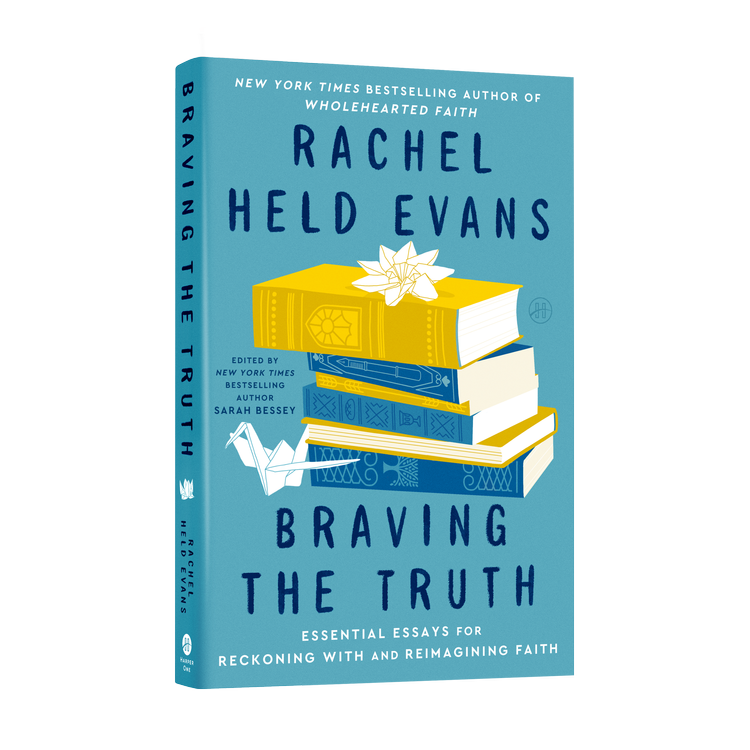
Braving the Truth


Rachel Held Evans died in 2019. Multiple additional books, including this collection of essays (with additional commentary by others), followed. I talk about it here and here. With additional Trump b.s.