About Me

- Joe
- This blog is the work of an educated civilian, not of an expert in the fields discussed.
Tuesday, June 18, 2013
"House GOP Passes Abortion Ban In Deeply Symbolic Move"
The House passed the post-twenty week ban bill basically by party lines. Curious [see here] about those six Republicans; at least four of the Dems seem to be from conservative areas. To add to my earlier post, even the rape/incest exception eventually added is too weak. BTW, even if the pain issue is open, requiring anesthesia would be a more appropriate rule.
"Joan Parker, 80; philanthropist was muse to late husband"
Two years earlier, Mrs. Parker told the Globe that Silverman could be improved: “I’ve actually grown to like her. But she still ain’t bitchy enough.”I watched the show and liked for a time the Spenser mystery novels. Sounds like a great lady.
[sigh]
The Mets have five games in four days and six rainouts so far so they were going to play the game even with a three hour rain delay. The game sped along, the Mets pitcher getting the sole RBI in the 7th, Gee throwing under 90 pitches thru eight. Lost it in the 9th, 2-1, failing to get thru the guy who got three of the five Braves hits. Sigh.

Monday, June 17, 2013
Supreme Court Watch: Not Quite Yet
The end of the term is approaching, so the big ticket cases (affirmative action, Voting Rights Act, same sex marriage) will be decided soon. Today was something of a preview with cases the general public might not care about though they are not totally without interest. Five cases that are helpfully summarized here, and of course, you can check SCOTUSBlog.
As noted at the link, some interesting splits -- Scalia/Thomas split three times though not quite glaringly. The notable (for sentencing fans) constitutional ruling is probably Alleyne, a ruling that cleaned up an exception to a rule first placed about a decade ago, Breyer joining on mostly for doctrinal neatness. Scalia usually went along, but split with Thomas in this specific instance, which might be of some importance to that area of law, but honestly, probably isn't that important day to day even for criminal defendants. At least, such is my uninformed view.
The other criminal case split 5-4 on predictable lines, though the majority split conservative/more conservative, with Scalia/Thomas in the latter camp. Contra here, "Shorter reasonable, moderate, thinking person’s conservative Sam Alito: “The Fifth Amendment does not entail a right to remain silent" is a bit too blithe. The ruling involved the state being able to negatively reference silence during a certain type of interrogation. The dissent looks to be right on a practical level, but it also seems to be a narrow ruling. He could have remained silent. Even the dissent doesn't say silence in all cases will save you from negative comment.
A forgotten case that looks a bit notable allows the feds to move along on a case against brand name drug companies that try to keep cheaper versions off the market. One of the interesting match-ups is also one of the longer opinions of the term (the Court favors short opinions of late). It looks to me to be a fairly narrow split on the proper reach of a law protecting the privacy of records as applied to litigation. Principles of privacy and discretion to obtain information in civil litigation to protect the public arise here and both sides have positive values to raise.
The last case involves an Arizona voting id law that the majority (by Scalia) decided 7-2 (Thomas/Alito dissenting) wrongly overrode a federal provision, particularly because the Election Clause gives the feds discretion (Kennedy concurred to note he would not focus on that) to override state law (by design). At first, reading Scalia wrote the opinion seemed a red flag, but it turned out to be an avoidance sort of ruling. Limited one -- the opinion noted that Arizona did have a constitutional power to set voter qualifications as well as to insure that voters met them.* [Election Blog provides more dynamics here.]
But, Arizona had a way to raise a claim that the feds here was not appropriately allowing them to do this. Thus, the voters might lose in the end, if the additional requirement (or something like it) was shown to be necessary and not otherwise a violation of the federal constitution. So, ball in the state's court to press the issue and see how the courts decide. Me personally, I think the law likely to be constitutionally problematic and/or not necessary to defend state voter qualifications, the federal rule of taking an oath satisfactory and additional requirements leading to denial of voting rights with racial and class discrimination implications.
Not apparently big on the grant scene either. To be cont.
---
* Justice Thomas' dissent did what "isn't done" -- he directly (not just to an article with the name in the title) cited Bush v. Gore.
As noted at the link, some interesting splits -- Scalia/Thomas split three times though not quite glaringly. The notable (for sentencing fans) constitutional ruling is probably Alleyne, a ruling that cleaned up an exception to a rule first placed about a decade ago, Breyer joining on mostly for doctrinal neatness. Scalia usually went along, but split with Thomas in this specific instance, which might be of some importance to that area of law, but honestly, probably isn't that important day to day even for criminal defendants. At least, such is my uninformed view.
The other criminal case split 5-4 on predictable lines, though the majority split conservative/more conservative, with Scalia/Thomas in the latter camp. Contra here, "Shorter reasonable, moderate, thinking person’s conservative Sam Alito: “The Fifth Amendment does not entail a right to remain silent" is a bit too blithe. The ruling involved the state being able to negatively reference silence during a certain type of interrogation. The dissent looks to be right on a practical level, but it also seems to be a narrow ruling. He could have remained silent. Even the dissent doesn't say silence in all cases will save you from negative comment.
A forgotten case that looks a bit notable allows the feds to move along on a case against brand name drug companies that try to keep cheaper versions off the market. One of the interesting match-ups is also one of the longer opinions of the term (the Court favors short opinions of late). It looks to me to be a fairly narrow split on the proper reach of a law protecting the privacy of records as applied to litigation. Principles of privacy and discretion to obtain information in civil litigation to protect the public arise here and both sides have positive values to raise.
The last case involves an Arizona voting id law that the majority (by Scalia) decided 7-2 (Thomas/Alito dissenting) wrongly overrode a federal provision, particularly because the Election Clause gives the feds discretion (Kennedy concurred to note he would not focus on that) to override state law (by design). At first, reading Scalia wrote the opinion seemed a red flag, but it turned out to be an avoidance sort of ruling. Limited one -- the opinion noted that Arizona did have a constitutional power to set voter qualifications as well as to insure that voters met them.* [Election Blog provides more dynamics here.]
But, Arizona had a way to raise a claim that the feds here was not appropriately allowing them to do this. Thus, the voters might lose in the end, if the additional requirement (or something like it) was shown to be necessary and not otherwise a violation of the federal constitution. So, ball in the state's court to press the issue and see how the courts decide. Me personally, I think the law likely to be constitutionally problematic and/or not necessary to defend state voter qualifications, the federal rule of taking an oath satisfactory and additional requirements leading to denial of voting rights with racial and class discrimination implications.
Not apparently big on the grant scene either. To be cont.
---
* Justice Thomas' dissent did what "isn't done" -- he directly (not just to an article with the name in the title) cited Bush v. Gore.
Sunday, June 16, 2013
Born to Scandal
A Regency romance that kept my interest the whole way, seemingly each character has some connection to a possible scandalous love affair. The younger widower with two children in need of a governess who has her own story made a pleasant little group, each of their dramas making for enjoyable reading with just enough bite to be somewhat nutritious too.
Rev. Joe: Reading
I have yet to read the Koran, but reading Red, White, and Muslim: My Story of Belief to get a sense of the liberal believer. Yes, a believer, who believes in stuff someone else would deem silly, but it works for them. There are lines not to cross, but respect such people, and find it tiresome (and crude) when some disparage them. The liberal version does help. There are cites to the "official line" that do make me pause, especially when a bit of nuance can help.
Friday, June 14, 2013
"GOP Congressman Fundraising After Rape Comment"
Update: See also, "Fetal Anomalies, Undue Burdens, and 20-week Abortion Bans" by Lisa M. Corrigan, Ph.D for further discussion as well as her previous article on fetal pain.
Chris Hayes recently tweeted a segment he did on his show generally pissed off at such to him legislative trolling, including comments that victims of rape should not be told to further the wrong by aborting the child. The congressman is pro-life and his wider message does sound like he -- if given his druthers -- would generally not provide a rape exception for abortion, even if here it is true he is specifically concerned about something where rape is likely to be an issue. Hayes was upset about ideological efforts like this with no chance of passage, but that is a common path for modern day Republicans. Legislators, especially in the House, push certain things sometimes. Republicans take it up a notch.
Yes, given all the pregnancies and abortions out there, rape is rarely involved. But, one number cited was that rape leads to tens of thousands of pregnancies in this country, so in raw numbers, rape is not that rare. Then, there is this specific provision. Violating Casey based on unsubstantial fetal pain claims, putting aside the problem with making it a national law (what? under the Commerce Clause? really?) is generally a bad idea. Still, if you are for it, why not include a rape exception, since you know, is is so "very rare," and is therefore allegedly basically symbolic. The argument probably would be that women would just lie.
When we are dealing with abortions after twenty weeks, there is no mundane cases. The likely cases involve fetal abnormalities or threats to the health of the woman. A few cases might involve delayed abortions based on youth, poverty or other reasons, worsened by sectarian anti-abortion laws that do not evenhandedly apply health regulations. This overall subset again might involve victims of sex crimes. Not having an exception overall is upsetting since it reflects a failure to respect the girls and women involved as compared to a one note focus on "life."
[Update: The bill was revised to include a rape and incest exemption when it was reported to the authorities before the abortion took place]
So, the critics that connect Franks to Akins have a point, and besides, a politician lives and dies by the trope -- nuance is a good value, but it is not something you really can rely on, especially when even on close examination, your stance is problematic at the end of the day anyhow.
“Pregnancies from rape that result in abortion after the beginning of the sixth month are very rare,” Franks said in a statement sent to TPM. “This bill does not address unborn children in earlier gestations. Indeed, the bill does nothing to restrict abortions performed before the beginning of the 6th month.”The title of this blog post comes from the one excerpted above. Emily Bazelon had a blog post entitled "The Myth That Rape Rarely Causes Pregnancy Comes From Nazi Experiments." She went from the above statement (connected to a proposal to pass a national ban on abortions after twenty weeks) to the "legitimate rape" comments of Todd Akins. They are not the same thing though both violate the "rape is a four letter word" rule Republican politicians are warned about by concerned party onlookers. So, it seemed a bit off to me on some level.
Chris Hayes recently tweeted a segment he did on his show generally pissed off at such to him legislative trolling, including comments that victims of rape should not be told to further the wrong by aborting the child. The congressman is pro-life and his wider message does sound like he -- if given his druthers -- would generally not provide a rape exception for abortion, even if here it is true he is specifically concerned about something where rape is likely to be an issue. Hayes was upset about ideological efforts like this with no chance of passage, but that is a common path for modern day Republicans. Legislators, especially in the House, push certain things sometimes. Republicans take it up a notch.
Yes, given all the pregnancies and abortions out there, rape is rarely involved. But, one number cited was that rape leads to tens of thousands of pregnancies in this country, so in raw numbers, rape is not that rare. Then, there is this specific provision. Violating Casey based on unsubstantial fetal pain claims, putting aside the problem with making it a national law (what? under the Commerce Clause? really?) is generally a bad idea. Still, if you are for it, why not include a rape exception, since you know, is is so "very rare," and is therefore allegedly basically symbolic. The argument probably would be that women would just lie.
When we are dealing with abortions after twenty weeks, there is no mundane cases. The likely cases involve fetal abnormalities or threats to the health of the woman. A few cases might involve delayed abortions based on youth, poverty or other reasons, worsened by sectarian anti-abortion laws that do not evenhandedly apply health regulations. This overall subset again might involve victims of sex crimes. Not having an exception overall is upsetting since it reflects a failure to respect the girls and women involved as compared to a one note focus on "life."
[Update: The bill was revised to include a rape and incest exemption when it was reported to the authorities before the abortion took place]
So, the critics that connect Franks to Akins have a point, and besides, a politician lives and dies by the trope -- nuance is a good value, but it is not something you really can rely on, especially when even on close examination, your stance is problematic at the end of the day anyhow.
Unpopular Privacy
This book is discussed here and see here for a nicely comprehensive answer to a comment by me spelling out different aspects of privacy. The book was fairly interesting though I expected a bit more "unpopular" privacy restrictions as compared to talk about proper rules on modesty or teen data use. The basic idea that privacy is an important value even if one doesn't like it seemed at times to be not fully addressed. On the whole, worthwhile read.
In the Land of Blood and Honey
Angelina Jolie's (shades of Ashley Judd) world-wide humanitarian work suggests the moral weight and experience needed to attack such subject matter for your directorial debut. It has received many accolades including from those directly involved in the conflict. Some mixed reviews, some were turned off. Overall, it is an impressive effort, underlining that along with the beauty, she is very talented and a serious artist.
I admit to finding the captive sister lead a bit too passive and turning it off half-way. A hour or so of the film gave you the idea of the situation, which perhaps suggests a flaw or my short attention span. But, it is well acted, shows the horror of war and an impressive debut. As some of the reviews note, the complexities of the story and relationship has various connotations, but again Ajla's passive character (which has plot implications, but still didn't like it dramatically) bothered me. Her sister, who had her own horrors to face, was a more engaging character. As to the captor, who falls in love and (selectively) protects her, the film bravely perhaps makes him a more active character, that is, he is often the focus of the plot. This humanization of evil, so to speak, is a valuable technique.*
I saw the English version (the only one available on the DVD), but (adding to the skill) a native language version was also filmed. There is a "making of" feature but the Q&A is only available with on the Blu-Ray disc, which I do not have. For some reason, it took awhile for my library to receive the film, so I was constantly checking to see if it was there yet. Glad to finally receive it, even if not totally satisfied. One more thing: it has potential to be shown to high school students.
---
* The film has multiple "gotcha" moments. A few cases involve innocents being killed (one foreshadowed almost cruelly) are particularly notable,. There are also non-lethal (except in the soul destroying fashion) to underline the horrors of the conflict. One early on involves a solider at a concentration camp asking an incoming group of women if anyone good cook -- not a "crap" cook, mind you. This led to a few trying to show they were useful, including one saying she could sew.
To put her in her place, the guard grabbed her, asked her if she could "fuck," and raped her in front of the rest. Rape a particularly well used tool of war, including the "benefit" of impregnating the women, something particularly notable in an ethnically divided conflict. This suggests perhaps the value of the passiveness of the Muslim captive, even if dramatically it did not keep my interest, which is not the most important thing on some level, but it is to the degree this is still a film.
The means used by our "hero" to protect someone was to tell others he "owned" her, a degrading matter that upset at least one reviewer (when there is signs of her falling in love), but note they were together before she was captured and as another review (both linked above) noted, the complexity of the situation is apparent. Such is skill of the film.
I admit to finding the captive sister lead a bit too passive and turning it off half-way. A hour or so of the film gave you the idea of the situation, which perhaps suggests a flaw or my short attention span. But, it is well acted, shows the horror of war and an impressive debut. As some of the reviews note, the complexities of the story and relationship has various connotations, but again Ajla's passive character (which has plot implications, but still didn't like it dramatically) bothered me. Her sister, who had her own horrors to face, was a more engaging character. As to the captor, who falls in love and (selectively) protects her, the film bravely perhaps makes him a more active character, that is, he is often the focus of the plot. This humanization of evil, so to speak, is a valuable technique.*
I saw the English version (the only one available on the DVD), but (adding to the skill) a native language version was also filmed. There is a "making of" feature but the Q&A is only available with on the Blu-Ray disc, which I do not have. For some reason, it took awhile for my library to receive the film, so I was constantly checking to see if it was there yet. Glad to finally receive it, even if not totally satisfied. One more thing: it has potential to be shown to high school students.
---
* The film has multiple "gotcha" moments. A few cases involve innocents being killed (one foreshadowed almost cruelly) are particularly notable,. There are also non-lethal (except in the soul destroying fashion) to underline the horrors of the conflict. One early on involves a solider at a concentration camp asking an incoming group of women if anyone good cook -- not a "crap" cook, mind you. This led to a few trying to show they were useful, including one saying she could sew.
To put her in her place, the guard grabbed her, asked her if she could "fuck," and raped her in front of the rest. Rape a particularly well used tool of war, including the "benefit" of impregnating the women, something particularly notable in an ethnically divided conflict. This suggests perhaps the value of the passiveness of the Muslim captive, even if dramatically it did not keep my interest, which is not the most important thing on some level, but it is to the degree this is still a film.
The means used by our "hero" to protect someone was to tell others he "owned" her, a degrading matter that upset at least one reviewer (when there is signs of her falling in love), but note they were together before she was captured and as another review (both linked above) noted, the complexity of the situation is apparent. Such is skill of the film.
Thursday, June 13, 2013
"Lawsuit Aims to Strip ‘Happy Birthday to You’ of Its Copyright"
One of the most stupid applications of long-held copyrights, parodied even on A.N.T. Farm, where they go out of the way not to sing it for copyright reasons (a joke for the adults).
Supremes: Nothing Much Yet
True that with Kagan writing even mundane cases might be notable and there's this in an otherwise unanimous (and notable with real life consequences for women, it likely to significantly cut costs of cancer screening) DNA patent case, but still, along with a water dispute, not exactly what everyone is waiting for. Expect conservative authors.
Wednesday, June 12, 2013
Army Wives
Managed to lose track and not realize the show has been back for awhile. Turns out CJ (who was mostly MIA last season) died of a heart attack. We were led to believe there was some crash, but the call Michael got turned out to be this. Oh well. Thought the show jumped the shark, so not too upset that I missed it. One more trauma for the Holdens.
Plan B For Minors Fight Not Quite Over
Oh well. Reporting at RH Reality Check suggested everything wasn't hunky-dory though noted it "would be difficult to exaggerate the importance of this new development in a decade-long case of scientific and public health malfeasance." Yet another long never-ending battle.
"Chad Johnson gets 30-days in county jail for lawyer butt patt"
As I mentioned there, this revocation of a plea deal because a guy patted his lawyer's butt while the judge was handing it out in a domestic violence matter brought mixed emotions. The brief "I agree" from former prosecutor Bill Otis, given his usual, is notable for regulars. It is a fairly serious thread in a blog that annoyingly often is surprisingly kneejerk.
Tuesday, June 11, 2013
"A Conservative Case for Prison Reform"
The ultimate arbitrary application of marijuana laws disrespects the law in a way conservatives who might morally agree with the prohibition find troubling. This (along with Mr. Levine's comment) makes a broader case against our current criminal policy.
Oh. It's a Rutabaga! Now, what is this?
Not a cook. So, the little things impress. For instance, those soup vegetable combos at the fruit store. They are enough for a few dinners' worth of vegetables. Or, bargain bins. Picked up like three tomatoes and four mini-potatoes for .99. The tomatoes were good on bagels. Liking garlic powder a lot too. And, fresh vegetables I don't quite know the name of. These Japanese cocktail nuts. And, certain types of pierogies, cooked non-cook microwave style.
Monday, June 10, 2013
"U.S. Drops Bid to Limit Sales of Morning- After Pill"
The Obama administration has decided to stop trying to block over-the-counter availability of the most popular morning-after contraceptive pill for all women and girls, a move fraught with political repercussions for President Obama.Finally! Meanwhile, after Charli Carpenter left, LGM was all boy (and repeatedly tiresome). They finally have a woman blogger, but she favors commentary like this. Blah.
Even SCOTUSBlog ...
had a net "yawn" from today's rulings. Still, for Ex Post Facto fans who eat raisins ...
"Mott Green, a Free-Spirited Chocolatier, Dies at 47"
emerged from a hermitlike existence in a bamboo hut in the jungle of Grenada to produce a coveted Caribbean delicacy — rich, dark chocolate bars that he exported around the world with the help of sailboats, bicycles and solar-powered refrigeration — died on June 1 in Grenada. He was 47.Sounds like a real character, including one who helped make the world a bit better.
Sunday, June 09, 2013
Painful
The Mets after a sweep of Yankee B team. Maybe a month or so late, sent Ike Davis down today. Expected mediocrity this season. Getting dross. SSDY is getting old.
Rev. Joe: True Equality in Chaplain Corps? (Nah)
“Humanism fills the same role for atheists that Christianity does for Christians and Judaism does for Jews,” Mr. Torpy said in an interview. “It answers questions of ultimate concern; it directs our values.”Saw an interesting tidbit in my local paper about a failed amendment "that would allow humanists or members of ethical culture groups to join the chaplain corps." Numbers-wise, this is a significant group, more than Jews or Muslims, e.g. But, respect for religious beliefs continues to be a bit selective, so it failed. Like gays, still have the "down lo" chaplains.
Imagine Me & You
As I said the first time, this movie has some soul, if a few (especially a bit near the end) annoying bits. That blog entry might continue to have some bite too. Anyway, some DVD extras, and the American lead does a nice English accent. The good guy husband is a major plus. Overall, with the cute, some serious adult fare there. Word of the day: Ladette.
Chinese Whiskers
Saturday, June 08, 2013
Rev. Joe: Religious Liberty Beyond Conservative Bishops Edition
I have gotten into some disputes with this person and the tone there suggests why. The fact is they DON'T want to "play by the rules," and it is not "aggressive" to require them to do so, including regarding contraceptives in ways that repeatedly involve "the state" trying to compromise. See also, my comments here and here (those darn "progressives"). Calling contraceptives, which the Church blithely lets their flock use, "evil" is hard to take seriously.
Friday, June 07, 2013
Thursday, June 06, 2013
A bit more ...
"bound by oaths of office to hold their tongues"This has annoyed me for years ... these "oaths" seem to override the Speech and Debate Clause -- "for any speech or debate in either House, they shall not be questioned in any other place." Never quite got that. Talking out on the floor against executive overreaching seems to uphold oaths, even if the clause literally leaves open legislative penalties.
And Also: Civil Liberty Protections Involving "Private" Action
The "order" here suggests even if you accept Smith v. Maryland (I don't), it is not really a "voluntary" matter. Still, this shows the overall importance of positive law/practice to protect privacy, like it is necessary to truly not "deny" 14A protections. Lacking such "affirmative action" might not be court secured, but constitutional rights go beyond that.
"Revealed: NSA Collecting Phone Records Of Millions Of Americans Daily" [Aka 4A Is Dead]
See here and here, e.g., for details/reactions. Not "horrified" or anything, but at some point, you start to worry about such mega-data dumps, especially when the company can't even talk about it. Note it was tied to the law, so no "new boss the same as old" and not actual conversations. Safeguards and oversight important here. So, good to be informed.
Wednesday, June 05, 2013
Happy Medium Bleg
Various people noted the tone of Scalia's dissent in Maryland v. King while a few noted Kennedy did his usual ignoring the dissent routine. Scalia isn't alone, but is a pro at the heavy-handed dissent. U.S. court opinions repeatedly are pretty personal, which is also unfortunate. He does take the time to respond, however imperfectly.
Inhuman Resources
This was a pretty good late night find that hooked you early on and kept you with some nice twists, humor and some talent. A somewhat unhinged manager type kidnaps six people to prove he was wrongly convicted as a serial killer. We aren't talking Shakespeare here, but skip over some genre silliness, good little thriller. Lead actress also has some spunk.
Another Off-Schedule 2013 Election
A 89 year old guy in bad health has died, but it's a bit complicated given he was the senator from New Jersey. Reprise of my support of tying short term appointments here to party somehow. He had various possible options, so Christie (R-sometimes not vomit inducing) went with short term appointment, special extra election. Is he gaming things a bit? I guess.
Tuesday, June 04, 2013
"Conservative Reps Say God Told Them To Spare Boehner From Coup"
This led to some to ridicule people thinking God "says" things and my comment that the President on down do this in some fashion. Not everyone. But, enough to be annoying. Focus on the merits. "Religion" itself is not the enemy. Statement probably isn't too important anyhow. Strategy as much as some voice of God probably influenced things.
Monday, June 03, 2013
Loving The Bad Man
Coffee Shop God is an example of a victim forgiving a violent criminal, so that part of this rape victim having the baby film didn't throw me. And, choice includes choosing that. Though that is a hard way of following "Love Thy Enemy." It's that the film is just not very good (did like the lead). Turned it off. Lesson: message movies are still movies. There still are minimal standards. I note this because the subject matter -- including redemption even after horrible crimes -- is worth thinking about.
Maryland v. King (or Scalia/Thomas Split Again)
Scalia/Breyer switched places to uphold a limited (for now at least) usage of DNA testing after arraignment (is waiting to then constitutionally necessary?) of one crime to investigate (or is it help "identify" the true nature of the person?) others. I agree with the dissent, but the potential here might be worse than the actual opinion.
In Search of Cleo: How I Found My Pussy and Lost My Mind
The book is not dirty, however. Just a funny one about how, years ago, Gershon lost her cat, Cleo, after the end of an eight-year relationship and became obsessed with finding him.Years ago indeed -- the friend's death that "just" happened occurred in 2002. Nothing profound, but amusing and the money is going to charity. Though I got it out of the library.
The Sessions
Overall, I enjoyed this film about Mark O'Brien (iron lung) deciding to go to a sex surrogate (Helen Hunt nudity alert), particularly because our sex laden culture too often does not actually seriously examine the complexity of the subject. The DVD has a few background interviews, including from the leads, director/producer, supporting characters and the actual sex surrogate portrayed. No commentary. Interesting cameo: Rhea Perlman as the "Mikvah Lady" -- reminds me of another movie where we see the freeing nature of women baths in some Middle Eastern country.
Some reviews thought it covered the subject matter too simplistically, including his Catholicism, but it is after all a movie. I probably would give it three plus stars out of four, the material not that deep, but overall smoothly done with points for novelty. The usual plus of good support cast helps. Didn't quite like how the sex surrogate got so emotionally attached -- she is a sex surrogate; why was this case special? A quick look at the article the movie was based on and her own book (see link for resources) doesn't seem to suggest it happened quite like that. However, the film seems overall fairly faithful to real life, including certain small touches like the elevator scene.
O'Brien is portrayed as someone with guilty feelings about sex, in part a reflection from his brand of Catholicism, though he has a sense of humor and a complexity of thought that makes the character and man interesting (and subject to an earlier documentary). The priest he seeks counseling from is shown in a sympathetic light (how could he not given William H. Macy portrays him!) as a laid back sort of guy. I take that -- as seen by his first reaction ("you mean fornication?") the Church would oppose this sort of thing. (O'Brien did later fall in love and have a more typical relationship with a woman though I take from the stuff I read that it was not quite like portrayed in the film.) But, many would be like the priest.
The Church would not have lasted two thousand years, if the flock was as doctrinaire about things as the rules required. Sex for the Church is a limited thing -- in the area of marriage and even there without artificial contraception. Likewise, inability to have vaginal intercourse means you are not able to even get married. So, if he was totally paralyzed and loved a woman, too bad for him? It is not quite that the Church (though some early writers surely didn't think much of it) does not "like" sex as the sex surrogate suggests. They do have a narrow view of it. Sad really.
As noted, the saving grace is that many (including some like the priest portrayed here) do not have such a limited view of things. If one wishes to accept the New Testament (a sort of Judeo-Christian term in that only some would see it that way) as gospel, there is only so much wiggle room.* There is play in the joints. As noted in The Notorious Elizabeth Tuttle, many Puritans somewhat against type had some liberal (for the time) views about sex and marriage. The gospels were interpreted to allow divorce for abandonment and part of this would be abandoning certain responsibilities of a spouse, including those of a sexual nature.
And, this was not only taken in a sexist fashion. The good of both was involved. This follows the true spirit of the Catholic principle that sex is an important "unitive" aspect of marriage though why only a certain form of it would be possible here is something some of us find curious. Some concern for the spirit over the letter and understanding that even holy text was written by human beings (even I reckon the Koran in its original Arabic) / fallible, can do a lot more to fit equality into religious doctrine.
For making us think through such issues, root for the characters and Helen Hunt's fairly consistent Boston accent, the film is worthwhile.
---
* See, e.g., here, where the text provides certain roles to husbands and to wives, even if there is no need to apply it in as sexist of a matter as is opposed in that discussion. The same is true with the few references to same sex behavior. At some point, it can not be totally explained away. But, trying to justify every single verse, especially read in a vacuum, is a fool's errand. When Paul (or "Paul") says things which make women ministers apparently a problem, this is pretty clear. Selective reading helps -- recall something about splinters vs. planks ...
Some reviews thought it covered the subject matter too simplistically, including his Catholicism, but it is after all a movie. I probably would give it three plus stars out of four, the material not that deep, but overall smoothly done with points for novelty. The usual plus of good support cast helps. Didn't quite like how the sex surrogate got so emotionally attached -- she is a sex surrogate; why was this case special? A quick look at the article the movie was based on and her own book (see link for resources) doesn't seem to suggest it happened quite like that. However, the film seems overall fairly faithful to real life, including certain small touches like the elevator scene.
O'Brien is portrayed as someone with guilty feelings about sex, in part a reflection from his brand of Catholicism, though he has a sense of humor and a complexity of thought that makes the character and man interesting (and subject to an earlier documentary). The priest he seeks counseling from is shown in a sympathetic light (how could he not given William H. Macy portrays him!) as a laid back sort of guy. I take that -- as seen by his first reaction ("you mean fornication?") the Church would oppose this sort of thing. (O'Brien did later fall in love and have a more typical relationship with a woman though I take from the stuff I read that it was not quite like portrayed in the film.) But, many would be like the priest.
The Church would not have lasted two thousand years, if the flock was as doctrinaire about things as the rules required. Sex for the Church is a limited thing -- in the area of marriage and even there without artificial contraception. Likewise, inability to have vaginal intercourse means you are not able to even get married. So, if he was totally paralyzed and loved a woman, too bad for him? It is not quite that the Church (though some early writers surely didn't think much of it) does not "like" sex as the sex surrogate suggests. They do have a narrow view of it. Sad really.
As noted, the saving grace is that many (including some like the priest portrayed here) do not have such a limited view of things. If one wishes to accept the New Testament (a sort of Judeo-Christian term in that only some would see it that way) as gospel, there is only so much wiggle room.* There is play in the joints. As noted in The Notorious Elizabeth Tuttle, many Puritans somewhat against type had some liberal (for the time) views about sex and marriage. The gospels were interpreted to allow divorce for abandonment and part of this would be abandoning certain responsibilities of a spouse, including those of a sexual nature.
And, this was not only taken in a sexist fashion. The good of both was involved. This follows the true spirit of the Catholic principle that sex is an important "unitive" aspect of marriage though why only a certain form of it would be possible here is something some of us find curious. Some concern for the spirit over the letter and understanding that even holy text was written by human beings (even I reckon the Koran in its original Arabic) / fallible, can do a lot more to fit equality into religious doctrine.
For making us think through such issues, root for the characters and Helen Hunt's fairly consistent Boston accent, the film is worthwhile.
---
* See, e.g., here, where the text provides certain roles to husbands and to wives, even if there is no need to apply it in as sexist of a matter as is opposed in that discussion. The same is true with the few references to same sex behavior. At some point, it can not be totally explained away. But, trying to justify every single verse, especially read in a vacuum, is a fool's errand. When Paul (or "Paul") says things which make women ministers apparently a problem, this is pretty clear. Selective reading helps -- recall something about splinters vs. planks ...
Friday, May 31, 2013
Thursday, May 30, 2013
Mets Sweep Yanks
Yes, the Yanks "B" team finally is starting to bite them, but the Mets don't exactly have murderers' row out there either. Gee sealed the deal, after being particularly lackluster this season. And, the Yanks 'B' team won before. The METS are the one who swept them in four, getting thru Rivera to do it. Still an uphill battle to .500, but nice job.
Loving Leah (Reprise)
This Hallmark film was on over the weekend and it's a favorite of mine. One lesson in this charming love story is that faith and religion can still have power even if the literal doctrine is not followed. The spirit over the letter. Each realizes this, including the Orthodox mother, adapting it to the reality of their 21st Century lives.
Wednesday, May 29, 2013
CAC Brief Supporting NLRB Recess Appointments
The brief [update] is a crisp convincing argument that at the very least provides a reasonable enough grounds to uphold the executive's actions here, which is enough to handle something that should w/o special or clear and convincing reason be entrusted to political checks and ebbs/flows of the means used there to check and balance each other.
"Henry Morgentaler, 90, Dies; Abortion Defender in Canada"
“I decided to break the law to provide a necessary medical service because women were dying at the hands of butchers and incompetent quacks, and there was no one there to help them,” Ms. Dunphy quoted him as saying. “The law was barbarous, cruel and unjust. I had been in a concentration camp, and I knew what suffering was. If I can ease suffering, I feel perfectly justified in doing so.”R.I.P.
And More
The Slave Trade and the Origins of International Human Rights Law is currently on the side panel and some further reading and analysis (just started to read) is here. In other news, I concur that it was great that/how Mets won last night (and Monday) but that there needs to be a shake-up. My man Daniel Murphy, however, is one of the few bright spots.
Tuesday, May 28, 2013
Religious Worship in NYC Schools, Endorsement etc.
[Mirror of Justice blog cited below covered the upcoming legislative prayer case as did liberal leaning Dorf on Law]
I did not read the cited book, but without more, it is simply misleading to cite what they thought in 1791 on the matter. Public schools were in their infancy and the the public school movement that led to big city schools like the one here was some time in the future. It is readily granted that public buildings, even the Capitol, partially given a limited availability of public spaces at the time. But, that is quite different from what is accepted today, particularly telling New York that it has to let religious institutions have religious services on public schools, schools there to join everyone together.
The resolution addresses legislation that can affect extended litigation which in the developments went against the church in question. The basic subject matter was covered in The Good News Club, more from me at the link. Suffice to say, it probably is a close case, which might explain why the justices did not grant cert when given the chance. I am with the NYT and the minority of the City Council (including Christine Quinn, frontrunner to replace Mayor Bloomberg) that it is a bad idea to change the law, especially if the result is to uphold the practice at issue. The limited nature of the holding, especially given current case law:
The link provided in the blog also cited language in the Bronx Household of Faith case concerned with appearances, not violations of the clause itself. Seems like a play on words. If the policy is struck, it has to be in some fashion on the grounds of constitutional violation. This is so even if it is sort of a "penumbra" violation, that is, not a direct violation, but a violation of its spirit. The activity "advances religion" in a particular way that violates the Constitution, including by sending the message that the government is endorsing religion, particularly certain kinds, given that only certain religious groups will take advantage of the policy.
If the appellate court used the wrong language to make the point, fine, but so what at the end of the day? It is truly curious and wrongheaded to think the matter "utterly bogus." There is something quite important in taking the effort to not appear to be doing something wrong. The appearance of impropriety can by itself cause problems. Here, it involves the government making an effort not to do things that will help or hurt certain religions over others. Why is this not part of what the religion clauses are all about? At worse, it is a debatable application. This is even more true if some reference is not used in a vacuum, but in the context of the question as a whole, which is how the endorsement test as a whole should be so applied. Something like that also arose elsewhere.**
Finally, I find it somewhat curious for a Catholic leaning blog to be supportive of the measure as a whole. Jesus instructed people to pray in private. Having certain church groups take over public schools to hold religious ceremonies seems to violate that sentiment (more so the legislative prayer case granted cert.). Such things should be done privately or at least in the proper places such as churches or the like. Treating a public school like any old public forum akin to a park or something to me is not required by constitutional law or Christian practice. Anyway, if endorsement rules bother you, use the Lemon Test unadorned though you might like the possibly more strict result.
---
* A major issue here has been requirements under PPACA for employers to provide contraceptive coverage as part of the insurance package required under the terms of the law. The NYT had a helpful article explaining how various Catholic institutions provided such coverage to many of their employees (here pursuant to union rules and state law), a means to address the half-truths provided by critics that act like the PPACA mandate somehow is this novel menace to religious liberty.
A useful comment by Justice Douglas in his concurring opinion to Lemon v. Kurtman, citing a 1899 case:
** I think missing the forest for the tree is seen here, where a comment by me led to a rather tedious targeting of a passing comment -- made worse by merely quoting a short excerpt -- in a separate decision by Stevens. Meanwhile, in comments, he shows more respect to application of the "activity/inactivity" rule by CJ Roberts in a discussion that seems to now be the law of the land. At most, Stevens took one form of "respecting" too far, but it was just a passing comment. And, as I noted in comments, even there, the OP goes too far in its criticism.
I learn that the New York City Council passed a resolution on Wednesday calling for the granting of equal access to churches and houses of worship to public school property (it calls for new legislation to amend the New York State Education Law in this respect).The post reports the matter, takes time to criticize the endorsement test as resulting in an "infinite regress of subjectivity" and noting that a statement that "the Founders did not intend the First Amendment to deny churches the right to pay money to rent public school properties" is correct.
I did not read the cited book, but without more, it is simply misleading to cite what they thought in 1791 on the matter. Public schools were in their infancy and the the public school movement that led to big city schools like the one here was some time in the future. It is readily granted that public buildings, even the Capitol, partially given a limited availability of public spaces at the time. But, that is quite different from what is accepted today, particularly telling New York that it has to let religious institutions have religious services on public schools, schools there to join everyone together.
The resolution addresses legislation that can affect extended litigation which in the developments went against the church in question. The basic subject matter was covered in The Good News Club, more from me at the link. Suffice to say, it probably is a close case, which might explain why the justices did not grant cert when given the chance. I am with the NYT and the minority of the City Council (including Christine Quinn, frontrunner to replace Mayor Bloomberg) that it is a bad idea to change the law, especially if the result is to uphold the practice at issue. The limited nature of the holding, especially given current case law:
The Bronx Household of Faith, a small congregation with about 50 members, has been meeting in P.S. 15 rent free for almost a decade as the result of the lower court’s order in the case. Many other churches have similarly taken over New York City schools on Sundays long-term. Church members post church signs, distribute flyers and proselytize outside school buildings. Under the terms of the policy, community groups, including religious ones, could still use the schools for lectures, meetings and other events on religious topics.This is not simply about religious clubs or afterschool activities, but letting certain religious groups take over school grounds to hold religious ceremonies, which is not surprisingly seen as a ripe for controversy by the Board of Education. This leads me to the comment about how the Endorsement Test has led to "a kind of infinite regress of subjectivity which enables courts to bloat the Establishment Clause without going to the trouble of ruling that a particular activity actually violates the Establishment Clause." This really annoyed me, especially on a blog that seems to be full of people who are fine with such expansion of the Free Exercise Clause so that even general laws against discrimination are problematic.* The endorsement test was created by Justice O'Connor:
The Establishment Clause prohibits government from making adherence to a religion relevant in any way to a person's standing in the political community. Government can run afoul of that prohibition in two principal ways. One is excessive entanglement with religious institutions, which may interfere with the independence of the institutions, give the institutions access to government or governmental powers not fully shared by nonadherents of the religion, and foster the creation of political constituencies defined along religious lines. The second and more direct infringement is government endorsement or disapproval of religion. Endorsement sends a message to nonadherents that they are outsiders, not full members of the political community, and an accompanying message to adherents that they are insiders, favored members of the political community. Disapproval sends the opposite message.[citations removed] This was a gloss on the Lemon test:
First, the statute must have a secular legislative purpose; second, its principal or primary effect must be one that neither advances nor inhibits religion; finally, the statute must not foster "an excessive government entanglement with religion."The "endorsement test" therefore is a means to put a gloss on the first two parts of the test and in O'Connor's hands repeatedly has resulted in acceptance of some things that many supporters of Lemon would oppose (her test itself was expressed in a case upholding a creche display, 5-4) though she took a middle position that would disallow more things than its strongest critics on the conservative side (e.g., she was on the dissenting side in one Ten Commandments case, while Breyer was the fifth vote). The test is at times criticized, like many of her tests, as subjective. Personally, I think such concerns arising from her pragmatism are a tad unrealistic -- these controversial cases over the years repeatedly turn on close issues that often involve such swing justices relying on what appears to be subjective grounds.
The link provided in the blog also cited language in the Bronx Household of Faith case concerned with appearances, not violations of the clause itself. Seems like a play on words. If the policy is struck, it has to be in some fashion on the grounds of constitutional violation. This is so even if it is sort of a "penumbra" violation, that is, not a direct violation, but a violation of its spirit. The activity "advances religion" in a particular way that violates the Constitution, including by sending the message that the government is endorsing religion, particularly certain kinds, given that only certain religious groups will take advantage of the policy.
If the appellate court used the wrong language to make the point, fine, but so what at the end of the day? It is truly curious and wrongheaded to think the matter "utterly bogus." There is something quite important in taking the effort to not appear to be doing something wrong. The appearance of impropriety can by itself cause problems. Here, it involves the government making an effort not to do things that will help or hurt certain religions over others. Why is this not part of what the religion clauses are all about? At worse, it is a debatable application. This is even more true if some reference is not used in a vacuum, but in the context of the question as a whole, which is how the endorsement test as a whole should be so applied. Something like that also arose elsewhere.**
Finally, I find it somewhat curious for a Catholic leaning blog to be supportive of the measure as a whole. Jesus instructed people to pray in private. Having certain church groups take over public schools to hold religious ceremonies seems to violate that sentiment (more so the legislative prayer case granted cert.). Such things should be done privately or at least in the proper places such as churches or the like. Treating a public school like any old public forum akin to a park or something to me is not required by constitutional law or Christian practice. Anyway, if endorsement rules bother you, use the Lemon Test unadorned though you might like the possibly more strict result.
---
* A major issue here has been requirements under PPACA for employers to provide contraceptive coverage as part of the insurance package required under the terms of the law. The NYT had a helpful article explaining how various Catholic institutions provided such coverage to many of their employees (here pursuant to union rules and state law), a means to address the half-truths provided by critics that act like the PPACA mandate somehow is this novel menace to religious liberty.
A useful comment by Justice Douglas in his concurring opinion to Lemon v. Kurtman, citing a 1899 case:
The government may, of course, finance a hospital though it is run by a religious order, provided it is open to people of all races and creeds. [cite] The government itself could enter the hospital business, and it would, of course, make no difference if its agents who ran its hospitals were Catholics, Methodists, agnostics, or whatnot. For the hospital is not indulging in religious instruction or guidance or indoctrination.This is basically what is involved in the PPACA -- the government is regulating health care via public accommodations and the tax power. Religions do not just want to join with others and not be singled out, but they want to single out, burdening the rights of employees and customs in the process. And, not just for ministers or the like. People like nurses or janitors, who would normally have basic benefits elsewhere.
** I think missing the forest for the tree is seen here, where a comment by me led to a rather tedious targeting of a passing comment -- made worse by merely quoting a short excerpt -- in a separate decision by Stevens. Meanwhile, in comments, he shows more respect to application of the "activity/inactivity" rule by CJ Roberts in a discussion that seems to now be the law of the land. At most, Stevens took one form of "respecting" too far, but it was just a passing comment. And, as I noted in comments, even there, the OP goes too far in its criticism.

China's One Child Policy
Given "the right of the individual, married or single, to be free from unwarranted governmental intrusion into matters so fundamentally affecting a person as the decision whether to bear or beget a child," the "one child" policy is wrong, especially as applied. But, the right goes both ways, and a place like China can burden big families in some ways. [Update: This is the problem with the other extreme.]
Rev. Joe: The Centurion: A Novel of the Ministry and Passion of Christ
[And Also: Lawrence O'Donnell had a good segment about the pope, Arizona and atheism last week. One of the more gentle stabs of religion on his show.]
The book's first third focuses on the title character, a middle-aged veteran world weary but ultimately a fair man, one who never married,* basically agnostic on matters of faith. We also learn about his servant, not the young man perhaps hinted by the text, but an old chieftain that he came across during his time in Britain. The book then mainly shifts to Jesus' ministry, seen through the eyes of a few apostles, particularly Peter and John (assumed here to be the beloved disciple, which is to my understanding deemed fairly unlikely). It all is crafted into a fairly compelling narrative from Peter (whose wife here has died) and the others fishing to the crucifixion itself. It ends on a wry note.
Some intrigue involving Pilate and the high priest (and, this guy named Saul from Tarsus!) is mixed in. Takes the gospels (including the infant narratives, which even Pilate knows something about!) at face value, but mixes in other stuff. The centurion is a sympathetic character with just the right amount of doubt and realism for even a non-Christian to root for. Strangely, the book has him witness the end, but not voice one of the lines the gospels has him say (Matthew ala John Wayne's portrayal has him declare Jesus is the Son of God, but some versions of Luke just has him say that he is surely innocent). It also leaves Judas hanging, especially after raising a generally sympathetic rationale for him.
The side panel currently has a book told through the perspective of a person of the Muslim faith and am reading another by the author. [didn't like it as much] Christians can do much worse than works like the one here.
---
* Hint, hint? The centurion shoots down an implication of this sort at one point while also noting that he now and then has a chance to indulge in good old fashion heterosexuality with those around not quite as doctrinaire about things as the faith of the people demanded. It's a good story, however you play it, and if there is no actual homosexual action involved (male friendship is not only of the sexual kind), it has value in that direction in any sense. After all, he still helped a non-Jew.
The servant at one point noted that some of the Jews were sinful since they did not honor the present, which to him was a gift, damning it for some future state of happiness. Many Jews in fact do honor the present, like Muslims, more concerned about living their life as a whole following the law of their God than some who see religion as more of a special occasion sort of thing. Enjoying the present is important though some then and now find it hard, since it has so much hardship.
When Jesus had entered Capernaum, a centurion came to him, asking for help. "Lord," he said, "my servant lies at home paralyzed, suffering terribly." Jesus said to him, "Shall I come and heal him?" The centurion replied, "Lord, I do not deserve to have you come under my roof. But just say the word, and my servant will be healed. For I myself am a man under authority, with soldiers under me. I tell this one, 'Go,' and he goes; and that one, 'Come,' and he comes. I say to my servant, 'Do this,' and he does it." When Jesus heard this, he was amazed and said to those following him, "Truly I tell you, I have not found anyone in Israel with such great faith. I say to you that many will come from the east and the west, and will take their places at the feast with Abraham, Isaac and Jacob in the kingdom of heaven. But the subjects of the kingdom will be thrown outside, into the darkness, where there will be weeping and gnashing of teeth." Then Jesus said to the centurion, "Go! Let it be done just as you believed it would." And his servant was healed at that very hour.I recently discovered that there was another book in the "Mouse That Roared" series after the last one about Wall Street (itself a bit weak as compared to the others). Looking for a copy, which might exist in a library near a relative, found this book. Leonard Wibberley wrote many books, but some might be surprised about this addition. It, however, is as enjoyable and human as a reader of the 'mouse' series might expect. His Jesus is a gentle man, humorous, loving nature and sympathetic; his more tragic side comes out later, but not his more angry side.
The book's first third focuses on the title character, a middle-aged veteran world weary but ultimately a fair man, one who never married,* basically agnostic on matters of faith. We also learn about his servant, not the young man perhaps hinted by the text, but an old chieftain that he came across during his time in Britain. The book then mainly shifts to Jesus' ministry, seen through the eyes of a few apostles, particularly Peter and John (assumed here to be the beloved disciple, which is to my understanding deemed fairly unlikely). It all is crafted into a fairly compelling narrative from Peter (whose wife here has died) and the others fishing to the crucifixion itself. It ends on a wry note.
Some intrigue involving Pilate and the high priest (and, this guy named Saul from Tarsus!) is mixed in. Takes the gospels (including the infant narratives, which even Pilate knows something about!) at face value, but mixes in other stuff. The centurion is a sympathetic character with just the right amount of doubt and realism for even a non-Christian to root for. Strangely, the book has him witness the end, but not voice one of the lines the gospels has him say (Matthew ala John Wayne's portrayal has him declare Jesus is the Son of God, but some versions of Luke just has him say that he is surely innocent). It also leaves Judas hanging, especially after raising a generally sympathetic rationale for him.
The side panel currently has a book told through the perspective of a person of the Muslim faith and am reading another by the author. [didn't like it as much] Christians can do much worse than works like the one here.
---
* Hint, hint? The centurion shoots down an implication of this sort at one point while also noting that he now and then has a chance to indulge in good old fashion heterosexuality with those around not quite as doctrinaire about things as the faith of the people demanded. It's a good story, however you play it, and if there is no actual homosexual action involved (male friendship is not only of the sexual kind), it has value in that direction in any sense. After all, he still helped a non-Jew.
The servant at one point noted that some of the Jews were sinful since they did not honor the present, which to him was a gift, damning it for some future state of happiness. Many Jews in fact do honor the present, like Muslims, more concerned about living their life as a whole following the law of their God than some who see religion as more of a special occasion sort of thing. Enjoying the present is important though some then and now find it hard, since it has so much hardship.
Friday, May 24, 2013
Soldier's Girl
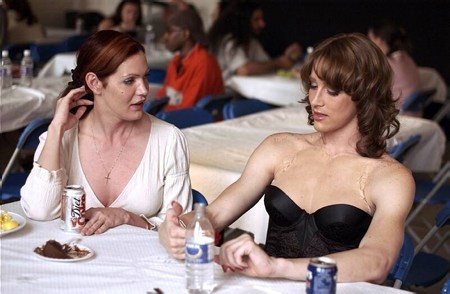
I commented about this movie in the past, but whenever it is on television (tends to be on pretty late), never seem to catch the ending. To repeat:
Later on in the night, Soldier's Girl was on cable, a true story about a solider who falls in love with a transsexual dancer with a military past herself. It is a good (and tragic) based on true life affair that both concerns their relationship as well the soldier's company, the sergeant who wants to leave sleeping dogs lie, another who wants to find the gay guy rumored, two troubled fellow soldiers and others who just want to have fun and do their job. Each part is well done, including Calpernia Addams [in white], who wrote a book about her own story. The book is well written but was not in the frame of mind to appreciate its somewhat flowery tone.Taped the last hour or so to ensure that I saw the ending this time: the brutal nature of the crime is done with the same skill as the rest of the film. I noted earlier that a striking thing is that the person who portrayed Addams later played an anti-13A member of Congress in the film Lincoln. Thus, one can imagine the skillful job required both on his (sic) part and that of those who made him into a convincing transsexual, including quite realistic looking breasts (which are exposed).
The film is so powerful and one for repeat viewings because it has so many layers. On a basic level, it is a simple love story. She is truly his "girl" and as noted in an excellent extended article not too long after the murder, him treating her as such meant a lot. Finding someone who cares for you and treats you right is something anyone would find perhaps a one in the lifetime thing. The gender issues only makes it more so here. And, that boat ride in the lake reminds me a lot of The Notebook.
The film also is about Barry Winchell, someone who we see early on as someone any woman might find a nice guy when he drives up to the base in a cool car and the woman at the gate basically flirts with him. Something of a troubled soul, even without the added bit of the romance, there is a lot of story and nuance there. It also has other stuff involving the people at the base -- as I said -- and to me at least, it all looks pretty realistic. Andre Braugher as the sympathetic sergeant is just one of those supporting characters that adds to a good film.
And, it is about the -- this is not meant to be a cliche -- troubled souls that ultimately led to the murder in question. The person who first took Barry et. al. to the club where Calpernia performed clearly had issues from the first we saw him, including those pills he took. His own conflicted sexuality is thinly veiled. He is but an example of one of those dark forces out there that cause society problems, people we cannot just sign off as evil or something. Not into that sort of thing. Possession of evil is a useful metaphor, but we are dealing with people here.
And, the film's refusal to show him and the younger guy who actually killed Barry as simple monsters is part of the skill here. The film overall is rich enough that I can imagine it being but part of a wider story, each character (down to a few minor ones) having additional stories of their own. There clearly is at least one -- that book by Addams that speaks of her life, some aspects hinted in the film here. That sergeant with his dogs, Addams' friend and mentor, the girlfriend of another solider who once worked in a gay club etc. all seem to have their own stories too.
Such is the sign of a good story -- so much there. Sexuality is clearly a theme here though as noted the film has various components that go beyond that. It is striking really -- we take such things for granted. That we are a certain sex. It seems strange to many that some might think they are the "wrong sex," but sex is not merely secondary characteristics. It is on some level something we feel. We take it for granted. It's useful sometimes to think outside the box here. Step outside a bit, so to speak.
I shall take a long weekend, blogging-wise, but come to think of it, this is a good film as any for Memorial Day. They both were military (she too) and the film is "in memoriam" to both, in a fashion. A nod to all others and if the latest speech will be path or nod in the direction of policy, however small, to reduce the killing of our own and others, it will honor them too. One of the best ways to remember is to reduce more war dead.
Wednesday, May 22, 2013
Shelter
A young guy with various issues (the uncle/nephew stuff was particularly well done) finds love with a guy in this touching film that does have a tendency to drag. Good performances and story overall though with Kate Walder (those eyes made me say, "hey, I know her!") and others providing good support. Decent commentary. Good scenery.
The viability line
John Hart Ely in Democracy and Distrust was wary about judges having the responsibility to determine substantive questions of fundamental rights. But, within the area they are appropriately deciding, Ely was supportive of clear lines that helped to avoid arbitrariness. One such example was the "one person, one vote" rule that held that different districts in a state should have basically the same number of people. A few justices accepted some differential if the rules set were reasonable, but this raised questions of line drawing. A clear rule seemed best.
This principle was held to be a core reason for the viability rule in Casey, even after the other two parts of the "trimester" test was removed as too restrictive. Undue burden was not exactly a clear line, but the plurality was still worried about setting some clarity here, especially for a line set forth by a court, not a legislature. Thus, they followed precedent as to the line (other than when necessary for the health or life of the pregnant person) where abortions can be banned. Viability was a sound line too:
Blackmun also in time had a firmer grasp on things:
So, I'm not sure what other line is to be used here. As Stevens noted:
Most abortions occur long before viability, but as noted, there is a small number that are close to or after the line (we are speaking something like 1% here over twenty weeks). This is not a trivial number in a raw sense, given the millions of abortions over the years. Just to keep that in mind. Still, some do arise and the viability line works. If fetal pain is an issue, and it will not unduly interfere with legal abortions, it might be warranted to use anesthesia. Twenty weeks, as the article cited above notes, is a dubious line even in that respect. And, a ban even less so. It isn't even necessary granting the premise. Amounts to be bad for various reasons.
Troublesome abortion regulations often are a question of special rules where neutral medical rules would work just as well, except as a bias against abortion choices. The concern here for the fetus is clear, but even on that level, a ban is not necessary. Depending on your goal.
This principle was held to be a core reason for the viability rule in Casey, even after the other two parts of the "trimester" test was removed as too restrictive. Undue burden was not exactly a clear line, but the plurality was still worried about setting some clarity here, especially for a line set forth by a court, not a legislature. Thus, they followed precedent as to the line (other than when necessary for the health or life of the pregnant person) where abortions can be banned. Viability was a sound line too:
the time at which there is a realistic possibility of maintaining and nourishing a life outside the womb, so that the independent existence of the second life can in reason and all fairness be the object of state protection that now overrides the rights of the woman. ... The viability line also has, as a practical matter, an element of fairness. In some broad sense it might be said that a woman who fails to act before viability has consented to the State's intervention on behalf of the developing child.Roe was subject more opaque (note the hedge):
With respect to the State's important and legitimate interest in potential life, the "compelling" point is at viability. This is so because the fetus then presumably has the capability of meaningful life outside the mother's womb. State regulation protective of fetal life after viability thus has both logical and biological justifications.In effect, it seems like the Court decided it was a medical question to be decided by the woman and her doctor, viability the line that was the norm in that area. Quickening was the traditional line, but that was largely practical -- it was when a life could be felt. Roe discussed the point, including the positions of various religious sects, such as forty or eighty days being the moment when the soul enters, arguably a sign of "personhood." A few years later, the Court reaffirmed that viability was a medical question, not a set legislatively set date. Such flexibility troubles some, in part since it is in part a matter of local resources, and would change as medical science does. But, it only changed a bit in over forty years. When it drops to let's under twenty weeks, we might have to talk.
Blackmun also in time had a firmer grasp on things:
The viability line reflects the biological facts and truths of fetal development; it marks that threshold moment prior to which a fetus cannot survive separate from the woman and cannot reasonably and objectively be regarded as a subject of rights or interests distinct from, or paramount to, those of the pregnant woman. At the same time, the viability standard takes account of the undeniable fact that, as the fetus evolves into its postnatal form, and as it loses its dependence on the uterine environment, the State's interest in the fetus' potential human life, and in fostering a regard for human life in general, becomes compelling. As a practical matter, because viability follows "quickening" -- the point at which a woman feels movement in her womb -- and because viability occurs no earlier than 23 weeks gestational age, it establishes an easily applicable standard for regulating abortion while [p554] providing a pregnant woman ample time to exercise her fundamental right with her responsible physician to terminate her pregnancy.See, both Webster and his separate opinion in Casey. What other line should we use? The issue here is fetal pain, but as noted by the article just cited, if anything, that happens in a true sense after viability. And, if the embryo or fetus cannot survive, what, the woman has an obligation to serve as a holding device until survival is possible? Some suggest sentience is proper line, but not only is it harder to tell when that occurs, that too very well might occur around this time or later. To me, there is a practical value to draw the line where there is meaningful chance for survival, even if the fetus has to grow a bit more in an incubator to survive on its own. As the article notes, there is going to be close cases where survival is very slim, and if at all, major abnormalities will occur. The word "meaningful" is somewhat tricky. But, viability still works.
So, I'm not sure what other line is to be used here. As Stevens noted:
I should think it obvious that the State's interest in the protection of an embryo -- even if that interest is defined as "protecting those who will be citizens," ibid. -- increases progressively and dramatically as the organism's capacity to feel pain, to experience pleasure, to survive, and to react to its surroundings increases day by day. The development of a fetus -- and pregnancy itself -- are not static conditions, and the assertion that the government's interest is static simply ignores this reality.This also is partially a matter of social judgment: there is a reasonable debate among people over the proper lines here, a plurality at least supporting abortions for various reasons in the first trimester, and leaving open later ones for special occasions, "special" often likely to be "mine." Doesn't mean they think embryos and fetuses aren't in some fashion "human" or even (though less so early on) "unborn children," but not in a full sense of human personhood. If the embryos or fetuses in some fashion had brain activity, this wouldn't likely change -- it won't be enough. Also, there is an understanding that there needs to be some time here to choose an abortion, including later on in cases of fetal abnormality or limited other reasons. A line too early clashes with this.
Most abortions occur long before viability, but as noted, there is a small number that are close to or after the line (we are speaking something like 1% here over twenty weeks). This is not a trivial number in a raw sense, given the millions of abortions over the years. Just to keep that in mind. Still, some do arise and the viability line works. If fetal pain is an issue, and it will not unduly interfere with legal abortions, it might be warranted to use anesthesia. Twenty weeks, as the article cited above notes, is a dubious line even in that respect. And, a ban even less so. It isn't even necessary granting the premise. Amounts to be bad for various reasons.
Troublesome abortion regulations often are a question of special rules where neutral medical rules would work just as well, except as a bias against abortion choices. The concern here for the fetus is clear, but even on that level, a ban is not necessary. Depending on your goal.
"Federal Appeals Court Permanently Blocks Arizona 20-Week Abortion Ban"
"Fetal pain" laws that try to elide past the viability rule is part of the "get Kennedy to stretch Casey" strategy. The 9th Cir. followed precedent and overturned a ban, it not their role to criticize the line or suggest alternatives. IF fetal pain did exist, the path might be anesthesia, not banning all abortions at that point. A bit blunt there anti-choicers.
Ike Davis Has To Be Sent Down
Really, this is too much. Can't hit or field, though now and then walks. Harvey was human, some struggling extra person getting three hits to add insult. Yesterday, Captain Wright flubbed a ball to help lead to three unearned. Today, Mets offense showed a bit of life. Found another way to lose, with a touch of embarrassment. One might say "again."
"U.S. Formally Admits Killing 4 Americans In Drone Strikes"
President Obama is due to make a big national security speech and useful letter by AG Holder was provided to Congress, including officially stating four Americans (only one "specifically targeted") were killed by drone attacks. The letter makes some good points, including limits and previous explanations. One name on list is news to me. Meanwhile, on GITMO.
The Other Typist
This time a review that made me want to read the book was worth it. A twisty look at a police typist in 1920s NYC with enough period detail to really imagine the possible film adaption. Its sharp protagonist, who early on hints at trouble, makes for an impressive narrator. Lost me somewhat late and not a big fan of the ending, but very good overall.
Tuesday, May 21, 2013
Metrish v. Lancaster (not that one)
The very last case heard already brought forth a (unanimous) opinion, suggesting a per curiam reversal might have been appropriate. It does teach a lesson about the development of case law (and conclusive rulings by the highest court) as well as how a reasonable position might not be enough to warrant federal habeas relief. A reminder to lower courts, perhaps.
Monday, May 20, 2013
Rules of Engagement
A pretty nice 100th episode/scheduled season finale involved a birth, two weddings and a surprise pregnancy. Plot slip-ups: Santana would not be a starting pitcher and DOMA suggests Russell marrying Timmy might not solve T's work visa issue [plus, Timmy is already a citizen!]. Still, nice combo of humor, sentiment and character bits. The end bit included.
Scarecrow and Mrs. King
The last season was released and overall enjoyed it though Kate Jackson's illness affected the last part of the season and led to the show itself ending without much resolution. Two recurring characters and the leads developing relationship were highlights. Various "I know that person!" moments. About five minutes of chase filler each episode. Not sure why they couldn't include any extras. Too bad these two never hooked up again.
Saturday, May 18, 2013
Rev. Joe: "Kinsley on Gay Marriage and Tolerance"
Something of a tool column but provides Millian value. Comments here.
Various
I'm a day early but will skip tomorrow. Talk Mets about "rays of hope" here. More such judicial picks (defense minded etc.) please. Some comments on the Gosnell prosecution here (see my comment). I'm reading What's Wrong With Homosexuality? (something of a trick title). Good quick coverage using the "reasoned debate" approach.
Saturday, May 11, 2013
Hiatus
I plan to take next week off from blogging here and elsewhere. A breather. I hope the Internet will survive. Happy Mother's Day and all that.
[Update: Did not "blog," but did read blogs, so the hiatus was a half-way measure. Will not comment on various things that fell within the week, my excuse for skipping over the IRS matter.]
"Is the Death Penalty Permissible for Feticide?"
Prof. Dorf links to various useful discussions and makes a case that patterns my own basically in respect to putting the death penalty on the table for the miscarriages alleged to occur in the horror story now in the news. I made a comment there too.
Friday, May 10, 2013
Umps Penalized
The Astros manager removed a pitcher in an non-injury situation before facing a batter and even after called on it, umps refused to overrule him. This blatant ignorance/non-enforcement of the rules actually resulted in a suspension and fines for the umps. This sense of sanity and fair play is appreciated. Seems less of it these days.
The Senator from Central Casting: The Rise, Fall and Resurrection of Thomas Dodd
This is a conversational style book with a lot of pictures. It is a bit petty at times, including noting the collection of letters published by his son (Letters From Nuremberg, which I recall finding worthwhile) didn't really add anything to the historical record. Overall, fairly pleasant reading of someone who comes off as an unpleasant man. His children are spoken of positively, including Chris Dodd, who some say is a bit too PTB friendly.
Thursday, May 09, 2013
NYC Bill to Give Vote To Non-Citizens
Don't know if this will pass, but I'm game. Lawful residents there for more than six months pay taxes, work, raise families in local schools etc. They are part of society and it is reasonable to give them the vote in local elections. And, naturalization can be a long drawn out process as this occurs. Citizenship still has privileges and respect those who disagree here. School elections and the like would be the strongest case.
Killer Joe
As with the book, no, not me. Wikipedia accurately labels it a "2011 American Southern Gothic black comedy crime film." The white trash flavor is seen early by the stepmom opening the door without panties (um think Texas). The cast is game and it overall is fun (if y'all are in the mood) the famous "chicken" scene [spoiler] coming late.
Wednesday, May 08, 2013
"S.E. Cupp on Gosnell"
aka conservative talking points done fairly calmly. I respond here with an additional comment that forthrightly notes that some late abortions includes morally tricky seriously disabled fetuses. But, unlike the tone on that blog, wrong or not, I'm sympathetic given the tragic cases involved here. There are voices of sanity there, true.
Bomb Girls Finale?
And in the very last scene, Gladys and Lorna quote Churchill, and it is my very favorite thing. “Now this is not the end, or even the beginning of the end, but it is perhaps the end of the beginning.”Final recap? The future of this show is very unclear as much as one or more of the characters whose stories have no resolution here. The high point was mid-season. The last couple episodes were somewhat weak. Still, worth watching, if you can find it.
Tuesday, May 07, 2013
Mets Win: One-Hit, 10 Innings
Mets shortstop Ruben Tejada did his best, gloving the ball on the edge of the infield dirt and making a jump throw. First baseman Ike Davis made a long stretch and caught the ball cleanly, but Rios was safe by a shade. The fans groaned when first base umpire Mark Carlson correctly called him safe.Nicely put.
Down Rebel Way
Welcome Delaware to the marriage equality fold. Delaware: not just the place for corporations any more.
Meanwhile, after some early high spirits, the chance for rationality down in South Carolina is on weaker ground -- Mark Sanford, who after all did win there thrice (two without opposition according to Wikipedia) though that was before some bit of drama, is now neck and neck. [Local coverage with the paper in question endorsing Colbert-Busch.*] The "his win was pretty expected" comments are already coming. Oh shut up.
The SC delegation is an example of gerrymandering** in action or something. There are seven members, one (black) Democrat. There are Dems in the state legislature. By the numbers, there should be at least two Dems in the House delegation. That to me might be the big reveal here. Also, the election matters since upsets (or even tough races) in red areas are of note, bleed Republican resources and spread the brand. Her bio also seems to be attractive; she sounds like a good “face” of the party, even if she cannot win here. And, darn, go Colbert!
Polls are now closing. [Sigh.]
---
Meanwhile, after some early high spirits, the chance for rationality down in South Carolina is on weaker ground -- Mark Sanford, who after all did win there thrice (two without opposition according to Wikipedia) though that was before some bit of drama, is now neck and neck. [Local coverage with the paper in question endorsing Colbert-Busch.*] The "his win was pretty expected" comments are already coming. Oh shut up.
The SC delegation is an example of gerrymandering** in action or something. There are seven members, one (black) Democrat. There are Dems in the state legislature. By the numbers, there should be at least two Dems in the House delegation. That to me might be the big reveal here. Also, the election matters since upsets (or even tough races) in red areas are of note, bleed Republican resources and spread the brand. Her bio also seems to be attractive; she sounds like a good “face” of the party, even if she cannot win here. And, darn, go Colbert!
Polls are now closing. [Sigh.]
---
* "We endorsed Ms. Colbert Busch in Sunday’s paper, citing
her impressive background in the business community, her energetic
advocacy of economic development in the district and her resolve to work
across party lines to advance practical solutions to the pressing
problems of our times."
** One local article notes "The 1st Congressional District follows no logical geographic lines but instead includes parts of five counties."
Pet Peeve
Blather about "as much as I would like" followed by opposition to a specific constitutional interpretation; extra points if the interpretation is likely to be wrong. Like "as much as I would like" same sex marriage isn't protected by the Equal Protection Clause. As if you thinking otherwise is not based on law, but your simplistic wishes for a pony.
I am J
Monday, May 06, 2013

Multi-Tasking
I like these snacks while reading at a nearby park space since a bag can be shared with the pigeons and other birds. Nifty to see them try to get one or the little birds to snatch one and fly off. Healthy and enjoying. Small bag for under $2 enough for me and them.

Rules of Engagement
Its seven year run might be coming to a close -- the 100th episode (though its already syndicated, a big milestone there) is next & both the baby and wedding is rapidly approaching. Also, Megyn Price just directed an episode. First time outside plays.
Sticks and Stones
The subtitle provides the message -- "Defeating the Culture of Bullying and Rediscovering the Power of Character and Empathy." This is a very readable and overall helpful book with special focus on three case studies that show the complexity of the situation. Probably helps she is both a parent and law professor/journalist. BTW, if I may, she's cute.
Saturday, May 04, 2013

"Sandra Day Late"
I'm reading Judge Bazelon's granddaughter's book on bullying and this column came to mind. Not quite "over it," but sorta forgive her for her failings there. She is only human. As to being on the bench, well, not a great fan of Alito, but twenty-five years were enough. Along with Souter, she provided a good precedent for resigning before you know she died.
Friday, May 03, 2013
"five non-negotiables"
Is the religious objection to same-sex marriage truly religious? How do you tell? Do religious people who believe marriage after divorce is adultery but have no qualms about providing flowers or cakes or health insurance to the divorced and remarry object to same-sex marriage because it is a worse sin in their estimation than adultery? Or are they prejudiced against gay people in a way that they are not prejudiced against adulterers?This was raised by me before in the thread alluded to before and yet again we don't get a real answer (as of this writing). As I noted, the claim that discrimination based on marriage is not likely to come up is bogus -- not only would it be consistent based on belief and practice, but public accommodations law cites it as a concern. People are discriminated against for being unmarried, you do hear of cases of people not wanting to rent to a couple unmarried. But, SSM is particularly cited here. Why? Religion or personal liberty generally would demand that one specific belief is not singled out in this fashion.
[And Also: The point of this post is that there is a double standard going on here that goes past merely religious belief, but a later comment on the thread this is directly addressing raises another point. There is a continual concern for the religious beliefs of certain providers, such as wedding photographers or something. What about their religious beliefs?!!!! But, as with contraceptive mandates, what about the beliefs of the customers/employees? Are public accommodation rules, state action, supposed to selectively respect them? Or, are we -- like for abortion -- to assume "faith" here only pops up one way?]
"Sean" argued that sexual orientation should be treated the same as race and gender. I chanced upon an interesting argument saying just that, getting a response that the guy is a great scholar and all, an appeal to authority of sorts (repeatedly I have law professor types preaching about basics while missing the point*) but wrong here. Also, it is "intimidating" to compare sexual orientation to "race" but wrong. The article upfront says race and gender. Why the focus on race? As with the pushing aside the question of why SSM is different, why religious accommodations here requires special attention, a law professor selectively responds. Bad pool. And, "intimidating?" Realize racism is seen as wrong, but the claim fails repeatedly -- affirmative action supporters or those against profiling do not always win, nor does victims of disparate impact. Also, sounds somewhat like the argument the merits is too much to take.
"David" (quoted above) in this thread on the "need" for special religious accommodations for SSM not present for other marriage related matters that violate religious beliefs (e.g., divorce) made a telling point late this afternoon. What are those five? Abortion, euthanasia, embryonic stem cell research, cloning and homosexual "marriage." Huh. One looks different from the others, putting aside the scare quotes and "homosexual" term for what is actually same sex marriage. War or the death penalty is negotiable. Helping the poor is too. You know, things Jesus deemed pretty important. But, not same sex marriage. Not just "marriage" btw. Contraceptives, cohabitation, re-marriage etc. are not listed. That is, things Jesus specifically talked about.
By numbers and effects, such things violate the Catholic sacrament of marriage and affects society more than same sex marriage. But, same sex marriage specifically is cited. Why? Contraceptives violate the "unitive" (itself having a special meaning here, same sex unions [sic] not enough) function, right? Divorce surely does. The Catholic Church handled Griswold and employing divorced people. SSM is different, why?
[Also, a few years back, I learned that there is a doctrinal problem with marriage if one person is impotent, but this is not you know, applied that strictly -- wink wink, chance of miracles, etc. Sort of "don't' ask, don't tell policy" in place too apparently. Still seems a bit cruel to those with some sort of disorder. OTOH, you don't need to be fertile to marry, even if you would otherwise be of the right age. This underlines "procreation" is not "the" reason for marriage. These days, it is not even cited by the Church as the only reason for sex as it must not be, since you know, people who cannot reproduce of the different sex still have it. It also has a unitive function. So does same sex relations.]
---
* I dealt with the same thing when Volokh Conspiracy regulars supported a federalism argument in the DOMA case. Asked about, quite literally, FOUR times what would happen in D.C., since it is not a state, so it would seem same sex married couples would lose out there. I simply never got an answer. I was not the only one who belabored the point either.
One person managed to respond, first, noting he thought (signing a federalist brief would seem to warrant being familiar with it) D.C. recognized SSM. Yessss, I said, that is why I wondered how the argument would work there. He assured me he was supportive of same sex marriage on policy (but didn't think it was constitutionally compelled). Okkkkayy. But, what about my particular question? I finally snapped at him a bit, the tiresome "hey, I'm a nice guy on policy" thing not helping. That's nice -- some who opposed segregation probably felt all nice and fuzzy too as the law allowed it to go on.
Is that a goat?
I pass one of these live markets fairly regularly since it is on the way to a subway station. Have a thought that some little kid pointed to it and asked if s/he can go to the "petting zoo." The customers include those who eat halal food. Certain honesty to that, I guess.
And Also
On that last point, see this thread, and how I basically got pissed off at a person speaking in generalities and misstating views (which led to all three of the people correcting him: "we get it" No, you don't.). Blah blah blah: okay! What about the specific point? This happens on call-in shows too and it is a personal pet peeve of mine. This citation of other sources is annoying too. People go to blogs to get summaries. So, simply summarize your position.
"No, the Pentagon won’t court-martial service members for sharing their faith"
A fear addressed here (see also links to Mirror of Justice, with both sides shown). Daily Kos also suggests that intrusive religious proselytizing (that is what is against the law, not simply speaking about religious faith) at time is a problem. The military skewers conservative and problem cases do exist there. Some selectively oppose stopping that sort of thing. See also, some posts at MOJ where, e.g., same sex marriage somehow requires special rules.
Thursday, May 02, 2013
Maryland Has A Busy Day
O’Malley (D) also signed bills to combat cyberbullying, allow undocumented immigrants to get driver’s licenses, expand early voting, reform campaign-finance laws and put in place the federal health-care law in Maryland. And he put his signature on a measure to legalize medical marijuana well into the ceremony, which lasted about two hours.A death penalty repeal was just one thing. RI also is the 10th state with SSM.
The Supreme Court vs. Freedom of Information
Reason criticizes a case where unanimous didn't necessarily mean correct.
Movie Quickies
Rust and Bone is a French film about a young layabout single father who hooks up with a woman who suffers a major accident requiring partial amputation of her legs. It was pretty good but not enough for two hours -- bored of it 1/2 way through. Girls Against Boys is something of a psychological thriller (note mirror in opening scene) about a young woman who goes on a rampage of sort after being raped. Okay for DVD/cable. Okay commentary.
Wednesday, May 01, 2013
Getting Warmer on Emergency Contraception
The FDA determined that "morning after pills" (work up to 3-5 days) should be OTC for all ages. A political decision overruled it but a federal judge overruled that. Now, 15 (not sure why they now determined this was the magical age) is being set as the age, raising various problems, including identification related. Better, but not there yet. Update: Administration appeals judge's ruling holding all age requirements invalid. Probably matching median parental sentiment, but still wrong.