About Me

My photo
This blog is the work of an educated civilian, not of an expert in the fields discussed.

Tuesday, January 20, 2015

SOTU As Pointless (or worse)

shall from time to time give to the Congress information of the state of the union, and recommend to their consideration such measures as he shall judge necessary and expedient
The Constitution provides the ultimate basis on some sort of "state of the union" address, but it does not require the President to personally go in front of the Congress etc.  The President need not do it once a year or in person or any such thing. Jefferson stopped the practice of doing so in person and so it was for around a century.  Today's ceremony is fitting for the pomp and circumstance of modern media practice down to having it televised, commented on and a ready response (perhaps more than one) from the other political party.  That's fine and all really.
Chris Lavoie ‏@RadioGuyChris

The #SOTU has become a huge waste of time and resources. We already know what will be said. Tonight will just be political masturbation.
This is the producer from the Stephanie Miller Show, a liberal leaning radio show that is regular morning listening for me these days. It expresses a sentiment various people have.  Think is a tad bit overblown.  It really is not a "huge waste" -- it's not really a big deal.  Presidents already welcome from time to time a chance to make speeches, including basic bullet points on their mission and goals.  This provides a chance for the general public to focus on the matter once a year, including the other side having a chance to respond.  The common person is not as likely as me and some others to regularly check in on blogs or talk shows to worry about this sort of stuff.

The whole thing is clearly largely ceremonial and theater. So? That is true about many things, but there is still some value to it all.  Also, "we" here at times means "us in the media," and not the average person who might not be as familiar with the basics of the message and platform points.  In today's world, giving such speeches in public on television is also different from just releasing a transcript.  There is plenty of "political masturbation" anyway -- what specifically negative additional material is applied here?  I recently posted something about Justice Thomas not speaking at oral argument. Some demean the value of that too; I disagree it is of no use.

And, it is useful sometimes to have the how government (we can debate about the Supreme Court*) in one room together.  If you don't care about it, and honestly I really don't enough to actually watch the thing, just don't watch it. D.C. is full with ceremony and political masturbation. This actually has some connection to constitutional requirements.  It provides a certain bare minimum baseline where Congress and the President has to meet together once a year. We aren't talking Oscars level pomp and circumstance here.  I would just accept it for its modest possible value and not make a big deal about it one way or the other.

Besides, it's an easy way to fill a few hours of television. 

---

* The Supreme Court formally meeting the President has been a long tradition as has justices going to the State of the Union. Justice Breyer, e.g., takes these sort of things seriously. CJ Roberts has felt a need to go too. Some justices, including Justice Stevens, stayed way.

Some have recently made comments about how they feel uncomfortable because -- shocker -- the SOTU is somewhat political. Was it ever not somewhat political? These days with television and so on, it more so - the idea it is somehow surprising or something seems stupid. I think the justices can handle an hour or so per year blandly listening and not making funny faces when the POTUS makes comments they don't like. If not, don't come.  It is really not a big deal to me personally. 

Supreme Court Watch: Alito Edition

Opinions. One a dissent in a per curiam habeas ruling where he flags that AEDPA is in part a means to address concerns (he name checks Breyer/Stevens) those concerned about delays in capital cases. Okay. Sorta true -- mix of factors there. Also, unanimously upheld the rights of a Muslim prisoner to wear a short beard. Ginsburg/Sotomayor briefly reminds how this is different from a for profit employer burdening a third party (employee). Yeah.

Update: The beard case is pretty low hanging fruit, partially I bet as a "we aren't trolls here" follow-up to Hobby Lobby. Sets basic rules, but might be too easy to settle many disputes.

As Obama Talks, A Reminder

The popularity of ACA. (Still think the slang term stupid.)

Monday, January 19, 2015

MLK Day

Selma, which I have not seen yet, provides one moment in his life, showing how he was part of a movement. His letter from the Birmingham Jail is an example of his personal leadership role. He was in jail as part of a wider protest and years later his sentence was upheld (article on this matter) by the Supreme Court. It was left to the dissent to mention his name.

Update: As noted in the article, confrontation was key to MLK's strategy. Thurgood Marshall used the courts. MLK's central concern was to force society to confront the injustice of their actions. A method that until today is controversial. See Garner et. al.

Saturday, January 17, 2015

Championship Games

I am rooting for GB and the Colts tomorrow, more so the latter. Given the odds, this is unfortunate though these picks suggest GB has a hard road and the Colts have at least something of a shot. Any port in a storm. Many locals are treating it as sort of a bye week. Damn I wish for an upset. Pats in the SB either way is one I won't watch. Meanwhile, the NYJ has hired a new GM and head coach, the latter another defense specialist. Will wait and see.

Update: The NYJ are somewhat amused by how Green Bay blew that game big time.

Mostly Sure About the SSM Ruling

The cases are consolidated and the petitions for writs of certiorari are granted limited to the following questions: 1) Does the Fourteenth Amendment require a state to license a marriage between two people of the same sex? 2) Does the Fourteenth Amendment require a state to recognize a marriage between two people of the same sex when their marriage was lawfully licensed and performed out-of-state? A total of ninety minutes is allotted for oral argument on Question 1. A total of one hour is allotted for oral argument on Question 2. The parties are limited to filing briefs on the merits and presenting oral argument on the questions presented in their respective petitions.
Rick Hasen thinks the phrasing of the question potentially troubling for same sex marriage advocates (the first  question can be answered "no," right? that is if the state has no marriage). But, I think Michael Dorf is basically correct, particularly since this "no marriage" thought experiment isn't the situation.*  Also, agree with Nina Totenberg (on Rachel Maddow) and others that note that the justices cannot really believe they can in effect put the toothpaste back in the tube after allowing all those court rulings striking down bans stand.  All those same sex marriages are out there. My "go to" guy on SSM and the courts explains some more how the USSC has basically played a "key role" in creating the inevitable here. 

I'm pretty sure -- more than than regarding the result in the latest stupid ACA lawsuit -- that same sex marriage will be deemed a constitutional right (however you wish to phrase that). I would be somewhat shocked actually if they don't hold that. Not exactly sure how they will go about it. Note as well that "same sex" marriage, not "gay" marriage seems to be the favored wording here, including in Holder's announcement of support. Finally, it seems more reasonable than not that somehow Roberts will join the majority though he might somewhat concur in judgment.

[Update: One person, who also has written on the "adding insult on injury" nature of mini-DOMAs that I think deserves a bit more attention, suggests the USSC might only decide the recognition issue.  He has already written in support of a broader decision, but this does touch upon the "right to stay married" argument he has made. Problems -- this doesn't cover all of the plaintiffs, it broadens marriage rights in a different way and reduces state discretion (the alleged charm here) in some fashion in a wider range of marriage cases and would put into question the broader rulings of all of the appellate courts that have decided already. And, is there something special about same sex marriages that in theory would allow only non-recognition from other states? So same sex couples would have some sort of second class status? Eh.]

The oral argument provides a chance to go over once again the standard stuff.  So, we have the Catholic response on how the "essential meaning of marriage as between the two sexes" -- so, the procreation part isn't essential? No, Catholic doctrine overlaps with the experience of the law here -- they are concerned about the consummation of marriage though you might have fewer people in this country who agree with their stance on birth control that accepts the literal idea that someone with some physical condition that makes an erection impossible cannot get married.  Clearly, not using artificial birth control -- which to them degrades the "uniting" here severely -- is not essential.  Or, not having easy divorce.  Sex is though. I think they are better off worrying about the other stuff; it surely is likely to affect a lot more marriages.

Some of the other standard tropes are cited in a footnote.  Another would be that we should trust the political processes here.  This might be more easier to take if not raised by those who strike down, somewhat dubiously, multiple major campaign finance laws. Free speech, you say? I give you the right to marry and equal protection.  The presence of animus is also apparent unlike a slew of marriage regulations (some problematic even without such baggage as was NY's ban even though it was not backed up by a state constitutional amendment, if perhaps somewhat less blatantly so) that were handled differently. And, the time has come -- same sex couples have in effect lived as married couples for quite some time. We have had decades to treat them equally.  It's time to do this too.

As Gay USA's Andy Humm noted on his Facebook page, even a win here will not mean nirvana, the time to truly exhale. There will be, there is, blowback.  A lot of hate and sometimes even horrible violence. Religious freedom exemptions that single out certain groups. The need to fight for civil rights laws akin to those in place for race and sex. The fight for transgender rights. But, a Loving v. Virginia for a new generation is of fundamental importance.  He also fears along with others that a win here will help cover a lousy ruling in the ACA lawsuit.

Sigh. This is after all the Roberts Court.

---

* At Dorf on Law, it is suggested that one or more retrograde states might try this "getting out of marriage business" approach and it is a standard reply of some when this matter is debated. Unlike private schooling, however, a state marriage license does not have a ready private analogue for all those benefits and obligations involved.  And, you will still have to determine if such and such a couple will get them, even if licenses aren't provided. Not only would that be more complicated, you will still have the basic question of treating same sex couples equally during state action.  Real life is not libertarian thought experiments anyway. 

Someone also wonders how marriage is a "fundamental right," which is more a matter of either not knowing what the term means or debating legal terminology (akin to "substantive due process).  The matter has long been a given, marriage a basic civil right deemed fundamental by most people. The debate is over marriage's reach; see Turner v. Safley, e.g., for why marriage is so special and thus applicable to SSM.

We will also have slippery slopes or libertarian types who deem it irrational to protect this and not marrying five people or your sibling. For a "developing social understanding" approach that notes how same sex relations is not on par with incest (etc.) see here.  Others can also take the common sense sentiments that sex or sexual orientation classifications are different in various ways than number or family status as true. Nepotism laws need not be chucked to uphold civil rights for GLBTQ either. 

Update: A recent new wrinkle, which this essay argues the Supreme Court should at least address, is the claim that there is some "domestic relations" exception -- even regarding things touching upon the 14A -- that removes federal court jurisdiction.  The essay (from someone representing a conservative organization)  for some reason skips over the Newdow case, which expressly dealt with the question -- it expressed a prudential avoidance rule in certain cases, but recognized there would be a few cases where it was "necessary to answer a substantial federal question that transcends or exists apart from the family law issue" such as race [or sexual orientation] discrimination. No sale. 

The Good Lie

The title is in effect a spoiler that comes late. The film overall is good, if a bit rough (e.g., you are left wanting to learn more about how things went), but the charm is that it focuses on the "lost boys of Sudan" from their original flight to settlement in the Midwest. Reese Witherspoon gets top billing, but unlike various other movies, this is not about the whites.

Thanks Obama

Attorney General Eric H. Holder Jr. on Friday barred local and state police from using federal law to seize cash, cars and other property without evidence that a crime occurred. Holder’s action represents the most sweeping check on police power to confiscate personal property since the seizures began three decades ago as part of the war on drugs.

When Randy Balko, a long critic of this practice, calls this a "big deal," you notice.

Friday, January 16, 2015

"flexibility on regulating outdoor signs"

Curious about the sign case orals -- the church's lawyer seemed to feel it necessary to make a general argument that brought in trivial signs (to birthday parties etc.). Why wouldn't the special nature of a religion related speech (more on par with the political speech related exemption) help here? Might not matter -- the city seemed to come off as more "silly." Meanwhile, a 2005 flashback (with my .02) on SSM. Has things developed enough since 2003?

SCOTUS To Hear SSM Cases

The big news this afternoon is that SCOTUS will hear the 6CA (the one appeals court that upheld bans) SSM cases. Justice Thomas probably won't ask questions; he should. That article does a good job showing the value of oral argument and tosses a few personal facts about Thomas many might not know. There are also a few other grants.

Presidential Proclamation -- Religious Freedom Day, 2015

On January 16, 1786, the Virginia Statute for Religious Freedom was adopted. It was one of the first laws in our Nation to codify the right of every person to profess their opinions in matters of faith, and it declares that "no man shall be compelled to frequent or support any" religion. Drafted by Thomas Jefferson and guided through the Virginia legislature by James Madison, this historic legislation served as a model for the religious liberty protections enshrined in our Constitution.

I'll take this over a National Prayer Day.

"Why the Supreme Court Should Reject the Arizona Legislature’s Challenge to the Arizona Independent Redistricting Commission"

Not so sure. The power of the "legislature" to prescribe districts very well might include the legislature delegating to a commission or being subject to veto by a governor or referendum. Those are the examples cited. Here the people themselves initiated things. And, "legislature" is not the same as "legislative power." Cf. "executive authority" (17A). Tricky case that might turn on the congressional statute especially since Congress has its own power here.

Hey! I Know Him!

I was watching Serenity (extras/commentary -- good stuff; two commentary tracks) and noticed ... yes! ... that is the goofball therapist from Suite Life on Deck playing the doctor leading River's torture. The director noted he purposely picked up Michael Hamilton since comedy is hard, so they should be able to do drama. And, some familiar in comic roles (take Robin Williams) do well in drama. What happened next: Puerto Rico v. Branstad edition.

Thursday, January 15, 2015

Oklahoma Executes Again After Botched Execution

There have been various concerns, including after a botched execution, about lethal injection protocols that led multiple justices to dissent from denial of stays. Via Sotomayor, we finally had a written dissent. As I note here, the fact news reports said it went without a hitch doesn't mean the dissent was wrong about the risk. I also continue to think openness about the drugs used etc. is a due process requirement. Tinker tinker.

The Dogs Were Rescued (and So Was I)

A follow-up to the author's book about how she and her dog both overcame cancer, this provides an update on Seamus the beagle and continues to mix dog and human news with the author getting two more dogs and becoming vegan. Amusing tone, covers some familiar ground, but fans of her first book should appreciate it. Perhaps a bit padded,

Wednesday, January 14, 2015

Obama/Biden/Kerry Not Being At Unity March

I did not find this a big deal.  

If you want to say someone more superior than the ambassador and assistant secretary of state* (Kerry was in India for a previously scheduled event; Holder was in Paris for a security event but didn't go to the unity march) should have been there, fine. Wouldn't think you dead wrong or something.  But, the harping on this (Laura Rozen, not a troll, was beating the drum over and over again on Twitter and on television too ... CNN's Fareed Zakaria found it "pathetic" to not be there for the reasons provided) was stupid.  The critics almost wet their pants when the White House press secretary said it was "fair" to think that. 

The arguments as to security and being a distraction made sense to me. Think it was a good idea for it to be an European and Middle Eastern (for clear reasons of unity) event in response to violence in France.  It is not all about us in the U.S.  It is also pretty obvious, I think, the U.S. is supportive** (if some place we were not friendly with or who didn't have powerful friends, a visit could be more important) and lest it be forgotten, free speech is sort of a thing in this country. It is a continual symbol of our support of satire.  Russia's President might have to show up at a march to show solidarity given the usual practice there.  

Finally, there was a few comments suggesting France might itself not have been too gung ho for the President to come.  I might be wrong, but think the President et. al. reasonably took various things into consideration here. They do at times misjudge things, so who knows really, but I can see some combination of the above being the idea here. One article noted that Obama was not really informed -- oh please. He was aware of what was going on and wasn't merely out of the loop or something.  As to sending Biden, other times, that would be deemed a token thing.  Goofy Biden! Now, he's some big guy. The whole criticism seems overblown form over substance stuff.

It is a symbol in that respect of how not to worry about things.

---

* The meme was some more senior official should have been there -- as if these people were chopped liver. Perhaps, we should have been like Canada with Canadian Minister of Public Safety Steven Blaney to represent Canada at the rally.  When I first saw a reference to that, thought it was some sort of joke at Canada's offense.  As is, might be a very Canada thing!

** Some sarcastically reminded people of those who opposed the French, including "freedom fries" etc., and the French has been a long subject of jokes and scorn for some people. Granting this, as a whole, we are generally friendly with Western Europe as a whole here.  And, like those we might not like personally, when something like this happens, the normal practice is to pull back and respect what is really important. Some even noted that we do not get the same reaction after killings in Africa or something. 

Tuesday, January 13, 2015

Light in the Piazza

TCM is the standard channel, but there are others for old movies, including two more obscure ones that for me are up in the 490s that I didn't know about until my mom told me about them. This film was on TCM, a sweet story about a mother (Olivia de Havilland, who is still alive btw) worried about letting her daughter (mental age 10 via a child age injury) marry a lovesick Italian (hey! that is George Hamilton). Is the title a pun?

Monday, January 12, 2015

South Dakota Same-Sex Marriage Ban Unconstitutional, Federal Judge Rules

She rested on the right to marry. The "go it slow" concern was in part refuted by noting that the state didn't use a limited means here -- a constitutional barrier vs. merely giving the legislation discretion. This point is highlighted here and to me deserves more emphasis than it sometimes received. It underlines the gratuitous outside of normal practice nature of the bans. SD lost on different grounds, but it helps suggest the animus aspect.

And Also: One person flagged "same sex citizens" (probable typo) being used but the repeated usage of "citizens" an issue -- 14A protects persons too.

Golden Globes & Two Hallmark Films

Two of my favorite Hallmark movies were on recently -- Loving Leah (DVD copy has "Making of" featurette, behind-the-scenes interview) and Candles on Bay Street.  I commented on these before, so a bit of a reprise.

I wrote this about Loving Leah: This Hallmark film was on over the weekend and it's a favorite of mine. One lesson in this charming love story is that faith and religion can still have power even if the literal doctrine is not followed. The spirit over the letter. Each realizes this, including the Orthodox mother, adapting it to the reality of their 21st Century lives.

Candles on Bay Street by K. C. McKinnon concerns a small town vet who finds out his first love (who now makes candles, which she explains has special symbolic significance -- truly now, since in effect her own candle is dying out) is dying of cancer. The first part (a life up to the narrator's 30s and how she affected it in miniature) is the best. Somewhere near the halfway mark, it becomes a somewhat drawn out road to the inevitable, the poetic musings getting a bit thick. It isn't a long book, but it comes off as too long.

I first found out about it because it was made into a Hallmark movie. The need for padding underlines the thinness of the novel's plot at times. As with Legally Blonde and a few other books, this is one of the times when the film version actually comes off as somewhat better. It was well acted  with the main roles fitting the characters, including Alicia Silverstone in the lead. [Now that I have seen the whole thing, I can add to my previous remarks that they altered a significant thing from the book, but as a whole, do think the film is a better complete package.*

As to the Golden Globes, saw some of the opening and a bit later on. Used to loyally watch the Oscars, but sort of got bored of the whole thing. As to the two hosts, Amy Poehler and Tina Fey are great role models -- Poehler, for instance did a kewl thing entitled Smart Girls at the Party to help educate budding feminists.  I sort of don't like their comedy as a whole (not a Parks and Recreation fan; Tina Fey movies tend to be "she can do better than this, can't she?" sort of things), but admire you know the concept. 

---

* Spoiler Alert: The film is basically about a thirty-something single mom who is dying and takes her son back to her home town to basically have her old friend adopt him. This provides the final step, in effect, to do one last thing for the first girl he loved and take a final move toward being an adult.

The book adds that she wants his help to die -- active euthansia. This tidbit is removed from the movie, which perhaps helped (lol) the "family friendly" (read conservative) Dove blessing. I admire the book's handling of this controversial subject, but don't think the film really suffers from them leaving it out. Also, again, I think the film is a better complete act of story telling while the book bottoms out midway.

Sunday, January 11, 2015

GB Comes Back / Helped By Overturned Call

Don't know. Seems it could have been upheld. But, you know, karma. Meanwhile, Rex Ryan gets a long term deal with the Bills. Thought he'd go to a team with an established QB, but guess Bills like effusive types. GL, I guess, to the one "NY" team that actually plays there. Update: Manning looked old. Can Colts actually win another? Please please!

Ravens Choke

Very aggravating ending vs. the robot Patriots (yeah yeah, elite team, blah blah). Seattle, of course won, though Carolina kept it close until the 4th. Amusing end of the half with three field goal attempts (after Carolina made a 4th Down, almost had a turnover as time was running out & went for a 14-10 deficit), two penalties and various block attempts involving a guy leaping over the defenders. A successful block overturned on penalty.

Friday, January 09, 2015

Unplugged: Reclaiming Our Right to Die in America

Not totally sure about the phrasing (Justice Breyer labeled it "right to die with dignity" - we all "die" after all), but the Cruzan lawyer (see side panel) eloquently covers the issue with an extended opening on the Schiavo case. He underlines there are no easy answers (though he strongly accepts a basic right to makes choices here) and the debate truly has only begun.

Thursday, January 08, 2015

The Lost Way: How Two Forgotten Gospels Are Rewriting the Story of Christian Origins

See Also: A more conservative viewpoint is expressed here, but there are comments that provide a somewhat tired interprettation from a more doubting standpoint too. For instance, the end of Mark -- "why did God allow it to be lost" etc.  The all or nothing approach is not compelled -- the fact the Bible was written and translated by imperfect humans results in imperfections, but it is a bigger leap to say it is not sacred at all.  "Gotchas" pointing out time based sexism or whatnot is more child's game than anything else past dealing with certain literalists. If you wish to say that fine; requires a bit more work though. And, "sacred" need not just be "the literal word of some entity in heaven" or something either. 

During an abortion discussion, Catholic doctrine came up, and I corrected a statement about their belief over vasectomies. Someone replied "who gives a damn." I found this both depressing (even the original person granted I was correct; caring about others to me is a good thing) and misguided (her desire was basically to have religious people keep their views secret and not push them on her -- noted how knowing them can be useful here).  But, the comment is not unique -- it is a standard mindset.

Find it overall interesting and helpful to understand religious faith and history with a personal leaning toward Christianity, particularly a sort of rational view, given the majority in this country and my general upbringing (grew up Catholic). Some disfavor "religion," which to many means a limited sort of faith, particularly of a certain irrational sort that is easily ridiculed by "the reality based community." (The murders in Paris would be a ready example.)  But, there are emotion laden sorts among those who use such terms (or "the village" and not as applied to a bad movie.)  

A more fulfilling and complete view of religion to me is possible here.  This need not be limited to books of this sort, which ultimately ends with the author laying his cards on the table -- he doesn't believe in the "end of days" sentiments of the four canonical gospels or really that Jesus is uniquely the "Son of God" (like gays and lesbians speaking of fellow "brothers and sisters," various times in the New Testament and elsewhere we read of "children of God" ... in effect "sons and daughters of God").  He isn't studying the "Q" source (the basically agreed upon idea that Matthew and Luke used Mark, some separate source ["quelle"] along with independent material sometimes called "M" and "L")  and Thomas (helpful in this context since it has a lot of overlap with "Q," providing an independent source of early Christian beliefs)  just for historical curiosity.

More conservative approaches can be useful here -- after all, as the book itself notes, even there it is generally accepted by many "Paul" did not write many of the "Pauline" epistles.  In other words, even if you take the Bible as the word of God, just how it was created and what it says and reflects can be a complicated enterprise.  I admit to be sympathetic to the p.o.v. of this book, so am not reading many books from a more conservative viewpoint though they also provide some useful insights. Overall, people in general can gain a lot of insight, including in promotion of their religious beliefs in "Jesus Christ" or other religious figures by deep reading here.

This is an ongoing theme of mine but it bears repeating, at least from my vantage point when reading comments like the one cited earlier.  Anyway, I have a general interest in history, so trying to gain insight into early Christians is my thing too. On that level, besides having a nice colorful cover, this book covers some standard ground (for those familiar with the genre) but in a good down to earth fashion with a specific focus. It adds some intriguing insights such as wondering why would they "bless the poor" (the word implying the destitute) -- do they have certain special insights?  And, a core early tradition appears to be for early disciples to be wandering evangelists, trading food for service to the poor. 

The book is careful to hedge and note that we don't know various things here, including the date of early gospels except to some vague range. But, it does at times cross that line where reasonable hypothesis moves into "this is how it was," especially since we aren't talking about an erudite journal article here (each chapter has a collection of sources; no notes). It isn't really clear why -- because such and such an area appears to be into the author of the Gospel of Thomas -- that is where it was written. Looking at the few verses that speak of Apollos, there was just not enough to reach the conclusions about his beliefs expressed here. Maybe, the longer works cited would be more convincing there.  Somewhat doubtful.  

Still, Apollos, the mention of something called "the Way" in Acts (related to the "two ways" of Didache, an early Christian writing that deserves more attention?)  and a slew other tidbits does provide a lot of fascinating (to me at least) questions.  The effort here to focus on a more wisdom and present day tradition (the idea that the "kingdom of God" was here, not in the future, not even reliant on Jesus' death/resurrection which these two "gospels" don't appear to even reference) overall is well worth a read. This is so even if I'm unsure about certain things like use of "empire of God" (as a sort of alternative to the Roman Empire) in part since I thought "kingdom" was at least in part a nostalgic look back to King David. 

Like various things, what seems old hat continues to intrigue.

Wednesday, January 07, 2015

Charlie Hebdo Attack

See here and here. Note: people saying what they say is bad doesn't mean we shouldn't defend a right to say it free from violence. See, e.g., Voltaire.

Tuesday, January 06, 2015

End of Christmas Season

New Republican Congress alone suggests that. I foresee a depressing time though the presidential election season might be a sort of break. But, we got thru the early 2000s, even without a Democratic President. This too shall pass. Battle continues.

Sanity Alert: Rep. Kyrsten Sinema

A sort of bisexual non-theist Rep. Giffords? "Squee" indeed.

Time for V.P. Biden To Swear In Some People ...

Monday, January 05, 2015

"Attracted To Men, Pastor Feels Called To Marriage With A Woman"

I think people marry in various cases not because of sexual attraction but for some other reason and might (if not so notably given the same sex angle) on a sexual level be attracted to others. In the past, sexual attraction often wasn't a major concern for marriage at all. Find his views on sexuality misguided but someone can have some other more troubling sexual attraction or unattainable all things considered. Few marriages are perfect anyway. The immediate reason is misguided but can't say it is clear this marriage won't work.

2015 began -- "2015" t.v. movies on last night

Sunday, January 04, 2015

Wild Card Weekend

Ravens seem to start playoffs well. Bengals lose. Detroit good but not good enough to be elite. Arizona just too injured though Carolina is not that great. Weekend went pretty as expected down to Dallas bringing on the offense when necessary. Blah generally though Ravens might be best to beat Pats. Would root for Carolina, but really? Not big GB fan.

Aired During Game ...


"More great news about declining homicide rates as we close book on 2014"

As reported in this Washington Post piece, headlined "In major cities, murder rates drop precipitously," the end of 2014 has apparently brought a continuation of wonderful news about modern homicide trends. Here are the basics:

Among the "all is horrible" brigade, it isn't all horrible. As to causes, the diverse explanation approach to me -- admitting I'm no expert though have read enough to get a taste -- seems sensible. I have doubts about the sure professor in comments here and how the police tactics are used is really key. Also, if we care about "broken windows," there are various approaches, including community beautification and empowerment. Isn't all stick/police.

Saturday, January 03, 2015

11 Wins or Not, Arizona Played Like A Fifth Seed (if that)

Carolina tried at times to help Arizona (offense? is that really needed?) keep in it with many gifts, but Arizona gave a few of their own. Carolina 8-8-1 now though it wasn't that pretty.

Mario Cuomo: Gov. Idealist

I remember most his anti-death penalty and separation of church/state abortion stances. Cuomo Jr. is liked a lot less by some, but see here. R.I.P. When does sainthood kick in?

Friday, January 02, 2015

Ohio Judicial Review Controversy

Many debate around the edges, but few oppose judicial review of legislation that fully overturns it. This book overall (overwhelmed by details over flavor of times at some points) does a good job showing a time when this wasn't quite so. Good constitutional history.

Into The Woods as AIDS parable?

Hmm. Article does show how dark it is, but then fairy tales originally were in general.

Thursday, January 01, 2015

2014 Year-End Report on the Federal Judiciary

Referenced in report. Let 2015 make him a prophet as to the slow journey of justice.

Happy New Year

Wednesday, December 31, 2014

Odds and Ends

Some good music; a piece on one of the singers. Valerie Plame liked this criticism of Israel. Israel provides a safe harbor in the Middle East, so I understand the U.S. giving it special treatment, but it is a coiled snake all the same. A letter from Obama in response to a black teen's concern for his community's safety. Favorite dictionary gal does "shit."

Tuesday, December 30, 2014

Police Chief Tells Pro-Cop Critic To Respect Protesters In Powerful Letter

Sanity. It isn't THAT hard.

"I, ROBOT"

First the blogs came for the trolls, but I did not speak up because I am not a troll. Then they came for for the spammers, but again I did not speak up as I was not a spammer. Now they come for me. Will Net Neutrality be next? Perhaps not with this robotic poetic license: SWISH! Nothing but net ... neutrality To asure Internet equality. [Source.]

Monday, December 29, 2014

Giants 6-10 and Other NFL News

NYJ head coach and general manager out. Oh well. I'm not really sure Geno Smith, with the right coaching and team around him, is not the answer. Can't believe it has been so long under Rex Ryan -- actually forgot about two of those years! Two championship games and 8-8 with a rookie QB mixed with three subpar years. Meanwhile, two QBs out and Seattle not able to lose made Arizona into a Wild Card. As usual, Chargers were inconsistent/choked.

Sunday, December 28, 2014

A Gift From Bob

This latest in James Bowen's cat series sort of is akin to a "best of" album -- you had the stuff really in the earlier ones. But, his story of dealing with drug abuse, homelessness and more is a success story and a reminder of how "the other half" (or whatever) lives. And, darn if Bob is cute. No "with" co-author credit either -- he tells a tale in a good "voice."

Rev. Joe: A Christmas Carol


"Forgive me if I am wrong. It has been done in your name, or at least in that of your family," said Scrooge.

"There are some upon this earth of yours," returned the Spirit, "who lay claim to know us, and who do their deeds of passion, pride, ill-will, hatred, envy, bigotry, and selfishness in our name, who are as strange to us and all our kith and kin, as if they had never lived. Remember that, and charge their doings on themselves, not us."


-- A Christmas Carol
The background of the story and author is interesting, Dickens himself having a rich biographical background, including his time as a journalist and observer of the U.S. shortly after Tocqueville's more well known journeys. Some years ago, I read a book on Christmas over the years and it was suggested that the story is a type of establishment middle class view of things, which given his background (son of a government employee, if one of lower middle class means), is not too surprising.

And, Dickens was a big part of the Victorian nostalgia over Christmas, a holiday with mixed expressions over the years. Dickens started a holiday tradition of sorts himself by giving readings of his work, the beginning of many versions of the story. I myself have seen various ones, including animated (e.g., Flintstones), but never read the original until now. The usual versions are basically loyal to the text, though when the spirit of Christmas present shows him various people (usually of the middling sort) celebrating, I think the movies tend not to be as complete, focusing on Fred and the Cratchits.

The original is a bit overly verbose at times though it provides many intricate word pictures of events. Sometimes, it has a nice sense of humor:
Gentlemen of the free-and-easy sort, who plume themselves on being acquainted with a move or two, and being usually equal to the time-of-day, express the wide range of their capacity for adventure by observing that they are good for anything from pitch-and-toss to manslaughter; between which opposite extremes, no doubt, there lies a tolerably wide and comprehensive range of subjects. Without venturing for Scrooge quite as hardily as this, I don't mind calling on you to believe that he was ready for a good broad field of strange appearances, and that nothing between a baby and rhinoceros would have astonished him very much.
Dickens also includes support of being in trying to keep in good cheer, even when life is hard, and the value of having a sense of humor that I concur in:
Some people laughed to see the alteration in him, but he let them laugh, and little heeded them; for he was wise enough to know that nothing ever happened on this globe, for good, at which some people did not have their fill of laughter in the outset; and knowing that such as these would be blind anyway, he thought it quite as well that they should wrinkle up their eyes in grins, as have the malady in less attractive forms. His own heart laughed: and that was quite enough for him.
His nephew and clerk both were poor but had happy lives, including good cheer and families who loved them. Dickens was in no way complacent about such things, biographies noting he never forgot about his own father being in a poorhouse and what that meant to the family. But, it does provide perspective that applies to many things. You might be wanting but still have a good head on your shoulders and view things in the right fashion.

Happy Holidays -- we are in the midst of Kwanzaa.

We Are Going To Nationals!


The fact I watched Robert Carradine a few nights ago on Lizzie McGuire (who grandpa?) along with this shows my range, really. The first ten minutes is the best in the t&a department and a few members of the cast are game (especially the goofy one), but this is best seen in small installments. A bit too bad -- on a low expectations level, didn't need much more.

Saturday, December 27, 2014

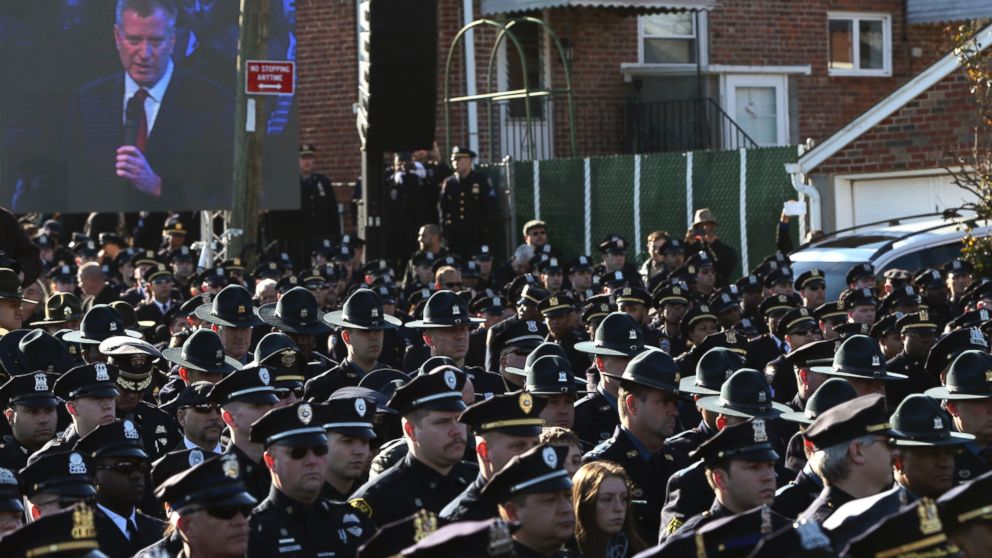
NYPD Turn Their Back On Their Clients

Mayor Bill de Blasio was something of a surprise since City Council President Christine Quinn looked to be the next mayor of NYC and had the support of three term mayor Bloomberg (seen as a negative by many -- lesbian or not, she was seen as a more conservative and establishment choice), but he won and won big. He was seen as something of an Obama figure, a reasonable liberal sort, also with sort of mixed background (his wife is black).  He previously with in the City Council, was public advocate and previously worked in the Clinton Administration. 

The mayor looks to be comparable to President Obama in other ways as well.  He will be seen as too moderate by some on the left, especially since we are talking NYC here, while doing enough to make others find him some radical socialist type. I guess such opposition from both sides provides both cover and is a sort of symbol of reasonableness. Meanwhile, things like settling a stop and frisk lawsuit and expanding spending (including in education). Returning Giuliani Era police commissioner William Bratton to that role was one of many ways he tried to balance things out.  He was a safe choice in some ways though his clashes with RG shows that Bratton's service there should come with an asterisk. 
"We will all work hard to identify why is it that so many in this city do not feel good about this department that has done so much to make them safe — what has it been about our activities that have made so many alienated?” Mr. Bratton said, speaking to a packed hall at Police Headquarters in Lower Manhattan.
This is the sort of thing that motivated many who voted for de Blasio over his competition, including in a landslide victory (over 70%, after squeaking over the 40% plurality line in the primary among a large field) in November 2013 (has it been over a year?).  But, this includes the mayor not always supporting the police 100% against the concerns of the citizenry.  When someone dies in an illegal choke-hold during an arrest for selling illegal cigarettes or talking about how he and his wife fears his black son doing something "wrong" when around the police,* sorry if some police officers might not like everything he says. He is the mayor of ALL New Yorkers, including those who protest wrongful killings.

The police turning their back -- predictable really after the head of their union tried to get them to sign letters telling him not to come to their funerals if they were shot on the job -- here was horrible. The family of Eric Garner, who their murderer used to give some sort of meaning to his violence (which -- this only most recently -- included shooting his girlfriend in the stomach and later killing himself), voiced sympathy.  The idea that the mayor has blood on his hands here is fucking asinine. You simply aren't helping, you assholes (this act of protest warrants the plural).  Police lives matter? No shit. All lives matter. Who other than the murderer here and a small number of people with overheated rhetoric here disagrees on the side of those protesting more than one wrongful police shooting?

Again, the FAMILY of Eric Garner and Michael Brown -- to bring him into it too though there are moving from NYC (the murderer here isn't some resident who was mistreated by the NYPD ... his shooting of his girlfriend in the stomach wasn't some sort of protest) -- opposed the shooting.  Let me quote them a bit for emphasis here:
"I'm standing here in sorrow about losing those two police officers. That was definitely not our agenda. We are going in peace," Garner's mother Gwen Carr said at a news conference today. 

Carr stood alongside Rev. Al Sharpton and her son's widow, each reiterating that while they want protesters to make a point, they must do so peacefully. 

"My husband was not a violent man, so we do not want any violence connected to his name," Esaw Garner said today.
I don't think the NYPD as a whole should be blamed for the protest here, but people will do so -- I have seen the at times expletive laden replies on Twitter. This is to be damn expected by this act of crude shameful disrespect.  A killer of a doctor who performed abortions murdered him in a church, which to me should have been seen as profane even for those few who cheer such people on.  This was an event for remembrance and healing, not one to further divide and instigate.  As a life time resident of New York, if it matters, white, and as someone in general who doesn't like making things worse, this saddened and aggravated me. 

It took deaths and murders to really flame emotions and protests but the anger and despair builds over time with much more minor incidents. Police are basic to a safe society and their jobs require them to go into sensitive and at times dangerous locations.  My brother was very upset someone was stopped for going a bit over the speed limit and told to get out of the car and deal with the full brunt of a police stop.  He couldn't believe that was justified.  He, a white guy, was also in the car when police came while his friends were merely in the car inside a suburban complex and at least one of the police drew a gun during the stop. This happened a few years ago and it still scares our mother when she thinks about it.  What if the police felt something was wrong and shot the person with my brother nearby? 

This underlines that both sides here need to react with some levelheadedness, even when some mistake or arguable overreaction arises. This turning their backs does not help.  The mayor supporting non-violent protest after a teenager is killed is not an incitement. The other side can be flagged at times too.  But, yes, public servants should at times be put to a higher test.  This photo is a sign of irrationality. 

---

* He recently told an interviewer that he has told Dante, his teenage mixed-race son, not to reach for a cellphone around officers because it might put him in danger as a “a young man of color.” John Marshall had a powerful discussion on the police response to the mayor as well.

Voice Aside, No That's Not Melanie Griffith


3D? Well, it was great in 2D DVD! You can't take this movie too seriously, but when you see a cameo of Kathleen Turner, you know the film can't be all bad. Caught it because of this and good catch -- though the last fifteen minutes of her going on a rampage was a bit much.

Friday, December 26, 2014

Into The Woods


After enjoying Wild and having Chinese, I enjoyed Into the Woods and had Chinese "Kagan-style" (at a restaurant for Christmas dinner -- a family tradition now including the problems with the wait). Saw a version of the fairy tale musical on PBS years back. This version is excellent from the sets, acting/singing (almost every character is like a perfect fit) and (mostly) overall story. Fractured fairy tale t.v. shows make it a bit less novel.

Thursday, December 25, 2014

Wednesday, December 24, 2014

Rev. Joe: Jefferson's Bible

And Also: R.I.P. Joseph Sargent, whose best known work might have been Taking of Pelham One Two Three (the original!), but also many more. This includes some good television movies and some duds (Jaws: The Revenge!). Got to take the 6 train in his memory!
It behooves every man who values liberty of conscience for himself, to resist invasions of it in the case of others; or their case may, by change of circumstances, become his own.
I read about the so-called "Jefferson Bible" (actually "Jefferson Gospels") in the past and found a version put out by the Smithsonian that is particularly attractive (if not as easy to read regarding the Bible part). This version has some introductory material and gives you a look at how the original looks with Latin/Greek, English/French versions side by side.  Again, this might look great (especially with the old fashioned look) but it is harder to read (the first link provides the text as well as letter to Benjamin Rush, Rush's encouragement to Jefferson to express his religious views perhaps the original impetus of this project). 

Jefferson was a rationalist/deist, who believed in some form of God and perhaps a future existence (recall a reference, but it might have been more of a hope -- a scientific mind like his after all would not know for sure).  He spoke of an admiration, if some disagreement (e.g., "I am a Materialist; he takes the side of Spiritualism"), of Jesus and saw his overall morals (particular as understood to be more universal than Judaism) as very beneficial. Thus, the "Jefferson Bible" tried to get to the heart of his message, which Jefferson deemed to be corrupted by those who wrote it down years later (no fan of Paul).  He compared this to Plato, who he also deemed to have corrupted Socrates' own words with personal sentiments.

The result in in effect Jefferson using a razor blade to cut and paste those portions of the gospels he deems rational, removing miraculous material such as related to his birth, miracles and his alleged resurrection. Later scholars have determined even some of the remainder did not actually happened (e.g., Jesus probably was born in Galilee and there was no grand census at the time of his birth as cited by Luke) and even if they did not, they have some meaning and value as other myths do. But, his was a worthwhile effort of finding the good even if it is thought to be mixed with some bad (in his words, "diamonds in a dunghill"), being an early case of a self-expressed "Christian" many might not think so.

Such mixture tends to be found quite often.

Tuesday, December 23, 2014

Some films

Barbara Stanwyck and Fred MacMurray made a good team in Remember the Night, which is basically a Christmas movie about a pair of cynical sorts with a soft underbelly. 

Its compact package might have made Christmas in Connecticut, WWI era corn -- though Stanwyck alone requires at least some spark -- somewhat better.  You knew where it was going, which is fine for a genre flick, especially at the holidays, but really -- it DRAGGED.  I had to shut the thing off half-way out of pure boredom.  It had a few charms, other than the female lead.  Looked good -- down to the city walk-up or whatever "Elizabeth Lane" was really living in. The joke arising from wartime daycare had a feminist touch.  And, the black bit players were not treated like moronic comic relief as in the first film. 

Skipping to the present, though if you want another pretty good Christmas movie check out Die Hard, Wild with Reese Witherspoon was very good too.  A few didn't think she really sold the part -- still looked like a movie star and all (unlike the actresses playing her friend and mom) -- but I think she did overall.  She looks appropriately worn down and regular basically.  It's basically part of a few films recently made where she shows more than her "Ellie Woods" from Legally Blonde persona.  I wouldn't be surprised if she is nominated for an Academy Award here. 

The film mixes her long wilderness check with the life she used it to move on from well too. Not a classic or anything, but it is something that is worth even full price (but I found it at $6!), which is a good selling point. And, don't know how much a double was used, but we see a decent bit of her. As noted by one comment, we also see how a single woman alone sees things at times -- each guy she meets in "the wild" is a potential threat. 

To toss it in, Hot Shots! Part Deux has been on a few times in recent days. It is one of those films that work well on television and without any explicit sex or language, works on basic cable too.  It is impressive how much was thrown in here -- the gag refrigerator items in the opening scene alone took some doing. Hasn't been this quality "everything and the kitchen sink" comic ribbing of genre flicks for a while though various people tried,. This shows why -- it's not easy. 

Monday, December 22, 2014

Forced Ultrasound Law Struck Down On 1A Grounds

And Also:  While Rust v. Sullivan is a problematic ruling, a more recent opinion did hold that: "United States may no longer compel US-based AIDS funding recipients to oppose prostitution as a condition of receiving federal funding." Though I wonder how the case discussed below would have come out if there was a forced ultrasound law without the coerced speech so blatantly required (e.g., a printout of the ultrasound has to be provided with a state pamphlet), again it's a promising approach.
This provision, however, finds the patient half-naked or disrobed on her back on an examination table, with an ultrasound probe either on her belly or inserted into her vagina.
A conservative 4CA judge wrote the unanimous panel decision, and in the process  clearly causing a circuit split (the opinion explicitly rejected the approach of the 5CA, e.g.), overturned a NC forced ultrasound law on First Amendment grounds. Since the law "requires physicians to perform an ultrasound, display the sonogram, and describe the fetus to women seeking abortions," to me it also is problematic on substantive due process grounds. Forcing unnecessary medical treatment is a problem there, especially when it requires inserting probes into sensitive areas.

Both are a problem independently of some liberty interest in abortion choice and it is helpful to view things -- especially given anti-abortion sentiments including on the Supreme Court -- in that fashion.  The abortion issue involves a range of matters, including various constitutional provisions, which is basically why the matter intrigues me so much.  The Supreme Court, putting aside the wrongly decided Rust v. Sullivan case, however, has largely avoided such things.  An exception would be the spousal notification provision in Casey, which was struck down partially as a threat to gender equality.  A circuit split might require a chance of pace.

The issue of physician-patient relations has been addressed in various cases though again it was treated as a privacy matter. After having a whole section on the free speech issues involved in his dissent in Poe, e.g., Justice Douglas did not highlight the issue in Griswold.  Later cases challenged certain required scripts as unduly biased and burdensome though the breadth of such rulings were themselves challenged in Casey.  The opinion left open the power of states to include some requirements, even if merely to promote a certain view of life, but the matter was only briefly addressed. A case the directly deals with this issue could be more helpful there though given the membership of the USSC ...

The 4CA discusses the normal informed consent law here, which doesn't go as far the law here. It's a rather curious law really since "rather than engaging in a conversation calculated to inform, the physician must continue talking regardless of whether the patient is listening." The idea there is partially to provide an out to the patient who doesn't want to listen, but it sets up a somewhat absurd situation for the woman on the examination table. The state admitted the information is "intended to convey not the risks and benefits of the medical procedure to the patient’s own health, but rather the full weight of the state’s moral condemnation." The state is allowed to promote that viewpoint and Casey suggests even do so by requiring the doctor to provide certain types of literature, but doing so in this fashion is "fraught with stress and anxiety" for the patient.

Unless there is an "abortion exception" to the First Amendment, this is problematic.  But, there is something of one already with Rust v. Sullivan, which allowed a content based alteration of the normal medical process, even when rules of constitutional avoidance at the very least counseled otherwise.  We saw it too when the state is allowed to single out certain moral views with clear religious overtones (see the "conscience" portion of Casey) to deny Medicaid funds even in cases of rape or serious health issues (not that the average pregnancy lacks some).  And, if certain courts can determine a forced ultrasound doesn't violate the 5A (due process), why shouldn't the 1A go to the wayside some too? 

Biased coerced speech requirements that are performed in such an intimate and invasive fashion provide a means to show that - contra Scalia - the Constitution does have something to say about abortion in various ways.  The "Woman’s Right to Know Act" is a somewhat Orwellian label, since it includes not only the "right to  know," but the obligation to do things even when one doesn't want to know. Likewise, as noted in the Cruzan discussion, the usual selective rules apply. Should women be forced to undergo this process to see malformed fetuses to inform them fully to help them determine if they wish to bring their pregnancies to term?  

Anyway, small Christmas gift for choice using alternative route. A few times, vagueness was used to help freedom of choice. This provides another route as well, one that in some cases has a chance.  It also has been used against regulations of "crisis pregnancy centers," so can be a two-pronged sword.  Ditto with regard to clinic protests.  But, this time, it was used to help those inside the clinics too. 

Family Planning (Donald Duck Assists)


Sunday, December 21, 2014

NFL Week 16

For three quarters plus quarters, the NYJ looked good, even the second year QB. But, an interception led to the go ahead score and later a 52YD potentially go ahead field goal was no good. Lost 17-16. Last time it was by two. Eh. NYG actually played well against a decent team. Buffalo lost to Oakland. Carolina/Falcons playing for post-season next week.

Long Goodbye: The Deaths of Nancy Cruzan

And Also: The Eagles (against a bad team) and SF just wanted to lose yesterday, didn't they?
An erroneous decision not to terminate results in a maintenance of the status quo; the possibility of subsequent developments such as advancements in medical science, the discovery of new evidence regarding the patient's intent, changes in the law, or simply the unexpected death of the patient despite the administration of life-sustaining treatment, at least create the potential that a wrong decision will eventually be corrected or its impact mitigated.
The title book is a very good account that could have just as well been a fictional narrative of a family -- particular a sheet-worker from the Midwest named "Joe" (a nickname) Cruzan  -- dealing with a horrible tragedy.  As noted here, the book does cover the legal matters very well, but ultimately it is a personal story with Joe Cruzan at the center. The book was written by the pro bono lawyer that took their case, thinking it would be a fairly simple probate matter.  It was written over a decade after the case cited above, providing time for contemplation.  He later wrote a general book on end of life issues, which I plan to read soon.

In the early 1980s, a twenty-something woman (his daughter, then married) was in a car accident.  Though a few of her caregivers claimed to see a few cases of recognition and even tears from a Valentine Day's card, all other appearances (including by doctors and the family, who took her home for Christmas at the end of the first year) she was in a permanent vegetate state (PVS).  As a dissent state judge noted later on, even if she was not, some form of recognition of her state would be a form of "living hell."

After a few years, treatment not doing anything and transfer made to a state hospital known for long term care (earlier special treatment paid by insurance she obtained via her job), it was determined that it would be best to end her life. This is what in effect what would happen by taking out her (to quote the USSC) "artificial feeding and hydration equipment."  Note that by this time, the state was paying for her care, but in other cases such fiscal concerns might be an issue. Also, there was the ongoing trauma to the family of dealing with her horrible existence.  It is unclear -- though here it seems enough -- if merely her own rights and dignity should factor into the decision-making here. IOW, if somehow, the family's well-being was part of the decision process, but it still was found to be in her own best interests, the former should not be disqualifying.  This so even though it is granted obviously that such third party concerns can in certain cases result in pressure to do things of a dubious nature.

The problem was that she did not provide any sort of living will, and (not noted by the book) akin to NY, Missouri had stricter rule -- as interpreted by the Missouri Supreme Court (4-3) (or, perhaps I should say, going by the book, on how the USSC interpreted what that court did) -- "clear and convincing" evidence had to be provided.  By this time, her parents were appointed guardians (her husband accepted a petition of divorce on her behalf and apparently basically exited the picture), but special concern for "life" per state policy required more for even this sort of third party to remove such treatment. This so even though the guardian appointed to represent Nancy Cruzan and the probate judge long involved in her case agreed it was in her best interests to do so. The USSC upheld the state supreme court 5-4.

This was one more loss in a series for the family (the book centered on the trio of the parents and her sister; a third sister was mostly off-stage) over the 1980s.  But, this is one of the many cases -- such as a criminal case where relief is later obtained in state court -- where the "loss" was mixed. First, the Cruzan opinion did grant, at least for sake of argument, a constitutional liberty interest to refuse treatment. This included the artificial nutrition provided here, something the state challenged. Five justices recognized this as a fundamental right (O'Connor plus the four dissenters).  The opinion was a narrow one -- a clear and convincing standard was an acceptable rule in a case like this, even though the family were the decision-makers.  If Missouri, e.g., refused to even allow this if she stated her desire for it via a living will, that would be a separate case.

The dissents by Brennan and Stevens (Scalia concurred to say that even the majority went too far) were eloquent and Stevens in particular is good reading for those who like that sort of thing.  Stevens in effect said that the state can't have a bare interest in defining life that allows them to override those who have different understandings. The guardian appointed to represent the patient's interests and fact-finding by the judge here provide safeguards. Use of Nancy Cruzan in effect as a means here is "unconscionable." And, note there is some argument there -- for instance, many (by no means all) of her caregivers were strongly against removing her feeding tube. The mind-set is understandable, especially for those whose job is to care for people like herself.  But, would they feel much different if some signed living will popped up? I think not. 

The range of horribles about killing the mentally retarded and the like had a certain ironic tinge.  One of the people who testified at the trial was wife of Paul Brophy, whose treatment was also removed. She supported the Cruzans.  She was a nurse for the mentally retarded.  Nancy Cruzan herself worked as an aide to care for the mentally retarded. In fact, the "new evidence" -- a key reason why the USSC opinion was not a total loss -- that ultimately was recognized as "clear and convincing" came by her two co-workers there.  [Another witness was added too, but the lawyer thinks he was much less important.] They reported her saying that she did not want to live like that.  Another remark made regarding her grandmother to her friend was not deemed enough, nor the family's general ability to understand her wishes. But, Nancy Cruzan's comments, in particular about a young girl that she bluntly called a "vegetable," here did the trick.

So, the state bowing out of the case after the Supreme Court ruling, the Cruzan family could finally after seven or so years have closure. But, showing in a different context how an execution might not do that (I do not think this was an "execution" -- it's a "different context"), the father did not truly move on.  A few years later, he committed suicide.  The mother died of cancer a few years later.  And, such stories continue, including when some wish a more active form of euthanasia, like the young woman who recently ended her life in Oregon.

---

* [ETA] The questionable biased assumptions here are also found in the abortion context. Special burdensome measures, such as counseling, is repeatedly only required when abortion is chosen. A person might arguably in various cases be making a questionable decision to have a child, but that is not deemed to warrant special state involvement.  A "state interest in life" or some such is cited there, but that's debatable. Who is to say that  such a state interest at least would warrant counseling in all cases?

Re-reading Brennan's dissent, the Cruzan case has a similar issue. If anything, it might be the case that most people, even without living wills, would want their guardians to do what the parents did here. But, non-action that would clash with this desire did not require special safeguards, a special hearing to reject the interests of the parents. Only removing the treatment did.  More so perhaps than in the abortion context (a child is surely not the "status quo" any more than an abortion), I can understand the different standard up to a point. But, the second guessing here is problematic all the same.  He has a point.

Saturday, December 20, 2014

End of Eras

The Colbert Report ended with a gigantic sing-a-long with guests from the likes of Jeff Daniels to Henry Kissinger to the Cookie Monster. Nice and self-indulgent, but the add-on with Santa Claus and Alex Trebek was silly and not really funny. Craig Ferguson ended the next day with an opening that had a bunch of people and a takeoff of the dream ending of Newhart. The latter is a bit derivative (homage?), but he did his lesser job well.

Friday, December 19, 2014

Fuman v. Georgia and the Death Penalty

Aikens v. California is alphabetically a quick get at Oyez.com and led me to look over Furman v. Georgia again as well. Anthony Amsterdam had multiple arguments so used Aikens to largely set-up his general arguments. In the end, the California Supreme Court declared the death penalty unconstitutional on state grounds (unclear why the USSC heard the case almost simultaneously -- the opponents argued in front of the state court less than two months before).  A Wild Justice (The Brethren being perhaps the first one) provides an examination of the history there. 

The USSC held the death penalty as applied in the cases granted unconstitutional 5-4, but only two believed it completely so.  This set up Gregg v. Georgia a few years later in which the death penalty was upheld 7-2 (Stevens replacing Douglas), but mandatory death penalty still in effect not (Powell/White switching places). Multiple justices on both sides thought the death penalty would be done with the first time, but Justice White did not -- he rested on it being applied too little to be rational. Something like thirty-five states raced to try to figure out a way to execute and the Supreme Court tried instead to "tinker with death." Still, aside from a few states, White's original concerns weren't really answered.

Justice Stewart also rested on the death penalty not being applied in a rational way, deciding later the new laws provided better safeguards. He also probably simply accepted that the country still strongly expressed a desire to have a death penalty.  Justice Marshall, though ultimately noting it wouldn't enough anyway given the death penalty was still disproportionate, appealed to "the opinion of an informed citizenry," the sort of "reasonable observer" that pops up in First Amendment cases, particularly during Christmas display season.  He has at least something of a point there, partially since we have a strong ability to assure ourselves certain things are true.  Burger and Powell do provide pushback.

The dissents are pretty strong and well written. Burger/Powell provide a broad based reply, Blackmun provides a more emotional one given he personally was strongly against it and Rehnquist rested on judicial restraint and trusting the people (this not being some affirmative action program or something). Not that majority opinions aren't strong either (White and Stewart had more of an essay approach, the others more in depth -- the whole affair would amount to around two hundred pages). The whole affair is rather intriguing reading.  The one thing I would call out the dissent on in particular is any suggestion the 8A did not deal with disproportionate punishments.  Justice Powell himself held otherwise a few years later.  

I believe the death penalty is both unconstitutional and bad policy -- digs of some, people like myself do not always think that is the same thing. Bad policy can be inspired by things that either violate the Constitution or at least its general principles. On that front, I mean that the document influences various things that might be a matter of policy -- let's say the nuances of criminal justice -- without compelling some court to strike down the "wrong" one. When Furman et. al. was decided in 1972, for instance, I'm unsure it was correct for the USSC to strike down the death penalty nation-wide. If fully honest, I think Blackmun was right at the time. There were corrections and tinkering around the edges (e.g., holding it unconstitutional as applied to rape or perhaps mandatory sentences*).  [Should add, that I don't quite agree with him in Gregg v. Georgia, where he dissented from a more restrictive approach, but he soon accepted that.]

On principle, I would have shared the views of Brennan and Marshall.  But, like same sex marriage in the 1980s, it is different when trying to use the USSC to declare something unconstitutional. Constitutional law there develops over time and requires some development of society in general. It also is appropriate to work up. The basics of speech protection came before the hard cases.  There was a lot of things to deal with in the death penalty context before a full frontal attack. And, twenty years later, there was enough water under the bridge for Blackmun's saying "enough" to have gain serious traction. Stevens' similar move in Baze v. Rees was a concurrence to an opinion upholding the death sentence.

I'm not a member of the Supreme Court, however, and never shall be. From my vantage point, and at this point in history, I think the death penalty is unconstitutional writ large for the various reasons cited in the Furman majority opinions et. al.  Meanwhile, it is proper for the Supreme Court to attack the punishment from various angles, including openness of the lethal injection process and things like the mental stability of those executed. Finally, this effort should not interfere with the many many more who are being mistreated in some fashion in our quite flawed criminal justice system.  This includes Obama's -- for whatever reason -- paltry use of the pardon power. 

See also, Mark Osler's Jesus on Death Row.

---

* Justice Douglas in his separate opinion basically rested on equality, overall arguing that "cruel and unusual" punishments in particular as applied here was a ban on arbitrary application.  He left open the question of mandatory punishments, which basically weren't done with few exceptions, noting however that they too might be shown to be applied unevenly. Powell argued the evidence for this was not present and in effect the nature of things will result in some people more likely to commit crimes. 

Brennan/Marshall argued that the death penalty was not needed for deterrent or other purposes. A passing note as to killing in prison etc. argued that even there that the death penalty was not necessary, but the matter was not dealt with in depth. Simply put, if the penalty is so problematic, we will have to deal with the extreme cases. And, anyway, it will not only be applied to them. 

Thursday, December 18, 2014

"Justice Department Will Now Support Transgender Discrimination Claims In Litigation"

Now, Holder wrote, “the Department will no longer assert that Title VII’s prohibition against discrimination based on sex does not encompass gender identity per se (including transgender discrimination).”
As noted, an outlier prisoner case should not let us forget the many other interests of transsexuals. GLBTQ indeed.