About Me

My photo
This blog is the work of an educated civilian, not of an expert in the fields discussed.

Thursday, January 29, 2026

The Struggle for Judicial Supremacy (Robert Jackson)


Imagine if someone wrote a book like The Struggle for Judicial Supremacy: A Study in American Power Politics today. Would they be confirmed to the Supreme Court, to replace the Chief Justice (someone else was elevated in-house), the next year? It might be exciting.

Robert Jackson was FDR's solicitor general and attorney general (his position when the book was released in 1940). He was a strong partisan supporter and testified in favor of the court expansion bill. Jackson includes FDR's message to Congress and radio address on that bill in the appendix. 

(Jackson skims over the controversy. He argues that a major problem was that the bill was not bluntly promoted to address misguided judicial supremacy. There was a hard-to-take argument; supposedly, it was really just a reform bill to improve the courts.)  

What is "judicial supremacy"? Each branch of government is "supreme" in its own sphere. Congress can impeach whom it wants (realistically speaking), as long as they are a federal officer. Presidents can veto what they want. In his famous Steel Seizure Cases concurrence, Jackson later discussed the broad power of the modern-day president.  

Jackson acknowledges an appropriate court concern (while noting they alone aren't involved) in protecting civil liberties. He does not reference it, as it was not yet famous, but Jackson endorses the famous "footnote four." 

(I don't think "judicial supremacy" merely means judicial review. Judicial review has its limits. Either way, being "supreme" in a certain area is not "supremacy." There is a greater meaning there.) 

His concern about "government by lawsuit" was the usage of substantive due process to, in his view, incorrectly override legislative discretion in policy matters. 

Likewise, an artificial application of constitutional provisions to rob the people's representatives of the discretion to make policy. This often had an economic flavor, so we have many cases involving employment, rate regulation, taxation, and so on. 

The Lochner Era and the battle of the New Deal were his particular topical focus. A specific concern, like now, was the lower courts, where injunctions could block government programs, even when federal law appears to deny the power to do so (tax injunctions). 

He provides an in-depth analysis of many legal disputes (after about 100 pages, I started to skim). Jackson argues that, generally speaking (again, civil liberties would be an exception), a strong presumption of constitutionality should be the rule. Eric Segall would be pleased. 

Justice Jackson had his limits in the area of civil liberties, especially after World War II. He thought there were limits to free speech, especially in the battle against fascism and communism. That is, "the constitution isn't a suicide pact." Jackson also thought there was a limit regarding the federal courts' interference with state criminal trials.  

Jackson warns that the courts have limited abilities. They work by lawsuit, argued by lawyers. Policy is not just a matter of applying legal principles, especially via specific disputes. A single dispute will not provide enough information. Litigation can also take a long time. Meanwhile, public policy is in limbo. 

He notes early on that what works for his time might not work in future days. Jackson was no originalist, though he respected history. Like FDR, he supported a "living law."

Justice Rehnquist (as he then was) in the link at the top of this entry noted that this is a "dated book." It is a project of its time. People might even have been surprised at it in late 1940. Wasn't the struggle for judicial supremacy won by FDR? Jackson knew, however, that it was a long haul. 

Imagine, for instance, what Jackson would have thought when the Supreme Court struck down the legislative veto a few years after Rehnquist wrote those words. Would he support a court expansion bill today? Either way, judicial supremacy remains bad.

Wednesday, January 28, 2026

First Execution of 2026

Charles Victor Thompson was sentenced to die for the April 1998 shooting deaths of his ex-girlfriend, Glenda Dennise Hayslip, 39, and her new boyfriend, Darren Keith Cain, 30, at her apartment. Cain died immediately, Hayslip lingered some. Texas executed Thompson today by lethal injection.

Thompson's final SCOTUS appeal sounds dubious:

Thompson's attorneys have asked the U.S. Supreme Court to stay his execution, arguing Thompson wasn't allowed to refute or confront the prosecution's evidence that concluded Hayslip died from a gunshot wound to the face. Thompson's attorneys have argued Hayslip actually died from flawed medical care she received after the shooting that resulted in severe brain damage sustained from oxygen deprivation following a failed intubation.

The state not only argued that this was not a new claim. It was besides the point. Thompson was still responsible for her death. Why, after all, did she need medical care? 

SCOTUS earlier today, without comment (as usual), rejected the argument. It very well might be sound as a matter of appellate review. I still would like at least a brief explanation before the final court paves the way to the deprivation of life.

I continue to find long lag times constitutionally troubling (Breyer's dissent). Over twenty-five years fits the bill. Others will be glad that "justice finally prevailed." 

The top link notes that he escaped from prison for a few days after an earlier appeal. It sounds like a result of a ridiculous laxness of security for a capital offender:

Shortly after being resentenced, Thompson escaped from the Harris County Jail in Houston by walking out the front door virtually unchallenged by deputies. Thompson later told The Associated Press that after meeting with his attorney in a small interview cell, he slipped out of his handcuffs and orange jail jumpsuit and left the room, which was unlocked. Thompson waived an ID badge fashioned out of his prison ID card to get past several deputies.

Thompson committed a horrible act, murdering two people in cold blood. It was a personal crime, a result of his anger and revenge, which makes it somewhat less blatant as a "worst of the worst" situation. He was in prison for approaching thirty years. That is not nothing justice-wise.

Few will cry over his execution, of course, and he is now mostly a statistic. The first execution of 2026.

I might not provide deep dives for each execution this year. Perhaps, only those that receive SCOTUS review like this one will be handled. Time will tell. 

Tuesday, January 27, 2026

International Holocaust Remembrance Day

Mayor Mamdani‬ on Bluesky noted:

[O]n International Holocaust Remembrance Day, we honor the six million Jewish lives — and the millions of others — senselessly murdered by the Nazi regime. We remember not only the unimaginable loss, but the warning history leaves us.

This day calls on us to do more than reflect; it calls on us to act — to confront antisemitism wherever it exists and to reject all forms of hatred and dehumanization. May the memories of all those lost be a blessing — one that guides us as we build a world where every life is sacred.

US Holocaust Memorial Museum:

The United Nations General Assembly designated January 27—the anniversary of the liberation of Auschwitz-Birkenau—as International Holocaust Remembrance Day, a time to remember the six million Jewish victims of the Holocaust and the millions of other victims of Nazi persecution.

As we are witnessing an alarming rise of antisemitism around the globe, it is more important than ever for us to recognize the critical lessons of Holocaust history as we commemorate the victims and honor the survivors.

A White House statement, which overall is reasonable (without acknowledging that nothing is wrong with it; credit/due to whoever wrote it), ends thusly:

On this solemn day, we remember every man, woman, and child senselessly killed by the evil, depravity, and hate of the Nazi Regime—and we commend the survivors who dedicated their lives to sharing their stories while carrying the unimaginable burden of the seen and unseen scars. This International Holocaust Remembrance Day, and every day, we honor their enduring resilience, faith, and strength—and we recommit to the sacred truth that every human being is made in the holy image of God.

Yes, let's be guided by some form of that final message, a sort of equal protection principle. 

Anyway, recall:

a time to remember the six million Jewish victims of the Holocaust and the millions of other victims of Nazi persecution.

Some time ago, there were some overheated responses to those who said this. That is, providing education materials for IHRD involving more than the Jewish victims. Which is what the day is supposed to entail. It includes all victims of Nazi persecutions, along with the Jewish victims. 

Mayor Mamdani‬ was supposedly not someone Jews could be comfortable with. Many of these people did not feel similarly about the Trump Administration

Okay, I know, we are supposed to focus on other things today. But the right does have its problems

Finding Phoebe (of Romans fame)

The Bible has many intriguing characters. We often wish to know more about them. 

This is true even with some rather important people. Isaac is one of the three patriarchs. We know very little about him, and one story (involving his wife) is just a repeat of a story about Abraham.

I commend to you our sister Phoebe, a deacon of the church at Cenchreae,  so that you may welcome her in the Lord as is fitting for the saints, and help her in whatever she may require from you, for she has been a benefactor of many and of myself as well. (Romans 16:1-2 NRSV)

Phoebe (not the friend of Monica and Rachel, though both are Jewish) is one such person. We can learn a bit about her by parsing the few words ("deacon" and "benefactor" or patron, for instance) supplied. And, considering what the typical woman in her position might have been like.

People have helpfully tried to do this. The book is written by both a historian and a church elder. It is useful both for the general reader and faithful believer (it has study guide sections intended for church discussion groups).  

I learned a few things, including how women in that era sometimes served in local administrative offices. The book reminds us that women often served an active role, even if they clearly were not treated equally to men. 

It is unclear why no chapter discusses the typical job of a "deacon" of a church. The role of a deacon is discussed, but such a chapter would have been helpful. A deacon basically was (and is) a general assistant. This webpage is helpful.  

Bart Ehrman, in his books, argues that some of his "surprising" discussions are well known by clergy from their college classes. He argues that they should encourage their congregations to learn about them.

The historical context overall is a helpful way to get the full benefit of scriptural works. The same includes close reading with help on what to look for. 

The result is not that the works (especially works from c. 100 CE) are free from criticism. They are more complicated than the "for" and "against" sides often think. This includes the more troublesome pseudo-Pauline letters with some of the most sexist language.

This book does so with the New Testament (and other works, such as Judith) to help readers learn what they can learn about its views on women. That is a good way to get the most from the material.  

An educated believer can be the best customer of faith traditions. To twist a famous advertising slogan. 

Monday, January 26, 2026

SCOTUS Order List

That's fairly long for the average order list. And, yes, there was a per curiam.

SCOTUS (with only Jackson publicly dissenting without comment) flagged that it thinks a lower court misapplied a limit on federal habeas. The opinion (this is relatively rare) includes photographs.

The case is, in effect, a matter of error correction to flag that the lower court did not appropriately apply a federal limit on habeas. The justices re-parsed the evidence to determine this. Hmm. 

The Court also granted cert in a case where the petition uses a scene from the film Hoosiers to make a point. The case involves the Video Privacy Protection Act. The next scheduled event is February 20th. 

SCOTUSBlog on Bluesky: "The court has agreed to weigh in on the interpretation of a federal law, enacted in the wake of Judge Robert Bork’s unsuccessful Supreme Court confirmation hearings, intended to protect videotape rental histories from public disclosure." The case involves Facebook. 

I continue to wish the Order List provided links to the docket pages of the cases covered. Instead, the interested person needs to look up each one individually. It's not really too much to ask in 2026.

Sunday, January 25, 2026

Seattle/Pats It Is

The weather was frightful, which is great when you have a lightly used back-up. Denver lost 10-7, giving the Pats seven, and leaving three on the table. Seattle stayed ahead and stopped the Rams near the goal line. Scoreless 4Q.

Brief Encounter with Nice People


I was watching Brief Encounter (the original, not the horrible 1970s t.v. remake) again. 

[BTW, I also watched the first season of Night Court. The DVD provided a commentary track for the first episode from the show's creator, who also separately talked about the show along with Harry Anderson. It also has its charms on the nice people front.] 

The film is wonderful on multiple levels, including its cinematography and use of sound.

One thing that is so enjoyable is that the characters are such pleasant people. Their normalness is a large part of the point.

They are just two normal married people who strikingly fall in love with other people. They know that it is crazy and that there is no future in it. That doesn't change the reality.

That is the basic tragedy.

The film is mostly shown through the eyes of the woman. She is the sort of woman who is upset at herself when being annoyed at someone who is an annoying pest. Yes, they are being annoying, but it's sort of mean to have mean thoughts about that.

It's nice to remember that people deep down often are like the leads in the film. That includes the woman's husband, a nice guy who she loves, and who would be the one person she would talk about her experiences, except that it would hurt him so much.

(Meanwhile, in Minnesota. My comments.)

Anyway, it's snowing. 

Yes, it's winter, but NYC usually doesn't get this much snow. Also, it is colder than usual -- we don't usually have pre-20-degree weather. Of course, it is all variable, with forty-degree weather recently.

Sunday is a good day for it, since during the week it would cause a lot more people problems.

Thursday, January 22, 2026

Easy Living

Easy Living is an amusing and overall well-paced screwball comedy starring Jean Arthur with a young Ray Milland (love doesn't mean saying you are "sorry") as her love interest. 

I enjoy her in various films, though If You Can Only Cook was too mannered. Her career spanned from the silent era to limited roles on television. 

She had to step aside after a few performances when she co-starred in the Supreme Court-themed play First Monday in October. I still don't know how she was not too old for the role. She was in her 70s. The role was for a much younger person (a young Jane Alexander stepped in to play the role).  

[The Wikipedia entry says she stepped out because of a viral infection. I read in the past that stage fright was also a major concern; she suffered it over the years and overall was a very private person.]  

Easy Living is also a dramatic film regarding an aging football star learning that he has a heart condition. Victor Mature (his real name) stars. Lucille Ball has a supporting role. She was quite good in a variety of dramatic roles. 

A familiar face portrays a doctor who confirms the condition. "Jeff Donnell" (a woman; "Jeff" is a childhood nickname), who plays the pregnant wife of a friend on the team, looks familiar, but I don't see anything in her resume that looks familiar. 

Overall, I liked this film too. 

ETA: T11 Incomplete (title concerning the injury of her client) is not quite as good as that review says.

Still, I liked it. Karen Sillas, as the older home health aide who is struggling with personal demons and other problems, is excellent. The other actors are a mixed bag, but overall give good performances as a bunch of flawed people.  It weighs a bunch of themes well.

The DVD box suggests a lesbian angle, which does exist, but there are multiple interlocking stories here. For instance, her son becomes more important as the film goes along. And, as with all good films, the supporting cast provides good touches. I wouldn't mind learning more about the daughter-in-law.

There is not much "easy living" here.

Tuesday, January 20, 2026

SCOTUS Watch: Justice Jackson Is Busy

Justice Jackson stands out in today's Order List.

The order list starts with a procedural move that includes Jackson going along, but for a limited reason (see here; correction)

Jackson and Kavanaugh don't take part in a case. Only Jackson explains why. (Kagan also follows that practice). 

Jackson dissented from the court’s decision to reject a request from Danny Howell, an Indiana inmate serving a 70-year sentence, to file a petition for review “in forma pauperis” – that is, without paying the $300 filing fee and the more substantial costs of printing a Supreme Court brief. The court’s order provided that because Howell “has repeatedly abused this Court’s process,” he would not be able to file new petitions “in noncriminal matters” (such as habeas relief, which is civil) without paying the filing fees.

(Amy Howe at SCOTUSblog)

The rule, put in place with the liberals of the day dissenting, has been around since the 1990s. Ginsburg et. al. went along. I appreciate that Jackson (she draws the line at incarcerated people), with her criminal defense background, did not. I wish she had done so before now, but better late than never. 

She also only concurred in judgment, a solo job, in a technical procedural case. The other two opinions were five and six pages each, each unanimous, though there were some separate writings. Sotomayor added a page in one, and Thomas (with Gorsuch) found another originalist hobbyhorse in another. 

Jackson also (along with Sotomayor) was an enthusiastic questioner in today's Second Amendment case out of HawaiiShe, in part, flagged how "history and tradition" advocates selectively find some history distasteful, skipping over it.  

The specific dispute was a strawman. The state's advocate tried to point out that, yes, one of the precedents cited was among those laws passed in the infamous "Black Codes" era after the Civil War. 

Nonetheless, the Reconstruction Congress accepted it, unlike others. Multiple conservatives latched on to the first part but ignored the second. Typical selective originalism. 

And, if the conservatives think "history and tradition" should be applied with an eye toward tainted pools, I have a thing or two to tell them about abortion bans. 

A completely nuanced take on history is both important and hard. See, e.g., the executive removal cases, which will continue tomorrow

Monday, January 19, 2026

NFL Divisional Round

The Ravens missing a FG led to a fired head coach, who eventually was hired by the NY Giants. There is hope! OTOH, overall, bummer weekend. The usual suspects won, the usual suspects (including the Bills) screwed up. Plus, the Denver QB got hurt, tainting next week, which will also include (yawn) Rams/Seattle: Part III. 

Saturday, January 17, 2026

SCOTUS Watch

I discussed this week's SCOTUS news here.

Two cases involving transgender athletes resulted in three hours of oral arguments. This led the usual suspects to complain that some were not being "originalist."

But as someone who respects the Constitution, I find it extremely difficult to pretend that the founding fathers envisioned a country, even with the gloss of the 14A, that required a later 20th-century view of the roles of women. They simply didn't, and trying to make that fit is a fool's errand.

The entry led to the usual comments. This person is a lawyer. They are openly a Trump supporter. OTOH, they are annoyed at Attorney General Bondi's antics and ICE thuggery. Must take the bitter with the sweet. That's pure Trumpism.

Anyway, the comment is typical. It is also equal parts tiresome and wrong. It led me to respond as I have for years. I will include my reply, slightly edited, below. 

I respect the Constitution. I read it and see an equal protection clause. It doesn't say "as persons were understood in 1868."

I read my history too. Many framers specifically rejected the conceit that the text should be limited to 1868 understandings of social realities and so on. 

The open-ended language made that particularly difficult. Due process of law? That has been developing since the Magna Carta.

And my McCulloch v. Maryland, an opinion that the Reconstruction Amendment's founding fathers cited regularly. An opinion written by John Marshall, a ratifier.

(See, e.g., the books of Gerard Magliocca.) 

We have a constitution that is not only for the limited understanding of the immediate society that ratified its text. It is for all time. For a future that ratifiers were only dimly aware of. I'm summarizing John Marshall here.

But people don't really consistently care about the framers. The First Amendment (such as free speech rules) and Taking Clause, for instance, are not applied as they were understood back then. 

The First Amendment, for instance, was understood to allow much more restrictive legislation than is allowed today. We do not slavishly follow the original understanding. That's fine. 

Did Benjamin Franklin, to take an example, expect the Constitution to be applied via 18th-century understandings of social groups when it was used in the 20th Century? His scientific mind would realize we would not be set in stone in that regard.

The 14th Amendment, not being kept up with the times, is especially absurd. Congress is given specific power to enforce it.

What Congress? The Congress in power at the time. So, Congress today would enforce the Fourteenth Amendment. What would they do? Try to figure out societal understandings in 1868? Who thinks that? 

They would look at current needs and understandings to determine what equal protection means. Do people consistently find this troubling? They do not. I include conservatives who talk about original understanding. 

The Constitution itself is set up not to be fixed to the past, which is simply impractical. It is not being applied as some kind of role-playing game. It is applied by 21st Century society. Using current understandings. 

The 19th Amendment alone changed the equation for women. Women now vote. They were in legislatures. Voters are on juries. They have a more equal role in society overall.

Over time, facts and situations change in other ways, including understandings of LGBTQ individuals overall. Not just that. For instance, a conservative justice back in 1926 spoke about changing facts resulting in different results in property cases. 

This overall principle was factored in over our history when interpreting the Constitution, including by conservative justices. It doesn't take much imagination to see it. 

But, selectively, we get such comments. 

Monday, January 12, 2026

SCOTUS Order List (and other stuff)

First off, I enjoyed Emily on Fire, a book co-written by James Patterson, which is a young adult novel whose title is a tad literal. I'm not usually a reader of Patterson (or Danielle Steel), but the cover drew me in at the library. 

Her mother died of cancer, and her sister committed suicide. Now, Emily plans to kill herself (you know how) to get the world to realize that we are fucked up and have to do something! The book mostly uses her point of view.

The book is raw (and honest, which is important) while retaining an empathy that provides some optimism that is much needed these days.

The only other news on the merits docket came Thursday—when the Clerk of the Court, in a letter to the parties, announced that Justice Alito is recusing from a case in which the Court is set to hear argument later today. 

Steve Vladeck explains an exception to the usual recusal without comment approach done by most of the justices, minus Kagan and Jackson. Sotomayor sometimes comments.

The norm (including applied to Alito vs. Kagan) was found on today's Order List. The Court granted some cases for review on Friday. Today, more so than normal perhaps, it was mainly about clearing brush -- a list of non-grants.

‪Sean Marotta‬, a lawyer, noted on Bluesky:

The #SCOTUS orders list today is a reminder of the shrinking commercial docket. Cases that would have been shoe-ins in the 90-case docket are getting denied regularly.

Kavanaugh, without saying why, noted he would have granted review in a bankruptcy dispute. As usual, I had to separately look up the docket number on the docket page, since the Supreme Court does not provide a link. Can you change that, guys?

The transgender athletes' oral argument is tomorrow. 

ETA: A comment in response to my reference to the Order List somewhere else flagged that there are two atypical requests for briefing respecting petitions for rehearing. I appreciate such information even though it encourages my excessive online habit. 

PFRhs are very rarely granted. The federal government waived a response in one case. In the other, it appears like they want to speed things along.

A bit of inside baseball during football playoff season.

==

I'm not too happy about most of the final scores in the first set of NFL playoff games. The Panthers (after two losses) gave the Rams a fight, but the end result was a third loss. I'm fine with the Bills winning.

A Jaguars' win would have been okay, too.

ETA: A close game, helped by the Texas QB screwing up, became a laugher in the 4th with Houston winning. It might be Rodgers's last game. 

I'm fine with that, particularly (1) not a fan of Aaron Rodgers, (2) Annoyed at the Week 18 win (they would have been better off losing that close game than yet another Steelers loss in the playoffs), (3) I'm fine with Houston, and (4) it's a better match-up with the Pats.

Saturday, January 10, 2026

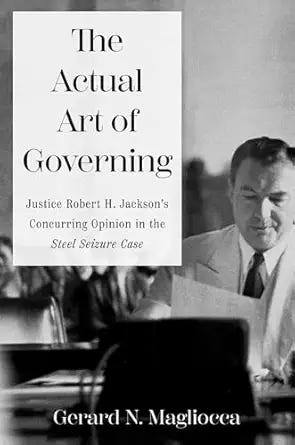
The Actual Art of Governing

I discussed this book in the weekly SCOTUS news discussion linked in yesterday's entry. It is overall interesting and well-written, stuffing a lot of analysis into around 150 pages. 

The concurrence provides the famous three-part summary of executive action (done with congressional approval, congressional silence/zone of twilight, with congressional opposition/based only on Art. II power). 

It also has the famous putdown of the use of history ("originalism" wasn't firmly a thing yet) to determine constitutional matters as akin to Joseph parsing Pharaoh's dreams. Or interpreting animal entrails, you can say.

The title refers to this passage:

"While the Constitution diffuses power the better to secure liberty, it also contemplates that practice will integrate the dispersed powers into a workable government. It enjoins upon its branches separateness but interdependence, autonomy but reciprocity."

Justice Jackson was concerned about executive power, including their claims of emergency power. He was in the FDR Administration and was the lead Nuremberg prosecutor. 

The Steel Seizure Case is a telling example. Truman lost, followed the opinion's dictates (he soon went to a barbecue or some such with Justice Black, famously disagreeing with his opinion but enjoying his bourbon), and nothing really bad happened. The feared emergency was overblown.

Jackson also wisely cautions the reader to "note the gap that exists between the President's paper powers and his real powers," especially as compared to the "eighteenth-century sketch of a government hoped for" in 1787. 

A conservative scholar, a Trump supporter, is now writing entries about how "almost" all former presidents pushed back on limits on their removal power. Okay? Congress and the Supreme Court also have a high opinion of their power. Consistency in that regard is of limited note. 

On the merits, I think Justice Kagan's partial dissent in Seila Law is correct. The Constitution leaves this matter generally to the political branches. Presidents don't have to go "meekly" along as Congress regulates. Each has significant power.

These days, as Justice Jackson noted in his famous concurrence, presidents have a special degree of power. The Supreme Court, now with a supermajority of former members of the executive department (five members of the conservative majority, including the Chief Justice, plus Kagan), adding more is not advisable.

Trump recently asserted to the NYT that the only limit to his power is his own morality. Jackson replies, quoting Kipling:

The essence of our free Government is "leave to live by no man's leave, underneath the law" -- to be governed by those impersonal forces which we call law.

Jackson refers to someone many of the founding generation (history has value, it just doesn't provide all the answers) followed including regarding judicial independence:

We follow the judicial tradition instituted on a memorable Sunday in 1612 when King James took offense at the independence of his judges and, in rage, declared: "Then I am to be under the law -- which it is treason to affirm." Chief Justice Coke replied to his King: "Thus, wrote Bracton, The King ought not to be under any man, but he is under God and the Law.'" 

Jackson, whose clerk's clerk wrote the opinion (this is covered near the end of the book), would have probably agreed with his namesake in Trump v. United States. In dissent. 

===

Note: The other opinions each have notable passages. Frankfurter, rambling as usual, included some words supporting a living constitution view of things.

That requires both a spacious view in applying an instrument of government "made for an undefined and expanding future."

He applied this rule in applying due process of law. The approach will lead some to worry about arbitrary, idiosyncratic judicial power. 

An honest accounting, however, will show that is how judges operate. They apply the law case by case, over time, taking into consideration various things, including developing conditions. 

There will also be a personal aspect in judging. Jackson's concurrence was a result of the biography of the writer. We need not ignore this reality, that AI does not write these things; AI has its own biases. 

As Westley notes in The Princess Bride, we are people of action; lies don't become of us. 

Black wrote the often forgotten opinion of the Court. Two justices "concurred," two explicitly said they also concurred with Black's opinion, while only one of the majority explicitly said they were only concurring in judgment. It's a somewhat curious way of doing it. 

The Chief Justice (with two others) dissented. Truman's appointments split (2-2) while Jackson (who Truman appointed as Nuremberg prosecutor) also voted with the majority. All nine were either FDR or Trump nominees. All Democrats.  

Black was second in seniority (after the Chief Justice) for around twenty-five years. Is that a record? 

SCOTUS Watch: First Opinion

 I covered the first opinion of the term and other matters here.

Wednesday, January 07, 2026

Some Books

The First Eight: A Personal History of the Pioneering Black Congressmen Who Shaped A Nation by Jim Clyburn is pretty good. It concerns the first eight black South Carolina congressmen, written by the ninth. 

The author was once a history teacher, so he has some skills in particular to write about the subject. The style is straightforward and generally easy to read. At times, it got a bit dull. 

Among the first eight is Civil War hero Robert Smalls and Thomas Miller, who looked white, and appears to have been the grandson of a signer of the Declaration of Independence. The book helpfully places the eight into the context of the times.

===

I recall reading The Princess Bride a long time ago. 

At least, I recall reading William Goldman talk about how (he takes this conceit quite far, including in later editions) the book is actually merely an abridgement of a much longer (nonfiction) work. 

The death of Rob Reiner led me to re-watch the film and read the most recent edition (it has "the first chapter" of a sequel) of the book. The book is quick reading with multiple asides. I read the over four-hundred-page book in basically two days. 

My edition had two anniversary introductions plus the intro to the main book. So, you read over fifty pages before getting to the main attraction. 

The book is mostly like the movie. The book adds a few things about Buttercup's parents and a "zoo of death," but the film and movie mostly overlap. 

It's enjoyable. I won't say it is GOAT material or anything. It is enjoyable.

I wish Buttercup had a more active role. She comes off as rather naive. As a satire of typical fairy tales, that somewhat makes sense, but still. 

The book also reminds us that these aren't great people. The heroes, after all, are criminals. Westley becomes a pirate. Pirates do some bad things. 

==

I listened to As You Wish, written by the actor who plays Westley. It is basically a 25th Anniversary era celebration of the film. The audio included many people involved in the film. That was charming.

I am not a big books on tape fan, especially for longer works. This book isn't that long. I didn't seek it out. I wanted the book, and the audiobook is what came up.

(I'm listening to Selma Blair read The Diary of Anne Frank. She does a good job. The diary is longer, and I don't know if I want to listen to the whole thing.)

The last disc was corrupted, so I could not finish listening to it. That was annoying. 

===

I also read The L-Shaped Room, an old British book about a woman who moves into a seedy apartment after she gets pregnant. The first time she has sex. 

It was okay. There was a certain artificial flavor to it, including how the main character never truly was at risk. For instance, her aunt eventually pays her to type a book, and then she makes money typing, allowing a means for her to make money after she is fired.

(The book was also at times somewhat tediously wordy. There were some interesting supporting characters, including a gay black musician and two prostitutes, each somewhat simplistically drawn.) 

The link is to a film starring Leslie Caron (more familiar for such works as Gigi), which I saw a long time ago and wish to see again. Nonetheless, the only DVD I was able to find was the wrong format. 

And, though TCM sometimes plays her films, they never air that one. Annoying. Checking the summary, the film changes the book somewhat, including explaining why a French actress is being used. 

Monday, January 05, 2026

More on the Chief Justice's End of the Year Report

I provided a relatively brief reaction to the Chief Justice's End of the Year Report. 

My first impression was that the author of Trump v. U.S. (presidential immunity) starting with Tom Paine (anti-monarchial) is a bit rich. Since he's talking to the nation, I'm fine with the first over the second. 

Various law professors have impressions. I added a link to one that felt it was inane and hypocritical. Basically, the professor argues the report is junior high school civics (at best) by someone who violated its terms repeatedly. 

Reading between the lines, one can find the Chief Justice of the United States standing up for immigrants; extolling the continuing aspirations of the Declaration of Independence; and reiterating the importance of judicial independence—three messages that are certainly welcome as we look ahead to the second year of the second Trump administration.

Steve Vladeck wonders who Roberts feels is his audience. Vladeck basically sends my sentiment that it promoted general republican values (small "r") and can be seen as anti-MAGA. He figures it is court-friendly mild Never Trump types who are still worried about speaking out. 

The problem, though, is that one has to read between the lines to find those takeaways. Given the year that just transpired—not just the substantive behavior of the executive branch but its unprecedented hostility toward, threats against, and defiance of federal judges—this would’ve been a golden opportunity for Chief Justice Roberts to make the kind of statement that might’ve resonated across the political/ideological spectrum. By opting for subtlety, it seems worth asking exactly who the Chief Justice views as his audience these days. 

Michael Dorf also notes the references to judicial independence (a self-interested one). Dorf also sees some anti-originalist implications. Maybe? Roberts is not a strict originalist anyhow. He's open to some development. 

(Roberts cites the Declaration of Independence as stating overall principles that the Constitution honors over time, more so in its later years.) 

A libertarian sort also references the usage of the Declaration of Independence. Supreme Court opinions from time to time over the years have cited the DOI, including its principles. He disagrees, not too surprisingly, somewhat with Dorf's opinion about the report's anti-originalist sentiments.

Vladeck liked it better when Rehnquist (who had Roberts as a law clerk) used the report to explicitly provide policy concerns and recommendations. Roberts arguably does this in a lower key fashion. There's something to be said about that.

None of the analysts care much about the second half of his report that provides statistics. Are they accurate? Are they provided in a simply straightforward fashion? 

Anyway, I think it is fine on some basic level to use the 250th anniversary of the Declaration of Independence to remind the country about some basic republican principles. Some words about the continuing threats on federal judges would have been good too. He did honor them.

And, yes, I remain cynical about his above the fray celebratory, honorary tone given how much the Supreme Court has failed us (as various people summarize) of late. 

We need change to fulfill the ideals he discusses. And, as Roberts shows, this is a long-term process, with earlier generations not meeting the ideals of the Declaration of Independence.

Ideals are like that. They are things we aim for and imperfectly uphold. The DOI also suggests what should occur when things get too bad.

Change, even if it requires ending long and familiar practices. Change that might be messy and uncomfortable, including for the powers that be. 

Saturday, January 03, 2026

Trump Has to Go (Venezeula)


My congressional representative (not AOC) has a good statement. More from me here and here. The rule of law = Trump has to go.  

Friday, January 02, 2026

As You Wish

I don't generally listen to books, partially because it takes too long. The audio for this book, written by "Westley," in honor of The Princess Bride, including drops from many people involved, is worthwhile. The last disc annoyingly got too glitchy.

Thursday, January 01, 2026

SCOTUS Watch: 2025 Ends

Roberts closed his report with a quote from President Calvin Coolidge for the country’s 150th anniversary in 1926. “Amid all the clash of conflicting interests, amid all the welter of partisan politics,” Coolidge said, “every American can turn for solace and consolation to the Declaration of Independence and the Constitution of the United States with the assurance and confidence that those two great charters of freedom and justice remain firm and unshaken.” Coolidge’s statement, Roberts emphasized, was “[t]rue then” and remains “true now.”

The Chief Justice's Year-End Report on the Federal Judiciary dropped on New Year's Eve at six o'clock per usual. The only other thing dropping this week was a single typo fixed in Alito's dissent in the Illinois case. 

2025 was the 250th anniversary of the beginning of the fight for independence. July will be the anniversary of the Declaration of Independence. Chief Justice Roberts used this for the history portion of the report, starting with a discussion of Thomas Paine and Common Sense

The Constitution was signed on September 17, 1787, a date later celebrated as Constitution Day and Citizenship Day.

Suitably, David Souter was born on September 17. He was later especially concerned about the teaching of civics. Souter died last year at the age of 85. 

The report's theme can be cited as an honorable statement of republican values. My first reaction was that Thomas Paine might have had issues with Trump v. U.S., given his views on the dangers and stupidity of monarchy.  (ETA: This takedown is appropriate.) 


The fifth anniversary of the event that should have disqualified Trump from future federal office (see 14A, sec. 3) is approaching. Our "solace" in the Constitution being in place might remain, but its firmness in action is not complete. 

Chris Geidner is correct that we should continue to fight to make it "a more perfect union." This includes addressing the issues of the Roberts Court.  

Is it 2027 yet?

ETA: No. Meanwhile, some more oral arguments, with the February calendar dropping.