About Me

My photo
This blog is the work of an educated civilian, not of an expert in the fields discussed.
Showing posts with label Roe. Show all posts

Monday, May 20, 2024

Roe/Doe Draft

I wrote some commentary the right to choose an abortion and health care generally in recent entries. I re-checked a collection of unpublished opinions of the Burger Court, which included the two abortion cases. 

The Roe draft was limited to procedural issues and vagueness. The draft followed the approach that I suggested -- the Texas limit on abortions only for the "life" of the woman is more difficult for a physician to apply than a general "health" (that the Supreme Court already held was not vague) exception. The latter is an open-ended concept that physicians are comfortable with applying. 

White's draft dissent did not do much to challenge it. His argument is that if a "health" exception is not vague, surely a "life" exception would not be just plain talked past why the two are different. White argued that there is less covered by a "life" exception. But, the majority still makes a valid case.

Other justices wanted to decide the general question regarding the right to choose so were not interested in the vagueness rationale. Nonetheless, vagueness was a credible approach in the Roe case. 

The Georgia law had a health exception along with a variety of other issues. The Supreme Court could have handled those issues, including the complicated physician committee process, and applied an open-ended definition of "health." This would have made the limited exceptions problematic. But, they went with a more open-ended privacy rationale.

Blackmun originally wanted to make Doe v. Bolton the main opinion. Roe v. Wade strategically was a better choice since the law was so extreme (only an exception for the woman's life). Nonetheless, it also would be extreme the other way -- why have a broad opinion with rules in place on how to apply abortion rights when you can handle it in a more limited way?

The original Doe v. Bolton opinion did not have the extended history portion or the discussion explaining how constitutional personhood arises after birth. It has an excerpt from Griswold but does not do much more to provide an in-depth discussion connecting past privacy cases to the right to choose an abortion. It is quite possible -- Douglas' concurrence summarized things and other lower court opinions provided more connective tissue. 

The draft references the right to obtain advice from a physician and medical care arising from the First and Fourteenth Amendments. If this remained in the final opinion, it would have provided a stronger backing to a general right to obtain medical care. 

Later opinions held that certain types of informed consent requirements were unconstitutional burdens on the right to privacy because they were coercive attempts to pressure women not to have an abortion. It was left to lower courts to occasionally rely on First Amendment arguments, including overturning a law requiring a physician to provide an ultrasound while talking about the unborn child or some such thing. 

If Roe v. Wade clearly recognized the patient-physician relationship had First Amendment aspects, there would be another (enumerated) source for such a right. Again, Justice Douglas references this, including his earlier Poe v. Ullman dissent though not in his majority opinion in Griswold. On the other hand, it would be more open-ended, a general right to health care not more limited to choices involving marriage and parenthood.  

The dissent in Rust v. Sullivan, involving funding, addressed the First Amendment. The majority argued the government has the power to selectively fund speech. Likewise, early abortion funding cases set forth the rule the government need not fund abortion services, even if it funded pregnancy care generally. A later opinion allowed for broad regulation of professional speech while being very strict (even as applied to licensed clinics) as to the rules for "crisis pregnancy clinics," treated as advocacy. 

Breyer's dissent in that case is quite correct. Professional speech, such as informed consent rules, is legitimately treated with a lighter hand than advocacy.  But, we should do so evenhandedly. A licensed clinic that does not provide some health options can legitimately be required to have an information hotline notice. Also, many so-called health regulations are thinly veiled ideological measures. They are more suspect.  

The draft notes that a woman is not isolated in her privacy, which remains in the final opinion. I find this argument dubious. The Catholic Church thinks birth control is immoral and not truly limited to the couple. Birth control prevents the creation of new life. Connecticut also argued that it helped promote adultery and other immoral things.  

Yes, pregnancy is more complicated because of the growing prenatal life. The general argument is that there are a diverse range of views, with particular moral and religious aspects, and it should be a personal choice. 

We have a clearer agreement respecting born children, who are constitutional persons. Nonetheless, even there, privacy rights do not disappear because their interests are involved. Multiple important privacy cases involve the right of parents to choose how to raise their children. Obviously, they are not "isolated in their privacy" here. Parents still have the right to make many different decisions affecting their welfare.  

The bottom line is that there is only a difference in degree respecting how privacy rights affect third parties. We need to draw lines there, including discussing the nature of prenatal life. Roe v. Wade could have done a better job of explaining the reasons for the viability line. 

I think it would have been helpful to wait to address that issue. The original draft avoided doing so as did various lower court opinions which vaguely spoke of possible greater state regulations later in the pregnancy. The laws were so extreme that it was not necessary to address such questions with specificity.  The opinions generally noted that there were decisions to be made. The specific nuances would come later.

The drafts therefore had some interesting and possibly better nuances than found in the final decisions.  

A final bit about the influential earlier Justice Clark law review article on the right to choose an abortion. The article provides a useful backing for the right to choose an abortion arising from the principles of Griswold. Nonetheless, it argues the legislature should have more discretion in drawing the lines. He might allow some form of "reform" legislation.

His constitutional argument would still require striking down laws like Texas, which would have meant many state laws were found unconstitutional.  The opinions that cited the Clark article tended to focus on the constitutional right theme, less on the last part.  

Wednesday, May 15, 2024

Vagueness As An Alternative Route to Abortion Rights?

Liberty and Sexuality: The Right to Privacy and the Making of Roe v. Wade by David J. Garrow is an impressive tome with a ton of endnotes. An update was written in 1998. 

He later reviewed a collection where law professors wrote alternative opinions. Garrow in 2014 wrote another article on Roe v. Wade. He criticized Blackmun's reliance on clerks though got a lot of pushback as the various links (annoyingly the Greenhouse link is broken since she had special access to the Blackmun papers, writing a book) show.

I re-read the section where he discusses the development of privacy rights and the early years of abortion reform in the mid-20th Century. One particular thing discussed in the overall discussion of Roe v. Wade is how Blackmun's original plan to rely on vagueness in Roe while using a companion case (Doe v. Bolton) for broader constitutional claims was rejected. Garrow assumes this is logical. I continue to find this dubious. 

Vagueness was repeatedly the grounds for striking down abortion laws. The lower court in Roe v. Wade itself partially relied on vagueness:

How likely must death be? Must death be certain if the abortion is not performed? Is it enough that the woman could not undergo birth without an ascertainably higher possibility of death than would normally be the case? What if the woman threatened suicide if the abortion was not performed? How imminent must death be if the abortion is not performed? Is it sufficient if having the child will shorten the life of the woman by a number of years? These questions simply cannot be answered.

Justice White (who dissented from Roe) argued that vagueness did not work. Texas had an exception for abortions necessary to save the life of a woman. The Supreme Court recently (after the district court decided) held a D.C. law allowing abortions "necessary for the preservation of the mother's life or health" was not vague. So, how can a "life" exception be vague? 

U.S. v. Vuitch held that "health" entailed physical and psychological well-being. Also, an abortion could be performed "for mental health reasons whether or not the patient had a previous history of mental defects."  Health was being sound in body or mind. The term "health" was quite open-ended unlike some of the stricter applications in states today.*

Sarah Weddington, the twenty-something advocate in Roe v. Wade, however, pushed back when the argument was made in oral argument. She logically argued that doctors generally make decisions regarding a patient's health. 

On the other hand, limiting their discretion to "life" is much less something they are familiar with. Health and life vaguely run into each other. "That’s not the kind of judgment that a doctor is accustomed or perhaps even able to make."

Now, this might be unconvincing. Still, to me, it seems a rather reasonable argument. Nonetheless, it is not referenced in the discussion. Plus, I do not think it was silly to decide Roe v. Wade on the narrow vagueness grounds. 

Blackmun would not avoid deciding the wider privacy argument. He would use the other case to do so. The case dealt with a "reform" law with exceptions for health, rape, and fetal abnormality. It also had various issues, including a residency requirement. It was more complicated. 

Garrow references a Blackmun clerk as well as other justices' clerks who grant that Roe v. Wade's discussion of privacy is too thin. I think that is reasonable. 

He provides a summary of the cases. Nonetheless, especially with his extended section on the history of abortion [if anything, too long] and discussion of how embryos, etc. are not constitutional persons, more analysis would have been nice. On that front, Planned Parenthood v. Casey did a better job. 

Justice Douglas' concurrence suggests the potential, including various cases about congressional investigations that reference a right to a private life.  Justice Stewart also has a brief concurrence that adds some useful context. 

Garrow in his book review suggested the incoming Roberts Court (at the time) was likely to cut back abortion rights to the first trimester. He was perhaps more optimistic when he wrote his book in the days after Casey. These days he would obviously take a more pessimistic stance.  

I continue to find the many details involved in these cases quite fascinating. So many nuances. The Internet provides access to more materials, including lower court opinions and law review articles. How did we survive without it?! 

Roy Lucas was one of the people discussed in the Garrow book. He clashed with Weddington and others. He wrote a discussion of a birth control case, which was released after he died. 

Not everything he says can be taken at face value. For instance, he criticizes counsel in one case for not providing medical testimony. Garrow's book notes that they had some available. The judges were not interested in hearing it. 

(Roy Lucas had a grudge against the Roe and Doe attorneys largely because he wanted a larger role in the cases. He was a pioneer in an extended constitutional analysis of the right to have an abortion and was involved in many early cases.]

Also, his proposed "right to health care" argument is creative but had little backing in actual case law. Douglas' open-ended Doe v. Bolton concurrence does list caring for health as an aspect of privacy. Nonetheless, like the right to association applying to the patient-physician relationship, it was a more novel argument than the Griswold-based privacy approach.

I have written about these subjects repeatedly on this blog and even before it was created. The extended note below discusses the term "health" in more detail.

As we fight to get back basic rights, it continues to be important to consider the issues. The lack of discretion of doctors and/or their fear potentially open-ended restrictions will lead to civil and criminal consequences has recently had horrible effects on people's lives.  This is not a new issue. 

==

* New York in 1918, in a case involving Margaret Sanger, also provided an open-ended definition of "health." Sanger opened a birth control clinic and was prosecuted. She lost her challenge because she was not a physician. Nonetheless, the N.Y. birth control law was held to allow physicians to provide birth control for reasons of health:

This exception in behalf of physicians does not permit, advertisements regarding such matters, nor promiscuous advice to patients irrespective of their condition, but it is broad enough to protect the physician who in good faith gives such help or advice to a married person to cure or prevent disease. “Disease,” by Webster’s International Dictionary, is defined to be “an alteration in the state of the body, or of some of its organs, interrupting or disturbing the performance of the vital functions, and causing or threatening pain and sickness; illness; sickness; disorder.”

[People v. Sanger, cited here.]

Since pregnancy overall is a threat to health -- though some antiabortion people push back on this since it is "natural" -- the open-ended nature of this definition is apparent. 

Some people have abortions because of fetal abnormalities. Nonetheless, even there, physical and mental health is likely a factor. The choice to have an abortion for other reasons, such as economic concerns, is also likely to affect health somehow. And, this is usually not much of a stretch. 

Justice Stewart in Vuitch argued the health exception in the D.C. law gave a physician carte blanche to determine an abortion was necessary for health. Granted, this is not a median position. There is an assumption a health exception has some limits, especially in the third trimester.

Nonetheless, I do believe "health" has an open-ended flavor. In fact, the term "therapeutic" abortion seems somewhat redundant. What abortion is truly non-therapeutic? If you think some of my examples are too broad, how about younger teens and those over 40, who have more likelihood of having problems? Many other examples can be cited.  

This question is especially important as applied to public funding of abortion, which under the Hyde Amendment is strictly limited in many states. The amendment clearly is intended to be a strict limit. So my broad definition of "health" would be a dubious approach, even if it is generally a quite honest application of the term.  

If a state has a "health" exception, as we have seen, there is wide discretion on how to apply it. Texas would interpret it much more narrowly than various other states. In fact, specific doctors and state officials are likely to use different standards. We see this in health care/insurance generally. 

Friday, March 08, 2024

SCOTUS Watch

Trump Immunity Case 

Some people thought that the justices would split the difference. They would overturn the Colorado Supreme Court ruling removing Trump from the ballot while not taking the D.C. immunity case. As time passed from the D.C. handing down its ruling, this seemed more likely.

We saw what happened. I think this added to the anger of the liberals, even if some people were mad they did not simply dissent. I get that. Kagan and Jackson flagged they would not dissent. It was notable they went as far as they did. Jackson was curious about the asinine "not an officer" argument!

We still should not handwave their criticism because they could have gone further. It's unfair and gives the majority opinion more credit than it deserves. And, yes, I know I said I was done. I did say "maybe." And, I'm not. Sorry.

Anyway, as Democrats talk about an enforcement bill (which would have been useful two years ago), the Supreme Court continues to show walk the immunity case. It scheduled oral argument -- even with time available beforehand -- on the last argument day of the term. Get your seating now! 

The Supreme Court has asked for more security funding. And, I do not begrudge them the need, especially with some threats to federal judges. But, Democrats should ask for something in return. And, that includes binding ethics requirements, especially after Thomas' involvement here.

State of the Union 

President Biden overall had a very good State of the Union though he used "illegal" when responding to a heckler. He called out the overturning of Roe v. Wade and supported legislation returning it into law. We had a quick reaction shot:

Justices Alito and Thomas (expected) along with Barrett (somewhat less so) were not there. Justice Kennedy represented the retired crew. Souter avoids the spotlight. It is somewhat more surprising institutionalist Breyer wasn't there. 

Correction on Barrett. It might be the case that she is the person who did the Republican response. OTOH, I figure she has better acting ability. 

Order Watch

The motion of respondents Jayanta Bhattacharya, et al. for leave to file out of time, for divided argument, and for enlargement of time for oral argument is denied. 

This order regards a case that some of the conservative justices flagged as a major First Amendment dispute. It is upon a closer look more of a nothingburger. To remind:

The Biden administration will be back before the court in March in another case involving its own relationship with social media. In Murthy v. Missouri, slated for argument on March 18, the justices will consider whether and to what extent government officials can communicate with social media companies about their content-moderation policies.

There is no Friday conference this week so no scheduled Order List on Monday. There is a conference / non-argument session next Friday. No arguments next week.  

Monday, January 22, 2024

SCOTUS Watch

Chevron Deference 

The Supreme Court had two oral arguments on Chevron deference. The other argument involved the Takings Clause.

[There were two arguments since Justice Jackson was recused in one case. This led them to artificially split the arguments though the questions presented for argument are basically the same.

The second argument had an also ran feel, except to have Paul Clement -- conservative advocate extraordinaire -- rant a lot.]

Amy Howe at SCOTUS, usually less excitable than certain liberal court watchers, suggested the oral argument is a red flag. They are likely to "discard Chevron" or at least significantly water it down. 

The Supreme Court in recent years has been more likely to not accept agency interpretation of statutes. The original case noted that agencies should be given the benefit of the doubt if the law is "ambiguous." The agency should not clearly ignore the law. When that occurs is quite debatable. The rules also change if constitutional rights are threatened. Now we have a made-up "major questions doctrine" rule. 

Let us say -- as one liberal commentator whose pieces seem to flag every other case as a big threat suggests might happen -- the Court decides this case on an off-ramp argument. I am unsure how much this limits court discretion. The federal government also does not grant the case is "non-ambiguous" against them. 

And, probably with language that can be applied broadly (if judges are inclined), the opinion can provide courts broad discretion to find fault with federal regulations. Chris Geidner was more upset than usual regarding the bullshit arguments made by the opponents. 

The argument put forth judges as above-the-fray truthtellers. That sentiment is a concern as much as overturning Chevron and replacing it with some other test that claims at least to some degree to trust agency review. The game also might be broader, as the usually on the money Prof. Dorf suggests (delegation).  

The next oral argument is the Trump insurrection case. Briefing taking place. 

Orders 

The justices met for their private conference on Friday (1/19). They will not have one again until February 16th. 

There were no separate orders between the two Order Lists (last Tuesday and today). The big news (Gorsuch not involved; doesn't say why not being  Kagan/Jackson, but he was on the 10th Circuit) is that they finally (after putting it off for a long time) took Richard Glossip's case for oral argument. They just can't admit his case is so screwed up that it is just obvious that he shouldn't be executed.  

Upcoming

Their mid-winter break will be interrupted by the insurrection case. But, there is no conference scheduled for the next day. They, of course, can meet off-schedule. We might also have additional miscellaneous orders. 

We still only have one opinion (basically a short punt) for this term. There are some big issues to decide but there are also other opinions that should be quick enough. 

There is also an execution scheduled this week. 

Roe v. Wade 

Roe v. Wade was decided 7-2 on January 22, 1973. It did not make fifty. A corrupt-packed Court, got that way because Trump Republicans, overturned it in a corrupt way (more details coming out later). Perhaps, it will long term be our Kansas-Nebraska Act moment. That's a good suggestion. 

Wednesday, April 26, 2023

Roberts Prefers Not To

There have been repeated stories about Justice Thomas' failing to disclose and his palsy-walsy with rich donors.  The stuff isn't new but we got some new details. Then, we got a failure to disclose for Gorsuch involving selling a house, suspiciously timed with his confirmation.  

Toss in what the Supreme Court and lower courts are doing decision-wise, this has been getting a lot of controversy.  There is more and more demand for a binding ethics code for justices. Over ten years ago, Roberts explained how the rules only really apply to lower court justices, though justices voluntarily follow them.  Here is a FAS report as well.  

Sen. Durbin, the chair of the judiciary, requested that Roberts (and/or someone else) come to talk to the committee next week.  He noted, for instance, that Scalia and Breyer came to talk about various matters, including ethics.  I saw a reference as well that Roberts himself talked about ethics to Congress directly in the past.  I'm not sure of the details. There are so many.

Durbin also pushed Roberts to investigate Thomas. Roberts instead referred the request from Senate Judiciary Chairman Dick Durbin to the Judicial Conference, which serves as the policy-making body of the federal courts. (Sen. Whitehouse supported that path anyhow.) Durbin, when asked, said he didn't ask Thomas to come since Thomas would probably say "no." 

Roberts said "no" to showing up, adding an appendix (signed by each justice) to summarize the current ethics rules.  As various people note, the letter is bullshit, and the appendix is not too much better (especially since the liberals signed on to this portion).  Roberts is concerned about the separation of powers, but grants justices did show up and talked about various subjects.  Why are things like funding (salaries are expressly cited in Art. III) okay but not ethics? Again, the subject was talked about in the past.  

The Slate piece cites the Vox reporter. One of his pieces blames the Constitution, but we had that for over two hundred years, and federal judges as a whole have life tenure.  Only SCOTUS doesn't have a binding ethics policy.  As Steve Vladeck noted, in the past, the Supreme Court was regulated in a range of ways.  Congress can regulate them more today.

The Roberts letter includes the appendix to help deal with "misconceptions" but don't think there are too many.  I think the misconceptions might be on their end. And, Kagan apparently joking about the situation is not too appreciated.  Kagan has had thin skin in the past when she thought people were attacking the Court.  Sotomayor references the importance of pushing for change but then joins with Gorsuch in "my friend" statements when he refuses to wear a mask.  

Feinstein is still out, so the Senate Judiciary Committee is evenly divided, but even if they tried to subpoena Roberts (try it, sure), he would declare privilege. Yes, it should be deemed bullshit, but if Trump flunkies can stonewall for years, even during impeachment, good luck with pressing the point.  I do think they should push it.  You pick your spots, and this is a good moment.  A "bipartisan" ethics bill was also proposed by Murkowski and Angus from Maine.  The Senate Dems can hold the court's budget hostage.

Meanwhile, the report (of course they don't post this on the website) is that there won't be any opinions of the court (still around 45 left) until at least May 11.  There will be scheduled orders days before then.  

ETA: Durbin followed up with a "Can you clarify this" letter.  Come on.  At least, send it to or "cc" each justice. They each signed the attachment.  Really, they look like powerless clowns here. 

The Dems.  (The letter got a brief reply that Durbin wasn't too happy about either. Back/forth.  See also this op-ed.)

Alito Comments: Roberts can't show up but Alito can feel aggrieved to the Wall St. Journal.  I read recently that Breyer in an interview opined that the Dobbs opinion leaker won't be found but that the leak helped cement the draft opinion in place. Whatever the motives, that seems to be true. 

Alito, complaining that the opinion has put his life at risk (seriously), said he has a good idea who the leaker is, but not enough to actually say.  Okay, tease-lito.  He does not think it is someone who supports the opinion.  His judgment, let's say, has shown to be lacking in the past.

I put this here since it underlines the state of affairs that Roberts refuses to try to bring down a tad even if they play nice during oral argument.  FWIW, the SCOTUS reporter Joan Biskupic, promoting her new book on the Court during a Strict Scrutiny Podcast, says she doesn't know who it is but doubts it is a justice. 

People are cocksure they know, though they have given different justices as the leaker.  

Sunday, April 09, 2023

Two News Events: Abortion Pills and Legislators Expelled

I won't say they are the only thing of special note, but two big things happened in the past week. 

Tennesse and Republican Government

First, the Tennessee House expelled two young black legislators for their roles in a gun control protest. A more veteran white woman legislator missed being expelled by one vote.  This is a supermajority Republican (modern-day version) legislature on steroids.  

I think the veteran status meant something, but sorry, any concern this was racism plain and simple is earned.  Also, the two might be back soon. At least one, maybe both, can be temporarily reappointed and then it will be left to voters to decide in a special election. This happened historically when legislators were expelled or resigned under pressure.  

There is a mixture of racism, attacking free speech and protest, and unhinged partisanship here.  This includes critics arguing peaceful protests here were like or worse than 1/6/21.  Finally, expelling representatives in this fashion might even be a Guarantee Clause violation.

This is one of those moments that should not just be labeled "just another thing."  It is a next-level thing and should be labeled as such. More cases might be on the horizon, this serving as a "precedent."

ETA: Both were reinstated by their localities. There will now be a special election.  They both plan to run.  Self-own, Republicans. 

Abortion Pill Rulings

Judge Kacsmaryk (who subtweeted Steve Vladeck for criticizing him, getting schooled in a Slate piece in response) was expected to strike down the usage of the abortion pill mifepristone.  Some conservatives beforehand flagged how the case was weak for various reasons. As one noted:

The plaintiffs’ lawsuit is extremely weak and deserves to lose. I believe it will.

Well, if it does, it won't at this level.  

[ETA: He has a strong criticism up now but I think is a tad too optimistic about how much this is an outlier, especially in the 5CA and about abortion overall.  And, you can be against abortion.  

But, strong advocacy, especially legal advocacy, is likely at some point to influence your judging. People are nominated for their backgrounds for a reason here.  It isn't merely some big academic thought experiment. Anyway, not going to get people to trust here if such people use their bench for opinions like this.]

Two Strict Scrutiny Podcast co-hosts have takedowns, each strongly attacking it using their own styles. Leah Litman at Slate in part attacked his biased rhetoric:

There are several ways the opinion is lawless, as Mark Stern has already pointed out. Start with the tone. Footnote 1 of the opinion announces that it is “unscientific” to use the term “fetus,” and so the great scientist (or judge, it’s hard to keep track) Matthew Kacsmaryk prefers the phrases “unborn child” or “unborn human.” (He cites a philosopher and political scientist for back-up.) Footnote 2 of the opinion then recycles personal-jet-flying, superyacht-riding world traveler Clarence Thomas’s efforts to falsely equate support for abortion rights with eugenics.

Kate Shaw (who has a pending law article with the third host about the claim Dobbs was "democratic" in nature) brings in her restrained anger style at NYT.  To touch upon that:

The drug’s long-settled approval is the result of a functioning democratic process: an accountable federal agency, exercising authority delegated to it by Congress, conducted a rigorous review process — one recognized worldwide as the gold standard. The F.D.A. concluded that mifepristone is incredibly safe, and independent research has since confirmed that it is safer, in fact, than Tylenol, penicillin and Viagra.

Prof. Shaw includes various strategic moves that the Biden Administration (the president and vice president both strongly criticized the ruling) can take besides (as they did) appeal.  The case is made more complicated because a competing opinion came down about the same time on Friday. The op-ed is an important reminder that a bad ruling does not necessarily mean that one judge simply can hold up the government.  

(More links. The Biden Administration's argument a law against abortion products being mailed should be interpreted in a limited fashion. Also, an article on New York's response to the ruling.)  

This ruling is again something that should not be treated as just more of the same.  This is different since unlike expelling legislators we have many more horrible lower-court opinions.  And, it underlines the need to update how we handle nationwide injections, judge shopping, and other matters.  But, even as such opinions go, this one is a doozy.  

Both news stories do touch upon wider things that have been taken "to eleven" (I would worry about this reference if anyone reads my blog) in these cases.  It is fine to talk about that.  Michelle Goldberg, who wrote a book about reproductive policy some years back, talks about the Comstock Act reborn as a whole.  Susan Collins "concerned" with this one opinion won't do it.  

As Biden notes:

But let’s be clear – the only way to stop those who are committed to taking away women’s rights and freedoms in every state is to elect a Congress who will pass a law restoring Roe versus Wade.  

We can note the particularly horrible nature of these two events while still noting the wider problem.  

ETA: This puff piece (curious how personal it is when he isn't supposed to be letting his personal experiences influence his rulings) on the conservative judge won't help NYT critics.  

I looked up the writer, and she's a new member of the SCOTUS coverage team with some real liberal crime coverage cred.  It's a depressing early effort.  

Wednesday, March 22, 2023

War, Sports, and SCOTUS

We are having various discussions of the twentieth anniversary of the Iraq War, including how it was a sham (with a few trying to convince us it was not).  I discussed it at the time over at the Slate fray.  Remember the "star" days?

My basic take was that war is a last resort (especially with the Bush Administration and some of the seedy characters supporting it on the Iraq side) and the case wasn't made.  At best, there was maybe a case. But, not enough to toss the keys (authorization of force) to Bush. It didn't seem too hard at the time. 

(The war decision.  The alternatives? Harder.  A basic lesson here is that killing people often doesn't solve matters. Horror movies with all those sequels sort of have a point on that end.) 

I also didn't buy the "can't criticize now, the war started" bit.

=== 

Sport is an alternative to war, including worldwide efforts like the Olympics. The World Baseball Classic is truly a "world series," and various baseball fans (and players) had fun with it.  Until now, Japan won twice, the Dominican Republic won once, and so did the United States. After an upset Mexico team (vs Puerto Rico) blew it late, it was U.S. v. Japan.  

The series ended on basically almost a scripted note -- Ohtani v. Mike Trout with the U.S. down by one, two outs, top of the ninth. The Mets connection was that Jeff "Squirrel" McNeil started the ninth with his second walk off the bench.  A double play then set up the finale.  Japan won.  

The spring break feel of it still was there for the U.S. gave some run-of-the-mill type (his overall record about even won/loss) the role as an opener. And, he gave up the two runs that made the final score (3-2).  Still, it was a fun series, even without the new timing and shift rules.  

MLB should have more games throughout Latin America at the very least.  They are starting with a series in England.  Fine.  Do more of that. Rotate in England, Spain, Italy, and so on.  I would have two foreign series to start: one in Europe, and one in Asia.  Promote the world nature of the game.

Our "World Series" amounts to one country and a team from Canada. This was the true World Series.

===

The dog toy parody game had some fun moments though many justices did not seem too interested. It was a fairly quick ninety minutes.  More details on the leak "investigation."  

And, the final March execution scheduled in Texas, for now, is off.  More SCOTUS action next week though. 

Friday, September 09, 2022

SCOTUS Watch

Summer winds down as we look at the start of a new term. Jeffrey Minear, a top aide to Chief Justice Roberts for 16 years, will step down at the end of the month. To quote the SCOTUSBlog entry:

Much like a chief of staff, the counselor to the chief justice is a vaguely defined position with broad responsibilities, including helping the chief oversee the Judicial Conference of the United States and serving as the chief’s representative to other branches of government, foreign courts, and visiting dignitaries. Minear also managed the court’s budget and worked to revitalize the Supreme Court Fellows program. Outside the court, he served as Roberts’ representative as chancellor of the Smithsonian Institution.

He had received some kudos, well deserved looking at his resume at that article. That was noted as a press release at the SCOTUS website. 

====

The last summer order list (9/9) was like the others not too surprising. Some pro se criminal defendant failed with a petition to Alito and tried again with Jackson (who has yet to get a circuit), who passed it to the full Court. Who, of course, rejected it.  The most notable thing is the allotment of oral argument time for two arguments, one out of California regarding a California law regulating sale of pork, and the affirmative action cases. 

For instance, the pork case:

The motion of The Humane Society of the United States, et al. for leave to file respondents' brief on the merits out of time is granted. The motion of The Humane Society of the United States, et al. for divided argument is granted.

The Humane Society is interesting since the U.S. from what I can tell agree with the challengers that the law is a violation of the Commerce Clause for interfering with national commerce. And, this provides a chance to hear more about the arguments the law is valid as a means to advance good treatment of animals.  Also, one of the affirmative action cases:

The motion of the student respondents for divided argument and for enlargement of time for oral argument is granted. The motion of the Solicitor General for leave to participate in oral argument as amicus curiae, for divided argument, and for enlargement of time for oral argument is granted, and the time is divided as follows: 45 minutes for petitioner, 20 minutes for the university respondents, 10 minutes for the student  respondents, and 15 minutes for the Solicitor General.

The other case (the one Jackson won't be involved in) also involved students trying to get involved, but this time their request was denied. Of course, we aren't told why such decisions are being made.  I am less concerned about that sort of thing as compared to the reasoning for some major order or death penalty request.

===

Gorsuch at a 10th Cir. event (he's the circuit judge) noted that the leaking of the Dobbs opinion investigation is still going on, and a report will be released on it (at least internally).  

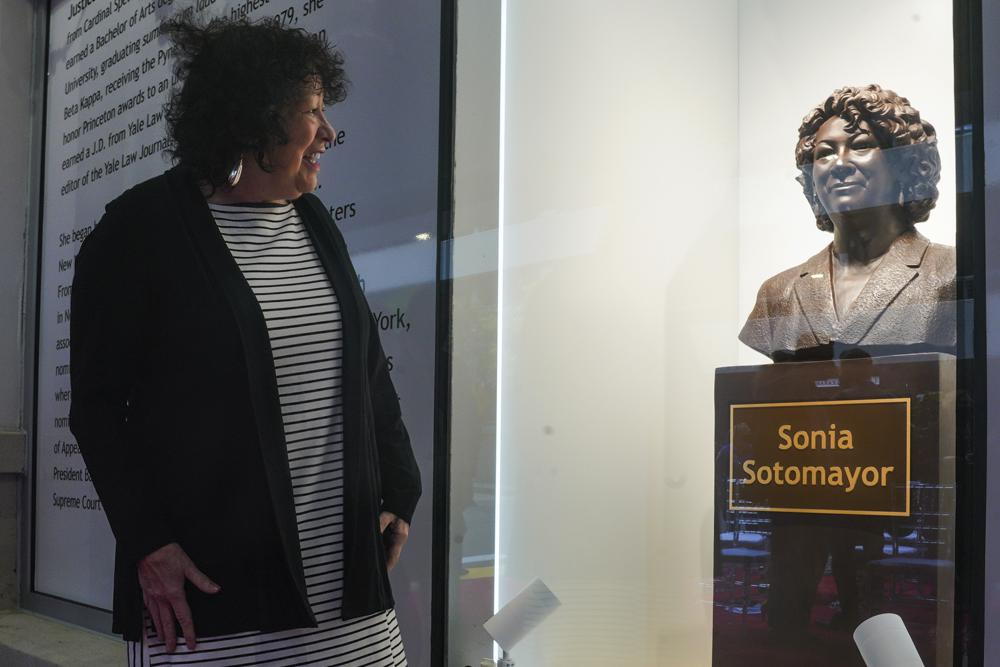
There is already a Justice Sonia Sotomayor Community Center and Sotomayor Houses.  The latest is a statue at the Bronx Terminal Market. Sotomayor is a big one to educate the public, probably part of why she was picked (including as a Latina).  She has included in this some local attention

===

Sotomayor dropped a brief order, the first stand alone order found on the Order Page (some actions are not found there) in a month, in a pending case that has received some attention. This includes from Steve Vladeck, whose shadow docket book is now available for pre-order.

Upon consideration of the application of counsel for the applicants and the response and reply field thereto, it is ordered that the injunction of the New York trial court, case No. 154010/2021, is hereby stayed pending further order of Justice Sotomayor or of the Court.

Amy Howe on Twitter briefly translates:

Justice Sonia Sotomayor has put on hold a NY state trial court's order that would require Yeshiva University to recognize an LGBTQ student group. In a brief order, Sotomayor stays the lower court's order "pending further order of the undersigned or of the Court."

(She expanded it for her full discussion which is at her blog and at SCOTUSBlog, where the photo is also posted.)

What this actually means is another matter. The case -- as noted by the group challenging the request -- is in its early stages. There is no compelling reason AT ALL for the Supreme Court to use (to use the jargon) its "rocket docket" here.  The case itself is not a major one (the group can still meet on campus and the like as I understand it; it's a limited benefit) as such. The principle at stake might be. 

OTOH, the Court majority simply put selectively favors its own view of free exercise [a comparable argument made by the university can be made by a secular one too on academic freedom or free speech grounds, but here it has a religious character].  EVEN THERE, this is a bit much.  

This is not to say that the full Court will actually "go there."  Looking at a few "legal nerds" on Twitter, the general assumption is that at least someone (more likely more than one) is likely to support Yeshiva here.  The question then will be if the whole Court will (likely with dissent) do so.  

The order is basically a holding action.  

We can only guess at why it was dropped now. Some did. Which is okay.  But, that's all it is.  All I'll say is that the special attention given to this case (it isn't a death penalty case or something; so why is it so time sensitive?) sends a message of endorsement of religion.  But, the Supreme Court these days does not really find that problematic.  

So we wait.

Monday, July 11, 2022

Griswold Again

The Dobbs majority (joined by Thomas and Kavanugh in concurrence though Thomas does want to go further) assures us that Roe v. Wade is special. The dividing line?

its effect on what Roe termed “potential life.”

Yes, the opinion does note that the contraceptives use ban at stake in Griswold was an "outlier" (the state pushed back on exactly how true that was). Nonetheless, the majority attacks the right to privacy too, at the very least as it is covered by Griswold, Roe, and Casey. Thus, Griswold's reasoning is attacked:

Since Griswold, the Court, perhaps recognizing the facial absurdity of Griswold’s penumbral argument, has characterized the decision as one rooted in substantive due process.

We are told that it a right to choose an abortion is not saved because it is somehow connected to family life and marriage since on a "a high level of generality, could license fundamental rights to illicit drug use, prostitution." Again, that is the sort of thing cited when contraceptives and so called "sodomy" (a crude term for non-vaginal intercourse) were involved.  

An opinion that purports to show -- contra how many historians frame it -- that abortion was never really seen as a legal right should not find it too hard to show that open access to contraceptives is not based in "deeply rooted in history."  

How about the potential life thing?

We are already getting evidence that a ban on abortion ("abortion") can lead to blocking what many deem birth control.  This news story shows how the IUD (the most reliable birth control method) is at risk. The Hobby Lobby case also shows how what people do not really deem "abortion" can be so labeled, including morning after pills.  And, on a wider level, the Catholic Church very well thinks birth control "involves" potential life.

Anyway, is there some "facial absurdity" to Griswold's argument?  The idea (to cite Holmes) that the Fourth Amendment's "penumbra" involves a broad "right to privacy" is often seen as arising in significant part from Justice Brandeis' dissent in Olmstead v. United States.  

As noted by Griswold, various Fourth Amendment cases speak of some "right to privacy." The footnote cites a 18th Century case protecting "sanctity of a man's home and the privacies of life."  Justice Harlan, whose Poe v. Ullman dissent was accepted in time as basically official, was also cited by a concurrence citing the same principle:

Certainly the safeguarding of the home does not follow merely from the sanctity of property rights. The home derives its pre-eminence as the seat of family life. And the integrity of that life is something so fundamental that it has been found to draw to its protection the principles of more than one explicitly granted Constitutional right. . . . Of this whole `private realm of family life' it is difficult to imagine what is more private or more intimate than a husband and wife's marital relations.

Harlan also wrote an opinion cited in Griswold holding that freedom of association has a "close nexus between the freedoms of speech and assembly," including the privacy of one's associations.  The opinion cites a few other cases (and writings) that show a right to "privacy" was recognized.  Sometimes, it was more of a general "liberty" (such as to raise one's children), but sometimes it was in cases involving specific rights.  

I do not see the 'facial absurdity" of the idea the same applies with other enumerated rights, privacy has a "close nexus" with them.  A bit of research can show how self-incrimination is part of the whole here (up to the of torture to force an invasion of one's conscience here). The same can be said about a right to conscience (First Amendment) though the opinion itself (as compared to the briefing) does not really address that.  

Justice Douglas in his Poe. v. Ullman dissent does not limit himself to some "penumbra" (though he used the terminology pre-Griswold), arguing that privacy generally is a necessary part of a free people.  He noted the importance of privacy in an earlier dissent, showing in part the wider First Amendment aspects involved:

The First Amendment in its respect for the conscience of the individual honors the sanctity of thought and belief. To think as one chooses, to believe what one wishes are important aspects of the constitutional right to be let alone.

A true respect of this principle, including as expressed in our history and traditions (and the text of the First Amendment), is not to draw a line among privacy precedents (or "liberty" precedents) at some greatly disputed, heavily mixed with religious belief, matter of where life begins.  

I do not think it absurd, especially as a means to try to practice (a bit ironically here) judicial restraint, to fit a right to privacy regarding birth control and general reproductive choices as a a wider application of enumerated rights.  

Melissa Murray in an article, for instance, reminds of a lesser known couple in the birth control litigation who wished to use it to secure a certain path as a couple.  Life choices here, association choices, can very well turn on not having the woman get pregnant.  The same applies to a person's equal citizenship role.  

I think it is probably true that reproductive liberty here is not merely a matter of fully protecting enumerated rights.  The enumerated rights do assume a wider range of freedom.  Nonetheless, it is not necessary or ideal to rest alone on them.  The Ninth Amendment and so on make this appropriate as well. 

(The usual framing of "matters relating to marriage, procreation, contraception, family relationships, and childrearing and education" is a mix of Bill of Rights and a wider understanding of freedom that grows out of history.)  

The "right to privacy" is a label that reflects a range of things. As summarized by one person (same cite):

The first is the right of the individual to be free in his private affairs from governmental surveillance and intrusion. The second is the right of an individual not to have his private affairs made public by the government. The third is the right of an individual to be free in action, thought, experience, and belief from governmental compulsion."

The contours here are determined case by case, in and outside the courts.  Justice Harlan's concurrence in Griswold is basically correct that the true restraint is up the judge, not some fantasy shibboleth (Mark Tushnet) like "history or tradition."  Who isn't in some way guided by that?  And, why is "potential life" separate from the rest here?  

Again, it is not like the Catholic Church admitted that contraceptives did not touch upon that.  And, how much of an "outlier" really was Connecticut?  For instance, regular controversies involving pressuring people to be sterilized continued at least into the 1970s.  Ironically, then, the military pressured women to get abortions.  

Is personal control over one's reproductive life so hard to separate from public sale of sexual services?  Years back, I imagined a right to prostitution.  You can craft one.  But, there is a pretty easy line drawn in current jurisprudence.  The same applies to regulation of the sale of illicit drugs though again cases do arise involving drugs, including lines drawn when you are forced to take it even to protect born humans.  

We past fifty years and are approaching sixty for Griswold v. Connecticut.  And, it is not yet quite secure, even though its popularity is so high that even Alito has to try to -- up to a point -- assure us (don't believe it) that Dobbs will not threaten its basic core and surely its principled wider application.

Saturday, July 09, 2022

Dobbs: The Majority

Okay. I really should have done this earlier, I guess, but it's time to look over the majority of the Dobbs opinion. 

Meanwhile, President Biden handed down an executive order, and Biden and Harris continue to meet with pro-choice leadership.  I wish there was more coverage of such matters.  For instance, after leading with yet more coverage of the 1/6 Committee and related matters, Chris Hayes had a guest talk about the order in the last five or so minutes of his show yesterday.  

Maybe, if there was more coverage, the "Biden isn't doing anything" type responses would tone down a tad.  Melissa Murray (Strict Scrutiny Podcast, familiar face on cable shows, etc.) on Twitter noted that basically the bottom line thing that matters now is November.  I do wonder what executive orders will do.  Probably at some point we will have litigation on state power to ban use of abortion drugs and travel issues. 

For the first 185 years after the adoption of the Constitution, each State was permitted to address this issue in accordance with the views of its citizens. Then, in 1973, this Court decided Roe v. Wade

Okay, I know, I have to deal with Alito.  This isn't really true.  I think that is going to be a theme.  Before Roe, multiple state and federal courts limited the power of the states in this issue.  Alito cannot even toss in a comment about some "recent" move here in the courts.  He has to say that Roe suddenly out of the blue changed things.  It did not.  

Although the Court acknowledged that States had a legitimate interest in protecting “potential life,” it found that this interest could not justify any restriction on pre-viability abortions. The Court did not explain the basis for this line, and even abortion supporters have found it hard to defend Roe’s reasoning. 

This is a lie.  It is a blatant (deep breaths) lie that "any restriction" was not allowed.  Words have meanings.  For instance, only allowing doctors to perform an abortion is a "restriction."  The word must be being used to mean "total ban," but that is not what he said.  

I left out a footnote citation, but it page cites a summary of the trimester lines.  It explained the "basis" of each.  Again, he could have said the basis was "wrong" or something.  But, the basis -- another tiresome case where a normal word is used as a sort of narrow code meaning -- was cited.  The Roe Court balanced state interests with the right to choose.  

[ETA: I want to underline this. The "trimester scheme" (as it is sometimes called)  is doctrine.  There are lots of doctrines.  They balance a range of things and channel them into applicable lines.  So, for instance, maybe you have to bring someone in front of a judge within "x" amount of time.  

Roberts posed some vague balancing test rule.  The trimester rules, like  like the Lemon Test or the three part test on how to define obscenity, allow people, including judges and law makers, to  have a more workable set of rules.  There will be some disputes, but it provides some basic guidance.]

In defending this law, the State’s primary argument is that we should reconsider and overrule Roe and Casey and once again allow each State to regulate abortion as its citizens wish. 

As noted by Roberts, the case was granted to consider a more narrow question, and it allows them to cheat to use their "primary" argument for the Court to do something it specifically didn't grant the case to decide.  The Court -- when it suits -- repeatedly does not allow that sort of thing. It even sometimes "DIGs" a case, disposes it as improvidentially granted, when the arguments made seem to be beyond the question presented. 

The Constitution makes no reference to abortion, and no such right is implicitly protected by any constitutional provision.

A state law that forces people to serve as incubators sure sounds like a form of involuntary servitude to me.  

BTW, the opinion tosses in various people who criticized the reasoning of Roe, without noting that they repeatedly also supported a right to choose, including (John Hart Ely Jr.) upholding Roe as precedent. 

Roe’s defenders characterize the abortion right as similar to the rights recognized in past decisions involving matters such as intimate sexual relations, contraception, and marriage, but abortion is fundamentally different, as both Roe and Casey acknowledged, because it destroys what those decisions called “fetal life” and what the law now before us describes as an “unborn human being.

These other rights are not directly (but see, of course, the 9A etc.) by the Constitution either and many of the same rhetoric/arguments pop up [reading the dissent of Chief Justice Roberts in Obergefell v. Hodges is telling here; oh do read it], so this is a key issue.  

Still, two basic problems.  (1) Not sure why such disputed moral/religious belief is the dividing line -- if anything, the First Amendment alone suggests, it is less sensible to make an exception here of all places.  (2) The state interests -- at least so far -- aren't so serious that there is found to be a compelling state interest to block abortion from being allowed.  

We begin by considering the critical question whether the Constitution, properly understood, confers a right to obtain an abortion. Skipping over that question, the controlling opinion in Casey reaffirmed Roe’s “central holding” based solely on the doctrine of stare decisis, but as we will explain, proper application of stare decisis required an assessment of the strength of the grounds on which Roe was based.

The second section of Casey (before the stare decisis discussion) provides an extended summary and agreement with substantive due process. The section is assumed to have been written by Justice Kennedy.  The basic principles are reaffirmed in his same sex couples liberty decisions.  

The Constitution makes no express reference to a right to obtain an abortion, and therefore those who claim that it protects such a right must show that the right is somehow implicit in the constitutional text.

Again, it is unclear how "implicit" the right at issue truly is. Still, fine enough. We soon see that their criticism is simply not cabined:

Roe, however, was remarkably loose in its treatment of the constitutional text. It held that the abortion right, which is not mentioned in the Constitution, is part of a right to privacy, which is also not mentioned.

The choice of Alito to write this opinion (though as I noted before, Kavanaugh's concurrence isn't really much better) encourages this sort of tone.  At any rate, Roe v. Wade summarized a range of opinions involved here.  Casey provides more detail.  As did many other opinions, on various levels.  As did a lot of other people.  And, again, this is an open-ended criticism.  Why is Griswold acceptable on this light? 

Neither Roe nor Casey saw fit to invoke this theory

The opinion disposes of the equal protection argument -- which again is made regularly -- in a dismissive handwave.  The abortion cases regularly spoke of the importance of the right here for a "woman," including Casey saying things like "We conclude, however, that the urgent claims of the woman to retain the ultimate control over her destiny and her body, claims implicit in the meaning of liberty, require us to perform that function."  

“deeply rooted in [our] history and tradition”

The right to choose an abortion has been recognized as part of substantive due process.  This isn't the only way you can protect the right, but it is the core of Roe and Casey.  I should be careful there because again by the time of Casey, surely, it was recognized there was an equality component. Justice Kennedy recognized the overlap in Lawrence v. Texas.  

We now have some (selective) exegesis on history, which Roe allegedly either "ignored" (it has a LONG section on it) or "misstated."  As the joint dissent notes, it is unclear -- if the majority is consistent about its recent originalism -- how useful the centuries of history summarized is.  

The point seems to be 1868.  But, let's say the history is still garbled with comments like "Although a pre-quickening abortion was not itself considered homicide, it does not follow that abortion was permissible at common law—much less that abortion was a legal right."  

This sort of thing is refuted by others.  But, again, what is the point to debate on such terms?  As the dissent notes here and in the gun case, and heck the praying coach cases, history is Calvinball with this bunch.  

The inescapable conclusion is that a right to abortion is not deeply rooted in the Nation’s history and traditions. 

The dissent basically conceded this was true in 1868 ("right"), but it is a matter of debating terms.  What exactly does this entail?  Was  "right to interracial marriage" deeply rooted?  The answer from conservatives would appeal to the meaning of equality in the race context.  That is, the usual originalism game of selectively being concerned with generality.  

There was some sort of "right" to control your body, family size, and so on.  The evils of slavery involved black women not having such liberty.  There also was a mixed understanding of when abortion was necessary for health, again, there being some understanding that there was a right to basic well being here.  And, then, there was the problem of arbitrarily applying the rules here, including by abortion panels at hospitals.

The regulation of abortion arose for a variety of reasons, some valid (safety), some not (concern for eugenics or monopoly of medical control).   These all factor into "history" and "tradition" as does reasons why abortion rights  began to expand.  The majority at one point denies any "illegitimate" motives at all here. This is just one-sided history.  

One may disagree with this belief (and our decision is not based on any view about when a State should regard prenatal life as having rights or legally cognizable interests), but even Roe and Casey did not question the good faith of abortion opponents.

So, "a sincere belief that abortion kills a human being" is not the line that differentiates abortion rights, even though "destroying" such "life" is for some reason.  See above, where that underlined as a key difference with Roe. Again, we are firmly told that contraceptives or marriage is not at issue here.  And, "belief" to me sounds like a religious concept that as Casey noted must be left (well regulated to be sure) to the individual in this context.  

Instead of seriously pressing the argument that the abortion right itself has deep roots, supporters of Roe and Casey contend that the abortion right is an integral part of a broader entrenched right. 

As a supporter, this is not true, unless again "seriously" means "not the way I agree with."  Supporters cite basic principles of liberty and equality with deep roots.  Roe v. Wade suggested the right to privacy at issue goes back to at least a case back in 1891 or earlier.  See also, Griswold.

The basic principles have deep roots.  The specifics change over time some, especially as women and others are accepted as more full equal citizens.  This is developed by precedent, which is seen as too vague for the majority, though it is how law develops in general (see speech).  

The most striking feature of the dissent is the absence of any serious discussion of the legitimacy of the States’ interest in protecting fetal life.

As Chief Justice Roberts et. al. argued about same sex marriage, the appeal of letting others draw difference lines do not stop at abortion.  Justice Thomas' concurrence aside, this argument is a bit too open-ended for all five of them.  So, we are told that the "critical moral question posed by abortion" is the difference.  

But, no matter if it was cited as a "unique" act, the precedents do not say it is SO unique that it can be banned.  Various rights have "unique" aspects.  Raising children, for instance, is involves the interests of a being no doubt about it is a child.  And, is limited to this, the opinion can cover a range of things such as certain types of "birth control" and in vitro fertilization. 

The majority is again wrong to say "potential life" is totally ignored.  The dissent notes as much, noting how the interests are balanced. The viability line is one. Ditto such things as providing waiting periods or counseling materials.  I myself think some of these things as accepted by Casey goes too far.  But, it underlines the talking past each other here. 

We next consider whether the doctrine of stare decisis counsels continued acceptance of Roe and Casey.

You would think that this would come before an extended look at the question as if you were deciding it the first time.  

First, obviously, some major precedents were overruled.  The overruling tended to be a matter of a societal change. So, segregation no longer was seen as appropriate, or Lochner Era economic policy was no longer accepted.  As the dissent notes, it is unclear what foundational change happened here.  An illegitimate Court, particularly set up to be a conservative activist one, is why this happened.  

In this case, five factors weigh strongly in favor of overruling Roe and Casey: the nature of their error, the quality of their reasoning, the “workability” of the rules they imposed on the country, their disruptive effect on other areas of the law, and the absence of concrete reliance.

Roe "was [not] on a collision course with the Constitution from the day it was decide."  It fit into a wider collection of precedents that went back to at least the 1920s, if not before.  The quality of the reasoning regarding the basics was fine.  Again, Roe explained why it drew the lines it did, and at best there was some reasonable disagreement on where to do so.  

This section of the opinion again has the specious citation of people like Tribe or Tushnet who do not oppose the core of Roe v. Wade.   Casey [did not] "abandoned any reliance on a privacy right and instead grounded the abortion right" -- it just framed it as a "liberty" interest, if one with the same basic principles.  The "workability" of the fundamental right or undue burden test is as good as any number of constitutional tests.

The section also cheapens the "reliance" interests involved in basic assurance that one's reproductive liberty is protected.  The opinion has mere ipse dixit that somehow abortion alone is affected by its analysis.  If the principles cited are consistently applied, it does not.  And, abortion rights do not corrupt other areas of law. 

Finally, there the opinion was not "egregiously wrong" the day it was decided.  The reversal of a fifty year precedent warrants a lot more than is shown here, including a clear warning and full briefing specifically targeting it.  Precedents tend to develop over time, not suddenly -- because the personnel changes -- be overruled.  The action here is crude activism.  

[They then ridicule Roberts' attempt for a middle path.  I don't think his analysis is very good either, but it at least is more tied to the alleged issue at hand, and not a total YOLO job.  The proper path would have been a Citizens United reargument.]

Under our precedents, rational-basis review is the appropriate standard for such challenges.

This standard basically is a carte blanche to do anything you want.  The cases cited are economic regulation policy type cases that have no real limits.  The section has NOTHING that suggests there is some exception. Kavanaugh in passing says a life exception was granted by Rehnquist.  

But, even that, as the dissent notes, is rather vague.  Pregnancy itself causes a range of health problems. So, clearly such a rule has to be narrow in scope as not to swallow the rule.  Surely, rape is not suggested.  

There is a strand of cases that probably are not respected much by various members of the majority that are concerned with discriminatory laws (a case like Romer v. Evans), but the opinion without analysis ridiculed the idea that anti-abortion laws are of that caliber.  It is hard to see what laws would be deemed illegitimate.  

Kavanaugh assumes a law blocking travel would be struck down (unclear).  The majority doesn't say this. The only time that comes up in any fashion is ridiculing the viability line to the degree that it might be somewhat higher some places where it is more likely for a fetus to survive outside the womb with better treatment.  This leads one not to be hopeful the majority will respect some limits in extreme cases.  

===

The opinion then has an appendix that lists anti-abortion law through the years without providing context and discussion of their terms and the conditions involved in their passage.  Curiously, it does not have the most recent "reform" type laws (the list goes past 1868) or state court opinions that protect abortion rights.  

It cites a D.C. law without citing United States v. Vuitch, which provides an open-ended definition of "health" that flows directly into Roe v. Wade.  This appendix is more more selective look of history.  This is an illegitimate institution. 

ETA: One other thing to toss in is that the opinion is critical of Casey's attempt to appeal to the controversy as a whole, including its attempt to settle things on some level, especially since (of course) abortion is still a major dispute.  The majority said their opinion might be controversial, but that is out of their hands; they were just judging is all. 

I was never a big fan of some aspects of that approach and (though Breyer focused on it during the oral argument) the dissent did not focus on it too much.  But, it is appropriate to carefully handle major legal questions, including those with very sensitive and controversial aspects.  They reached out here and went out of their way to be a bull in a china shop. 

Sunday, June 26, 2022

Dobbs: The Joint Dissent

I will not provide a comprehensive discussion of the dissent. Here is one summary by a high school student (Class of 24) at High School SCOTUS. Other summaries can be found by Amy Howe and Dahlia Lithwick. These all provide various aspects covered, including talking about the majority opinion.  

[Also, Linda Coffee, the lesser known co-counsel in Roe v. Wade, is still around.  Just to check in.]

The dissent does not try to comprehensively argue for the constitutional right to abortion.  It does not discuss (flagged by Sotomayor) possible religious liberty arguments.  It references that the choice is a moral one that people have conflicting views over.  But, it does not address that argument. It does not discuss the (expressed more often in commentary these days) Thirteenth Amendment argument.  

It does not provide an extended look at how the liberty at issue arises from a range of constitutional provisions.  It does summarize the basic constitutional interests involved and precedents that protected them. This is a basic core of what is at stake:

The Court’s precedents about bodily autonomy, sexual and familial relations, and procreation are all interwoven—all part of the fabric of our constitutional law, and because that is so, of our lives. Especially women’s lives, where they safeguard a right to self-determination.

Without the ability to decide whether and when to have children, women could not—in the way men took for granted—determine how they would live their lives, and how they would contribute to the society around them.

This answers two basic arguments of the majority and concurrences. (1) Abortion is somehow unique (2) Only substantive due process is involved. It is not unique.  The right to choose an abortion is part of a united whole. And, it is one that is necessary for women's equality.  

The majority covers both.  This includes how the denial of a right to choose "situates a woman in relationship to others and to the government. It helps define a sphere of freedom, in which a person has the capacity to make choices free of government control."  The denial of this right, the idea that Constitution is "neutral" on this, is a horrible announcement. 

The dissent also reaffirms what is often known as "living constitutionalism" (some don't like that name), not primarily concerned about what the state of affairs was in 1868 or even 1972.  A lot has happened even in the last fifty years here.  The "common law constitution" approach looks at all the facts, including the law and experiences of each specific era. 

Those responsible for the original Constitution, including the Fourteenth Amendment, did not perceive women as equals, and did not recognize women’s rights.  

Instead, the Framers defined rights in general terms, to permit future evolution in their scope and meaning. And over the course of our history, this Court has taken up the Framers’ invitation. It has kept true to the Framers’ principles by applying them in new ways, responsive to new societal understandings and conditions.

I find the citation of "the Framers" overdone, but understand that by now that is how the Court and the people want to see things. One might call this part of stare decisis.  What the Framers did was ratify specific text, which we today have to apply, using our own judgment be an eye to the complete history behind us.  

And, I think many Framers was well aware that this was how it would happen. How else is open-ended language likely to be applied?  I think the dissent overdid the women's rights bit a tad.  The Constitution did provide certain equal rights to women. Women slaves were freed.  They had due process rights when prosecuted for a crime. And so on.  

But, clearly, in large part because they played only a limited role in the political process [not NONE -- women did speak out, petition, and so on], in 1868 they were not treated as full citizens.  The facts on the ground in 1868 has to be taken into consideration when history is referenced here. As I noted in the Kavanaugh entry, the history of abortion regulations here is complicated.  Breyer noted in his gun dissent that justices aren't historians. But, selective use of evidence is also what judges tend to do in general.

They also typically make access to early abortion easier, for example, by helping cover its cost.

The dissent has some bite, both snark (such as reference of the possibility of a right to time travel) and anger ("The effects will be felt most severely, as they always have been, on the bodies of the poor. ... It is a history of women dying.")  It also strongly replies to the majority on precedent, including how other countries also secure a right to abortion.  And, if some countries do so only in the first trimester, there are significant differences, including open-ended exceptions and a much stronger social welfare state. 

It makes the Court appear not restrained but aggressive, not modest but grasping. In all those ways, today’s decision takes aim, we fear, at the rule of law. 

The YOLO Court.  At some point, it must get oh so tiring.  

And after the fetus’s viability—the point when the fetus “has the capability of meaningful life outside the mother’s womb”—the State could ban abortions, except when necessary to preserve the woman’s life or health.

The dissent takes Planned Parenthood v. Casey for granted, and realizes Chief Justice Roberts is but one vote.  His concurrence is (as I noted) dealt with in basically a dismissive way in one sentence.  They don't agree with him, but clearly the majority is much worse.  Since the majority set the line at fertilization, and there is so much more to talk about, a debate over line drawing is not covered.  

That is, the dissent does not substantively (other than as an appeal to precedent that reasonably decided the issue without any good ground to overturn) try to defend the viability line.  The quoted passage does suggest that there is a basic difference between so-called "potential life" inside the womb and persons protected outside it. One with a basis in the Constitution.  

The dissent denied that it did not recognize any state interest in potential life. By accepting the current balance, the dissent was accepting that the growing life inside the womb legitimately can be recognized in ways not in place otherwise.  Again, the dissent did not in depth discuss such things, and I would not be surprised if Sotomayor might have differed some from the others (at least) on what exactly was involved here.

The extreme take of the majority eased the task here. Again, it might have been reasonable to have re-argument to carefully examine such questions.  Plus, overall, they are obviously touchy. To make a reference to the opening tweet, there is an overhang of religion there.  Anyway, are you ready for more SCOTUS?

ETA: The dissent now moves to the country, including in theory Congress:

It can impeach and remove justices. It can increase or decrease the size of the court itself (at its inception, the Supreme Court had only six members). It can strip the court of its jurisdiction over certain issues or it can weaken its power of judicial review by requiring a supermajority of justices to sign off on any decision that overturns a law. Congress can also rebuke the court with legislation that simply cancels the decision in question.

When the Republicans gained control in 1801, it responded strongly to the Judiciary Act of 1801, including causing a delay of the judgment of Marbury v. Madison.  Republicans in the 1860s controlled the size of the Supreme Court and jurisdiction. So, these things can be done.

But, good luck with the current 50-50 Senate, even if you can convince the thin majority of the House (now with a new Republican, replacing a conservative Democrat who resigned this year). Long term, however, something needs to be done. Short term, the move is trying to win as many seats as you can.  And, I would say, confirm as many judges.

As to the majority opinion, I leave the dissent to answer it.  The only thing I would add is that it simply is unclear what sort of regulation would violate rational basis. Its brief discussion at the end surely does not clarify much.  Kavanaugh cited Rehnquist's comment that a life of the woman exception would be required.  

But, as I noted, how strong would even that be?  The three district court in Roe itself said the law there was vague.

Dobbs: Kavanaugh Concurrence

One minor debate going on is who exactly assigned the opinion. Roberts concurred in result, but not in the overruling Roe/Casey. Some, but not the joint dissent, handwaves the difference. The majority is not just a minor change from Roberts' position. It is shades of Justice Brennan not assigning a death penalty case because he strongly disagreed with the plurality only finding the specific law a problem. 

And, why would he assign it to Alito of all people?  If you are going to overturn Roe without being a total ass about it, when dealing with something like this is sensible, Kavanaugh or Barrett makes some sense.  Barrett knows how to sound reasonable and professional.  Kavanaugh seems more forced about it.  Gorsuch always lays it on a bit too thick and his originalist sentiments make him too Thomas-y.

Barrett (unlike in the gun case, where she tossed in a brief professor-type concurrence) decided to sit this one out. Kavanaugh, who Collins is full of shit to be so "shocked" about, did write a concurrence. He was in "I'm so reasonable, let me explain" mode.  I will let you off the hook and not post a picture of him.  But, if it wasn't clear, I find this whole thing fucking bullshit.  A basic part of this is HOW DARE THEY.  But, 2016 (and January 2021) has a lot of ugly consequences. 

Anyway, Thomas' concurrence is short (under seven pages). Kavanaugh takes twelve pages.  Since he along with Roberts (see the gun case) are likely "swing voters" here, the concurrence is fairly important.  There is also a matter of how reliable the whole thing is.  The travel comment is strongly written, leading Kate Shaw (Strict Scrutiny Podcast / Chris Hayes' wife) to think it is likely to stick. Her co-hosts were doubtful.

If Roberts, like he did in the gun case, went along with the majority, he might have signed on to this Kavanaugh concurrence. Now that the opinion is here, it is somewhat academic to imagine if there is any anti-abortion law that Roberts would not agree with but Kavanaugh would.  Perhaps, something of the sort of SB8, that screws up normal judicial rules.

I write separately to explain my additional views about why Roe was wrongly decided, why Roe should be overruled at this time, and the future implications of today’s decision.

This is again typical O'Connor/Kennedy sort of thing to try to frame a majority opinion and explain why a "centrist" type is going along. Such people are not just ideologues, mind you, they are just looking at this reasonably.  It is clearly his view of himself at this point. 

And, putting aside the "it's the law, we just have to see how it falls" (which Kavanaugh joined) Alito remarks, finessing societal reaction like this is part of the game, so to speak.  That is a basic assumption regarding respect for how Chief Justice John Marshall handled things in Marbury v. Madison. That is, a judicial, in a form of that word, approach that carefully addressed public and institutional realities. 

The issue before this Court, however, is not the policy or morality of abortion. The issue before this Court is what the Constitution says about abortion. The Constitution does not take sides on the issue of abortion. The text of the Constitution does not refer to or encompass abortion.

Usual stuff -- abortion is a matter of deep dispute and there is no reason for the courts to step in. The Constitution is "neutral" on the question.  This is false. I have spent decades talking about this and in "Joe's Constitution," I spend a chapter running down the multiple constitutional provisions involved here.  A basic point here is that enslaving people is something the Constitution does not allow.  

(The Constitution is "neutral" -- to be clear -- on the result, just as it is "neutral" regarding whether someone needs to believe a certain idea or religious belief.  The very right, the very equal liberty, to make these decisions and all that entails, is something the Constitution is not neutral on.)

The concurrence is striking in that it tosses in some conservative shibboleths (to use Mark Tushnet's term).  Some might not expect this sort of thing from this guy:

The Constitution does not grant the nine unelected Members of this Court the unilateral authority to rewrite the Constitution to create new rights and liberties based on our own moral or policy views

This is the usual strawman (straw-bro?) bullshit.  There is no need to "rewrite" things here.  "New" rights are not being created out of whole cloth.  The right to choose allows individuals to choose their own moral views, with clear religious liberty aspects.  The "policy views" are based on constitutional principles.  There is a strong debate on what they are.  But, it is not just justices relying on their "own" views.

As I see it, the dispositive point in analyzing American history and tradition for purposes of the Fourteenth Amendment inquiry is that abortion was largely prohibited in most American States as of 1868 when the Fourteenth Amendment was ratified, and that abortion remained largely prohibited in most American States until Roe was decided in 1973.

One thing covered in the discussions of this case is the complexity of how "largely prohibited" abortion was in 1868.  The same can be said for its prohibition afterward.  Lawrence v. Texas comes to mind.  For instance, there was a general opposition to targeting women themselves in enforcing anti-abortion laws.  A telling point that is just one reason why abortions occurred in large numbers during this period.

Abortion was legal in various ways during this period. Also, one reason why we have constitutional rights is to serve as checks against legislative violations.  The Thirteenth and Fourteenth Amendments were ratified to override many current policies and the decades afterward were filled with state laws that were later found to violate its terms.  

Finally, why the laws were in place is a rather important matter. Medicine significantly developed.  Times changed, and a growing understanding that women should have control of their own health care arose.  Such things reflect other cases where courts determine that merely because something was illegal did not mean constitutional rights were not present.  

The Court in Roe erroneously assigned itself the authority to decide a critically important moral and policy issue that the Constitution does not grant this Court the authority to decide.

How? It can't just be that some disputed moral issue was involved. The courts (see Tocqueville) decide greatly disputed moral issues.  How did it "distort" its role?  How is Roe different, for instance, from Griswold Other than pointing out that Casey did not end the big debate, I see no ... NONE ... discussion about this.  It's just his ipse dixit

Be sure, tossing in his usual weasel, he has "deep and unyielding respect" for the Casey plurality.  I'm sure you are quite supportive of your predecessor.  Not sure how far Souter or O'Connor (if she was competent) would want to toss you though.  

I emphasize what the Court today states: Overruling Roe does not mean the overruling of those precedents, and does not threaten or cast doubt on those precedents. 

Like the majority (and Thomas to the degree he claims abortion is unique), Kavanaugh assures us that contraceptives, same-sex marriage, interracial marriage, and so on won't be threatened. On some level, that is somewhat reassuring, and I don't think Roberts or Kavanaugh really want to go as far as some make out is liking. Can we stop with the "Loving is next" stuff?

But, Roe reflects the basic principles of these precedents.  It is hard to believe Dobbs (especially given some of its language that is far from so easily cabined) will be so limited.  A basic thing that is clearly next is just what "abortion" entails, including IUDs, abortion pills, and so forth. And, what about in vitro fertilization or stem cell research?

And, why exactly is same-sex marriage different?  The Chief Justice strongly dissented in that decision.  It was 5-4.  It was a greatly disputed moral matter. There was a long history of non-recognition of same-sex marriage.   The dissent's "well, we want to believe you but" replies as much as those from those specifically affected (GLBTQ) have bite.

For example, may a State bar a resident of that State from traveling to another State to obtain an abortion? In my view, the answer is no based on the constitutional right to interstate travel. 

There will be -- as noted last time -- a slew of legal questions to determine in state and federal courts.  Not even "will no longer decide the fundamental question of whether abortion must be allowed" is likely to be true unless "fundamental" does a lot of work. As the dissent notes, what about if it is necessary to protect health?  Mind you, every pregnancy is a health risk.  Would a ban be even "rational" then?

I surely think you cannot block a person from traveling to another state to have an abortion (or any number of things).  Move beyond the burden in place from having to travel.  But, it is far from clear how the courts will finally determine various issues here. For instance, can a state penalize a doctor licensed in said state for providing abortion services elsewhere?  

(The linked article -- also cited by the dissent -- provides various complexities about how a state might penalize out-of-state action.  And, what exactly -- as it notes -- will "interstate" quite mean?  What if you call a clinic for an appointment or help someone go there? Is this "in" a state and something the state can criminalize as aiding and abetting an abortion?)

And, he tosses in an unlikely concern about states penalizing people for abortions before Dobbs. That would clearly violate the Ex Post Facto Clause.  But, any "liability"  (see SB 8) is less clear.  That clause from the 1790s only applied to criminal behavior.  It would be a question of procedural due process to determine.  Anyway, even that, seems not really a major concern. 

greatly respect all of the Justices, past and present

Sure you do.  You just assume they are blatantly violating their judicial duties, including the "constitutional principle of judicial neutrality."  

The concurrence ends:

The Court today properly heeds the constitutional principle of judicial neutrality and returns the issue of abortion to the people and their elected representatives in the democratic process.

The "issue of abortion" will remain subject to a range of legal disputes.  The state of California regulated crisis pregnancy centers and the Supreme Court struck down as unconstitutional a reasonable disclosure law.  Tell me again how ...

As Justice Scalia explained, Roe “destroyed the compromises of the past, rendered compromise impossible for the future, and required the entire issue to be resolved uniformly, at the national level.” 

The Supreme Court allowed the states discretion on how to regulate abortion, including as applied to waiting periods, who performs them, parental involvement, medical regulations of a varied type, how exactly to frame informed consent, and more.  No, it did not allow states to enslave people by forcing them to be incubators.  See, Amendment 13.  

And, it is so very rich that the same people who support the reduction of voting rights talk about tossing things back to the people themselves.  Plus, this result came via minority rule, mixed with other skullduggery. Normal practices put in place a Supreme Court that upheld Roe.  

I'm not inclined to go all the way like those who attack the Court as a historical institution, but talking about the one in place now, the general sentiment when people like Kavanaugh talk in this fashion is STFU.  And, yes, we should not merely accept them ala Breyer being so pleased with the response to Bush v. Gore.  The start of a solution is often a change in mindset.