I cover both here.
About Me

- Joe
- This blog is the work of an educated civilian, not of an expert in the fields discussed.
Showing posts with label 2020 elections. Show all posts
Showing posts with label 2020 elections. Show all posts
Tuesday, May 19, 2026
Sunday, February 15, 2026
SCOTUS Watch: Past and Future
Scalia/Court Expansion
The tenth anniversary of Justice Scalia's death recently passed. Volokh Conspiracy had multiple positive accounts. A Fix the Court email update I received was more negative.
My position is also largely negative. See here. I linked a VC post, and "Joe" says more over there.
Scalia's death led to a de facto "packing" of the Court when Republicans refused to even have a hearing for Merrick Garland. They then rushed (one month) the confirmation of Barrett.
Raw political hardball mixed with hypocrisy.
A minority argues that the overall history here warrants court expansion. Only a small number of Democrats in Congress openly support this. Some observers are loudly supportive.
The FDR court "packing" scheme is cited by both sides. Did it help change the law, or is it generally a sign the whole thing is a bad idea?
FDR'S Gambit by Laura Kalman provides a detailed account while near the end drops an opinion that it was helpful for FDR's ends.
I found the book a tedious slog, without ignoring it is also an impressive work of scholarship. There is a lot of unnecessary detail without overall seeming to add much. I finally gave up reading the book straight through around 100 pages in.
There are, as is usually the case, some interesting and informative details. Overall, however, I don't think I learned much new about the bottom line.
The book ends up somewhat agnostic if dubious about a court expansion proposal today. The book was published in the middle of the Biden Administration.
Ultimately, an expansion proposal should at least be pushed as a negotiation tactic. I have discussed this in the past and won't repeat myself here.
We now have evidence that Alito will retire soon, maybe in a few months. A 6-3 Court with four (and I think Thomas will resign before the end of Trump's term) younger conservatives nominated by Trump is just appalling.
Something major has to be done if the Democrats get a trifecta. A strong expansion faction might make it more likely that we will have serious reforms passed.
SCOTUS News
SCOTUS dropped a schedule for the final oral arguments.
It also "may" (nearly always means they will) announce opinions on the 20th (when they officially come back from their break), 24th (they start hearing orals again the day before), and 25th (my sister's birthday). SCOTUSblog will have live blogging.
For whatever reason, Oyez.com still doesn't have the opinion announcements from last term. There is a new AI-aided approach to provide video. Fix the Court has more, and its comments are basically on point.
John Oliver's dog justice videos were good, too.
Holiday
Okay. So, next Friday is when the justices officially come back with a conference (surely) and opinion announcements (probably).
Tomorrow is a holiday. A historian is wary about the "monarchial" practice of celebrating presidential birthdays. Her piece is generally on point.
The name of the holiday varies, including the use of punctuation. On the federal level, it is George Washington's Birthday, which was originally February 22 (using today's dating), so it is somewhat early to celebrate it on the 16th.
Sunday, February 08, 2026
Storm at the White House

A narrative history of the events of January 6th is still hard to read. The book provides diverse voices, including police, members of Congress, and even some insurrectionists ("protestors or riots" in the author's words, but multiple members of Congress, including Mitch McConnell, called it a failed "insurrection"). The violence was horrible:
Weapons [used against the police] included hammers, rebars [metal bars], knives, batons, and police shields taken by force, as well as bear spray [meant to stop a 500-1000lb animal] and pepper spray. Some rioters wore tactical gear, including bulletproof vests and masks.
An officer later described a fellow officer being tasered. The officers were also hit, gassed, choked, and more. Four officers were so stressed out that they committed suicide. One died of "natural" causes.
Rep. Mullin (R-OK), after Babbitt was shot:
He [U.S. Capitol Police officer] was the last person in the world that ever wanted to use force like that. He wasn't wanting to do that. I know for a fact, because after it happened, he came over. And he was physically and emotionally distraught. And I actually gave him a hug. And I said, "Sir, you did what you had to do."
(He later voted to object to the electoral votes, the debate over which was ongoing when they had to take a break because of the storm at the Capitol.)
People were prepared for battle:
US Park Police officers reported seeing "numerous individuals" with firearms, pepper spray, pipes, and other possible weapons. Others were wearing body armor and riot gear, carrying radio equipment, and wearing "military-grade" backpacks. Among those who were screened, the Secret Service had confiscated hundreds of prohibited items -- knives, pepper spray, brass knuckles, gas masks, Tasers, body armor, and batons.
[The claim that the protests were peaceful is absurd. There is also clear evidence that guns were involved. Strict D.C. gun laws did help keep more people from bringing them. Even stun guns are quite dangerous.]
VP Mike Pence comes off well. A staffer quoted 2 Timothy to express his actions on that day: " I have fought the good fight, I have finished the race, I have kept the faith."
A symbolic moment was now Sen. Kim (NJ) going outside of the House chamber and starting to, by himself, join in the clean-up. The official vote count was complete late in the night, hours later than necessary because of those objections.
Trump told the protestors to "be wild" and let them be wild for hours, until telling them to leave. He was correctly impeached (10 Republicans), but only a few (seven) Republicans voted to convict. Thus, we are where we are.
The vile video, which repeated false claims about a stolen 2020 election, showed the Obamas’ heads edited onto the bodies of apes as part of a “Lion King”-themed meme that cast Trump as “King of the Jungle.”
Republicans aid and abet Trump. They now and then find something to be upset about. People like Senator Tim Scott, who is suddenly appalled at Trump's racism. I'm with him:
“This disgusting video posted by the so-called president was done intentionally,” Jeffries said. "Fuck Donald Trump and his vile, racist, and malignant behavior
“This guy is an unhinged bottom feeder,” Jeffries added. “Every Republican sycophant who continues to stand by their cult leader should be run out of office.”
[The NY Daily News didn't spell out a certain word, but Jeffries said it.]
Every time Trump does something, remember it isn't just him. He is there because of his aiders and abettors. We talk too much about him. This is a wider problem. It is both natural and misguided to focus on one person, both for doing good and ill.
Some -- like Mike Pence -- will have a limit and stand up at times. I doubt James David Vance would have acted like he did on January 6th.
We must continue, to quote members of both sides of the aisle on that day, not let the "thugs" or thug, as the case might be, win.
Tuesday, January 06, 2026
Friday, November 28, 2025
SCOTUS Related News
Originalism
This blog post on originalism is interesting even beyond the specific allegation. Originalism appeals to people for various reasons. Sometimes, outdated bad stuff helps conservatives.
When they want to support things that actual original understanding might not support (e.g., campaign finance bans or regulatory takings), they find a way around it. It's a bit of Calvinball.
For instance, Dred Scott v. Sandford had to play with history. The dissents show another path.
Brazil Recognizes Rule of Law
Bolsonaro to Start Serving 27-Year Sentence Over Coup Plot
Trump v. U.S. and the end of the Georgia prosecutions are not the only way. Multiple former Brazilian leaders were prosecuted for crimes.
I still don't understand, regarding the Georgia news, how some ethical issue involving a romantic relationship with the third choice for prosecutor was some sort of due process issue. Fani Willis at most should have gotten an ethical slap on the wrist.
As with Trump v. U.S., there was no need for the state supreme court to take the case, delaying things until after the election, which sealed the deal. And that included many state defendants who still could have been prosecuted now.
Limited Security Funding
As judges face more threats, only the Supreme Court gets new security funds
The number of judicial threats has increased over the last ten years. Trump's vitriol does not help. It led to multiple threats and even some actual sanctions during his civil and criminal trials. For what good that did.
The failure to provide more security funds for lower court judges (tough on crime!) is suspicious.
According to several former judges, the money issue has also fueled perceptions that President Donald Trump’s administration and its allies in Congress have politicized judicial security. In hearings this year on the judiciary’s budget, some Republican lawmakers criticized judges who had ruled against Trump’s policies and pressed judiciary officials who testified on whether they would try to rein in what the lawmakers called a partisan judicial process.
Right-wing attacks are not the only cause of judicial threats. Vitriolic attacks from the top, however, matter. It worsens the situation. It leads to some more harassment. An article linked to the recent piece notes:
A simpler solution, several former judges said, would be for Trump administration officials to cool their rhetoric, which they believe fuels threats from extremists and fanatical supporters. While the White House has denounced violence against judges, President Donald Trump and some of his most powerful allies have continued to use inflammatory language to lambaste those who rule against administration policies.
In social media posts Wednesday and Thursday, top Trump adviser Stephen Miller called a federal trade court’s ruling against the president’s tariffs a “judicial coup” and reposted photos of the three-judge panel, saying, “we are living under a judicial tyranny.”
[More here.]
More Trump News
The Supreme Court *delays action* on Trump's request to fire Shia Perlmutter, the register of copyrights at the Library of Congress, pending the court's decision in two upcoming cases about the president's authority to fire federal officials. Thomas would let Trump fire Perlmutter now.
(Mark Joseph Stern on Bluesky regarding a Wednesday Order. No discussion from justices.)
The second case is scheduled for January, so it will take some time. Meanwhile, the justices will be back on Monday with stuff scheduled until the 15th.
Monday, January 20, 2025

Tuesday, January 14, 2025
Jack Smith Report (Partially) Released
Senator Elizabeth Warren said back in 2019:
First, a hostile foreign government attacked our 2016 election to help candidate Donald Trump get elected. Second, candidate Donald Trump welcomed that help. Third, when the federal government tried to investigate, now President Donald Trump did everything he could to delay, distract, and otherwise obstruct that investigation.
That's a crime. If Donald Trump were anyone other than the President of the United States right now, he would be in handcuffs and indicted. Robert Mueller said as much in his report, and he said it again on Wednesday.
That's why I came out in favor of impeachment after reading all 448 pages of Mueller's report. This is not about politics — it's our constitutional duty as members of Congress. It's a matter of principle.
Warren supported changing the current policy against indicting sitting presidents. She supported a special task force to investigate the Trump Administration when she ran for president.
I cannot find the exact words but as I recall it would be separate from a normal investigation in the Justice Department. President Warren probably would have appointed a special counsel before Trump ran for re-election (2024). Biden did not do #2 and #3.
Attorney General Elliot Richardson promised Congress he would not fire the Watergate special counsel except for cause. Merrick Garland did not promise Congress to appoint a special counsel to investigate Trump. The Senate Democrats could have made that a grounds for their confirmation vote.
The release of Jack Smith's report related to the election interference case brings to mind these things. In hindsight, at least, a special counsel should have been appointed earlier. But, this is not just about Merrick Garland. The investigation of Nixon was not just about one person either. We need to know the full story to assign responsibility and know how to act in the future. Scapegoating is not advisable.
One analysis takes a strong potshot -- "dithering coward" etc. -- at Merrick Garland for not changing the policy against prosecuting a sitting president. What good was that going to do in context?
The policy allegedly is constitutionally required. I disagree but many liberal law types disagree with me. It is not just Merrick Garland. And, if the prosecution continued, Trump would have gone to the courts to try to block it. There was not enough time after the election to prosecute Trump before January 20, 2025.
Jack Smith's report argued that if Trump did not win the election, that evidence was there to convict. Chief Justice Roberts and his conservative crew slowed things down via Trump v. U.S. The trial could have been over months before the election.
The impeachment managers in Trump's first impeachment warned that if he was not convicted and removed he would "do it again." He did. As summarized by the Washington Post:
[Trump] pressed officials in key swing states to ignore the popular vote and flip electoral votes from Joe Biden to Trump; tried to submit fraudulent slates of electors from such states; threatened Justice Department leaders to open sham investigations and falsely claim election fraud to get states to join the plan; and pressured Vice President Mike Pence to use his ceremonial role overseeing Congress’s election certification on Jan. 6, 2021, to overturn the results.
The second impeachment involved a charge of insurrection. Others pointed to the 14A, sec. 3. disqualification provision. Jack Smith argued that as a criminal matter, the case was not clear enough to warrant that route. He used other criminal provisions.
The interference of the electoral count cited in the criminal indictment very well involves the sort of thing that is "insurrection" for purposes of 14A, sec. 3. The provision is not a criminal provision for purposes of the "beyond a reasonable doubt" standard.
But, even there, there were seditious conspiracy convictions in a few January 6th cases. There is a clear overlap between insurrection and sedition:
In order to win a seditious conspiracy case, prosecutors have to prove that two or more people conspired to “overthrow, put down or to destroy by force” the U.S. government or bring war against it, or that they plotted to use force to oppose the authority of the government or to block the execution of a law.
Garland did not release the second part of the special counsel's report respecting the classified documents case. First, let us recall the multiple delays there involved different issues than in the election interference case. Garland himself has even less blame in that case for the delay. Judge Aileen Cannon had a large role, for instance, in multiple delays.
Second, the reason is that two prosecutions are pending involving Trump flunkies involved in the mishandling of the documents. There is a sort of formal reasonableness to that but (1) without Trump, the cases are fairly trivial (2) the Trump Justice Department is likely to drop them.
(Yes, something to ask the presumptive Attorney General.)
The rest of the report will then likely be stuffed (again, ditto). Why not just drop the two cases and release the report now? I think it is correct to call out Attorney General Merrick Garland (who overall I think is a tragic figure who some people think was there to do one thing) here.
Trump is already a felon for election interference in New York related to the 2016 election. I heard on Fox News (someone else was watching it as I put together a table) an argument that the unconditional discharge shows how the prosecution was phony.
A confusion of cause and effect. The judge only provided that sentence for the same reason why Jack Smith dropped the prosecutions -- the rules for a sitting you know what. The special counsel's reminder is no less true because of its bad taste:
The Department’s view that the Constitution prohibits the continued indictment and prosecution of a President is categorical and does not turn on the gravity of the crimes charged, the strength of the Government’s proof, or the merits of the prosecution, which the Office stands fully behind. Indeed, but for Mr. Trump’s election and imminent return to the Presidency, the Office assessed that the admissible evidence was sufficient to obtain and sustain a conviction at trial.
If you want an assured happy ending, watch a Hallmark Channel movie. But, gaslighting aside, guilt is not washed away with nearly fifty percent of the fraction of the voting population that deigned to vote.
There are certain safeguards in place when handling dangerous items. Let us remember that when handling things after noon next Monday.
Monday, January 06, 2025
Trump/Vance Electoral Victory Confirmed (One Is Still Disqualified)
Trump aided and abetted the attack on the U.S. Capitol on January 6, 2021, which was an attempt to stop the peaceful transfer of power.
After a violent attempted insurrection, the electoral votes were counted early the next morning. The 14th Amendment specifically addresses keeping such people out of federal and state office:
No person shall be a Senator or Representative in Congress, or elector of President and Vice-President, or hold any office, civil or military, under the United States, or under any State, who, having previously taken an oath, as a member of Congress, or as an officer of the United States, or as a member of any State legislature, or as an executive or judicial officer of any State, to support the Constitution of the United States, shall have engaged in insurrection or rebellion against the same, or given aid or comfort to the enemies thereof. But Congress may by a vote of two-thirds of each House, remove such disability.
The Supreme Court, not even showing up to announce the unsigned opinion (5-4 on some points), blocked a state attempt to keep his name off the ballot in Trump v. Anderson. Later, they split by ideological lines regarding criminal immunity for such presidential acts. The case was well named: Trump v. U.S.
As Rep. Jayapal noted:
I know that many Americans across the country are still processing how it is possible that a President, who resisted the peaceful transfer of power four years ago and is also the first ever convicted felon elected, could enter the Oval Office.
Since the days of John Adams in 1793, vice presidents have presided over official counts even if they were one of the candidates. Vice President Humphrey skipped it in 1969. Might be the best policy.
There often were a small number -- not a majority of one party as with House Republicans in 2021 -- electoral vote challenges.
There was a proud but bipartisan tradition of using Jan. 6 to make technical objections within the byzantine electoral college system. And I think all of that got washed away with the attempted political coup and the mass insurrectionary violence of January 6 the last time around,” said Rep. Jamie Raskin (D-Md.), who had made a symbolic objection along with other Democrats to Trump’s victory in 2017.
Such challenges were not "election denial" generally speaking. They might have been picayune or wrongminded in certain cases. I think there was a reasonable ground to challenge after the 2000 elections. But, it is quite different when it is done after the Capitol is attacked as in 2021.
A majority of Republican House members (under 10 senators) furthered the lies that motivated the violence. That was wrong. We now will bend the other way. For instance, it would have been appropriate for someone to go on record to argue Trump was not constitutionally qualified.
They did not but a peaceful token resistance would not be what happened last time. As Jayapal reminds:
What we do today will be in stark contrast to what happened four years ago, when insurrectionists—fueled by sitting President Donald Trump — attacked the U.S. Capitol in the most violent attack since the War of 1812. That day, U.S. Capitol Police officers were killed, and hundreds — including over 140 law enforcement officers—were injured.
We still are processing "how it is possible" that Trump will be in power in two weeks. We should not just move on and congratulate ourselves on a peaceful transfer of power (when one specific side wins).
On a basic level, Trump won in the end, even if it took a few years. Rick Hasen continues the effort -- oh so reasonably -- of helping him to resist even largely symbolic consequences. For instance, reference to Trump's sentence "hanging over him" is some reason to block even an unconditional discharge.
(Hasen opposed the prosecution in the first place. I'm not going to shade his analysis generously here.)
What was the New York trial judge supposed to do? If he sentenced Trump before the election, there was a reasonable concern that it would be deemed problematic. Maybe wrongly, but his fears were well founded. So, he waited.
The sentencing process then involved some more procedural stuff that would take time. The appellate courts, especially the Supreme Court, have not shown much inclination to speed things along. Months upon months of appeals would still have occurred.
Same result: he runs out the clock. We failed as a nation in November 2024. It was a joint effort. We should at least remember what happened and still is happening. The voice of the people is not god.
We saw that in 2016. The person who tried to violently overturn the election last time gets a peaceful transfer of power this time. Rightly so, putting aside the whole 14A, sec. 3 issue, though I think it was a bit too easy. Still, shades of ...
Two more weeks of sanity.
Tuesday, October 29, 2024
Trump Is Among Other Things A Fascist
Steve Bannon refused to comply with a congressional subpoena related to the 1/6 investigation. Traditionally, this resulted in no real consequences. Sometimes, we had years of litigation. This happened here too. But, he eventually lost and served a few months in prison. He was released today.
I hope this will serve as a small deterrence to future stonewalling. It takes a lot. The whole branch of Congress has to agree to hold the person in contempt. The executive has to agree to prosecute. There is theoretically inherent contempt power for which Congress can act on its own. People talk about it. Good luck with it actually happening.
We still have much to learn about and address regarding January 6th. The greatest unfinished business involves Donald Trump. We are in a crazy situation where the guy is running for president and has a reasonable chance of winning. I hope he does not. I think he will not But, we shall see.
Multiple people, including academic experts and his former Chief of Staff, have labeled Trump as a fascist. The term fits even if it is one of those terms like "racist" which some only want to apply to other people. What more do we have to know about Trump before people are not wary about the usage?
We can summarize the qualities of fascism:
- Extreme nationalism
- Cult of Personality
- Militarism
- Ethnic Divisions
- Use of Mass Movements (Negative Populism)
- Denial Of Civil Liberties
What part doesn't apply to Trump? Yes. My mayor, currently indicted for federal crimes, Eric Adams associates "fascism" with Hitler. Adams is a Democrat and Kamala Harris supporter.
However, he wants to downgrade how bad the guy is, including as Trump has a NYC rally that is so bad that Republicans running for office in close races are running for cover. A rally that took place at the same location as a 1939 Nazi rally. A bit too on point.
Trump isn't Hitler, however, so Eric Adams doesn't want to call him a "fascist." Okay, dude.
"Fascist" is one of those words that are controversial. You can find people quite unpleasant without them being a fascist. But, at some point, we need to accept and remind people about how particularly bad some people are. Liz Cheney is not supporting Kamala Harris because Trump has a bad tax policy.
Anyway, among other things, I'm tired of, I'm tired of Eric Adams. New York City deserves better.
Friday, September 13, 2024
SCOTUS Update
Harris and the Supreme Court
Vice President Harris strongly supported abortion rights during the presidential debate. She also supports court reform:
Vice President Harris believes that no one is above the law. She’ll fight to ensure that no former president has immunity for crimes committed while in the White House. She will also support common-sense Supreme Court reforms—like requiring Justices to comply with ethics rules that other federal judges are bound by and imposing term limits—to address the crisis of confidence facing the Supreme Court.
(New issues page on her campaign website.)
Judges for Court Reform
Justice Kagan reaffirmed her support of a binding ethics code enforced by lower court judges. Likewise, she noted that the "emergency docket" (aka shadow docket) has been overused. Prof. Melissa Murray of Strict Scrutiny Podcast interviewed her.
(Kagan also warns Dobbs can be an open-ended threat to other rights.)
Former Chief Judge Diane Wood supports statutory term limits of federal judges. She even positively cited the Presidential Commission on the Supreme Court. That commission deserves a bit more love.
Broad 19th Amendment
I have previously argued that the 19th Amendment suggests an open-ended view of sexual equality.
Sexual equality is required to truly protect voting rights. Also, equal voting rights are part of a united whole of equal citizenship. More here with a connection to Dobbs (abortion).
Trump v. Anderson
A duo who argued the 14th Amendment warrants Trump's disqualification, using originalist arguments, has a follow-up to the ruling itself.
I don't agree with everything they say, especially that "obviously" original understanding, not SCOTUS precedent, provides meaning to the Constitution. However, it is overall a strong and correct reply.
They argue the per curiam -- at least the final version -- does not actually (contra the main concurrence) say only federal legislation will enforce 14A, sec. 3. States can't (even there, maybe they would have a role).
OTOH, the opinion leaves in language that leads people to think that. So, what it "really" says might be beside the point. If it is assumed they said it, it might be enough. Anyway, the whole thing is likely academic. As to Trump, one surely hopes so.
Ketanji Brown Jackson
Jackson's autobiography, Lovely One, provides an intimate life of her life.
The four hundred-page book, which she wrote with someone thanked in the acknowledgments, should appeal to the general reader. It might be a bit too long at 400 pages, but it is easy reading overall.
We learn about her parents, her academic drive (including debate in high school), her relationship with the white future doctor who became her husband, and the struggles of her older daughter (neurodivergent). The last subject is one of the more personal discussions, including the couple's struggles to balance career and family & find out what was the best academic path for their daughter.
[Like two ships passing in the night, Jackson and Barrett also worked at the same law firm, but apparently not at exactly the same time.]
She also informs us how she came upon her current hairstyle. Hair is very important to women of color. Melissa Harris-Perry on her MNBC weekend show (Perry and Chris Hayes had more ability to have free-range discussions on those shows) once had a very interesting segment on the subject.
Some readers might wish she talked more about law and her legal experiences. Jackson did cover that too though the section on her law school experience is brief except for a discussion on the law review.
The book ends with her Supreme Court confirmation so don't expect her to talk about her time there. She also followed the usual rules about talking about her Supreme Court clerkship though provided some basic details while not talking about inside material.
Overall, it was an interesting and personable book that should get a wide readership.
Upcoming
The new term will start on the first Monday of October. We will likely have more miscellaneous orders before then.
There will also be multiple executions, starting next week. There might be one or more final orders dismissing Hail Mary attempts to stop them.
Monday, August 05, 2024
A Few SCOTUS Tidbits
Missouri Loses
Missouri v. New York involves an asinine attempt to use original jurisdiction (disputes between states) to obtain a "stay of New York’s gag order and impending sentence against Donald J. Trump during the 2024 Presidential election season so Missourians can participate in the election free from New York’s exercise of coercive power limiting the ability of Trump to campaign."
The Supreme Court decided today:
Missouri’s motion for leave to file a bill of complaint is denied, and its motion for preliminary relief or a stay is dismissed as moot. Justice Thomas and Justice Alito would grant the motion for leave to file the bill of complaint but would not grant other relief.
Thomas and Alito likewise would have granted an asinine original jurisdiction complaint during the 2020 elections. They stated a principle that the Court had a duty to hear such a dispute.
The Court could reject it on the merits. I'm not sure why the motion is "moot" since a limited gag order is still in place as is the impending sentence. But, as usual, they have not deemed it warranted to explain.
Court Reform
Neil has a book coming out so is doing some interviews. Nothing too newsworthy so far.
One tidbit is that Congress should be careful when considering court reform. Okay. I grant "Oh shut up, you asshole" is a reasonable reply here. Still, who cares? So, the reform should be carefully handled.
As it should be. Judicial independence is a positive good. Term limits and so forth won't rob us of it.
There is still more news about Justice Thomas not disclosing his trips properly. Binding ethics reform will not harm the independence of the judiciary.
If done correctly, if anything, it will help promote judicial integrity. This will help people trust the courts to be independent without worrying that they are corrupt.
D.C. Trump Case
The D.C. Trump case is back in the district court after the Supreme Court finalized sending it back down, and the appeals court did so as well.
The district court now has to go through the complicated process of determining what can still be prosecuted. And, then, it will likely be appealed again. So, basically, more delay.
If the Supreme Court handled this matter properly, the trial could have been completed by now.
Monday, July 01, 2024
SCOTUS Watch: More Opinions with Some Tyranny
Stephen Breyer's Book
Various liberals were not impressed by Stephen Breyer's latest book, Reading the Constitution: Why I Chose Pragmatism, Not Textualism.
The book's purpose was to explain his approach to serving as a justice and judge and interpreting the law. His guest appearance on Stephen Colbert (blah) underlines he is writing for a broad audience. He has written some books for specialists. He intended a broader audience here.
If you want a readable (if still somewhat academic) book on his constitutional vision, you should read Active Liberty. It is shorter and covers the important bases. He had a longer one, which was still approachable. His book on international legal disputes also was not bad though some might find it too long.
This book is a slog. His message is important, which makes it unfortunate Breyer could not manage a condensed version. I am sympathetic to his purpose-based approach. I find originalism asinine. Textual (not the same thing) without more is inadequate. And, a book about how the Court is doing it wrong (though he is loathed to admit his colleagues, to whom he dedicated the book, using their first names, are ideologically biased) has value.
I wouldn't suggest this one even if from time to time there are some kernels of interest.
Yes, It's Bad, Even if It Is Not TOTALLY HORRIBLE
Some takes on the Supreme Court opinions underline how horrible everything is. Then, some people respond to argue things aren't that bad. They are pretty bad.
Multiple cases (including one handed down today allowing more time for people to sue) are blows against the administrative state. The opinions were 6-3 and each liberal took turns dissenting from the bench. The administrative state isn't dead. But, surely, as a whole, these cases were a BFD that were part of a years-long campaign.
The 1/6 statutory case was of limited reach. Nonetheless, it was problematic, especially how the case was framed. And, the majority [Jackson tried to show otherwise in her concurrence] helped. The "vibes" can influence lower court actions and how the overall prosecutions are interpreted publicly:
Among other things, that misperception will only further embolden a future President Trump, if he wins election this November, to drop the remaining January 6 prosecutions and pardon those already convicted — even where the charges are completely unrelated to the statute the court narrowed in Fischer. The justices are savvy, smart people who live both physically and metaphorically inside the Capital Beltway. They should have known better.
A reference in today's immunity case even suggests it might have some implications in the Trump trial. The Trump immunity opinion, which is horrible in a variety of ways, does not seal out all means to prosecute him.
Nonetheless, it significantly expanded (with the backing of a majority opinion of the Supreme Court) the reach of immunity from prosecution. Official presidential acts or even those on the edge ("presumptively" protected) now are immune, based on made-up rules. Melissa Murray of Strict Scrutiny underlines the breadth (here Barrett got off the bus):
Another huge aspect of this decision that is not being covered in media coverage--conduct that is protected (i.e. cannot be prosecuted) also can't be used as evidence to prove charges stemming from conduct that is unprotected. Totally hamstrings the prosecution. This is huge.
You know this is bad when the dissents don't end with "respectfully" dissent:
With fear for our democracy, I dissent. [Sotomayor]
In the meantime, because the risks (and power) the Court has now assumed are intolerable, unwarranted, and plainly antithetical to bedrock constitutional norms, I dissent. [Jackson]
Sotomayor dissented from the bench. The Supreme Court does not deign to provide audio or a transcript. Jackson dissented from the bench in today's administrative law case, which received less attention but was still important.
To bring the liberal trifecta (Barrett wrote the administrative case & Roberts the Trump immunity case), Kagan had the middle case involving Texas and Florida laws that targeted social media. All nine justices agreed the litigants aimed too high ("facial challenge").
A mixed majority went along with some more of Kagan's opinion, including a takedown on the Fifth Circuit. Three conservatives and to a lesser extent Jackson were careful to note the complexity of the issues. They felt the majority went too far into the weeds.
Kagan crafting together as much of a majority (six justices joined parts of her opinion) was something of a surprise. Many predicted someone else would write the opinion and that it would be more fractured. Anyway, the opinion was the calm in the storm, between two more problematic rulings.
Opinions done. They will hand down a "clean-up" Order List tomorrow. And, then it's summer recess with the usual practice being three summer order lists to quickly address odds and ends that come up before they come back.
Call to Action
The Supreme Court reminds us about what should be our focus. Dwelling on a bad debate performance or hoping for unicorns? Not what we should be doing.
First, we need to win in November.
Second, we need to reaffirm basic values. Justice Jackson's dissent in the Trump immunity case was a philosophical exercise, including the importance of individual accountability and limited presidential power. The administrative law cases also provide us a chance to address basic principles, including the role of Congress and expertise.
Finally, we have to focus on the problems with the Supreme Court. And, this Supreme Court in particular. They have ethical problems. Have too much unlimited power. And, standing pat without statutory and perhaps constitutional change (e.g., term limits) is untenable at this point.
The last part is a long time process. Change also will often require a trifecta (control of the presidency and Congress). We can imagine limited change (e.g., ethical tweaks) without that. Also, control of one house can result in oversight hearings and some pressure.
An informed citizenry starts now.
Friday, June 28, 2024
SCOTUS Watch: Bye Bye Chevron
Half of the six (two doubles) cases left were handled today.
First, the conservatives (via Gorsuch) upheld a law targeting the homeless as a generally applicable anti-camping in public law which is not otherwise cruel or unusual. Thomas (as usual) goes for bigger game, wanting to overrule a sixty-year-old precedent that blocked criminalizing drug addiction (illicit status offense).
Gorsuch spends a third of the opinion taking homeless policy and how much pushback the lower court opinion received before getting to the actual merits. Sotomayor (reading her dissent from the bench) argues the law is an unconstitutional attack on the homeless as well as likely having other problems.
[Did I say I wish opinion announcements were available on the website? Yes? I'm told I have said this many times. Okay.]
The BIG (and expected) opinion today struck down "Chevron deference," which was firmly established over forty years ago. The Supreme Court used to give administrative agencies discretion to interpret statutes unless it was blatantly wrong or violated some constitutional principle.
Roberts handled the great white whale for many conservatives as well as those who spend so much time and money to get the right judges. Showing how hard it is to move tankers and so on, the ruling doesn't give judges free rein. Agencies still have some deference. Noticeably less though. Basically, the opinion makes it easier for judges to intervene when they want to do so.
Kagan (reading from the bench) dissented for the liberals, including explaining why the Administrative Procedure Act does not require the result. The majority claimed that was the basis of their ruling though mixed in "the courts say what the law is" rhetoric. Thomas and Gorsuch (who blathered on about stare decisis) would have also firmly relied on that.
(Congress could in theory amend the APA but good luck with that.]
The decision gives federal judges much more power to interfere with the actions of administrative agencies. Agencies always had a large amount of discretion, often involving extremely technical and specialized matters. The modern administrative state only increased this principle.
The courts, including the Supreme Court, already have means of causing problems. There is the made-up "major questions doctrine," for instance, that has repeatedly caused the Biden Administration problems. The concept here is that when a piece of legislation is deemed too big, the courts can strike down things that allegedly go "too far."
This concept was involved in the final opinion, which will make it harder to address January 6th. One law professor noted the opinion, which narrowed the reach of one prosecution approach, reaches around 20% of the defendants. Not Trump, another assures us, well, not likely. Uh-huh.
Roberts took this one too. Jackson concurred, opening with an acknowledgment that 1/6 was horrible (perhaps since Roberts went another way), but that can't allow them to stretch the law. Barrett for the other liberals strongly dissented that the government did so. For instance:
The case for the Government’s interpretation is straightforward. It can be accomplished in three paragraphs, as compared to the Court’s many, many more.
Prof. Barrett also wasn't impressed by the majority's statutory interpretation that was "like using a hammer to pound in a screw." Their "atextual" reading did "backflips" and "failed to respect the prerogatives of the political branches." Again, Justice Jackson disagreed.
The net result is that the government has to go back and try to show that a correct application of the law would validly prosecute this defendant and anyone else who can bring a similar claim.
Again, this case isn't about Trump though I'm not going to be totally assured yet that somehow it will deemed to be. And, it is a "win" for that side in some ways.
Monday was announced to be the final day of opinions. They are running out of "power grabs" though the delay of the Trump case surely was.
ETA: As expected, SCOTUS denies without comment a request by Steve Bannon to keep him out of prison.
Friday, June 07, 2024
SCOTUS Watch: Financial Disclosure

Fix The Court provided an analysis of the gifts received by SCOTUS justices for the last twenty years. Justice Thomas stands out by a ridiculous margin. Alito and Scalia come up a respectable second. Justice Stevens is a distant third.
Other justices might have things to answer for but Thomas truly is the king of SCOTUS grift. And, who the heck would give Brett Kavanaugh a six-figure book payment? The article also reports that Thomas finally got around to disclosing two instances of Harlan Crow largesse (his Senate subpoena is still pending) while leaving out many more.
In a sane world, Justice Thomas would have long been investigated by a House impeachment proceeding for financial wrongdoing, including failure to disclose millions of gifts (ProPublica per the article estimates just one trip costing $500K). Not to worry:
At the Judicial Conference meeting in March, the head of the conference said a committee is still examining the allegations from lawmakers.
He is guilty of "bad behavior," which violates the basic requirement of being a federal judge. If the Democrats win the House, they should start an impeachment investigation. Justice Fortas resigned for a lot less.
Justice Jackson getting a few thousand dollars worth of Beyonce tickets and Sotomayor getting lucrative book deals are things to keep your eye on. Financial disclosure does not only include the ridiculous corruption of the likes of Thomas and Alito. So, let's have sunlight across the board.
The same is true with court ethics as a whole. Ethics should not be a partisan issue. McCain-Feingold supported campaign finance legislation as a bipartisan team. Morality and ethics should be a universal good.
The point holds that the blatant guilty parties are found on one side. Noticeably, not everyone on the side is equally corrupt. Nonetheless, ethical reform should be a non-partisan issue. It's not. Wonder why.
===
In MAYBE an ounce of justice is coming news, a federal judge has ordered Stephen Bannon -- who could have been in prison for multiple crimes at this point -- to report for his few month prison sentence for stonewalling Congress during the 1/6 investigation a few years back.
Meanwhile, Trump's son-in-law continues to act like an anti-American scumbag, using his connections to help enemies of our nation and way of life (see also, his friendship with the Saudi prince behind the murder of an American journalist).
This is all generally relevant since Thomas and Alito are MAGA supporters. After all, with Trump, Thomas enjoys watching his former clerks become federal judges.
Thursday, June 06, 2024
Georgia Trump Case Delayed Until 2025
Judge Aileen Cannon, a Trump-nominated judge confirmed after the people voted in 2020 (mid-November) continues to provide fodder.
She held the national security trial in indefinite abeyance. However, Cannon still has the chance to put forth asinine orders, such as giving argument time for friends of the court (amici) regarding the constitutionality of Jack Smith's appointment. This sort of thing is simply not done and is just a continual exercise of delay, delay, and more delay.
Multiple legal minds have been disgusted at her "incompetence" but the evidence at this point makes that generous. There is clear evidence of a pattern that shows bias or (at least) the appearance of bias. The rules in place make it extremely hard to remove her. The truth remains.
Question: Did Willis violate any laws, codes, or policies? If so, let them appeal. If not, there is no justice, and should be no peace.
Answer: I don’t think she did, no.
The Georgia trials (likely all of them though something may take place) will now be held up until 2025. Mid-2025, perhaps.
The appeals court agreed to hear if the trial judge's decision that Fulton DA Fani Willis could remain on the case after a conflict of interest dispute arose should stand. The appeals court has a busy schedule. So, on normal scheduling, this made it basically a goner.
(ETA: Yes, it was a long shot for the trial to begin in 2024, but there was still a chance. This decision ended any hope. It also helps delay the trials even further. Generally, even if the trials — remember there are many defendants — did not come, the possibility still would keep them fresh in our minds. This pushes the whole thing into the future.)
I say "basically" since it is hard to believe there is no room to speed things up for a time-sensitive case of this importance. The U.S. Supreme Court could have heard the Trump immunity case in December or January. I grant I know little about Georgia appellate law. Nonetheless, it would surprise me if it was absolutely against the law for the court to this court to speed up.
Prof. Anthony Michael Kreis (the "no" above) is an expert on Georgia law. He has regularly been a legal analyst, discussing state and federal constitutional law. Kreis is a reliable source. He is on Twitter/X and splits his time being a serious scholar and kidding around. I appreciate him except when he goes into "virtuous liberal" mode.
There are only two people responsible for the Georgia trial not having a chance to go to trial before the November 2024 election. Neither of them wear robes. History will judge them for their poor decisions, especially if Donald Trump wins the presidency. And rightfully so.
He's wrong as are those who "yes" him on the thread. What is particularly bothersome is that he does not even think they should have taken the case! It angers me that he wants to remove the agency of judges here. Or whoever specifically was involved in taking a needless delaying tactic.
The "poor decisions" in his view do not violate any laws, codes, or policies! Multiple ethics experts agree. Since articles often speak in generalities, here is a helpful timeline of events.
A significant factor here is how long the judges involved take to deal with the situation. They have agency. People, including prosecutors, make mistakes. The proper thing to do is to balance all factors and not let the mistakes needlessly affect the overall process. People make mistakes and misjudgments. They are human. We have to factor that in.
Should the two prosecutors have had an affair? No. The importance of the investigation also warrants an extra degree of due care. People rightly note that other prosecutors have affairs, including those in a supervisory position. This does not take them off the hook. My comments here are not meant to be a full apology for their actions.
The bottom line still holds that this is not merely supposed to be a human resources or internal ethics matter. The dispute involves a conflict of interest that allegedly threatens the due process rights of the defendants.
The "live in infamy" (reminds me of Pearl Harbor) stuff aside, how exactly is that involved here? The affair seems to have started after he was appointed (he was the third choice after two others turned her down). She did not pick her boyfriend for the role. And, picking people you have some personal relationship with (other than romantic) is regularly done.
He is not incompetent. He had basic qualifications. There are also references to some spending that might be a misuse of public funds for personal reasons. Trips and the like.
I don't know what relevance this has to the actual issue here -- the defendants' fair trial rights. It's all soap opera bullshit. The trial judge had a two-week (or so) hearing over this bullshit. It was just too drawn out.
Yes, I am annoyed at the whole thing. Since she was personally attacked, Willis struck back when she was on the stand. The trial judge in his ruling strongly criticized some of her remarks. The judge sets her up and denounces her when the expected happens.
Yes, she should have toned down some of her remarks. A sense of perspective, however, is warranted all around. Again, the two prosecutors are not the only ones at fault. And, bottom line, as Prof. Kreis noted, she did not violate any laws, codes, or policies.
Critics were upset for various reasons. What about Justice Alito and Judge Cannon? That is just whataboutism! Not quite. People have a right to be upset if the rules are applied selectively, especially if it leans one way.
They (rightly in my view) think this is a tempest in a teapot. The core allegation is in the relevant form (the defendants' rights) a nothingburger. Why should this be dragged out so far? See also, the Supreme Court and the meritless Trump immunity claims.
Yes, here Fani Willis specifically helped things along. But, her human failings do not take everyone else off the hook. The failure of people to understand this appalls me. Many examples in ordinary life would suggest the problem here. Ditto if we are judging legal liability.
Consider someone who negligently leaves a loaded gun out. Someone else uses it to kill someone. The first person is not the only person responsible. Shared fault is a basic legal principle, is it not? And, multiple people with expertise argue Willis is not even on the same plane there. She was not legally negligent. She did not break the law or internal codes.
They think sexism, racism, and partisanship (various Republican state judges) are involved. If this was not a successful delaying tactic, something else would have been. Prof. Kreis resists the idea but the facts are there to be suspicious. Some lashing back goes too far and adds fodder to his belief the critics are unreasonable and uninformed. Not everyone.
He notes the New York trial was not blocked. Nonetheless, quite a few things (some of which people thought had some merit) were tossed at the wall. There is still plenty of time for something to be latched onto on appeal (see the Harvey Weinstein case).
"History will judge" everyone here, including the judges and everyone else who has not taken things with a degree of seriousness and timeliness warranted by the situation. Oh well. Obviously, the true person at fault here is Merrick Garland. He is the general scapegoat, including of the Mets season.
ETA: Kreis wants to be above the fray, an honest broker law professor but he is overcompensating. The emphasis on the two prosecutors having all the agency is a choice.
He even eventually said that he probably would write an amicus brief in support of her! Not on his own. He only said that in response to criticism alleging he was biased against Fani Willis. I don't know how fair that charge is but at some point, I don't think it is totally unhinged either.
His opposition to the appeal is only referenced in passing when he specifically was called on it. Isn't it RELEVANT to show how the appeal is a questionable choice?
The net result is counterproductive. It is akin to a liberal newspaper going out of its way not to support a candidate and in the process going too far the other way. I do not want him just to be a cheering session for the prosecution. Nonetheless, there is a middle path possible.
People are not just treating (as he alleges) Fani Willis as a "celebrity." That is a bullshit charge.
Kreis went this virtue-signaling route other times.
Many people were upset at Trump (and others to some extent) repeatedly breaking the gag order. They wanted him to be locked up (it could be home detention). The threats to witnesses and court personnel are real. He argued this was one-note pro-prosecution stuff.
He once put all the delays on the prosecution as if the defendants had nothing to do with it, including their complex criming by people that require an extra level of due care. Likewise, stonewalling by Sen. Lindsey Graham took months. That's the prosecutors' fault too?
He was SURE Lindsey Graham did not testify to the grand jury regarding anything warranting punishment. It was unlikely -- given legislative immunity -- he would be.
But, Kreis had no special inside knowledge of what Graham testified behind closed doors. His level of cocksure assurance here ("I'll eat my hat") was unnecessary. When people pushed back, he could have simply said, "Fine, we will see."
(The idea Graham's involvement in "investigating" the 2020 elections by checking up on officials in other states was all part of his job voting for the electoral count is dubious. He is a senator of South Carolina. Why would he call officials in Georgia?
This would allow every single member of Congress to do this. They would have the clear authority to call officials to "suggest" certain things and "just ask questions" all over the country. They do not do that. It would be problematic if they did.
The selective nature of his actions is suspicious. Again, when pressed, he granted there were some outer limits to Graham's legislative actions. Since the grand jury deliberations were secret, we do not know what was exactly covered.
A consciousness neutral law professor would qualify his remarks somewhat more.)
He calls out the Supreme Court and Judge Cannon (though him merely calling her "incompetent" is annoying) for delaying the trials needlessly. But, his blessed Georgia court system is different! They are doing things by the book. I think there is some home court bias there.
I respect him a lot. But, he deserves criticism too. I'm using him as a case study since I respect him. The stakes have led some people to yell at him, which I think overall makes him think he is doing his job. Sometimes, however, I think there is a kernel of validity mixed in. All the "attaboys" notwithstanding.
Friday, May 31, 2024
New Ways to Get Trump Off The Hook ("The Constitution Turned Upside Down")
I know "someone is wrong on the Internet" should not lead to an extended reply each time. But, the argument below is present in various forms, and we continue to get it for Trump. So, it warrants a reply.
President Biden touched the right notes in his response to the verdict. He honored the rule of law and opposed reckless attacks on the justice system.
Gerard N. Magliocca is a Never Trump type who opposed the second impeachment and was "meh" about the first. He strongly wanted to use the 14A, sec. 3 provision, including offering expert testimony.
GM thought Trump v. Anderson was wrongly decided. He has (more strongly than his usual, generally above-the-fray law professor ways) continued to be quite snarky about the ruling's idiocy.
I have spoken (including at one of his blogs) about my opposition to his opposition to the second impeachment. He is at it again:
Section Three of the Fourteenth Amendment established that the appropriate sanction for engaging in insurrection against the Constitution was civil disqualification from office, not criminal punishment. Trump v. Anderson reached the opposite conclusion. The Court there held that states can sanction insurrectionists holding or seeking federal office only through criminal law.
Where is this coming from? His m.o. is to provide short takes that regularly don't hold up to scrutiny. He doesn't go in-depth (and that's appreciated somewhat since others do so in boring detail) and on both blogs (one rarely allows comments; the other none). But, at times, it might help.
The 14A provision is an extension of the impeachment clauses. It holds that those (state and federal) who already swore allegiance are blocked from further office for a specific category of acts. And, this disqualification (underlining this is not a criminal punishment) can be removed by a supermajority vote.
The idea that impeachment was the only limitation on wrongdoing as applied to Trump was rightly labeled asinine. Why should this provision be any different? This is a law professor. He is saying that someone who did not previously hold an office requiring a constitutional oath could be prosecuted for the VERY SAME ACT as these people commit. But, only those who did not hold office should be prosecuted.
And that is what New York and Georgia are now attempting to do.
This extends the insanity of the argument and he's not alone in finding (inventing) ways to keep Trump from obtaining justice.
The way New York particularly is "sanctioning insurrectionists" is by prosecuting one for non-insurrectionist related acts. GM argues that the cases wouldn't have been brought if Trump was disqualified.
So, the only way this makes sense is by arguing the indictments are indirectly for insurrection. This includes Georgia's indictments for events before January 6th. Does he think Georgia would also not bring a case against all the other people -- some of whom not covered by the provision -- covered in the indictments? So, for instance, they wouldn't really care about the harm to two election workers? I find that just asinine.
The choice to indict Trump for the New York crimes had something to do with it being Trump. Nonetheless, it was a balance of multiple factors. Multiple people involved in the scheme were either prosecuted or signed a non-prosecution agreement. Trump was not and did not. Trump also committed significant civil wrongs of a financial character.
The Georgia indictments had a more direct relationship with 14A, sec. 3 activities. Nonetheless, they involved various crimes, including some specifically local, that were separate. Likewise, Trump was one of eighteen people charged. The office disqualification route is not only a limited one but was not applicable in each case. His disqualification was not likely to have led Fani Willis (judge her as right or wrong) to not prosecute.
Even if I'm wrong about that, the damage done by these prosecutions is much greater because he is a candidate. If Trump loses in November, many people will conclude (not unreasonably) that the conviction did him in. This will encourage future state prosecutions of candidates for federal office either as a Section 3 proxy or out of partisan revenge. That's more dangerous than the fear expressed by some of the Justices that there would be a retaliatory cycle of state ballot exclusion.
Well, yes, a candidate who is convicted of multiple felonies is "damaged." They are appropriately so because voters have grounds to be wary of convicted felons, especially those convicted of crimes related to sleazy election interference-related crimes.
The wariness of prosecuting candidates is present but prosecutions for illegitimate reasons are a general concern. We still realize that often prosecutions are appropriate. This rule applies to people who run for office. People who run for office do not get a special immunity from crimes everyone else is liable to be tried for. To continue a theme, that's asinine.
Does he also think the national security documents case is improper and would not have been brought if he was eventually found disqualified? I suppose if he was impeached and convicted (which GM opposed), he might not have had access. But, if it was left to a 2024-5 application of the insurrection provision, he would have lots of time.
Finally, people raise the specter that the disqualification will be applied in a partisan way. I think the argument does not warrant taking it off the table. The overall concern is still present.
One final thought--the Supreme Court's refusal to say whether Trump is constitutionally eligible to be President, combined with Trump's state conviction, increases the probability of instability following the election if Trump wins.
I don't know what difference it made that the Supreme Court refused to say whether Trump is eligible. The gaming out the possibilities here includes Trump winning and then his election being challenged.
I assume that if he wins, there is a possibility of instability. A sizable group will just not find it possible to accept the election of someone so dangerous, especially (as it is likely to be) if yet again he is elected without the popular vote. This is true even if the Supreme Court (which this group largely does not trust) declared him eligible.
It was doubtful in the extreme that they were going to declare him ineligible. The very question did not need to be answered.
Finally, the state conviction does not add much to this whole thing. Would the people challenging the election act much differently if the acts they believed happened were not tried in a court of law? The court of law avenue very well might be a means to cool things down. Justice is being served. The guilty verdicts add little to the fear of instability.
Ultimately, we are doing mental somersaults here (as with his challenge to the second impeachment) to block a modicum of justice from happening. I appreciate his support of the insurrection provision route.
But, like the impeachment clauses, this doesn't mean Trump (unlike loads of other people) gets criminal immunity from punishment. How far is he taking this? Are the New York civil proceedings wrong too? What about his sexual abuse and defamation trials?
Please stop with this asinine bullshit, people.
Wednesday, May 22, 2024
More Alito Flag News
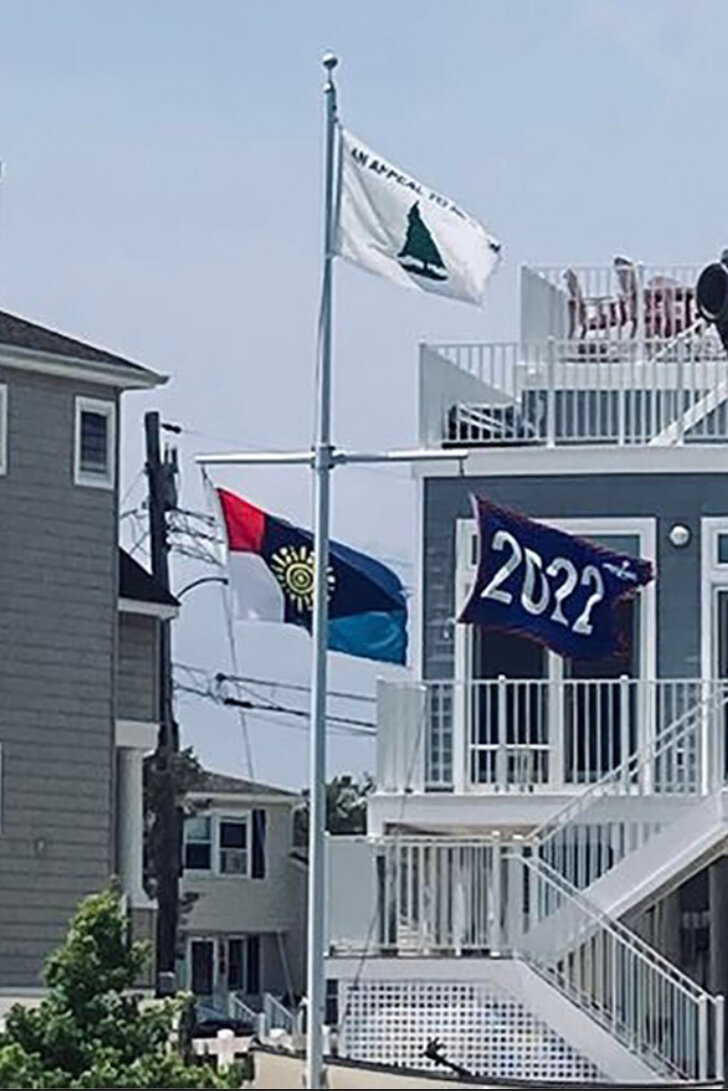
The “Appeal to Heaven” flag flew outside the Alitos’ New Jersey vacation home last summer, along with a “2022” Phillies flag and a Long Beach Island flag.
The NYT reported that in January 2021, after January 6th, there was an upside-down flag flying over the Alito household for multiple days.
Alito said his wife put it up for a short time in response to anti-Trump criticism. He informed a friendly Fox News reporter that the criticism included nasty language targeting his wife. This led to a "Stop the Steal" flag incident.
Democrats and Republicans spoke against spoke against this sort of thing:
“It’s not good judgment to do that,” Graham told reporters. “I don’t know what role — he said his wife was insulted and got mad. I assume that to be true. But he’s still a Supreme Court justice. And people have to realize that moments like that — to think it through.”
Sen. Mitt Romney, R-Utah, said he hasn’t delved into the Alito matter but added, “Obviously it looks very unfortunate, and we ought to take a good look at it.”
Sen. Sheldon Whitehouse, D-R.I., the second-ranking Judiciary Democrat, said “we should investigate” the Alito incident. He said that it was “too early to tell” what a probe should look like but that it should “obviously” involve subpoena power, if necessary.
(Whitehouse on Laurence O'Donnell's program tonight reminded us that the recusal statute is a law. It is not just akin to the voluntary ethics guidelines. Justices do not just have life tenure. They serve for "good behavior." Alito and Thomas failed that test clearly.)
The Chairman of the Senate Judiciary Committee, Sen. Dick Durbin, spoke out and said Alito must recuse from 1/6 related cases. A big one -- the Trump immunity case they had no business taking and might have done so with only four votes -- is pending. That's it from him:
Durbin: “No, we haven’t got anything planned. I think he’s explained his situation. The American public understand what he did,” he said. “But I don’t think there’s much to be gained with a hearing at this point. I think he should recuse himself from cases involving Trump and his administration.”
Sen. Durbin has recently made noises about bringing back blue slips for appellate nominations. He's a pill.
Dahlia Lithwick underlines we all must make this an issue. Nonetheless, the Democrats in the Senate have special power, including holding hearings and submitting subpoenas. See also, this proposal to bring light to the shadow docket.
President Biden has honored has honored the 200th judicial confirmation. Which is great. But, as he says the work is far from over, especially in certain unbalanced circuits. And, Trump was able to nominate three justices.
I was not alone in wondering why we are just starting to hear about this now. But, it now seems that there was more to the story. We should also recall that the context here is years of Alito's quite public, including speeches, conservative religious views. The issue here is not, as one liberal law professor suggested, a "libertarian" or "Tea Party" mindset alone. No, contrary to his attempt to clarify, we cannot quietly include some "plus" here. The plus is quite notable in understanding the Alitos' beliefs and actions.

NYT followed up with an "Appeal to Heaven" flag later being flown over the Alito summer home various times for at least two months. He didn't supply an excuse for that one. The flag was flown during the 1/6 insurrection along with the upside-down flag. It has Christian nationalism connotations.
Alito has the right to believe these things. We are quite aware that he is a "Fox News" justice. His conservative religious views have also not been a secret. These things influence his decision-making. On the other hand, they are less blatantly unethical or breaches of "good behavior" requirements.
But, there is an obligation to avoid the appearance of bias. The first NYT article notes that "employees" of the Supreme Court broadly are prohibited to express partisan views (including bumper stickers).
I am wary about the outer limits of that rule. Why should court marshalls be prevented from putting stickers on their cars or promoting political causes? Or a typist or cleaning lady? A justice is another matter. We saw this when Justice Ginsburg got in trouble saying how horrible Trump was before the 2016 elections. They are supposed to be nonpartisan. For instance, no partisan political campaigning for one side. You can be a Philly fan.
I wrote Justice Sotomayor a letter a few years ago regarding the lack of bilingual transcripts. For instance, I think Puerto Rico-related cases should have a Spanish translation available. She thanked me for my concern and pointed to a FAQ section of the SCOTUS website written in multiple languages.
But, she said she could not personally voice an opinion. I thought that was rather strict. But, it underlines the ethical rules in place. Partisan flags, especially related to ongoing litigation of national importance, should be avoided.
Chris Geidner has called out Chief Justice Roberts and other justices to pressure Alito to recuse. Who knows what sort of pressure is being done behind the scenes. Nonetheless, a guy who won't show up voluntarily in front of the Senate Judiciary Committee or willing to explain (like Kagan and Jackson have) why he recuses is not showing much willingness to apply pressure.
Dahlia Lithwick's statement that we as a whole have a role underlines the breadth of the solution. When President Biden used a commission to delay and push aside concerns about the Supreme Court, the responsibility was not his alone.
I have said this before. I will say it again. Strict Scrutiny Podcast respects multiple people on the commission. They had one or more people on their show. Why not have them on to discuss the commission? No. They sneered at it.
The January 6th Committee shows the potential value of a congressional investigation. The Democrats had control of Congress. They still control the Senate. They could have had hearings parallel to the subjects covered by the commission.
A strong and vocal minority of progressives are pissed off about the courts. It has to be made a clear political issue, one that does not just come up now and then for us to shake our heads regarding the latest Alito or Thomas news.
We are not talking about snapshots. Roe v. Wade being overturned is connected to Christian Nationalism and Trumpism. The New York criminal trial is winding down with closing arguments next week. If Trump wins, Alito and Thomas are likely to resign for younger replacements.
Michael Cohen was prosecuted partially for these crimes. The National Enquirer company agreed to a non-prosecution agreement. Trump so far received no consequences.
Meanwhile, the D.C. case is being held up by 1/6 fellow travelers and people who enable them. And, we await to see what Alito's first opinion of the Court will be.
Plus, what new "WTF" moment will arise.