About Me

My photo
This blog is the work of an educated civilian, not of an expert in the fields discussed.

Friday, April 27, 2012

Comics Encourage Classical Education

The way to be introduced to classic literature -- comic strips. I downloaded this work (it translates to just over 50 pdf pages) and will put it on the reading list along with Demian, a work by Herman Hesse (which I'm sure Rat will dismiss just as well), the library copy reserved having an introduction by the author of the former work!

I would also have little reason to note the latter work -- German literature is generally not my thing though I'm about to read Guilt, a sequel to Crime, both a collection of short stories by a present day German defense attorney.  The book popped up in Eloise's Lover (summary of book), a good movie that I came across my chance.   The film had a good moment when said lover noted that she "hated" Eloise because falling in love with her was quite hard and rather scary -- shades of Moonstruck, where the mother was sorry her daughter truly fell in love with Nicholas Cage (pre-conspiracy thriller) since that makes things so much harder.

No telling if I will like either, but if nothing else, both are short. 

Thursday, April 26, 2012

The Hunger Games

I will probably wait to see the film, but the book was pretty good, though the games could have been a bit better. I'm interested to learn more about this society.  I like the title character's name.

Interesting Article

"Medical Marijuana in Colorado and the Future of Marijuana Regulation in the United States." Helpfully covers main points.

Sometimes, Best To Let It Go (Prosecution Edition)

I voted for Edwards (for symbolic reasons in the primary) and was at a personal appearance his wife gave for her second book.  Guy is an ass.  But, he lost his wife and political good name.  The prosecution is a lousy idea, even without its questionable legal basis.

Wednesday, April 25, 2012

More Mets

I was tad pissed when a misplayed ball by Bay's replacement scored a run, ending Santana's great night.  The Mets have yet to score a run for the guy and one just missed being scored on a wild pitch.  But, the Mets scored on a walk later on (thanks to four different pitchers) and won it on an infield single later still.

UUA / SB1070


I am deeply disturbed by the recent flurry of attacks on women’s rights. I am especially troubled by how religious fundamentalism is used to justify taking away rights from women.

The fact is that our major religious traditions have within them both liberating visions and histories that give legitimacy to unspeakable oppression. Think for a moment about the last few centuries. Religion has been used to justify slavery, to keep the vote from women, to condemn gays and lesbians, and to justify horrible violence.


I am so glad that Unitarian Universalism has long taken seriously the idea that every human being has inherent worth and dignity and that a spirit of justice, equity and compassion should guide human relationships.
A tweet sent me to the above from the UUA, more evidence  that there are religions, faiths, values and the like that need not make people treat such terms like dirty words or as somehow inherently Republican or something. The UUA is also on record as against SB1070 and protesting it as violation of its and our country's basic values.

I'm all for flexibility when appropriate, but immigration policy is clearly a federal matter, a matter of commerce between nations and so forth, so find this approach questionable.  As suggested yesterday, this is not merely a matter of state v. federal power. When the nation as a whole, not a specific border state, sets policies, various compromises are made, various things are taken into account that might not occur in a more limited venue.  This is why commerce among states, domestic and foreign, was entrusted in the federal government.  Locals still have discretion, as the Whiting opinion and others show.  There are limits, especially when the state is clearly trying to push federal policy and officers.

[Update: The reports are not positive, but the justices were most doubtful that merely asking for immigration status and providing the feds with the information by itself (as the SG noted, it isn't by itself; it is part of a whole) is pre-empted.  There might be the four votes needed for the others to at least uphold 4-4.  The justices themselves started with the weakest point, Roberts upfront trying to not make this about racial/ethnic profiling. 

It is a bit unfair to blame Verilli for doing badly here. I think he did provide reasons even for the first provision being a problem (see transcript at USSC website) and likely effects, including racial/ethnic profiling, factors in on the ground.  But, a narrow rejection of a facial challenge of this one provision seems fairly likely, if not a big loss by itself.]

Some like to talk about the 10th Amendment, but there are two sides of that coin.  If the states have their area, the feds have theirs, the states not having the authority to invade that either.  We shall see (Scotusblog will later talk about the orals and the audio will be available Friday afternoon) how things go.

---

 * Since it came up, let me add a local tidbit that I talked about in the past. A member of the NY Assembly has recently tried to amend state law to clarify the right of ULC Church (not related to UU) ministers to officiate weddings. Upon contact with her office, I was informed that the AG's office told her that "[t]heir reading of the law and case law since is that universal life ministers and any minister who is ordained on-line cannot officiate."

Suffice to say, the matter is debatable, the highest state court never ruling on the question and the last of three rulings occurring over twenty years ago. New York City hands out marriage officiant certificates to such ministers. As I noted in the past, I find this stupid and misguided. It's a real issue as shown by the number of NYT wedding announcements that include reference to such ministers, particularly favored by same sex couples.  If this is what a couple wants to give meaning to their wedding, it is unclear to me the point of not letting them.

If the state allows online courses to be used for education credits for teachers, why should on-line ordination matter?  Technically, an actual person processes the requests and sends you paperwork. What if a church in Africa or some other distant place sometimes ordained people in such a fashion?  Would Skype work? 

By Chance DVDs

I saw a daughter from Mayor Cupcake, a slight but nice film with a familiar face in the lead, first on Suite Life On Deck. Saw The River Why in the library, familiar leads and interesting interviews. Film bored me -- too talky, let the visuals work guys! Turned it off.

Tuesday, April 24, 2012

Mets Continue Their First Bump in the Road

The new CF got hurt the first game. The back-up IF got hurt, but that opened up a slot for a doubleheader. But, now the LF is hurt and Pelfrey suddenly is on the DL for the first time ever. Serves him right for pitching well. Reyes is visiting with his new haircut.

Arizona Law To Be Heard Wed.

USSC will review Arizona's controversial "papers please" law. For various reasons, it will be of limited importance. The possibility of a 4-4 ruling alone makes me a bit curious. The issue is federal power, though it does affect how racial issues are treated. See, 14A.

Double trouble for the Mets (.500)

Old poet/jack of all trades (currently good at none) Batista got behind early but the call-up did do well (the Mets tweet noted the bullpen did well).  Lot of Mets on base for the score. Gee went longer, but same basic result.  Call-up was sent back.  Why not just start the guy? 

Monday, April 23, 2012

That's Media Mail, Please, No Insurance or Stamps

I sometimes sell stuff, mainly books, on Ebay.  Sold an old one and got a net profit to buy a jar of fruit.  Plan to put them on some waffles, maybe two servings worth.  Sort of zen/barter thing there about the meaning of trade or something.  Life be easier if I can just trade this for that on a regular basis.

Charles Savage's Latest

I respect Charles Savage's reporting/analysis over the years regarding executive power, including in the Obama Administration, but some aspects of his "Shift on Executive Power Lets Obama Bypass Rivals" piece leaves something to be desired.  It is getting some attention, Election Law Blog saying it is a "must read" and (shocker) a Volokh Conspiracy conservative uses it to show "him too" on executive power. Marty Lederman, previously having the job of defending him in-house, provides some useful balance here.
For Mr. Obama, that meeting was a turning point. As a senator and presidential candidate, he had criticized George W. Bush for flouting the role of Congress. And during his first two years in the White House, when Democrats controlled Congress, Mr. Obama largely worked through the legislative process to achieve his domestic policy goals. 

But increasingly in recent months, the administration has been seeking ways to act without Congress.
The overall thought here is that once people enter a position, there previous doubts regarding it tend to become at least somewhat altered. Jefferson, e.g., was able to live with himself once President doing things like negotiating a treaty to obtain Louisiana without amending the Constitution.  Robert Jackson and others changed positions once they left the executive department to go on the Supreme Court.  Also, Obama never was as civil liberties friendly as some on the left seem to believe. It was a matter of degree.  For instance, he never said he was against ALL signing statements.  Finally, with Republican control of the House and a few pick-ups in the Senate, and particular forceful obstructionism, obviously his approach would change in various respects.

So, my concern is that the piece speaks of a "shift" that has occurred to some degree but on some level [and this part is fine and informative], there was never some "pure" position anyways.  This seems misleading on some level.  We also read a critic note "Still, he said, because of Mr. Obama’s past as a critic of executive unilateralism, his transformation is remarkable."  But, Obama was never a total critic and his "executive unilateralism" can be exaggerated. Presidents are by design "unilateral" to some extent anyways.
“Obama’s not saying he has the right to defy a Congressional statute,” said Richard H. Pildes, a New York University law professor. “But if the legislative path is blocked and he otherwise has the legal authority to issue an executive order on an issue, they are clearly much more willing to do that now than two years ago.” 
As ML notes, telling point.  The article, e.g., notes that Obama decided "to stop defending" DOMA. But, he still is enforcing it. You might not know this key fact from the piece.  Nor, that this was done in the past.  Cf. Bush's executive power veto of torture laws etc.  As to waivers, often laws allow that. Is this a "shift" of some sort?  Did he never give waivers early on? This is not just a mild if important change in tone -- like the author of Miral suggested yesterday on Chris Hayes was the difference between Obama and Romney on foreign policy (more finesse; Romney will piss people off more while Obama will do things like promote freedom in Egypt and get Nobel Peace Prizes apparently just for showing up while using drones etc.).  There is some difference in kind. 
First, he proposed a jobs package and gave speeches urging lawmakers to “pass this bill” — knowing they would not. A few weeks later, at the policy and campaign strategy meeting in the White House’s Roosevelt Room, the president told aides that highlighting Congressional gridlock was not enough.
This seems pretty standard stuff as is the ability of the executive -- by executive orders etc. -- to work within the existing laws. No examples are provided on what exactly Obama did in this respect here, but it's informative to show how things work when a President is blocked by Congress.  The recess appointment issue also was cited.  It was not noted that without a new consumer financial protection bureau head, the law would not be able to be carried out.  The special nature of the obstructionism (I don't recall a similar Democratic move of late; e.g., when the Democrats with a bit of Republican support blocked Bolton, the administration still could put an assistant there and the Democrats didn't want a new treaty or a change in UN policy before voting for any UN representative) is essential to know the full story. The article does touch upon how the level of obstructionism altered the balance of power, leading Reid to accept the move.

Executive orders are again cited, but Presidents always have the power to use them, and Obama long before now used them in various cases (e.g., regarding abortion funding) in a policy way.  There is some "ho hum" nature of what is going on here, but yet again Bush and Obama weren't just peas in a pod:
“This is what presidents do,” Mr. Goldsmith said. “It’s taken Obama two years to get there, but this has happened throughout history. You can’t be in that office with all its enormous responsibilities — when things don’t happen, you get blamed for it — and not exercise all the powers that have accrued to it over time.”

The reason why such a diverse coalition was upset under Bush was that he did things more bluntly, went further, even when working with Congress would get much of what he wanted.  The power of the executive in the 21st Century, especially in national security areas where it is hard to find a forceful enough counterweight (Obama in fact notably wanted less free reign than the House Republicans wanted to give the executive), is troubling.  No matter who's in power. Also, it is useful to understand how checks and balances work, including executive push-back, and not be surprised when it occurs.

I guess it is a good piece overall, but with some grains of salt. 

Army Wives

I have watched this show from the beginning, but it has been something of a mixed bag, including early this season, after a two part action packed beginning.  As noted the last few weeks, it has really moved into first gear with a multi-episode story arc that appears to have been completed last night. A mission was sent to some African country to evacuate some non-combats as violence rose after the death of a possible coalition candidate.  Meanwhile, some drama occurred back on the base.

A lot of stuff happened, some inter-connected, overall all well done.  Turns out guest star Kelli Martin (ER etc.)  would have a lot to do. She began her role as a captain in intelligence give a situation briefing with special knowledge of the ongoing problem in Africa. There was some thought by some viewers that there was a thing between her and the general (whose wife, CJ's nemesis -- who now appears to have a little anti-depressant or something drug thing going on -- left him after an affair he had with an underling). Anyway, it was an early on hint at how important fairly low ranking people are in strategy moves.

Her skills, plus even her sex (a group matrilineal, so respecting women), helped deal with a possibly lethal incident in the field.  It also showed the risk and stress involved, including by young newbies who are facing people with guns.  She was injured in the leg on the way back as they mowed past a barrier.  Earlier, someone else was seriously injured when a possibly long standing land mine blew.  His Asian wife committed suicide because of the various stresses of their marriage and her life here.  This subplot was handled nicely with various characters, including a new minor one (a German wife that Roxy had to deal with when her macaroni salad made her husband sick) talking about the stress of such wives.

It turns out the the captain is the girlfriend of Roland/Joan's adopted son's after school center.  I wasn't sure, but it turns out that this is supposed to be happening after DADT was over (early on, the show seemed to be a bit behind actual events). There was a nice ending where she meets the injured captain at homecoming; they kissed, but no flash bulbs or anything.  It was a private moment and we saw how special it was for the captain to be able to have a loved one there.  Also, another issue arose earlier, since the captain's mom is her emergency contact, who did not inform the girlfriend of the injury.  They were keeping it private or perhaps there would be a way to have more than one person to notify.

[On the subject, I by chance -- Fios doesn't provide t.v. guides and there are a ton of channels -- caught Eloise's Lover on Sundance.  First, I wasn't going crazy -- the Spanish dialect is a bit different than many films. Second, well acted and nice to look at, but some stereotypical aspects and not the best of ending.  (It also is a bit confusing, but the comments there and at IMDB suggests a logical explanation.)  Overall, I enjoyed it -- hard not to like the leads and the beauty of the language.]

This is only a brief look at the three episode story arc that is very impressive.  Afterwards, I watched Veep on HBO.  Nice to see My Girl (Anna Chlumsky), but wasn't really impressed.  Seems like something various political blog viewers (the sorts who love to say "villagers" or such) would love, a lot of potty mouth immature goings on.  Might be an okay time waster.  There was a preview for yet another cable series (it's amazing really) with Jeff Daniels and various other familiar faces (including Alison Pill, a talented young stage/screen actress) that takes place in a newsroom.  I even found a web series looking into something.

No wonder I read fewer hard copy things these days.

Sunday, April 22, 2012

Two Books where VPs Mattered (pre-Cheney)

I read/skimmed two books in which the vice presidency became quite relevant.

The first is Gail Collins' entry in the mini-bio series of American presidents, which is perhaps appropriately briefer than appears to be normal, just like its subject's term of office: William Henry Harrison.  The only ones left being Reagan (a bit curiously), Clinton (a bit less so) and Obama (obviously).  Bush43 has a volume already, according to the list in the book, so not sure about the first two.  Anyway,  it is an enjoyable brisk read of someone who didn't promise to be much of a President even if he survived.The most notable aspect is really his campaign, which was the first full-fledged party affair with rallies, songs and silly slogans. 

The Whig Party had a standard model in its brief existence: bland military leaders of the ticket who can paper over the splits among its constituency. The party promoted the idea of a limited executive (in answer to "King" Andrew Jackson) while supporting a somewhat modern looking national program of road building, education and a national bank.  One possibility in fact is that if Harrison survived, the bank issue would have came to a head, perhaps even in the Supreme Court, with Taney going the other way than John Marshall.  The problem for them (and a similar problem for its successor a few years later) is that the person they put to balance the ticket (John Tyler and then Andrew Johnson) didn't really share many of the party's core beliefs, which unexpectedly became an issue.

The second book is He Almost Changed the World: The Life And Times Of Thomas Riley Marshall, the title a bit more promising than the book itself.  It seems okay, but doesn't have much bite and spends much of the time providing background material (such as pages on the people that pop up along the way) and what comes off as filler.  In the introduction, we are told he isn't a big man in a historical sense in many ways, and we basically find out why. It is an open question that he would have "changed the world" either, that left to conjecture on finding a way to get through the League of Nations, even though his major skill seemed to be that he was a pleasant enough guy and a decent governor.  The Wikipeida article linked is rather detailed and seems to includes a few more details than the book.


The book provides something of a window of the times, including local state politics, while using a easy to read tone throughout.  The reason why we care about him is because of President Wilson's stroke.  His condition was kept secret, so Marshall rejected some calls (including from inside the Cabinet) to take over his duties. The Constitution gave him that power when the President was incapacitated but the issue was never pressed in the past. The 25th Amendment actually only clarified the matter somewhat.  The situation where the President is not dead or personally makes clear they are unable to carry out his/her duties notes:
Whenever the Vice President and a majority of either the principal officers of the executive departments or of such other body as Congress may by law provide, transmit to the President pro tempore of the Senate and the Speaker of the House of Representatives their written declaration that the President is unable to discharge the powers and duties of his office, the Vice President shall immediately assume the powers and duties of the office as Acting President.
This is followed by a long and somewhat convoluted paragraph that is probably one of the more obscure parts of the Constitution.  Even if he had the ability, Marshall very well might not have wished to provide such a written declaration, wary of tragic results of what might be seen as a coup d'etat.  He was wary even of accepting that he had presidential powers when Wilson left the country to negotiate peace terms after WWI.  Raising controversy with a probably split Cabinet, challenging the First Lady (who thought he was basically some uncouth boob), presidential physician and a lead adviser too. 

Like dealing with various national disaster scenarios hopefully best left to fiction, the best path is a debated matter to this day. 

Rev. Joe

A group of leading scientists and evangelicals have chosen to put aside their differences on how the world came to be and join forces to protect its future. They've formed a coalition and are lobbying Capitol Hill on environmental issues.
I alluded earlier to the possibilities of diverse groups, including religious, joining together on environmental matters. The above subject is topical given Earth Day. This important, especially as some stereotype religious beliefs, on various signs of the spectrum. Many liberals, e.g., don't think much of Catholics, but actual self-expressed Catholics have diverse viewpoints. The links provided earlier underline the point though I continue to be a strong opponent of much official Catholic doctrine, which seem pretty misguided in various respects, on various grounds.

One link earlier raised the point that Catholicism motivates anti-death penalty activity, though some of this is not a total opposition, but various safeguards or limitations. One person who commented, who is (let's be nice) strongly dissents from various limits on capital punishment, noted that various people on death row are "scum" and it is shameful that people (he tends to say "Democrats") help them out.  In another thread, a person called me out for criticizing the johnny one note style, saying I should be honest and admit I don't like the death penalty at all.  Well, I don't, but it is tedious to make everything about ideal societies, though this is a common trope.  We can deal with details.

[Let me as an aside deal with the "what about abortion" issue.  The state is not allowed under  the basic principles protecting freedom of choice to force women to have an abortion.  It is a personal choice.  The state is the one who executes people. Just one difference.  In one book, a Catholic raised the point; his interviewee noted that he believed an embryo was not a "person" yet.  Other differences can be stated, but there are a few who consistently oppose and wish the state to ban both.] 

Still, I will firmly say that I oppose the death penalty.  Regardless of that, I oppose calling anyone "scum," even murderers.  I don't like at some point the term or some similar one being used against neocons or justices we do strongly oppose.  These are people, not lower life forms.  There is a basic principle here.  And, it does have a religious and moral sentiment to it. I can quote the New Testament* or humanity respected by the Eighth Amendment, but it shouldn't come to that.  We can respect both sides here (Dead Man Walking shows this) and in fact even arguably do so without banning the death penalty (those who directly carry it out are often forced by reality to deal with "humans" not "scum").

This came up during the torture debates.  A basic philosophy arose here, an idea of an "other," in which on some basic level you cannot see the other person as quite like yourself, it's bad to torture, but it's not quite the same with these people.  Chris Hayes said something similar today talking about life under occupation, noting we don't need to worry about similar military night raids. One guest referenced the Taliban, but even horrible criminals don't have to deal with that and to the degree comparisons can be made, it is troubling, even there not quite being the same (no knock raids can be lethal, but still not foreign soldier). 

I can discuss views and so forth, but basic values hold too.

---

* Matthew 25:36: "I was naked, and you clothed me. I was sick, and you took care of me. I was in prison, and you visited me."

Hebrews 13:3: "Remember those in prison as if you were their fellow prisoners, and those who are mistreated as if you yourselves were suffering."

Rev. Joe (Catholics in News)

"Catholic nuns group 'stunned' by Vatican scolding for 'radical feminist' ideas" and "Noting the notable role of Catholicism in recent state death penalty abolition efforts" were both interesting.  And also.

Saturday, April 21, 2012

Mets News (In and Out of NY)

Bobby Valentine is having a bit of trouble in Sox Nation, but today was something else. Up 9-1 after six, the Yanks scored seven runs twice to win 15-9.  Meanwhile, another ex-Met had a perfect game. None for the Mets yet.  They ended a three game losing streak with help.

Law In America

Lawrence Friedman wrote a few books on the history of American law, including crime and punishment, writing in a down to earth and informative style. This "short history" is a great introduction with wise comments down to the end of the bibliography.

BP Spill Turns Two

First, the fairly trivial. One of my pet peeves is litter, particularly in my residential neighborhood, often in eye sight of a garbage pail.*  This is both ugly and shows a lack of respect for your environment.  It also is a small thing that can be done.  It seems to me that doing something beneficial and not taking much effort in the process is doubly useful.

Second, the not so trivial.  The two year anniversary of the BP oil spill has arrived and various MSNBC shows (Rachel, Chris, Melissa)  covered various angles of the issue.  Chris Hayes had Antonia Juhasz on, who has long covered oil issues in various progressive publications.  She wrote a book on the spill and a quick search found various audio and video of her talking about it and other related issues.

Like Katrina (which in effect put Rachel Maddow on the map, her excellent reporting for about a week filling in for Al Franken on Air America showing her abilities), this was a short term way for the coutnry to be upset, but long term solutions less so.  We have not had an EPA moment. Apparently, hoping for environmental friendly presidents like Richard Nixon, too much to hope for.  I can and will note that I think one side is much worse at the moment (like with birth control, the other party used to be more credible), but blame can and should be spread around.  Not enough pressure is put by various people, including let's say Dems who help big business with tax breaks and other things.  Quid pro quo? 

Chris Hayes has noted that global warming and related issues is perhaps his biggest concern, something he sees -- like Al Gore -- has ultimately a moral matter.  The inability of some sort of real bipartisan effort in this respect in the last decade or so is telling.  I personally think this is a "Nixon goes to China" thing.  Health care is a telling example there: even using a Republican model as a linchpin was not enough for ANY Republicans to vote for the f-ing thing (though for some amendments, which watered it down).  This is one of those moments where I simply do not respect the other party.  Your party has various things to answer for in recent years. When will more members show some willingness to govern? This includes compromise and showing some respect for something that took a more conservative path even when each political branch was controlled by one party (if one with many conservative members).  Republicans do not want to do this. Until they are, they (I'm sure they are pissing in their boots now) will not be respected by me.

Anyway, the chance for major change here, other than some sort of major disaster (or a bigger one, apparently), might come when a Huntsman type is in power, or even a Romney type if the Democrats have the votes in Congress to force his hand. Too much water under the bridge really to offer much respect for Romney himself, and I continue to wonder really why anyone other than a true believer would vote for him in November.  I'm sure reasons can be made here or there, but writ large, why exactly?  Seems like a sad safe choice, yet again Kerry comes to mind, while at least there the current occupant could hardly been seen as a moderate type.  Realize that politics has changed some, but still find it hard objectively to compare Obama and Bush on the "not moderate" spectrum. 

I tire myself by bringing that up again, but it is no less true now.  Actual hope for winning comes from a fresh new voice, even if one might not personally like the person for some reason.  Even when the opening is there, such as in '80 and '92, such a voice was key.  Romney is a dull safe choice that sends an overall depressing message.  I might not like who we get (see Reagan), but my hope is for more of a game changer (yeah, the Palin movie does come to mind, but there, the winner was Obama).  Environmentalism is a pretty safe issue there, ways possible to (like with the PPACA) to help out big business along the way. It has a religious angle as some evangelicals make clear. The ultimate hope might be a union of diverse people with a common goal, like small government types who pressure conservatives not to invade their privacy in various ways not involving the wrong type of sex or such (not the only way to do it).  Even there, changes in places like Iowa are hopeful.

It is a way to do good while finding something that unites different groups. It also is essential.  Keep fighting Antonia et. al. 

 ---

* The word "litter" interests my word nerd side too. Where does it come from? This is a useful way to think things through and do a bit of research, tools more people should have.

Another pet peeve (I have no pets; I have a lot of pet peeves) is those who don't seem to have even a rudimentary form of this skill though lack of role models means the ultimate blame is elsewhere. I don't recall critical thinking being pushed much in my schooling as a separate matter. It is really important to teach this early on. 

The first definition in the online dictionary seems to me the least used term these days, though perhaps so found because it is the earliest use -- "a covered and curtained couch provided with shafts and used for carrying a single passenger." Then, comes the stuff for cats, than the kittens ("runt of the litter"), finally trash. The etymology in effect comes from the fact the stuff lies around, like you "lie" on a "litter." A litter of kittens seems to come from the fact the cat is "lying in" or something, which is sometimes used in human contexts too.

Friday, April 20, 2012

420

Today is not just for Hitler lovers. It's Pot Day!

Thursday, April 19, 2012

Rules of Engagement

Okay enough episode with two standard trends -- no reference to the baby (apparently of little interest to a couple who is so passionate that they do it via surrogate) and Jen having little to do. The final joke was that always funny child molestation double entendre.

"Very Important" Voting Id Case

Election Law Blog cites an "very important" 9th Cir. en banc ruling regarding a voter id law with special emphasis on the citizenship issue, particularly since it "contains a major statement of what plaintiffs would need to show if they want to prove that a voter identification law violates section 2 of the Voting Rights Act."  An earlier summary of the litigation:
In this case Plaintiffs, registered voters in Arizona and voters' rights groups, challenged Proposition 200, a law that imposed new restrictions on voter registration and voting. Among these restrictions was the requirement that registrants provide proof of citizenship; the six forms of identification valid to prove citizenship are: (1) a state issued driver's license; (2) a U.S. birth certificate; (3) a U.S. passport; (4) a U.S. naturalization document; (5) another immigration document that proves citizenship; or, (6) a Bureau of Indian Affairs card number. When voting at the polls, voters must provide identification with their name, address and photograph, or two forms of identification with their name and address. Voter mail registration applications, prescribed by the U.S. Elections Assistance Commission, are no longer provided.

Plaintiffs claimed that the State of Arizona did not obtain preclearance to stop using the prescribed voter mail registration applications. Plaintiffs also alleged that the voter identification requirements disparately impact Latinos as Latinos are less likely to possess the forms of identification required to register to vote and cast a ballot. Finally, Plaintiffs asserted that the enforcement of these new voter identification requirements diverts funds from programs that would encourage voter turnout. Accordingly, Plaintiffs sought a Preliminary Injunction preventing the enforcement of these voter identification requirements.
The opinion notes a usual trend here -- absentee voting does not have such a requirement, using a signature check; it is unclear to me how this could not be done for in person voting, especially since it seems a lot easier to do (putting aside the lack of a real problem of fraud) it the other way.  For various reasons, many do not want to use absentee voting (sometimes, it is not an option for everyone; unclear if this is so here), but IF it was an option for everyone, that would temper the problem. The ruling held that for federal elections, federal law (statutory) required simpler rules, but it was okay for state elections. 

One problem, as noted in a brief, is the cost.  This is not a trivial matter for some people -- the costs offered ranged from $10 to $100 to even $380.  The specific id for voting might be free, but what is necessary to obtain such id is not.  And, when faced with this issue, some do logically think of this as a type of "poll tax," which violates the Twenty-Fourth Amendment (federal elections) and the Fourteenth Amendment (illicit classification) while some see some hints to an illicit racial classification as well (Fifteenth Amendment).  Federal law addresses the last concern, the problem a matter of proof and how much care we determine matters.  The other two are related and had logical force (imho) but has not been too successful in court.

Both sides relied on a ruling (Crawford) a few years back that split the Supreme Court in about three ways.  Stevens wrote the plurality for three that basically held that the "facial" challenge to a voter id law must fail because there wasn't enough evidence that voters as a whole were burdened and (even though nothing much was there) the state had enough of an interest to have the law to validate it.  Would more evidence change the equation?  Who knows, really?  The opinion in a footnote:
For most voters who need them [the id documents], the inconvenience of making a trip to the BMV, gathering the required documents, and posing for a photograph surely does not qualify as a substantial burden on the right to vote, or even represent a significant increase over the usual burdens of voting.
Hint, whenever a word like "surely" is used in cases of this nature, be on your guard. Particularly, when three justices dissented and argued that, yeah, there was such a burden of a fundamental right.  The opinion helped the voter id movement out by providing a sheen of respectability and noting that we shouldn't let the partisan nature of the law bother us (in another context, partisan or incumbent motivations have been used by Scalia to disparate campaign finance litigation; here, he rejected the limited nature of the controlling opinion). Some believe Stevens was being strategic here, getting as narrow a ruling as he could, others took him at face value, perhaps given his Chicago background or whatever.  Hard to tell, but either way, the dissents have the stronger case, and the matter begs for some in depth district court fact-finding.

The Crawford plurality if nothing else suggested the 1960s state poll tax case set up a too restrictive rule for burdens on voting, supporting a more balancing approach.  The panel here held that a voting id law "is not a fee imposed on voters as a prerequisite for voting" so it is not a "poll tax" and it is not "a burden imposed on voters who refuse to pay a poll tax" so does not meet the requirements of the state poll tax case. The case, though apparently we should not read it too broadly, held "affluence of the voter or payment of any fee an electoral standard" is an illicit voting requirement.  It seems a bit of sophistry to consider id laws merely a neutral voting requirement when in effect payment of a fee is required and "wealth" in this area (like getting lawyer for a felony) is not a licit barrier without some heightened need. There is no such need here. 

Crawford did hold that "evenhanded restrictions that protect the integrity and reliability of the electoral process itself" are legitimate and (as here) rejected a facial challenge, though leaving open (as here) as applied challenges that have better evidence. Also, as noted by the Election Law Blog, the federal statute being used here is stricter than is the case in some cases (e.g., the South Carolina law the Obama Administration opposes) where the burden of proof is on the state. The expert at that blog is against voter id laws as a whole, since the "evil" being targeted is at best small while the means uses at best is an unnecessary threat (even if small) against a fundamental right done in a a partisan way. 

Overall, the restrictions are not really "evenhanded" in practice and their need (or even usefulness) toward "integrity and reliability" is unclear.  After all, somehow, the feds can provide an easier path to voting as do quite a few states, a majority actually, this id regime quite recent. Throughout our history, in practice, what is "evenhanded" is a complex matter (see here, as to religious "neutrality") , particularly in the field of voting rights.  Identification is useful to have, though only johnny come lately in this respect for voting, but the proper path to take is to provide it for free if the alternative is in effect a class based voting requirement.

Well, it is only the 9th Circuit, and there is this big specter by some that the USSC might find the whole Voting Rights Act illicit because it isn't properly congruent or proportional or something.  So, "to be continued."

Chelsea Handler

Why she was in Hop, playing it totally straight, is unclear to me. It suggests the problem with the film: the whole scene was like ten minutes of filler. The "intervention" scene, however, was amusing. Good beginning at Easter Island. Lame ending & climax pretty weak.

Throwback Game

Lee went ten, Cain went nine.  Giants win 1-0 in 11. 

Wednesday, April 18, 2012

Holiday Movies

Hop was better than Despicable Me ("from the makers of") but not enough there for a full movie.  Turned off the latest Harold/Kumar (Xmas) movie after about twenty boring minutes.  If good stuff happened later, sorry, too long. Second one stunk, btw.

Economic Rights, yes, Libertarian Nirvana, No

The Hettingas’ collision with the MREA—the latest iteration of the venerable AMAA—reveals an ugly truth: America’s cowboy capitalism was long ago disarmed by a democratic process increasingly dominated by powerful groups with economic interests antithetical to competitors and consumers. And the courts, from which the victims of burdensome regulation sought protection, have been negotiating the terms of surrender since the 1930s.
This sort of thing is why the Dems tried to block Janice Rogers Brown (of the "Thomas is a bit too liberal" school of jurisprudence, apparently) from being appointed to bench.

My overall sentiment at the time was that I simply didn't trust President Bush ("this is horrible" ... yes Sandra), in particular, getting the sense from various accounts that he was playing hardball on judicial nominations. This was standard stuff from at least the Reagan Administration, if not before. Meanwhile, Democratic presidents of late were less ideological, as far back as Carter more concerned with diversity overall than ideological conformity. I was challenged on a Volokh Conspiracy blog (pre-Facebook) to prove this fact, the other side using the usual two-tier approach where they get to make various one-note claims with thinly disguised spittle while you need to prove general principles with footnotes. To be fair, one person used the "but he wasn't a pure knee-jerk idiot" approach. Sort of like, well the Astros do win sometimes so they are like the Yanks.*

Bush41 is the sort of approach that appeals here. You got your Souter AND your Thomas. Fair is fair there. Eventually, helped by winning the '06 elections, Bush was forced to tone back his approach. I realize, you know, that (favorite example) the Dems pushed Miguel (I heart Kagan) Estrada drop out, but Janice Rogers Brown et. al. did not. This was the result of the "Gang of 14" compromise in which only "extraordinary circumstances" would now (at least in their opinion) be the appropriate time to filibuster nominees. Goodwin Liu (Judge Liu / CASC) shows this includes "being mean to Alito." Anyway, the approach there was that most of the controversial nominees were confirmed, a few obscure ones were not, and Republicans still had the chance to block people like Victoria Nourse, who various conservatives/libertarians thought was unfair, but hey, we are still going to vote for the senators anyhow. Yes, yes. The Dems, when President Romney (no) is in place, will get to filibuster some too, just not as badly.

The opening quote is an excerpt from a rather blatant bit of pique (concurring, accepted the benighted Supreme Court required the unfortunate result regarding some dairy regulation) that was joined by another libertarian favorite while a third concurred separately to note that "well, I sympathize, but that was bit much." The "ugly truth" is that we never quite had "cowboy capitalism," even back in the days of yore. As noted by CJ Roberts in a recent opinion, government might have been smaller back in the late 19th Century true (comment about race relations omited, since the Rogers is black), but not that small. And, as noted by Walter Dellinger (ACA supporter, Clinton S.G.), you can support economic rights more than current doctrine without rejecting the idea that modern economic regulations further competition (if not the brand you like) and protect consumers.

The concurring opinion reads more like a libertarian tract than a reasonable criticism of a current aspect of modern day doctrine. As noted by an appellate judge who knows for what he speaks, concurring and dissenting opinions (there a certain category) has value. Even those like these that do not seem very judicial. Still, I think the value of economic liberty warrants a better voice. The Constitution has various protections, down to the Due Process Clause ("property"), which apply to all things, including things of an economic nature. Contraceptives can not just be owned, e.g., but bought. Economic matters are often more "public" than other matters and thus require (warrant) less judicial scrutiny, but even there, that is different than none. It is unclear how that helps this litigant though, except if you simply do not like the modern day regulatory state. Not that days of yore, back in the days of John Wayne and Clint Eastwood, lots of economic regulation would not exist as well. Note that Justice Harlan, not just Holmes, dissented in Lochner, the former quite willing to strike down some laws.

Anyway, good reading, including the "growling" reference.

 ---

* Not taking a certain Internet comic to heart, I take such things seriously, and spend lots of time checking up on things, at times going a bit crazy trying to find the right source material. On how Republicans are special here, the book Broken Branch (by a conservative and a right leaning centrist) is a nice source, though darn if it never tends to impress the "pox on both their houses" crowd that pushes my buttons.

It is almost amusing how we have some on the left upset that Obama doesn't do more to press the issue in the courts as well as wanting him to pick more left leaning judges (see Kagan) while others find it hard to accept that at the very least (putting aside if Bush did anything wrong) that Obama is less hard core on this issue than Bush/Reagan. Anyway, I defended filibustering then and push for reform now because I realize the tactic is in effect an emergency mechanism. It also didn't do that much then, push comes to shove.

If some Bush-like Democrat comes on the field and uses heavy-handed tactics when not even getting a popular majority of the vote, come back to me. Obama does not do this as a whole. The recess appointment issue is far from that -- ironically, he had to deal with (and did so sparingly even there) a recent Democratic precedent of phony sessions that were recesses in all but name. Even then, he only acted in an extreme case and long after it was clear the Republicans had any desire to actually full a position unless legislation that got through the filibuster laden Senate changed. Filibustering a judge -- a life term appointment at that -- didn't make some appellate court become nonfunctional.

As with my note earlier with fiscal responsibility, sorry, the allegation won't wash.

Republicans are not fiscally responsible

Another one bites the dust, along with military/diplomatic skills.

Atheists Are Cute

I was surprised to see "In God We Trust" in a local court room. Why the quotation marks? Is that new? Congress has God's back.

Tuesday, April 17, 2012

Frank Puts Foot In Mouth

He was wrong then and is now on the PPACA. I comment various times here. Also, the pride comment is off. Still, love ya. [On that front, note new book on side panel, an informative graphic novel that should be handed out free by Democrats.]

Monday, April 16, 2012

Literally via Sexy Librarian (aka Emily Brewster)

Via Twitter. On home page now.

Army Wives

Superior episode with various goings on at home and in the field, dealing with a rescue mission in Africa. Series should do more to show all the sides of things. Legal shows tend to be narrowly tailored, e.g.

Sunday, April 15, 2012

That Will Do Pig

The Mets had a bad few innings but a good series overall. Davis and Duda getting two hits today along with Pelfrey's six innings of one run ball almost made the loss okay. Acosta/Batista made it look ugly. After scoring three runs in 24 innings, the Phils were due.

Sunday TV

Chris Hayes had tax stuff and Romney's stance on poorer at home moms. MHP had some transgender stuff, reminding that Obama has done some real good in a workmanlike way. Mets slipped late, not sweeping, Pelfrey pitching okay and Batista a mess again.

Yeah, We Are

Today's news (somewhat hopeful) makes this more topical.

Rev. Joe

I was reading a book on God's place in film, not knowing most of the films cited, though Babette's Feast was one.  Some films lately, like The Wise Kids, aside we need a few more religious films. In fact, a religious epic is about due.  Where is the modern day Cecil DeMille?

Tax Day (Not Observed)

The Congress shall have power to lay and collect taxes, duties, imposts and excises, to pay the debts and provide for the common defense and general welfare of the United States; but all duties, imposts and excises shall be uniform throughout the United States
Don't worry.  Given it's a weekend, you have a couple more days (because people don't do Mondays that well?) because it falls on a Sunday.  This is just the traditional tax day, like when the day when Columbus discovered America for the Spanish doesn't always fall on a day best for sales.  Romney, for instance, apparently is having problems being on time.

Taxation is basic to society, though like various other things (like the mandatory coverage provision of you know what), many rather not think about that too much while enjoying the benefits.  Benefits that they often undersell.  I know someone, e.g., who has long felt only the rich and poor receive much of anything from the government. I note the person's husband worked for the government for quite a number of years.  Another person was upset about needing to pay taxes to a city where he worked but did not live as if his pay came (and the general well being of the surrounding area) is not reliant on just that urban area.  Of course, the felt idea taxes are too high (or low, as it might be) is a major political issue.

The basic legislative branch of Great Britain was created to my understanding centrally to control the power of the purse, still shown by the need for revenue bills to arise in the House of Representatives (along with the power to impeach, the basic power it has over the Senate).  "Taxation without representation" (now translated by the Tea Party as "taxation with representation"*)  is often what many think about when they consider why we declared independence. The power to tax effectively was a major reason we have our Constituent, the national government under the Articles of Confederation largely reliant to requesting states pay, instead of doing so directly.  And so on.

I never was really into fiscal policy, except to be concerned with certain ways the money was spent or broadly how it was collected. I guess, perhaps, if I had more money. Anyways, matters of tax and spending repeatedly are red flag issues for me even if the nuances of finance can go over my head (e.g., why exactly are things so much more money now, even on a relative basis? I guess it has something to do with the dynamics money supply and distribution). I personally think the PPACA is defensible as a tax.  Many experts agree with me though even Justice Ginsburg didn't seem game -- if the law is upheld (knock on wood), I can forsee this as a thing tossed in to unite people (though Breyer and maybe someone else might not agree).  The idea that if it is a tax, it is a "direct tax" (which I don't buy, along with four justices back in the 1890s, even as to income taxes of most types) is to me risible.  The brief linked quotes a few justices back in the 1790s on the point, and I too:

am inclined to think * * * that the direct taxes contemplated by the Constitution, are only two, to wit, a capitation, or poll tax, simply, without regard to property, profession, or any other circumstances; and a tax on LAND.
The law requires you to pay a "tax" based  on a certain "circumstance," namely what health insurance choices you make to address health needs that arise during various activities. A certain blindness is required to pretend this somewhat is a tax merely for breathing, though people apparently seriously believe that.  Well, people believe various silly (and some nefarious) things, so that is understandable on some level.  Employment is also a "circumstance" and a type of "profession" and thus income taxes are indirect taxes (unless on land or back in the day slaves) in my book too.  The Sixteenth Amendment, at any rate, doesn't empower Congress to tax incomes; it eases it along by not requiring apportionment.
The Constitution was framed under the dominion of a political philosophy less parochial in range. It was framed upon the theory that the peoples of the several states must sink or swim together, and that in the long run prosperity and salvation are in union and not division.
Taxes are "to pay the debts and provide for the common defense and general welfare," which is why a "tax penalty" can be in place only tangentially (if at all, really) to raise revenue.  We do not tax marijuana just to obtain revenue, but as a sort of "sin tax."  Tariffs encourage domestic manufacturers, even if foreign goods without tariffs might provide more revenue to the federal treasury.  Domestic manufacturing might also promote the common defense in that less reliant on foreign goods can lead to less foreign entanglements, including of the violent kind. 

Tax policy also is not merely a matter to obtain funds.  "Tax fairness" also can be important here, including a progressive tax system in which ability to pay is factored in.  Those who support a flat tax, e.g., to my knowledge do not merely imagine some sort of tithe system.  Certain basic things are exempted first, such as dependents. Flax taxes are regressive because those with more money have a lot more discretionary income.  Even if you do not need the money for immediate use, money might be needed for some later need that arises.  Those with, let's say Romney type money (see Chris Hayes today for his "at home moms are great, unless you are poor, where work is better" sentiments), need not worry even there.

Now, this is where I start to lose track of the policies, but even from personal experience, there are various nuances involved.  Tax time is for one a time when you realize it can matter where you live: certain urban areas will provide taxes on top of state and federal, while other areas can provide different types of taxes (such as property taxes).  There are also various exemptions to factor in, underlining that taxation is a major area for social engineering.  This is seen also in debates related to health care (including reproductive services), religious schooling and sexuality.

Many will not be thinking too much about these things, only what they have to pay or the money they receive back because of a form of governmental borrowing (or personal savings) where they collect an excessive amount and then pay you back the difference at the end of the year.  Still is a pretty important deal and perhaps we can think a bit about it along the way. 

---

* The name is open to ridicule, including the childish "Tea Bag" deal, which has an added childish sexual slang connotation. The most defensible connection is to the Tea Party of the 1770s, a result of a bit of special favoritism of the tea cartel of the day.  This connects to the bailout and so forth that helped certain corporate types of today, a symbol of overall separation of the government from the regular people.

Okay.  Still, the original Tea Party was part of a wider movement that also believed that far away government was violating local rights, including the fact that the colonies were not directly represented in the Parliament.  All of that is not present here. Also, special interests were favored for years.  Economic downturns do lead to protest movements, but the problem began during the late Bush presidency.  So, why do the Tea Party sorts seem only (I put aside outliers) to support Republicans? 

Writ large, the Republicans should piss them off more. A close look shows that the validity of their case is tainted by special pleading. 

Saturday, April 14, 2012

The Girl with the Dragon Tattoo

Wary about seeing this in the movies given its length, but though it feels a bit long, it is a good though not great crime/character film with the latter the reason to see it.  The final reveal feels a bit cheap but taking the time to tell the story does do wonders.  Mara good.

Friday, April 13, 2012

Rabbi's Cat 2

I am reading the sequel to the book on the side panel (the two were later made into an animated film) and it as amusing, humane and thoughtful as the first.  The author.

Rules of Engagement

Notable this week is a baby reference (via a surrogate) after several episodes without one and Jen having a bit more to do.  The "cooling spoon" is pretty neat sounding.  BTW, NCIS was decent.  I caught a few second season episodes lately -- pretty heavy-handed.

Thursday, April 12, 2012

Obama surrogate?

H/t.

Moderate Republicans: Disgusted

A "moderate" Republican law professor (she supports a strict separation of church and state AND thinks Bush v. Gore was rightly decided; she clerked for Justice O'Connor) is upset:
Truth be told, had Santorum not jumped into the presidential race, all of these somewhat hidden agendas likely would not have been revealed, and we might now just be talking about our disastrous debt situation and the economy.  It used to be that the Republicans were the go-to folks on those issues.  But at least while Santorum was on the national stage, their righteous focus was on their social religious agenda.  It is a sad fact that the Bush Administration undermined the Republican reputation for fealty to economic issues when it engaged in runaway spending, a good portion of which was to appease religious groups demanding federal funding. Where does that leave female moderates like myself who are concerned about what the future will be like for our children, both socially and economically?

Disgusted.
In effect, and Rachel Maddow noted this once perhaps to justify covering them so gleefully, Santorum along with others served a purpose (maybe, Huntsman should have staid in longer too?): they brought to the forefront what the ugly underside of the party is thinking.  "Gotcha" moments like this doesn't change that.  I think you are not quite the people to talk when referencing a somewhat misspoken tidbit of her wider remarks.

Females / moderates have one credible choice: vote Obama.


Wednesday, April 11, 2012

Trayvon Martin

Good announcement. Hopefully, the matter will be dealt with some care out in open court.  I wouldn't be surprised if this guy is not convicted, but let's see.  Too many assumptions made.

Mets ... Blah Again

No Cute Woodland Creatures?

H/t RH Reality Check.  Not bad really for 1946.

Tuesday, April 10, 2012

Mets 4-1 / First Messy Loss

Murphy flubs one that counts after his heroics last night, Mets don't hit much and Wright is out with a hurt pinky. The fill-ins did well and Gee pitched okay though. Shake it off and hope Santana pitches well.

Nuance Alert

Linda Greenhouse does what much reporting (in pretty one note fashion) did not -- see the nuance to the strip search ruling, suggesting maybe the same is true with the health care matter.

More Overkill on Obama SC Remarks

He isn't trying to pack the Court.  Blah.

NC "Marriage" Amendment

As with some past efforts, the upcoming vote goes beyond marriage, blocking the legislature (why do you hate democracy?) from recognizing, e.g., civil unions. This is anti-equality overkill and can be (successfully?) opposed on that ground alone.

Monday, April 09, 2012

Jewish Gospels

Sometimes, things to many appear to come out of left field, when they are most assuredly not.  Many might not be aware of the big picture, but it has a tendency to make things more complicated.  For me personally, it also makes things more interesting and reasonable. It doesn't solve everything, but it changes the equation.

Such is the case with the title book, which was referenced yesterday.  About half-way through the small volume.  The book argues that the idea of "Jesus Christ" would not have been novel by the time of his historical existence as well as when the gospels and the rest of the New Testament (a past book dealt with Paul) was written (into the 2nd Century). Others have noted that "miracles" have been done by others in the time, but many scholars suggest the Jesus Christ idea was much more novel.  The author here disagrees, pointing to more than one Jewish writing (e.g., Enoch) on the point that at times uses imagery quite familiar to Christians.

This is not to say that the concept would be widely accepted, much less than that Jesus himself played this role.  But, the idea was in the air by that time, perhaps centuries earlier (at least, in the 2nd Century B.C.E., when the book of Daniel appears to have been written and the "son of man" figure pops up).  "Christ' and "messiah" was a long held idea of some sort of savior, often purely human, ancient kings being "anointed ones" as well (the overall meaning of those terms, one Greek, the other Hebrew).  Ironically, "son of God" is more of an uncontroversial term here, a label often applied to let's say a David or some special representative of God.  After all, logically, are we not all "sons" and "daughters" of God in some sense?  We are, according to the Bible, in his image and likeness.

The terms, discussed in a somewhat repetitive section, ultimately came to be applied to the same person.* Still, the two terms (son of god/man) developed somewhat on different tracks first, one a human on earth given special authority (like an ancient king), the other coming from above, ultimately some though, to earth in the form of a man.  "Son of man" was a special term, one with special supernatural significance in which the human qualities of the figure were at times suggested to be just apparent.  The figure was ultimately a god figure, though it might have originally had a lesser implication in other references in the Bible (see here). 

Thus, though it sounds more banal, "son of God" in the gospels (with a special appeal to Daniel) is freighted with special significance.  If we take it as his own words, whenever Jesus asserts the authority as this figure, he is not merely an ordinary human being, but in some sense has special "god stuff."
Mark 2:23 And it came to pass, that he went through the corn fields on the sabbath day; and his disciples began, as they went, to pluck the ears of corn. 24 And the Pharisees said unto him, Behold, why do they on the sabbath day that which is not lawful? 25 And he said unto them, Have ye never read what David did, when he had need, and was an hungred, he, and they that were with him? 26 How he went into the house of God in the days of Abiathar the high priest, and did eat the shewbread, which is not lawful to eat but for the priests, and gave also to them which were with him? 27 And he said unto them, The sabbath was made for man, and not man for the sabbath: 28 Therefore the Son of man is Lord also of the sabbath.
First, this is an example where the author argues that Jesus is not really challenging Jewish law, if perhaps providing a disputed reading of what it means.  He points to a Jewish source, for instance, that took a related approach to the Sabbath. I can't really go hand to hand with a conservative Jewish scholar on the point, but the overall idea that Jesus' teachings were not supposed to be in violation of the law (Torah), but a richer application of it in various cases is fairly convincing.  We can apply similar themes in constitutional disputes and challenge similar claims that such and such person is trying to replace the law, instead of arguing a disputed take on it. Anyway, second, "the son of man" here also suggests the authority that figure was said to have over God's law and people.  Simply put, the term is not generic, but unique. 

To me, it is hard to be too determinative on the gospels and other matters given we have so little to go on, though some scholars seem to be able to get a lot out of the material, but so far the book is pretty interesting.

[Update: Another chapter uses a careful analysis of Jewish law to show that Jesus as kosher, a particular reference that is used to suggest otherwise argued to be confusing food that is always illicit and the proper preparation of food.  In effect, Jesus was the conservative on the issue while Pharisees were the "liberal" ones. Here, his approach seems somewhat more liberal, but in other cases (turn the other cheek etc.) not so much.  I wonder about his take on Acts 10, the book focusing on Mark, giving it a more Jewish friendly reading than some.  Luke, however, is seen as the more Gentile friendly evangelist. 

The last chapter argues the "suffering servant" aspect of Jesus is quite Jewish in nature, if again, a matter of dispute, particularly the specifics.  There is a dispute over whether its use in Hebrew scriptures was purely metaphorical for the Jewish people but he argues there was some broad agreement that the messiah was going to suffer.  Again, some accounts pattern the "Christian" doctrine believers are familiar with. Overall, "Christianity" was not as much a difference in kind but more akin to Catholicism v. Protestantism on some level.  Intriguing overall.]

---

* Likewise, the ancient sky god El and Yahweh (YHWH) were once two figures, the latter a more direct presence, like the one Moses experienced; in fact, the "pagan" Ba'al deity perhaps was but a form of Yahweh for other groups ... "monotheism" early on was met when one god had supremacy -- "no gods BEFORE me."

The Book of Daniel also expresses an idea found elsewhere that can be seen as germ of the Christian trinity, at least the Father and the Son:
Daniel 7:13 I saw in the night-visions, and, behold, there came with the clouds of the sky one like a son of man, and he came even to the ancient of days, and they brought him near before him. 14 There was given him dominion, and glory, and a kingdom, that all the peoples, nations, and languages should serve him: his dominion is an everlasting dominion, which shall not pass away, and his kingdom that which shall not be destroyed.
"Ancient of days," according to the book here is like El or some other older God figure. The terminology, down to "his kingdom," would be recognizable to Christians.  The third part, the Holy Spirit, could easily be added here, it having use in Judaism as a sort of divine force. 

Justice --> President?

Interesting discussion of justices with presidential aspirations.

Army Wives

A good episode about family: CJ dealing with illness with hers, Roxy having a birthday party for her son while another (whose fiance was killed in a previous mission) fills in for another sent overseas (a new army wife's husband goes too) so she can watch her child. And, more. A lot happened, balanced well. Overall, well put together / touching.

Sunday, April 08, 2012

Various

No hit broken up in the 7th.  None in Mets history yet.  I knew the talk by the announcers about pitch counts and defensive moves were academic.  No score yet mid-game for the Cubs.  Another bad (pitching) game for the Red Sox.  Another well pitched game for the Pirates.  Still chance to win.

A Philip Seymour Hoffman-like picture for the author of the book just cited.  Charles Darwin had a philosophy of not being publicly anti-religious, in part in respect to his wife, but some groups are less so.
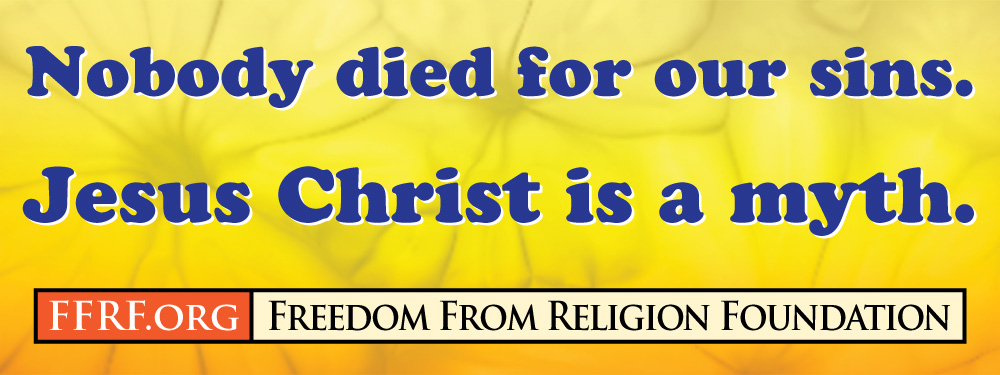
The back-story here is a bit more complicated though because the sign is in response to Christian displays in a public park, including one that says Jesus did die for our sins. Still, such "in your face" signage are somewhat counterproductive. On the merits, people have died "for our sins" in some sense unless the message is that "sin" itself doesn't exist.  I'm wary of the natural law from above implications of the word "sin" myself, but I'm not sure that is what the sign is supposed to be saying.

Isn't the point there to be rationalists, perhaps one who would use such logic to challenge the first sentence?  Anyway, when the no-hit bid was over, I switched to the Cubs game.  The Braves scored four on two hits.  A 7-0 laugher is now a more stressful 7-4 (two unearned). Niese had to handle a tough at bat with a few questionable calls both ways before giving up a hit.  He was up around 100 by then and then an error was made.  No outs, he was about done, but kept in for one more.  No go.

Red Sox up 9-7 now.  Pirates losing 4-1.  Cubs up 1-0.  Twins hitless through seven.  Just another Easter Sunday afternoon of baseball.  [Twins just got a hit.]

[Update:  Mets win 7-5.  Cubs hold on 4-3 (two unearned in 9th or the starter would have gone the distance -- apparently, about the only way for them to win so far).  Boston blew lead, 10-10 in 10th.  Pirates won.  Twins lost.  Meanwhile, Yanks now 0-3.  And, the afternoon continues.  One last update.  Boston blew a two run lead in the 11th, losing it 13-12. Their replacement "closers" have struggled thus far, each blowing it today.]

Food Matters

Chris Hayes dealt with the "pink slime" issue yesterday, having a guy I mentioned here on to talk about that and wider issues of healthy diets, while MHP today dealt with other matters of food justice.  Good stuff that should get more attention. Hopefully, with nuance.

A bit of nostalgia

But before taking a "mommy" sabbatical, Farrell played Regina Kostas, Ted Danson's love interest on the CBS sitcom "Becker," and alien hottie Jadzia Dax on "Star Trek: Deep Space Nine." Baker, meanwhile, was the iconic Trench Coat Guy on a long-running series of Sprint commercials.
 Sounds like a good team.

Rev. Joe (The Jewish Gospels)

This series of comments is but one time when I find it annoying when a complicated question is dismissed as simple. There is usually a mixture of truth on major issues of the day.  Religion often is the same way.  So far, this book nicely underlines the point.

Saturday, April 07, 2012

Messy isn't always bad

“I’m just saying that English may be a mess, but it’s a lovely, powerful mess.”

-- Kory Stamper
Yes, sexy nerd (we say this nicely), and such is the case with other things too, at times it seems constitutional law, no matter how some wish to "fix it up" or make it all smooth and shiny.

Friday, April 06, 2012

Kagan Shows She Is Pretty Good After All

Some didn't like when NY's accidental governor appointed Kirsten Gillibrand, but I thought she was fine and  turned out that way.  Others weren't pleased with Kagan's pick, including me really, but she was an unsurprising "Obama" sort and has shown some value too.

Rules of Engagement

A few laughs of the "yeah, that's funny" variety plus a lot of time wasting laziness (Jen really hasn't had much to do for some time).  Enough for an off 1/2 hour on a Thursday Night but at times barely.

Thursday, April 05, 2012

Winter's Bone

I tried to watch the film and read the book.  The lead actress (logical Hunger Games pick) was great and the writing poetic, but couldn't get into it.  Lots of atmosphere, not much actual story.  I'm also with those who found the ending made it something of a cheat. 

Mets win/are 1-0

Santana got in trouble in fifth but along with the bullpen a couple times, got out of it.  New bullpen looked good.  New CF got hurt.  Should be standard stuff toward a mid-70s win season.

DOJ Replies To Baby Judges

The reply is good stuff.  Thank goodness someone is a grown-up.

Mountains/Molehills

A lot of blather was made about Obama's remarks about the Supreme Court reviewing the PPACA. They were a bit sloppy but as a whole, especially as a politician making a case, not much "there."  The harping on "Lochner" v. "Lochner Era" especially is petty.  The concern he crossed some line or this matters much to me is ridiculous.

Wednesday, April 04, 2012

MLB Season To Begin (Except For M/As)

Last home Mets Spring Training home game was a 9th inning win (after a mid-game blown lead) by an Ike Davis HR.  Some minor leaguers blew the last ST game. Not a great record.  Now for real.

Perepolis Author Loved It

Amusing and humanistic look at the trials and tribulations of a rabbi and his cat in 1930s Algiers, though the cat stops talking half-way.

Tyranny In Action?

The dog squeeze toys are an interesting touch.

Tuesday, April 03, 2012

Robert F. Kennedy and the 1968 Indiana Primary

Martin Luther King Jr. was killed 4/4/68, and shortly afterwards, Sen. Kennedy famously gave "an impassioned, extemporaneous speech on the need for compassion in the face of violence." It and other matters are addressed in this interesting and still fairly topical book.

Arrest in PP Bombing Case

According to statistics gathered by the National Abortion Federation (NAF), an organization of abortion providers, since 1977 in the United States and Canada, there have been 17 attempted murders, 383 death threats, 153 incidents of assault or battery, and 3 kidnappings committed against abortion providers. Attempted murders in the U.S. included.
And, it continues.

Hyperbole

I think the strip-search ruling was incorrect, but "police state logic" is a bit much, especially since it did not give "free rein" or "radically" do anything.  Why not, e.g., note even Roberts and Alito reached out to narrow it? Hyperbole is not the way to address wrong-minded actions.

Rachel Maddow cited this ruling as another case of the "5-4" splits in the Supreme Court, highlighting the fact the person (in jail for days with the general population) was wrongly arrested.  The minority here did not have some "turns out he was innocent" rule that would bar requiring new inmates to have a shower (and allow prison guards to watch -- this was provided to show the unreasonableness of the more close-up search here) or be checked by doctors.  Even "more than once."

As to the "free reign" of the opinion, why not quote CJ Roberts:
I join the opinion of the Court. As with Justice Alito, however, it is important for me that the Court does not foreclose the possibility of an exception to the rule it announces. Justice Kennedy explains that the circumstances before it do not afford an opportunity to consider that possibility. Ante, at 18–19. Those circumstances include the facts that Florence was detained not for a minor traffic offense but instead pursuant to a warrant for his arrest, and that there was apparently no alternative, if Florence were to be detained, to holding him in the general jail population.
So, RM's dog walking violation very well might not be treated the same.  Justice Alito recognized the "undoubtedly humiliating and deeply offensive" of these strip searches, which might be why he went out of his way to comment on this matter. As noted by the SCOTUSBlog discussion linked yesterday, these qualifiers, these bits of judicial minimalism, very well might be why the ruling took so long to be handed down. Alito, notwithstanding his conservative cred, has shown concerned for privacy in the past.  His concurrence in the GPS case might be more inexact than the majority, but it would recognize violations of the Fourth Amendment even without a direct property violation.

Not denying the guy is repeatedly wrong (his performance during the PPACA orals left a lot to be desired), but like the knee-jerk "Thomas is a Scalia toadie" comments, Alito is not just some knee-jerk fascist either.  This matters.  The PPACA orals got some more attention because of the "controversial" nature of the President's comments on judicial activism and the obvious constitutionality of such an important law. Some think he was "throwing rocks at tigers," which seems a bit infantile.  Can we grow up here?  Is he not allow to speak about such a major issue during the election season because Kennedy et. al. might have hurt feelings?

[Update: Absurdity. It's not the 9th Cir., so it's okay, you know?]

Anyway, back to the ruling.  It earned some scorn, the Timothy McVeigh bit pretty blatant trolling ("People detained for minor offenses can turn out to be the most devious and dangerous criminals.")  Even there, was there any evidence he or the serial killer cited was hiding a razor blade where the sun doesn't shine?  The dissent cites a slew of authorities, including practice by the U. S. Marshals Service, the Immigration and Customs Service, and the Bureau of Indian Affairs, to support the "reasonableness" of the approach the four justices would use.  Still:
The case is limited to strip searches of those arrestees entering a jail’s general population, see 621 F. 3d 296, 298 (CA3 2010). And the kind of strip search in question involves more than undressing and taking a shower (even if guards monitor the shower area for threatened disorder). Rather, the searches here involve close observation of the private areas of a person’s body and for that reason constitute a far more serious invasion of that person’s privacy.  ...
The circumstances before the Court, however, do not present the opportunity to consider a narrow exception of the sort Justice Alito describes, post, at 2–3 (concurring opinion), which might restrict whether an arrestee whose detention has not yet been reviewed by a magistrate or other judicial officer, and who can be held in available facilities removed from the general population, may be subjected to the types of searches at issue here. 
The ruling is wrong but addresses a limited reach of cases and will not (unless they change their rules or in some cases, probably, state courts do not hold state constitutional guidelines are more strict) affect a lot of prisons in any immediate way.  The mind-set is troubling, but the opinion was written by the same person who addressed overcrowding in California.  Two Bush appointees went out of their way to send red flags to willing lower court judges of the ability to restrict its reach. Like Santorum speaking out against an explosion outside a Planned Parenthood Center, there are important limits placed here.

A bit quite unlike your garden variety "police-state." 

Monday, April 02, 2012

Back to the Files

Perhaps, one day, health care also will be deemed a basic right, one that follows this principle.
Part of a discussion some years back on "Economic Inequality / Governmental Responsibility." See also here.

Prison Strip Search Case

I agree with the dissent, but the ruling seems fairly narrow, especially with Roberts/Alito's separate attempts to underline said fact.  Listening to the orals, the somewhat fine line asked for was iffy.

Army Wives

The new wife dealing subplot was relieved a bit too fast.  The question of not telling parents about a student with HIV when there is a chance of blood being spilled and the emotions that arise is a serious one.  If a doctor's visit "just to be safe" is required, at least. 

Sunday, April 01, 2012

"We’re all going to die, Johnny. Hit the iron bell like it’s dinnertime.” Remember her from Air America?  I caught one of these once.

Rev. Joe

More seriously, today is Palm Sunday (for Catholics at least, you collect the palms, burn them & use the ashes for Ash Wednesday), and MHP had a "faith and policy" segment that in part addressed that. She had Rev. Serene Jones on in the past; see also, here.

Rev. Joe

I guess the day is an appropriate one for the Church of the Flying Spaghetti Monster, a healthy sacred meal (perhaps with broccoli, to be topical) appropriate.  Still, religion these days tend to be more about forces than old fashion creatures of yore.  I'm having broccoli with garlic bread later all the same.  Without being "mandated."