About Me

My photo
This blog is the work of an educated civilian, not of an expert in the fields discussed.

Sunday, February 15, 2015

Hallmark Valentine Movies

The channel has lots of films, some of them enjoyable on various levels. Checked parts of some yesterday. Lacey Chabet (very good in Color of Rain, which impressed me though it tacked on a made up complication that was somewhat forced) was fun in All of My Heart (Ed Asner still is playing crusty old guys), the new one. A bit too cheery early, including having the means just to up and leave her job as a young assistant chef, but the duo had good chemistry and the plot was fairly well paced. Chabet is now a pro in these films, but the guy is good too as are a few supporting roles.

Cloudy With A Chance of Love was decent -- it was a bit weird (though I saw her in a hearing role before -- in real life, she has some of her hearing) to see the "deaf" actress from Switched At Birth (like The Fosters, liked this show for a while, but grew tired of its ABC Family style melodrama) in the lead. She plays a doctrinal candidate who fills in as a "weather girl" and has to find the confidence to be herself. The plotting was more boring -- seemed to drag especially with commercials -- and I turned it off before some expected plot developments.  But, the lead was appealing and there were parts of the film that were enjoyable.  Mid-range effort. Nice to see Gregory Harrison (first saw him on the Trapper John t.v. show years back) again -- he was a supporting cast member in another Hallmark movie too.

Away & Back is somewhat a take-off of Fly Away Home, the 1990s Jeff Daniels help save the birds film (a fictionalization of a core of truth; the whole family story that is -- the young girl grew up to be on True Blood). Given past roles (down to being the lead human in the chipmunk movie), seeing Jason Lee as a serious widow of three is a bit strange, but he handles it well.  The brainy sexy one from FNL playing the ornithologist works a bit less but she's okay.  I shut it off when the "vegetarian" decides to have a corn-dog since you know "not much meat in it." Seriously? 

The late nite feature (well, old-time style -- ten to midnight)  was thanks to Svengoolie, an amusing throwback host of horror films with a comic touch. The film this week was Captive Wild Woman, which sounds like the literal translation of some foreign movie or something. I caught most of it (the throwback channel shows Wonder Woman too and last night Debra Winger, looking quite young, plays her baby sister) and it was fun. A problem is that you see too little of the actress who plays the ape transformed into a woman, Acquanetta, who spends most of her screen time staring at things (she doesn't speak). Query why a transformed ape mesmerizes lions and tigers.  The film only has about an hour running time, a significant part stock animal footage.  Ends on a somewhat lackluster note.  

Acquanetta later was later well now to the Phoenicians.  While that movie was on, the "old" film of the usual Saturday night duo on PBS (at 9, you'd have a Clark Gable film or something; at 11, some indie or fairly new foreign film) was Broadcast News, which I checked out during commercials and such.  Might have actually seen it in the theaters; if not saw it some time back. Darn Holly Hunter was cute there. A reference to "date rape" as a "new" story idea suggests it is not too recent -- late '80s, which is probably "classic" for some people these days.

Finally, Crazy/Beautiful, on one of the pay channels, after the amusing Dick (as in Nixon) was over.  I checked out the beginning of the film before going to sleep.  Starts out well with a great dramatic role for Kirsten Dunst (also in the film before), but one rating guide notes that it drops off later.  Don't recall myself -- do remember mostly liking it.  Spoiler -- looking at the plot at Wikipedia, the reviewer might have not liked how -- after a fairly dark and honest beginning -- the film ends up with a sort of happy ending. Well, it has a good edgy feel early one, both for the troubled girl and the from the other side of tracks but having a serious plan for a future male love interest.

A good end for Valentine Day's viewing.
Acquanetta
Acquanetta

Saturday, February 14, 2015

"Madison's Music: On Reading the First Amendment"

The idea behind this book by Burt Neuborne is worthwhile. He argues that the First Amendment should be read as a sort of poem that is a comprehensive message of freedom and democracy, an overall approach to be taken for the Bill of Rights and Constitution as a whole.  It starts with a touching page long dedication to his dad (a taste: he promised his young son that they would see the Giants when he came back from WWII, but did not since they weren't integrated -- BN's future career in civil liberties was in his blood).  It's entitled: "Odysseus the Tailor."

And, it has an extended section later on that skewers Marbury v. Madison as a result of some self-interested politician sort, who was not being honest about various things (e.g., the basic argument that the request for relief was unconstitutional was far from clearly the case).  Neuborne's long record in front of the courts, including the Supremes, surely influenced the bemused and somewhat cynical tone here. I don't think it that surprising, nor that Marbury is quite as bad as he makes it out to be. Not that he's alone in slaying that dragon. Perhaps, though, it is one that needs underlining, especially when I see some people given the courts the unique rule to decide questions of law and/or ignore how others affect that. Others overcompensate.  Go in between!.

The message: be careful and remember we can merely trust the courts.  This is well taken though -- and this begins the negative --  Yes, all are involved here -- "We the People," each branch of the federal and state government and so forth.  This is why the whole Alabama same sex marriage issue from the federal judge's order, Roy Moore's response, the actions of the probate judges, the commentary from various sources down to the general public (not the least the couples involved!) are ALL important here. And, this provides an important role for the democratic republican protections, including structural, that are found in the Constitution.  It also advances the progressive view of campaign finance reform, voting rights, individual rights of conscience and so forth.  The current Supreme Court is of mixed value here.

The document is not crystal clear.  Reading it as a whole and looking for an overall theme helps.  The First Amendment is the the only "poem" here. The Bill of Rights is not a bunch of isolated protections. The Fourth to Eighth Amendments is in effect a series that cover everything from investigation to punishment. The First Amendment factors in the formulation of the laws being enforced there from their creation, the religious and secular [the author argues the Ninth Amendment provides a rule to interpret rights enumerated broadly and by analogy, so the 1A protection of religious free exercise would be expanded to secular conscience] guiding our actions, the press [he argues it is an institutional concern contra some who see the protection as a matter of technology] both informing and checking government etc.

And, the 2A ensures the law and public safety is enforced by a force that includes everyone, not just a special class.  It too is a democratic protection though he favors the "militia" approach while accepting the individual rights argument if the alternative is not to have it mean anything today. Other constitutional provisions are also part of the whole here as well. He thanks Scalia for forcing him to take a close look at the text though also Prof. Akhil Amar, who likewise finds a way to proclaim a respect of the text, as well as an argument that others are missing important things, while finding a lot in there Scalia does not.

The author does this, criticizing various decisions of the Supreme Court etc., often not really showing his work.  Note, e.g., how the "press as institution" approach is debated. One glaring example is the idea that Secretary of State James Madison was arguably a "minister" as that word is used in the original jurisdiction provision, which is news to me. The term to my knowledge is only used here as something that means some sort of diplomatic official. He argues that Marshall's opinion basically gave Marbury no one to go for relief, but only apparently because the local judges that might have authority to rule on his claim were self-interested (either as a Jefferson appointment or Marshall's own brother, who would have to recuse himself ... though unsure why if Marshall himself wasn't given his role in the whole affair!). 

The book repeatedly -- I read a few chapters and then skimmed -- had moments like this.  The focus on "Madison" alone is a bit annoying. He notes in passing or in endnotes little qualifiers here -- like how Madison himself wanted to mix the provisions into the original Constitution and Roger Sherman pushed to have them listed separately. The "music" would be a lot different if Madison's approach was used. Likewise, reference to the importance of the "first" amendment, when MADISON et. al. originally had two other amendments (one that wound up as 27A) first.  Again, BN notes this in passing, but it sort of robs a bit the Madison poetry bit.

The whole result is somewhat garbled, I hate to say, a sentiment expressed since I like the overall idea of the book. Was wary about it in the first place, since such efforts often are somewhat a trudge -- the ideas attractive, but reading a whole book somewhat repetitive and tedious. The book is only a little over two hundred pages plus notes, so that helps, but its brevity is a problem since it is full of conclusionary comments and references (the endnotes helpful here, one paragraph or so eluding to a range of court decisions) that are not self-evident.  The good parts are useful and the rest might be better for the general reader with less familiarity than I, but then, they might not catch some of the problems either. What do I know, right? The book has received accolades from people who studied these subjects much more than I. Then again, I have found some of these professor types lacking at times.  The author would welcome such criticism, surely!

Left with a negative feeling and a belief there are better platforms for this sort of message.  Hopefully, since this one -- though I surely respect the life and career of the author (one who has commented on these subjects for years) -- is flawed. 

Thursday, February 12, 2015

Darwin Day

It is something of a coincidence that Charles Darwin and Abraham Lincoln was born on the same day. Since we now have a "Presidents' Day" to honor Washington and Lincoln (even if some other President has a birthday in February), today can be "Darwin Day." The day "is global celebration of science and reason."  So, it goes beyond evolution.

Edward Larson has written various things about evolution and the wider battles arising here and aboard from scientific conflicts.  This includes the award winning Summer for the Gods: The Scopes Trial and America's Continuing Debate Over Science and Religion. There are also various court opinions on this subject from the Scopes trial to teaching evolution at all to a need for some "balanced treatment."  And, more cases on this subject and other questions of science and reason.  Religious debates often arise here, e.g., "Christianity" deemed threatened by certain education.

The link to the actual state court opinion from the 1920s is interesting reading beyond reference to "rhetoric exposition by iteration."  The opinion punted by finding the trial judge illegally applied the fine, the case ending on that point since John Scopes was no longer in employ of the state. He later wrote an interesting autobiography, Center of the Storm, where we find that this small town school teacher later studied geology then worked as a geologist with the United Gas Company until his retirement.  

The Scopes opinion did uphold the law itself, one that prohibited schools to teach any theory that denies the story of the Divine Creation of man as taught in the Bible, and to teach instead that man has descended from a  lower order of animals. The opinion gave little respect to in effect an academic freedom argument, Scopes merely being an employee of the state.  The law -- contra to a later Supreme Court opinion -- also didn't see it as furthering a certain religious belief -- lots of religions believe in divine creation. A concurrence even argued that evolution itself need not be a problem, since it could assume a divine creator! A judge dissented in a brief opinion, arguing that the law was unconstitutionally vague. 

It is somewhat dubious at best to say that a law that singles out one story of "the Divine Creation" isn't favoring some religious beliefs over others, even if it is doing so in a less blatant way as some other law. Still, it is notable that even in the 1920s a means to have religion and science living together without some "inherit the wind" situation was deemed possible. The part of the opinion that accepted constitutional provisions that required acceptance of the divine, even to hold public office (a sort of test oath) is trouble. All the same, as shown by the number of scientists who believe in God (a sizable number as noted by Larson in one of his books), science and religion can be live together, even if somewhat strange bedfellows.

See also, Darwin and his wife (strong believer in God).

"Friend: This Was No ‘Parking’ Murder"

Powerful article, but that photo. That's image deserves to be a keeper.

Wednesday, February 11, 2015

John Oliver Returns -- Still Got It

He flagged that via a provision of PPACA (sic) there is a website where you can look up doctors and see what they’ve been accepting from pharmaceutical companies.

Tuesday, February 10, 2015

"Supreme Court Won’t Stop Missouri Execution Over Drug Secrecy Concerns"

Four justices, who should explain themselves, would grant a stay. Four justices (later more) stayed executions elsewhere to examine such lethal injection protocols, but apparently in some fashion this is argued to be different. Again, secrecy is a problem here. Meanwhile, talk of nitrogen gas and firing squads. Update: He was executed. Step up dissenters!!!

People's Brief in Support Of SSM

Barack Obama was "bullshitting" his opposition to gay marriage and support for civil unions during his 2008 presidential campaign, according to a new book authored by former senior White House adviser David Axelrod.
The biggest reveal here -- since the fact that pols soften their positions for political reasons etc. is not freaking news unless you are six years old -- is that Axelrod convinced Obama to do this, even though he found it hard to b.s. He comes off as a reluctant b.s. artist. We are supposed to be "cynical" about this sort of thing.  I'm just annoyed at people who suggest we are supposed to be surprised or even that upset at this.  Come on.

I have seen comments about how upset people are that Obama "lied" here (even the "hopey changey" guy -- not St. Obama!!!!) as well as how he flipped flopped on marriage from back when he was Mr. Nobody in the '90s.  Shut up!  I'm so sick of the same old crap.  Bottom line, he and his administration did more for the rights of each letter in the GLBTQ movement than any other.  They are pushing for the rights of transexuals. The Administration stick their neck out on DOMA, pushing for heightened scrutiny for sexual orientation.  Pushed for the end of DADT.  etc. etc.  Even in his campaign bio when he opposed same sex marriage, Obama said he was open to change on the point.  To be shown to be wrong or outdated.

Worry about this guy -- Sen. Ted Cruz and his push for an amendment to block judges from upholding marriage rights.  Does he actually believe this crap (like his supporter "reasonable" Eugene Volokh did a few years back when he was anti-marriage amendment curious? asshole)? Who knows. I judge him by his deeds.  Such is part of the test of "animus" as a legal matter too.  A "people's [amicus] brief" spells this out:
HRC’s Chad Griffin — who fought California’s Prop 8 — joins with DOMA-slayer Robbie Kaplan to describe the “animus” that they say is behind states’ marriage bans. The brief will be one of many amicus briefs to hit the Supreme Court in coming months.
The additional wrinkle here -- I did it -- is that people can sign it, like a petition or something.  I appreciate the brief since it addresses what to me is a particular problem with most of the states' anti-SSM laws -- they are a sort of special burden and message of unreasoned dislike that is a type of adding insult to error.  Blatant animus is possible but not necessary:
“You don’t have to have hatred in your heart,” Kaplan said in explaining what legal “animus” means, “but you have to have a misunderstanding or a failure to understand or appreciate that the gay couple who’s living across the street from you are just the same as you are.  It’s that lack of understanding in this context, which I think explains what happens, and which gives the court, I think, a reason to hold that various statutes and constitutional amendments before it are unconstitutional.”
The states did not just let the legislatures decide the question (like mine own state -- NY -- or Hawaii, which had a state amendment that merely gave legislative discretion to deny SSM).  SSM was seen as so scary and/or different that constitutional amendments were necessary, even to recognize out of state marriages (generally put to a lesser test). There is enough baggage here that it is hard to imagine legislative action without these barriers that blocked SSM would lack animus even then. The sentiments will overlap, the lack of reasonableness of the denial of a range of rights tied to marriage (even "civil unions" will in practice deny some) will be apparent.  A group will be targeted with a special degree of disrespect.

It is true that  relying on "animus" doesn't go quite all the way.  Windsor reads like an animus decision with it's notation of laws that should be looked at with special wariness.  But, it also speaks of same sex marriages as having the same qualities as different sex marriages, so ultimately it has the net effect of being like Lawrence v. Texas -- intimate associations should be enjoyed by both groups.  This would ultimately knock down the few states left in recent years without some sort of special barrier.

Marriage is a fundamental right and sexual orientation should be treated with heightened scrutiny.  But, especially in respect to the states at issue in the lawsuits to be decided by SCOTUS, there is a somewhat narrower ground that could do the trick.  And, it also would help provide context on just what is happening here.  It is not quite like the case that led the 9CA to provide heightened scrutiny for sexual orientation -- the issue of peremptory challenges. Such a narrow issue that was not subject to constitutional amendments and the like is a somewhat closer call.

The brief is signed by the lead lawyer in the Windsor case as well as Dale Carpenter, who wrote a very good book on Lawrence v. Texas. Check it out.  There are going to be lots of these briefs, but you cannot sign them!

---

* The brief provides a summary of the usual arguments mixed in with the focus on animus, particularly on why the usual explanations for bans don't work. Besides wondering "if not now, how long?," it says that the unions that need protection here are not all that new anyways. We need to see the:
true significance of the decades-long emergence of gay couples and families in American life. These relationships and families have not sprung up overnight, as if they were somehow the abstract creation of political activists. Rather, gay couples have been supporting each other, raising children together, and facing the same quotidian joys and burdens (“in sickness and in health”) faced by other married couples for many years. Social science has been studying gay relationships and parenting for decades.
After all, "States and local governments, in addition to private employers, have been formally recognizing such relationships since at least 1984."  There will be briefs that refer to a lot older signs.  To me, along with the special insult argument (and the basic understanding that the couples here have the same rights and reasons for them as others), the key thing to not forget is that same sex marriage is not really new.  Couples have been in a form of common law marriage without a license for decades.  

The failed attempt decades ago in by a couple still around in Baker v. Nelson underlines the point -- it is just a matter of recognizing it.  Selectively not recognizing it when the indicia is there underlines the animus and need for heightened scrutiny. If not the lack of a rational and legitimate state basis (mere moral opposition or sex discrimination)!

Review Quickies

Reread Becoming Justice Blackmun by Linda Greenhouse & though it surely isn't comprehensive, it's an enjoyable read. His notes, btw, suggests at first Justice White planned to concur in Roe (felt health exception needed), which would work better than his crude total dissent. Couldn't get into Breaking Bad, but Better Call Saul was still good.

Sunday, February 08, 2015

"How to talk to an anti-vaxxer"


Coming from a people nearly wiped out by disease, I say, “Fuck you, you superstitious, selfish anti-vaccination assholes.”
As noted here, vaccination is part of the duty of citizenship or more generally living in a society where harm to others is something you are supposed to care about.  Even if this means you have to sacrifice a bit of liberty  The tweet itself reminds me of the case where a lawyer noted that instead of banning peyote, Native Americans might worry about the evils of alcohol.  Different perspectives can be useful, huh?


There is a continuing demand to deal with the basics, even when many think they are so basic that anyone should recognize them.  Thus, birth control, Medicaid and now vaccines are controversial issues again.  Oh vey.  This leads to some people calling people out, especially when the comments are made in places where they amount to speaking to the choir. Following up on another person who argued belittling people like Jenny McCarty on the vaccine thing is not the best way to go, here is more discussion on "how to talk to an anti-vaxxer." The discussion is not only applicable to one range of people who some rather just snark attack

One bit of advice is to have empathy for their concerns, but the overall discussion still suggests you use some facts.  Facts alone won't convince when people think they are among the Illuminati who have special evidence the herd don't know or ignore, but even such people reason somewhat.  The same with those who ultimately rest on belief in regard to things like same sex marriage.  You aren't going to convince them all, but you might be able to whittle things down to some degree. People do change their views, especially when they don't rest their lives on them.  And, to me, empathy includes respectfully reasoning with people as much as possible.  It's not always successful, but is less mean too.

Also, degree of belief can matter a lot, especially when accepting certain things. Thus, at some point, the Catholic Church stopped trying to get the state to actually ban birth control, at least across the board. (They still are trying to stop it in certain cases, such as efforts against the morning after pill or funding insurance where individuals decide the question.)  We have gotten to a tipping point here in the area of same sex marriage. Some even today are not supporters of interracial marriage, for instance, but they realize they cannot ban such a thing.  Rationality can help here.

"Doc Amazing" adds more:
First, as has been pointed out, the vaccine-shy are not a monolithic population. Those who dogmatically oppose all immunization are, in my experience, fairly rare. When I am speaking with them, I open the discussion on immunization, make it clear that we can initiate immunization at any time if they change their minds, and move on. Can I spin scary stories? Sure. If I perceive that those will be useful, I’ll pull a few out–I have studied abroad and in Bakersfield, so I’ve seen the ravages of vaccine-preventable illness. However, some people are merely hardened by scary stories. Can I address some of the objections to immunizations? Sure. I even pull up numbers to show parents who are worried about Big Pharma that vaccines are very low-margin and that pharma companies have to be bribed by the government to continue to manufacture them. 
The majority of vaccine-shy parents are concerned about what I call “the immune-overload hypothesis”–the idea that giving too many vaccines all at once is a heavy load on the immune system. Can I point out that a ride on a city bus exposes one to much more of an immune load? Sure. Not useful most of the time. Many of these parents are fans of the Robert Sears MD school of spacing out immunizations. Is that ideal? No, but it’s harm reduction. As long as I can talk them into getting an MMR into their kid at twelve months, we’ve accomplished something.
As noted, "people are irrational," so you have to work with a flawed population.  The article for instance notes that Mississippi of all places has a strict policy regarding vaccination to enter public school and the rate of vaccination is high in the state.  (I wondered earlier if such a rule was really enforced, but guess there is some evidence it is followed.) I have an idea that the state is something of an outlier given its poverty and perhaps the high black population that the state traditionally was more willing to control. But, a hard and fast rule can lead to acceptance of authority, even if many on their own might not do that thing.

And, snark and ridicule has limited uses. It is first and foremost a sort of coping mechanism to deal with all that irrationality and other bad stuff that are not easily addressed.  Second, people in general are followers and also don't like to be shamed/ridiculed. There has to be some strength to their irrationality and confusion here to being willing to continue it. And, shaming and ridicule is a way to demean certain arguments that are seen as so bad that they do not even warrant discussion. Finally, shame and ridicule might affect politicians and others who may not be true believers, but in effect troll-like are truthers/deniers.  Shame and ridicule can deter some.

Finally, the article argues that the problem here is not as big as other lethal issues. It is true on some level that there are problems like guns, drowning, car accidents and so forth that are much more lethal.  But, these are more avoidable and/or more a matter of personal failings (especially guns) than not vaccinating.  You can avoid being hit by a car more easily than keeping your child out of places where unvaccinated children might harm them.  Plus, the reason why it is not a bigger problem is because of the advancements in public health because of things like vaccines.

Still, yes, snark only takes us so far.

Saturday, February 07, 2015

Lauren Yanofsky Hates the Holocaust

This is the third of an unrelated series of young adult books, each with a young woman dealing with a matter of Jewish culture in some fashion. Here is a personal review. I recall "trees" being a bit rough but each book made you think, including this one in which various p.o.v.s get some respect. For instance, overdoing it causes problems, parents. But, we get a sense why they do it. Promoting empathy like that is a good thing.

Thursday, February 05, 2015

Death Penalty SCOTUS Watch

Two orders. The first denied a stay for someone who murdered a cop during a robbery during an escape. Not knowing possible special facts, yes, a "worse of the worst" sort of case, but one most of the world still doesn't use to execute. The second was granted for now and raises various issues, including mitigating factors, innocence and long time on death row.

Wednesday, February 04, 2015

"New" Harper Lee Book

Understand the concerns about Harper Lee not truly consenting to it, but still excited about her "lost" sequel (though written first) coming out. Art goes beyond personal stories. Literary sorts should demand independent oversight -- some already saying it will be really a major re-write at best. Expect some roughness akin to forgotten early efforts of actors.

More on vaccines

Evenson did not say whether Walker believes parents should have a choice on whether their children get vaccinated.
The problems Christie (already a known asshole with corruption problems -- let's not forget Bridge-gate) being hinky on vaccines (appointed a gay judge and was happy about Obama helping with Hurricane Sandy, got to balance things out here!) led me to think Gov. Walker was watching gleeful. The current conventional wisdom seems to put him up there though might want to up those foreign policy bona fides. But, if he is going to "not say" here, I'm going to assume that he is for voluntary vaccination.

Here's a helpful history of the vaccine/autism controversy.  To be fair, that summary shows that the truthers here have some presence on the left (see, e.g., Robert Kennedy).  Exemptions to vaccinations tend to have both "religious" and "conscience" prongs here.  Opposition to vaccines go back to the days of John Adams when they first was applied to our shores, into the early 1900s and now today. Life goes on, some things don't.
"for the common good, for the protection, safety, prosperity and happiness of the people, and not for the profit, honor or private interests of anyone man, family or class of men."
The reason, according to the original constitution of Massachusetts as cited Jacobson v. Massachusetts (1905), why government was instituted.  This ruling upheld a mandatory vaccination law, even if there was some dispute over the science of the matter.  The author of the opinion is Justice Harlan, who had a moderate position regarding state power (e.g., joined with various "Lochner" Era rulings but dissented in the case itself), and is not really the Tea Party justice.  The case recognizes the limits of liberty:
There is, of course, a sphere within which the individual may assert the supremacy of his own will and rightfully dispute the authority of any human government, especially of any free government existing under a written constitution, to interfere with the exercise of that will. But it is equally true that, in every well ordered society charged with the duty of conserving the safety of its members the rights of the individual in respect of his liberty may at times, under the pressure of great dangers, be subjected to such restraint, to be enforced by reasonable regulations, as the safety of the general public may demand

Such rhetoric can be used too broadly, but when we are dealing with something like contagious disease, it is a lot more appropriate.  As noted here, such forced medical treatment (the rules are somewhat different in respect to minors and there parental rights also enter the picture) would be put to a higher test these days. They still should be met, especially when school attendance is involved; as with health insurance, no person is an island here even outside such broad situations.  Do you home school? Does your child play at a public park with other children?  

The most appealing types are of the Jenny McCarthy variety (like the co-star of Clueless on FOX as a news commentator, she has celebrity cred in areas where of course she really shouldn't, but that's how life works) who think their kids were negatively affected. As one discussion noted, just calling her bad names or questioning her good faith is not the best approach here. They also these days do seem to get the most succor from the Right, the same who put forth stupid anti-ACA arguments that hurts the well being of real people. Including those with pre-existing conditions like autism. They also are selective about choice on health care (see abortion). The same applies to family leave policy (very good article). If you are going to be inconsistent people, the scorn lashed at you is appropriate.

The "right" not to vaccinate -- and it's there nation-wide to some degree -- is troubling enough.  What got Christie et. al. particularly in trouble was their citation to the now clearly debunked possibility that some vaccines are dangerous because they cause autism (if some specific problem is cited).  Science raises its ugly head.  Those who are loathe to be specific at least arguably consistent with their "I'm not a scientist" philosophy about climate change.  But, policy makers need to get informed about science. And, one side still seems more so.

My mom told me some time ago about her bout of whooping cough as a girl, including the hallucinations.  She grew up when polio was still a problem.  The horror blogger I link tweeted about how as someone who is in treatment for cancer, those not vaccinated can be deadly.  The idea of "herd immunity" might seem too much like us being sheep, but living in a society means working toward the common good.  That means that even if a tiny number of vaccinations were deadly, the statistical chance does not really negate the justice of mandatory regimes. 

We need to get past issues that seemed dead years ago.

Tuesday, February 03, 2015

Birth Control, Medicaid Funding and Now Vaccines?

THESE things are controversial? Seriously?!

Monday, February 02, 2015

Is it Baseball Season Yet?!

"James Bowen and street cat Bob’s Quick Reads Crusade"

Good discussion on the power of reading in promotion of "easy reading" books.

Seemingly without a "grim roster of victims," California reduces extreme prison crowding as ordered in Plata

The Supreme Court ruled in Brown v. Plata that a lower court was correct that California had to reduce prison overcrowding that lead to serious harms. There were concerns, including in a dissent by Alito that was joined by the Chief Justice of "a grim roster of victims" resulting from this order. Prof. Berman, citing a conservative legal blog's numbers, suggests that so far the sky did not fall. If anything violent crime decreased. A reply wondered about all the "murders" and "rapists" helped by this. Response:
[B]efore Plata a prisoner was dying unnecessarily every single week because of the unconstitutional conditions created by California's mismanagement of its prison system and its failure to reform its sentencing system for many years even after Gov. Arnold Schwarzenegger declared a state of emergency. Plata came to be because legislators and executive officials refused to deal with hundreds of dead prisoners being, in essence, tortured because of state neglect. Plata involved federal judges properly applying the PLRA, a law passed by Congress to provide remedies if/when a state refused to comply with its constitutional obligations.

Asking if Plata, which was based in constitutional vales and Congressional authority, was "worth it" after pointing to some crimes that you claim Plata caused is a bit like asking if the Second Amendment is "worth it" after pointing to kids accidentally shooting and killing family members. In a society committed to certain constitutional values and conceived in liberty, judges are tasked with safeguarding those values when others will not.
  [read the whole thing]
The original person disagreed with the need for the ruling in the first place, but the comment he (pretty sure) made is standard for him, including the potshot at Sotomayor.  Ironically, he often complains about how she doesn't have enough empathy for crime victims. This guy, according to one person, is a civil lawyer in some big firm.  So, it's a tad bit depressing he rants about things while ignoring that in this country we have rights, rights that apply to defendants and even those in prison.  The proper balance is complex, but if you aren't even going to grant that, well okay.

The person is cited as a representative of a type, which is the usual value with flagging such people. It is realized they are but one person, but they stand for more. Correcting one wrong person on the Internet still can be taken too far.  Anyway, it is somewhat hopeful that something is going well in regard to this issue.

Sunday, February 01, 2015

The Chatterley Affair

This BBC film from about a decade ago mixes the true story of the "trial" of this book with an fictional account of its effects on two jurors who have an affair.  One review ironically argued that it has "a distasteful amount of nudity." Nudity it has, including that rare (not keeping up with all pay channel series to any degree etc., perhaps not totally so these days) thing for these shores full frontal male nudity.  Quite germane to the plot, surely, but yes, it has some very sexy scenes there.  Positive aspect.

As a whole, though, I was somewhat disappointed with it. The somewhat one-sided nature of the trial is -- from that article cited -- some reflection of reality. The prosecution did focus on dirty words, didn't call witnesses and the defense was in effect an overdose of experts, making the whole thing seem rather one-sided.  Still, the experts all seemed dull -- curiously given my understanding of D.H. Lawrence's point, they made the book seem too academic, too good to be true.  The jury's deliberation skipped from some for prosecution to a unanimous verdict the other way. What happened?

Anyway, as the U.S. Supreme Court reminded in a case involving a film version, free speech allows one to "alluringly portrays adultery as proper behavior" -- it is up to you to take what you might from that.  Speech is about challenging norms. This wasn't directly stated by the defense here. Also, why not include works that cover what is seen as "profane" subjects? Justice Douglas actually did something atypical in 1960s obscenity cases here and raised the question why not talk about them?  In part:
But we are not in the realm of criminal conduct, only ideas and tastes. Some like Chopin, others like "rock and roll." Some are "normal," some are masochistic, some deviant in other respects, such as the homosexual. Another group also represented here translates mundane articles into sexual symbols. This group, like those embracing masochism, are anathema to the so-called stable majority. But why is freedom of the press and expression denied them?
I do think it was overall a good library DVD find, including given its interesting subject matter. I'm of an opinion there are many legal cases that would make good films, including one where we see the various sides of the question from the parties to the deciding in the courts.  The film did a decent job covering various questions and the cast as a whole was good. The leads were as well and the sex was portrayed in a mature fashion, which is somewhat surprisingly not the norm here. Lots of sex, but perhaps it is seen as too dangerous or something to be so mature about it. Nothing fascinating about them,and we might be left wanting somewhat as regards to their characters, but overall well done.

Overall, it is somewhat incomplete, but especially for a t.v. drama, above average.  A prime marker here is that more than one supporting character was a worthwhile addition. What is around the lead material is a good sign.

[I recall trying to read the book and not getting into it but also read some of the author's own remarks as to sex and the like.  Quite "puritanical" as one expert used that word indeed -- he did have a deep concern for its value. See also, Justice Frankfurter's quotation of D.H. Lawrence's views, which I state without knowing the full context of the citation.]

Alternative Programming


Super Bowl Sour Grapes

[I was wrong. Pissed off. ANOTHER team blew it!]

Friday, January 30, 2015

The Jet Sex: Airline Stewardesses and the Making of an American Icon

This is a good historical account the reaches from the 1930s to 1970s with a personal connection since the author's mom was a stewardess. We get a variety of issues such as airline history, gender and race dynamics, Cold War (chapter on Russian stewardesses) and feminism. Has lots of notes, but is a mostly crisp two hundred pages with photos.

Thursday, January 29, 2015

Originalism and Same Sex Marriage

"Shag" near the bottom of this thread talks about another blog's discussion of same sex marriage and originalism, the latter an ongoing concern for both authors. Not being as interested in originalism as Shag, summaries like this and five page "nutshells" are more up my speed than some longer works on originalism. But, scholasticism can be interesting, especially when the monks run things.  I use the "s" word advisedly -- use of history, including original understanding or whatever (there are so many threads here) is an aspect of constitutional interpretation.  That's all. 

As Prof. Solum notes: "Different theorists want to draw the line at different places."  Indeed.  There is no real clarity there, even if (and I don't) we rely on originalism as our guide here. The author here is agnostic about the right path on various questions, which is probably a major reason why Shag (an eighty something ex-practicing lawyer who provides insights mixed with spleen and humor at various blogs) appreciates him. Those that rely on history here provide some interesting coverage of various topics such as over fifty pages on what one person thinks about the first section of the Fourteenth Amendment.  Of which someone else will have a different take. Agnosticism at best is a useful trait, especially when reading someone like Justice Thomas selectively looking at history to get where he wants to go. 

Solum also notes the role of social norms on how people and judges in particular will interpret and apply text and so forth. As to social norms, I earlier provided two links to 2003 (Lawrence v. Texas) and 2005 (same sex marriage deemed not yet clearly protected by the Constitution via reasoning I found at the time weak) by Prof. Balkin. Someone who claims to be some sort of originalist (Shag has his own take; I suspect satire), Balkin's view of "due process" itself doesn't only recognize application is "influenced by changes in social norms" but argues that they directly change over time the liberty protected. Rights here develop in part by social recognition such as the right to have sex outside of marriage. Much has changed here even since 2005.  Prof. Balkin therefore is due for an update. Maybe soon.

There is also a discussion on how changing facts can provide an "originalist" take that applies basic rules in a different way given new knowledge.  Changing "facts" also is important here -- the facts on the ground, in our scientific knowledge etc. all affect the rights of same sex couples and GLBTQ individuals. Scalia's question to Ted Olson about "when" same sex marriage became a right comes off as simplistic at best.

Also, there are various reasons offered to why originalism is the best (or least worst) interpretative scheme. They tend to go beyond the "four corners" of the text of the Constitution and provide hidden biases.  Take the idea that it will "constrain."  In the real world, the "constraint" function of originalism has been shown to be dubious. A few cases will be cited, but the same can be applied to those using some other technique. What if the "fixed" text and meaning is not constraining? What if it is not really fixed? What if original understanding requires "due process" etc. to develop over time? If this gives "too much power" to the judges, is it their job to resist it? The policy is set by the document -- it is not their job to resist it, right?

Finally, as to "require" vs. "can be affirmed," the reality is the latter. That is, Prof. Solum argues that we need to determine if the case for same sex marriage has to reasonably "required" by originalism or if it "can" be so affirmed.  Realistically, on a range of complicated questions, there are reasonable grounds here for various conclusions. This is especially the case with changing facts and restraints like precedent or whatever. Also, you have some who don't care much about originalism. So, the determining factor will be those in the middle who need it to be originalist friendly enough to work.  Factoring in the text, overall principles and changing facts, same sex marriage works here as some have pointed out.* The fact Ben Franklin or something would be surprised is not the determinant here.

"Don't know" remains a useful bit of humility.

---

* For instance, some have argued that framers of the 14A provided a basic "anti-caste" principle and this applies across the board, including to sex and sexual orientation.  We would then add things like changing facts as to our knowledge of sexual orientation and same sex families. Those who merely quote 19th Century understandings of such things in effect do it wrong. 

BRIEF OF THE COMMONWEALTHS OF VIRGINIA, KENTUCKY, MASSACHUSETTS, AND PENNSYLVANIA, THE STATES OF CALIFORNIA, CONNECTICUT, DELAWARE, HAWAII, ILLINOIS, IOWA, MAINE, MARYLAND, MISSISSIPPI, NEW HAMPSHIRE, NEW MEXICO, NEW YORK, NORTH CAROLINA, NORTH DAKOTA, OREGON, RHODE ISLAND, VERMONT, AND WASHINGTON, AND THE DISTRICT OF COLUMBIA AS AMICI CURIAE IN SUPPORT OF AFFIRMANCE

Sanity: in the latest move to destroy PPACA, it isn't just for blue states.

Wednesday, January 28, 2015

Dialogue 101

Basic reasoning and dialogue has to be instilled as a value young and often. Repeatedly, e.g., someone online thinks I say something wrong and they just say it's wrong. Why? Who knows. Another nifty rejoinder -- uh no, read it again. Read it the first time. We view things differently or at most I missed something. Help me out dude or dudette, okay? Finally, harping on religious belief or something. Focus on the specific thing being claimed.

Tuesday, January 27, 2015

SCOTUS Watch (Warren Hill Executed etc.)

Lawyer discipline information will be more open over at SCOTUS; update also on this curious discipline investigation. Warren Hill executed, Breyer/Sotomayor dissenting without opinion. His capital offense was a murder while in prison; claim rested on Georgia's strict rules for showing mental retardation. Recent case seemed applicable. Also, patent case update.

Two approaches to respect religion

First, from the oral argument in an abortion case:
If she would prefer that the fetus undergo demise before the extraction begins, some women may feel better about that. The testimony was also that other women absolutely don't want that. And you know, feel that they... you know, it's a very personal question that really goes to the heart of this case. It's a very personal decision how the woman who has made this very difficult moral/religious decision to end her pregnancy, often for very tragic reasons, how does she want the fetus to undergo demise? Different people will have different views about this. But here Congress has legislated that for the woman and done so previability, when the state interests really are insufficient to require the woman to undergo a procedure that is not marginally safer but significantly safer for her.
Next, a letter -- on official letterhead -- from Chief Justice Roy Moore (yes, the Ten Commandments guy) to the governor regarding same sex marriage. Citing century old or older materials, we are told how the state recognized marriage as a "divine institution" that honored biblical (per his version) demands for one man to marry one woman (biblical recognition of polygamy not noted).  Should we look into how they thought about interracial marriage or gender roles in marriage c. 1900?

The "tyranny" of federal courts interfering here must be dealt with, quoting a 1825 letter to Jefferson on the point. Jefferson's sentiments about the separation of church and state is left unreferenced. An oversight, surely.

Raiders of the Lost Ark

Watched and mostly enjoyed this last night (watched it straight thru) but don't take it as fully historically accurate. The ark was not taken by the Egyptians in the 10th Century B.C.!

Snow? In Northeast?


Monday, January 26, 2015

A truly inclusive meaning of religious liberty

Justice Kagan's dissent in the Town of Greece v. Galloway town meeting legislative prayer case received some criticism from those supporting its result for not going far enough.  I found it naive and misguided to expect the four dissenters there to attack legislative prayer across the board, even if Marsh v. Chambers as a first matter was wrongly decided.  

A somewhat better argument is that the dissent is concerned with nonconforming theists. I think this was a somewhat sensible approach -- it underlines the breadth of the problem of the majority -- but the most problematic thing there is that it disregards the atheist who was part of the lawsuit. This was also done by her own lawyer (or supposedly her lawyer) at oral argument when justices tried to flag the problem with a sort of "not blatantly sectarian test," one loyal to dicta (if dicta the swing justice here didn't join).  A secular group  suggested a different way:
“Recognizing that absent reconsideration of Marsh, this Court is going to allow prayer, it’s clear that if we want everyone to feel part of the political community, at a minimum, three things must happen: one, the local government must take explicit steps to ensure that citizens know the views expressed in the prayer are not a reflection of the government’s position; two, citizens must know there’s no requirement to participate in the prayer; and three, opportunities to open the business meeting must be offered to all, including to nonbelievers who are willing to deliver a solemn secular opening.”
And, there have been cases where "nonbelievers" (find the word misleading -- nonbelievers in God or some similar supernatural concept, apparently) who have submitted such openings. The assumption, stated by some justices in the past, that solemnizing proceedings required deistic invocations alone is mistaken. The core problem, according to the appellate court below, was that the practice here was too sectarian.  At the very least, and the majority opinion at least says the opening should be there, a more inclusive approach was possible. This includes non-deists.

The dissent provided a chance to truly respect the diversity of religious belief in this country. It sadly did not fully take advantage of this, especially sadly because in the process -- again -- one of the very plaintiffs was thrown under the bus.  The focus on Jews, Muslims or Hindus might be more appealing, but as one reference shows, underinclusive:
These are statements of profound belief and deep meaning, subscribed to by many, denied by some. They “speak of the depths of [one’s] life, of the source of [one’s] being, of [one’s] ultimate concern, of what [one] take[s] seriously without any reservation.” P. Tillich, The Shaking of the Foundations 57 (1948). If they (and the central tenets of other religions) ever become mere ceremony, this country will be a fundamentally different—and, I think, poorer—place to live.
This definition covers the average atheist in some fashion, I'd think, and it underlines why I find concern "religion" alone is a discriminatory governmental interest is somewhat tedious. The concern is more appropriate, and the dissent shows the critics have some reason to be wary, if the term "religion" is given a more limited meaning.  Some belief in the supernatural of "magic genies" to cite one scornful comment.  So, I wrote a letter to Justice Kagan expressing the basics of the above. FWIW.

A broad view of religion, or even a more average view, also provides insight in major controversies of the day.  The case of Harris v. McCrae continues to be of special relevance when the House of Representatives votes to make permanent the ban on funds for abortion -- even when a woman's health is at stake.  As it just did.  I continue to share the arguments of the dissents in that case that this is an unconstitutional policy.

But, the opinion below added another wrinkle -- religious liberty.  The court below provided an extended discussion on the religious beliefs of various mainstream (that is, major religions -- Jews, Catholics etc.) groups and the influence of some on the ban in question. It summarized the "divergence in views among religious leaders" and that "the major religions whose views were presented all regard abortion as presenting religiously framed questions of moral right, moral duty and conscience, that they are in disagreement on the appropriate rules of conduct but in agreement that abortion is a morally grave undertaking in any circumstances, and that their sharpest disagreement concerns the role of civil government."  Of particular interest, given later conservative strains having an important role:
The Baptist Church has a long history about the family and responsible parenthood, and of persons electing this for themselves; these matters involve a decision-making process and require the exercise of conscience. There is no history of teaching that marriage necessarily requires children, that procreation is essential or a divine obligation of all people. It is for the people themselves to decide on the number of their children, because that is a value judgment. Conscience means moral awareness, and liberty of conscience means the exercise of one's moral awareness. Abortion presents a matter for individual moral decision, in a matter of ultimate concern respecting bringing a life into the world.
The opinion even provided a statement of the the General Board of American Baptist Churches in the USA against Catholic bishops that it believed were trying via public policy "to coerce the conscience and personal freedom of our citizens through the power of public law in matters of human reproduction constitutes a serious threat to that moral and religious liberty so highly prized by Baptists and so long protected for all people under the nation's policy of the separation of church and state."  The opinion found the ban on funds for medically necessary abortions unconstitutional in part because it unduly burdened* those making private religious choices in this area.  A free exercise problem.

For instance, the opinion stated that various Jewish faiths put the woman above the fetus, which was not deemed a "person." And, the positions of Christians were diverse here, not limited to the Catholic position:
The United Methodist Church affirms the principle of responsible parenthood and takes account, in the abortion context, of the threat of the pregnancy to the physical, mental and emotional health of the pregnant woman and her family; in that belief continuance of the pregnancy is not a moral necessity if the pregnancy endangers the life or health of the woman or poses other serious problems concerning the life, health, or mental capability of the child to be.
The opinion also provided a broad definition of "religion," one that reflects the one cited above.  The law was challenged as favoring one religion over another in breach of the Establishment Clause. The opinion here argued that opposition to legal abortion was a traditional secular position, one not in breach of the clause.  The Supreme Court also noted that there was no religious purpose here.  Both are somewhat weak in truly examining the mind-set behind the law, especially since it burdens women's health.  The dissents did not address the religious arguments. Unfortunately.

The Supreme Court did not refute the free exercise argument, which was stronger before Oregon v. Smith.  It held that there was no proper litigant truly making it.  This is rather weak -- if pressed, it is hard to imagine there wasn't lots of women involved who was deeply influenced by religious beliefs in choosing an abortion in such and such a case. It is most definitely the case that religious or if you wish moral beliefs motivate many here. Since the claim is left open, did anyone try it later on? I know of no attempt, which is admittedly somewhat unlikely to win. Still, it very well might if the merits are taken seriously.  As seen in the Hobby Lobby case, many did not -- in effect, it is the wrong sort of religious belief.

Religious belief is a major factor in human society, so it is not surprising that many controversies involve it as a major factor.  The right to privacy or some similar analogue in effect has a free exercise component here -- for instance, Lawrence v. Texas rejected mere personal moral opposition as a legitimate state interest to ban same sex sodomy.  Some "public" purpose in necessary here, even if it might be phrased in some value-laden terms (we can call this "public morality")  such as harm to others.  "Moral" here is full of religious content in these debates. It seems useful to take this into consideration, especially since by some accounts favoring one side is apparently necessary to honor "values"  or "religion." 

True freedom, including religious freedom, true equality, requires more. It requires a broad freedom to make decisions in these areas pursuant both to personal needs and personal "religious" beliefs as well. If one wishes, though it is unnecessary, this can be said to include doing so without one. And, examining practices in First Amendment contexts without a truly inclusive approach in problematic. It risks not recognizing many people.

---

* The term "undue burden" was not merely an invention of the Court later in Planned Parenthood v. Casey.  In the Medicaid funding rulings, "undue burdens" were cited, apparently since this is ultimately a test of substantive due process. The test need not in that fashion be a reflection of some intermediate protection between "strict scrutiny" and rational basis.

Joy in the Morning

This is a sort of follow-up to the better known A Tree Grows in Brooklyn, both semi-autobiographical accounts. This one about a young couple (she's 18, he's 20) who get married [in 1927] and have a busy/stressful first year as he goes to law school. It is a charming "simple" story that has some pretty earthy (sex, menstruation etc.) asides that I wonder about even in 1963 might be controversial. Good for young adults and everyone else.

Saturday, January 24, 2015

Same-Sex Couples Able To Marry In Alabama Under Federal Court Ruling

Didn't even take ten pages this time. There are [three!] left without such a ruling and/or SSM (a handful of inequality was upheld by the 6CA in the cases the USSC will hear).

Friday, January 23, 2015

USSC Takes A Lethal Injection Challenge (with some confusion)

And More: See here for an account about problems a few years back, showing this issue has been going on for some time. It is about time for a follow-up to Baze though this is a bit of a cock-eyed way of doing it. Update: The state thinks a stay makes sense, for now, though depends on further developments. Seems better to let the USSC decide, which provides more clarity on what procedures are correct. Further Update: Stay granted as to "using midazolam" until final deposition of case.  

After some justices dissented without comment (or in one case by referencing a dissent below) in related cases, four justices joined an opinion dissenting from a refusal to stay an execution because of concerns with the lethal protocol used. Shortage of drugs led to new techniques that were called into question* and controversy over the lack of openness regarding the source of drugs and so forth (e.g., a reduction of witnesses to the execution itself).  The man, convicted of rape and baby murder, was soon after executed. Four justices are needed to hear a case for oral argument, but five are needed to grant a stay.  

The lack of a "courtesy fifth" has received some criticism in the past -- back to the 1980s -- and continues to be a concern today.  "Today" can be taken quite literally, since the Supreme Court just granted a case from a petitioner from the same group that included the man just executed.  Now, it shouldn't matter (it's a drug protocol argument), but one thing that is a flag for me is that the crime committed by this person appears somewhat less heinous, there even might be some sort of doubt involved.  Overall, he seems to be -- for a murderer mind you -- a much more sympathetic candidate.  A bit from that article:
Justin Sneed, a young contract handyman who worked and lived at the Best Budget Inn that Glossip managed in Oklahoma City, confessed to beating motel owner Barry Van Treese to death with a baseball bat on Jan. 7, 1997. Prosecutors said Glossip feared losing his job and recruited Sneed to kill his boss. Sneed would later testify that Glossip promised him $10,000 to commit the crime. Both men were convicted of first-degree murder. In exchange for his testimony, Sneed received a life sentence without parole; Glossip received a death sentence.

A judge told Glossip that if he admitted his involvement in Van Treese's death, he would be sentenced to life in prison and eligible for parole in 20 years. Glossip said he refused to perjure himself by admitting to something he didn't do.
This is a tad more palatable than a person who was convicted of rape and murder of a baby.  I'm sure someone will also note that he's white, the person executed (Charles Warner) was black.  There is also the fact that the state can cite an execution being done without a hitch though here appears to be some lack of clarity on that point.  Meanwhile, for now, the USSC has not formally granted a stay even here and why this one defendant of four (due to die next week) was singled out is unclear.  More here.

[Update: Glossip is the lead here, but there are "et. al." -- that is, this petition is in the name of three defendants. So, the above might be largely besides the point, though to me it is notable. This guy has a "story" so to speak a lot more relatable than the guy executed.  I have not looked into the other two.  Anyway, looking at the file number of the dissent to the refusal to stay his execution and to this grant of cert., it's the same.  So, "et. al." would seem to include him though it is largely shall we say moot now.  I guess, in theory, his survivors or something might have  a civil case or something if wrongdoing is found.]

There has been a busy time of it as to cases refused for cert. (not limited to SSM), per curiams, dissents from denials etc, often without opinion or much clarification. The Supreme Court didn't quite show their work that well in various cases.  This is troubling, especially when a person's life is at stake.  It is somewhat amazing that so few opinions are provided by the USSC in a country this size, but not explaining yourself does help.

As with last Friday's SSM rulings, late week activity from the Court can be of special interest. Last year, there even was an early Saturday morning dissent from Justice Ginsburg in an election case. For good or ill, interesting times for court watchers.

---

* SCOTUSBlog summarizes:
The Oklahoma case focuses on one of the three drugs that Oklahoma uses in execution procedures — the sedative, midazolam.  The first drug in an execution by lethal injection is supposed to make the inmate unconscious so that the two other drugs can then be injected without causing excruciating pain.  The three inmates contend that midazolam is not supposed to be used as an anesthetic, and is not reliable in achieving a coma-like unconsciousness. Lower courts, however, rejected the inmates’ challenges.
As noted, shortages, significantly influenced by foreign sources closed off because of opposition to the death penalty, aggravated (in a matter of speaking) the situation.  This opposition also led certain states to increase secrecy, raising First Amendment and due process concerns, the latter because if you don't provide enough information, how do you know the drugs and procedures are safe and will work properly? 

Thursday, January 22, 2015

The We Don't Care About Women's Health Act

Jon Stewart provided the classic case of showing where this "can't taint government" with abortion logic takes us. In the real world, the House passed an attempt to make permanent a restriction of federal funds for health care, even when necessary for women's health, when abortion (will morning after pills factor in?) is involved. But, what does the rape exception (which for now knocked down the twenty week ban) mean? A sworn statement? Will women be second-guessed? Seems like a major loophole for those crafty feminists.

Baptist Response to Roe

As noted by Gov. Cuomo (the other one) at his famous speech at Notre Dame, religions have a broad range of views on abortion, so "values voters" are all over the place on this issue. It is particularly interesting to look at the original Baptist response, a key player on Roe side having a significant Baptist connection. To me, this is in large part a religious freedom issue.

Women’s Health Protection Act (WHPA)

not singled out for medically unwarranted restrictions that harm women by preventing them from accessing safe abortion service
A key phrase in the Women’s Health Protection Act (WHPA), not likely to pass in this Congress, but a very appropriate bill for these times of TRAP laws that target women's reproductive care while (by now poorly) disguised as neutral health laws.

Happy Anniversary! (Roe v. Wade Edition)

In honor of the 42nd anniversary of the abortion rulings, I offer this past post that looks at things from the dissents' p.o.v.  Later dissents were more detailed, but the basic problems continued, including the open-ended nature of the logic of the opinion. The key differential would be the "life" or "personhood" of the embryo/fetus, but that too is rather broad if we apply it to the early months of pregnancy. And, most abortions occur then, while those later tend to be "special cases" in various ways.  

Roe v. Wade and its companion case Doe v. Bolton together took over eighty pages. Then, there were about twenty pages of concurrences, Douglas and Stewart giving a thumbnail sketch of the issues in a helpful way given the breadth of the majority opinions (and summary nature of the core privacy rights discussion), Burger briefly noting the right to choose an abortion is not absolute.

Then, there are the dissents, which amount to about ten pages, pretty thin and not greatly responsive to the opinions themselves though sadly basically of a piece with how things are often handled on that end to this day.  Justice Rehnquist starts by noting it is not clear that "Roe" was early enough in her pregnancy to really get any benefit from the ruling but the opinion made clear (putting aside that it was a class action) that the particular nature of pregnancy made it prudent to decide the case given otherwise the matter never might be decided.  Litigation could always take longer than the short period of pregnancy and anyway there is a good of enough chance for the same issue to arise once again in a woman's life  Rehnquist simply did not respond to this section of the opinion.

Next, he is confused how an abortion involves a matter of "privacy" as if the term has some narrow definition that could not cover such a medical procedure, though in fact the average person would not find it strange at all.  The various opinions explain just what the "right to privacy" means, including a range of personal subjects and decisions that ultimately is left to a person or persons, particularly matters involving one's body or family life.  As Douglas notes, the "right of privacy has no more conspicuous place than in the physician-patient relationship, unless it be in the priest-penitent relationship."  Again, why is this so hard?

Rehnquist next agrees that a "liberty" interest is involved, but without more, this does not require much in way of a governmental interest.  So, if a law didn't have an exception for an abortion to save a woman's life, yes, the law very well would be so arbitrary to violate the Due Process Clause.  But, what about a woman's health?  Justice White strangely separately says that "the Texas statute is not constitutionally infirm because it denies abortions to those who seek to serve only their convenience, rather than to protect their life or health," but in fact the statute does not do that.  It does not have a "health" exception.  We are left wondering how they would rule upon a narrow "as applied" challenge.*

The various opinions underline that an open-ended "liberty" interest is not involved here, but a fundamental right honored by various precedents. Rehnquist might not like the test used in that context, including the compelling state interest rule, but there is nothing novel in applying it outside the Equal Protection Clause area.  Not addressing the fundamental rights at stake, he then notes the long history of abortion regulation, if ones that began some time after the ratification of the Constitution. This shows to him that the states could "legislate with respect to this matter."

The majority doesn't dispute the ability to pass abortion legislation but its long history section underlines the state's interests in the area changed over time.  Again, the short dissent does not actually face this matter head on at all.  The trimester scheme that is criticized as judicial legislation, for instance, is a means to provide clear judicial lines arising from changing state interests throughout the pregnancy.  There can be a debate on how best to deal with such things, but you have to at least address just what is at hand.  The last section of the dissent that would for the stake of argument would only strike down part of the statute does not really explain how to manage it in this case.

Justice White takes a somewhat different approach, particularly given his support of other substantive due process rulings such as Griswold though he too is particularly upset by breadth of the ruling: 
At the heart of the controversy in these cases are those recurring pregnancies that pose no danger whatsoever to the life or health of the mother but are, nevertheless, unwanted for any one or more of a variety of reasons -- convenience, family planning, economics, dislike of children, the embarrassment of illegitimacy, etc. The common claim before us is that, for any one of such reasons, or for no reason at all, and without asserting or claiming any threat to life or health, any woman is entitled to an abortion at her request if she is able to find a medical advisor willing to undertake the procedure.
This reflects the belittling of some on just what is at stake here as if any abortion is likely to have "no reason at all" or will not in some serious way be a result of some threat to the life or health (particularly in the broad understanding of that term in a recent ruling**) of the woman.  The sneering tone of the dissent is striking -- the majority "values the convenience, whim, or caprice of the putative mother more than the life or potential life of the fetus." Compare the majority approach:
The detriment that the State would impose upon the pregnant woman by denying this choice altogether is apparent. Specific and direct harm medically diagnosable even in early pregnancy may be involved. Maternity, or additional offspring, may force upon the woman a distressful life and future. Psychological harm may be imminent. Mental and physical health may be taxed by child care. There is also the distress, for all concerned, associated with the unwanted child, and there is the problem of bringing a child into a family already unable, psychologically and otherwise, to care for it. In other cases, as in this one, the additional difficulties and continuing stigma of unwed motherhood may be involved. All these are factors the woman and her responsible physician necessarily will consider in consultation.
Such a broad understanding of "health" interests was also expressed in defining the terms of the abortion statute in U.S. v. Vuitch, "psychological as well as physical wellbeing." What woman trying to avoid nine months of pregnancy and the resulting effects would not meet this test?  If one seriously looked at the matter, there is a fundamental right at stake here, a strong compelling interest for the woman to have a choice. How does potential life, life that no justice denied was not a constitutional person or one which past cases would hold overrides the fundamental rights of actual constitutional persons win out?  Particularly given how states still allowed abortions, even Texas as a matter of practice, in a range of cases?

Update: Let me underline this -- no justice has argued there is a "right to life" here for the embryo or fetus based in the Constitution that overrides the right to choose an abortion.  Some of them (Rehnquist is notable for his lack of passion here) show their hand regarding personal beliefs as to abortion, but unlike those that appeal to Dred Scott v. Sandford and the like, no justice has rested on the constitutional rights of persons. This is notable -- as I have noted in the past, the states in these two cases themselves in oral argument in part appealed to such rights.  

In a later case, Justice Stevens called White to task on the point, noting that taking everything into consideration, part of the point of all of Blackmun's verbiage (Douglas covered the point in more summary fashion, as was his wont), it was not sensible to so broadly deny privacy rights at the point of conception. White himself perhaps knew this, leading him to exaggerate and belittle the interests at stake.  The same continues to this day, including those who try to explain how a woman "chooses" to risk pregnancy and how "unfair" it is that the man does not have equal rights in this area.  The skewered view of reality continues.

Others have done a better job dealing with the hard questions at issue here, though personally I find many of them (including John Hart Ely's famous "Crying Wolf" criticism from the left)  somewhat lacking.  But, in a fashion, the talking past each other (even Douglas and Stewart, the former seeing "substantive due process" more as a sort of bad word than anything else, an ugly reminder of Lochner) was there from the beginning. No wonder that the same old themes seem to continue, forty years in.

---

* Doe v. Bolton concerned a law that provided more than an exception for the life of the woman, adding a health exception, one involving certain fetal defects and "forcible or statutory rape" (incest implied).  The breadth of these exceptions were somewhat limited, some noting that particularly given the times, even spousal rape very well might not have been covered. 

** The ruling concerned a D.C. law that allowed abortions when necessary for reasons of health, but as the advocate in Roe noted, Texas only allowed it for life -- this made it harder for the physician to know where to draw the line, so contra to White's summary comment on the matter, vagueness was a serious problem.  The lower court here was not alone in finding such vagueness problems, even with health exceptions.

Wednesday, January 21, 2015

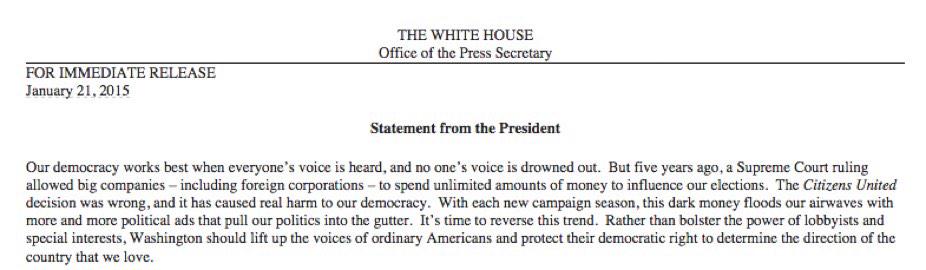
Happy Anniversary! (Citizens United Edition)

As police were taking that person out of the chamber after wrestling the demonstrator to the ground, another protester started shouting "one person one vote" amid the clamor of chairs being knocked over. Another demonstrator began shouting about "the 99 percent," a reference to the majority of Americans as opposed to the richest 1 percent of the population.
There was a protest during the opinion announcements at the Supreme Court, it being the fifth anniversary of the Citizens United ruling (tomorrow is the 42rd anniversary of Roe v. Wade, but there is no open court scheduled).  I'm glad they said more than "money isn't speech," since I find that lame -- it's obviously not speech, but like a range of rights, money is needed for free speech. The problem is the appropriate regulation.  
As I argued in a recent review of Zephyr Teachout’s Corruption in America, the problem with Citizens United was not that it recognized that corporations have speech rights, or that restrictions on money spent for political campaigns should be viewed skeptically as regulations of speech, but that the Court rejected any rationale for regulation other than avoiding quid pro quo corruption in the narrowest sense. The reports released last week underscore how much our democracy is paying for the Court’s flawed analysis.
David Cole hits to the core of the problem that can be lost among those who speak of money not being speech or corporations being treated like human persons (which few doubt is appropriate in some cases, such as for advocacy organizations, media institutions or incorporated churches). Corporations also aren't treated "the same" as human people --  corporations, e.g., don't have the same right against incrimination or the breadth of privacy rights generally as human persons.  The problem is how equally and ultimately the concerns here go beyond corporations to regulation of campaign finance generally.  Rhetoric can confuse.

Cole in the article notes that "problems with the Court’s campaign finance jurisprudence predated that decision," but we should not assume that the problems are "due" to that decision or earlier decisions.  They very well are aggravated by them, but the ultimate problem is going to be present either way, and is inherent in the political process.  Such is Prof. Teachout's point and her argument is that campaign finance laws are loyal to original understanding concerns about corruption and the dangers to good republican government. Moving beyond history, her arguments can provide an overall argument in support for regulation here.

[For sake of clarity, I will add a bit more here. The argument is that the corruption issue provides a compelling state interest that authorizes limits on 1A rights, if such "freedoms" are to be understood to cover that sort of thing in the first place (cf. obscenity as arguably not an aspect of free speech).  Likewise, it is not really true that until the amendment was passed, people didn't have a right to free speech.  So, the underlining contours of republican government that the 1A here furthers and helps elucidate the reach of  would require some limits here.  Finally, at the very least bribery laws provide a limit here; Teachout and others argue a broader quid pro quo threat is out there that can be regulated.  So, those like Scalia who admit money can "corrupt" but it is allowable in a range of ways can be answered, using original understanding as a means of support.]

I did then and do now find the specific ruling at least possibly correct. To be clear, do think it probably was needlessly activist (the term is not bad, it's the application that matters), it very well possible to decide the case on narrow grounds.  If you are going to make a significant change in the law here, an in the middle of things re-argument seems to be somewhat bad pool. And, there very well probably are certain things about a "corporation" that can justify special rules.  Still, the concept itself is not to me some sort of talisman to reduce 1A rights generally.  And, don't think the average critic disagrees really -- they are concerned about a narrow number of rich corporations and again usually have bigger game, like money generally.

This goes back to the dangers of deciding this question too broadly. Some don't like the "minimalism" of the Roberts Court and I flagged the usage of a fairly extreme prison rights case to decide religious rights of prisoners. But, free expression and the like repeatedly turn on specific facts and narrow issues.  So, we had a case the other week about regulation of signs. There are a range of possible regulations here, possible even after Citizens United, if there is a will.  Agree with CU critic Rick Hasen as well as to the foolhardy, except to push the middle along, amendment approach. A case involving non-citizen residents that the USSC upheld without comment underlines the possible nuances here.  President Obama flagged "foreign corporations" in that infamous SOTU comment and did so again today

And, it continues to be a good idea to talk about corruption and progressive ideas of free speech (e.g., not crowding out voices by wealth) and election reforms (you want your money in politics? at least don't add other sorts of invasive regulations like stupid id laws). There are a range of possible solutions here such as voluntary rules for parties, free air time,  matching funds schemes, limits on foreign money and so forth.  After all, even if at least some of Citizens United is right, it doesn't mean all campaign laws are wrong.  Justice Kagan showed that here, even if you thought as solicitor general she was on the wrong side five years back. Disclosure laws, including as applied to corporations (and their shareholders), is another way to go. And, that is one area that Kennedy et. al. actually supported.

MLK believed that confrontation was essential to force society to face up to its flaws.  Acts of civil disobedience, notable for their lack of nuance they might be, have value.  The issue continues, including yesterday when the Supreme Court heard oral arguments concerning judicial elections.

SOTU

It was fun to follow along via the WH text and video feed (with pictures/graphs/etc. on the side to match various themes) and tweet/follow various comments on Twitter. TPM labeled the speech "jaunty, bumptious, with a certainly crackling of aggressiveness," and saw that sometimes. Seemed a bit long. Reference to "transgender" and related civil rights a first.

Tuesday, January 20, 2015

FYI

Designated survivor is Sec. Foxx (so either way, should have a black president).