About Me

My photo
This blog is the work of an educated civilian, not of an expert in the fields discussed.

Tuesday, July 05, 2016

"Machine Guns Are Not Protected By The Second Amendment, [5CA] Rules"

The Fifth Circuit led the way regarding the individual rights view of the Second Amendment so it was interesting to read a recent opinion holding that machine guns were not included. A 1986 expanding a national regulation to specifically ban machine guns* (including conversion of other weapons) made after that date. Pre-existing ownership is still legal as a matter of federal law. The Fifth Circuit was following recent lower court precedent in this respect, but went somewhat further than merely saying machine guns are not covered.  The reasoning particularly interested me.
We hold that possession of an unregistered pipe bomb, by its very nature, creates a substantial risk of violence. Unlike a handgun, it is not considered sport to hunt or engage in target practice with a pipe bomb. Moreover, it would be quite difficult to protect oneself or one's family with a pipe bomb. In fact, we cannot conceive of any non-violent or lawful uses for a pipe bomb.
This is from an earlier opinion cited here regarding the "dangerous" nature of a pipe bomb.**  It is relevant since an exception in D.C. v. Heller are "dangerous and unusual weapons," though the last opinion cited there was handed down in 1874. However, Scalia rejects the "startling" (possibility of a federal law somehow being unconstitutional doesn't seem too shocking in itself) idea that the current machine gun ban is unconstitutional. He does so in part to separate personal ownership from ownership that might have a valuable militia purpose.  But, just what this specific term means was left noticeably to the lower courts to determine.  Handguns were noted to be in common use and practical for personal home defense over other guns without comparing it as such to a "dangerous and unusual" arm.

OTOH, in Staples v. U.S., cited by the 5th Circuit, the Supreme Court (in 1994, with only two justices dissenting) required actual knowledge a gun is a banned machine gun. Justice Ginsburg concurred (only Stevens/Blackmun dissented) to emphasize  that Congress recognized "widespread lawful gun ownership” and a "very limited class of firearms, those they considered especially dangerous" that was "often difficult to distinguish from others non-regulated types."  This would have been a useful citation in Heller to help clarify rankings among categories, including the comment: "we might surely classify certain categories of guns -- no doubt including the machine guns, sawed off shotguns, and artillery pieces that Congress has subjected to regulation -- as items the ownership of which would have the same quasi suspect character we attributed to owning hand grenades."  

All guns are "dangerous" in some sense of the word. The term "dangerous and unusual" (interesting match to "cruel and unusual") has been interpreted to use that word to mean "especially dangerous."  The earlier case was not a Second Amendment case, but comparison of a pipe bomb and handgun is telling. The Second Amendment might not have expressly been given the Heller reading, but there was a widespread general understanding that individual ownership should be treated differently when certain types of arms were involved.  The opinion here also discusses "unusual," which it notes has been a matter of some debate. Regardless, like using various Establishment Clause tests, machine guns are "unusual" no matter what test used.  A key factor being widespread bans (cf. Alito's analysis as applied to stun guns).  This again reminds one of how "cruel and unusual" has been applied.

This is interesting and itself goes into more detail than the 3CA opinion, but overall seems rather straightforward. Plus, Heller itself assumes the government can ban machine guns. It also addresses the possible rejoinder that machines guns would seem to be helpful for a "well-regulated militia."  The opinion determined that this was advanced by an individual right to keep and bear arms, arms in common use at the time for personal self-defense.  This was actually the core concern according to Heller -- the personal right to have an arm to deal with confrontations, particularly in the home ("Putting all of these textual elements together, we find that they guarantee the individual right to possess and carry weapons in case of confrontation.")

What really made me say "hmm," though it does seem to logically follow, is page 11 of the appellate ruling:
Heller, therefore, distinguished between two classes of weapons: (1) those that are useful in the militia or military, and (2) those that are “possessed at home” and are in “common use at the time for lawful purposes like self-defense.” See id. at 621−27 (quotation marks omitted). The individual right protected by the Second Amendment applies only to the second category of weapons, though that category at times may overlap with the first. 
The italics are in the original.  A logical -- one made by the author talking about his book on the First Congress --  interpretation of the Second Amendment is one that focuses on the militia.  States would retain the power over their militia, which would be armed with various types of weapons (the First Militia Act actually required ownership of certain weapons and equipment; state militia laws did as well) and they would not necessarily always be "possessed at home."  Given the recent holiday, reference can be made to the spark that started the Revolutionary War -- reports militia stores would be seized by the British.  Home and personal defense was not quite the same thing here. 

The usual complaint is that modern arms are quite different from the typical musket of old, helping to show that the Second Amendment is obsolete.  The Supreme Court tries to deal with this by noting that yes we have much more serious weaponry now, but the type of arms the amendment is meant to cover is more limited.  This seems a bit of a quirk of technology -- if the advancements in technology that arose not too much later (cf. weaponry of the Civil War), would the overall logic of the amendment be different?  I think not.  The basic logic of the militia and the need to arm "the people" (which turned out generally to be a subset of white males)  would hold.  The fact the average person might not have some repeating rifles or the like at home wouldn't change this.  

As noted in McDonald v. Chicago, sure, there was a development over time regarding the understanding of just what the Second Amendment meant.  Calling out Scalia on bad originalism is a bit of a parlor game, but even textually, the whole thing is somewhat troubling, at least curious. A text that specifically highlights -- something the Constitution nearly never did -- what is specifically at issue largely edits out the first part as something of an also ran ("might').  Yes, in the long run, this is said to advance the needs of the militia.  But, doesn't it have a sort of round peg in a square hole flavor?  Why wouldn't the "arms" be militia arms?  

The focus on an individual right for personal self-defense in the home, a right that I do think exists, is confused here. The Second Amendment to me is best seen as tied to a specific purpose that does involve individual ownership, but only as a means to an end.  People have guns for a range of purposes -- hunting, self-defense, target shooting and so forth.  Originally, one purpose was to defend society in generally, beyond the degree self-defense itself does that.  The current approach is too personal, solitary for my tastes. The image is of a solitary (probably male) person defending hearth and home. But, the Second Amendment is about the "militia," which like the jury is more of a group effort.  

I would get to the same basic place in another fashion. First, the "dangerous and unusual" exception would provide a narrow means.  Second, more broadly, personal ownership would be seen as part of a wider whole, just as free speech and other rights would be. There is a general right to keep and bear arms to advance the interests of the well-regulated militia.  This involves regulation, more so than religious belief or speech; we don't read of "well-regulated churches" or the like. This alone seems notable, including as a partial reply to Justice Thomas' recent dissents that argue that the Second Amendment is getting second class treatment.  Guns here are different.  It's in the text alone. This is so even if you think "well-regulated" is self-regulation to "make regular." Still not present for religion and speech, which can be rather irregular. Disorder is more encouraged in those contexts. 

All rights will be regulated somehow. Specifically, the regulations here are appropriate for the items ("dangerous and unusual") and overall ends. The ends here being self-defense, certain types of firearms can be banned, just as certain types of speech is deemed too dangerous or not worthwhile enough to allow (libel, child porn, threats etc.).  The home is special here as it is for various rights.  Thus, yes, possession in the home would get special protection, but like Lawrence v. Texas, don't think the right is limited to the home. This would not really for me be a "Second Amendment" purpose.  Personal self-defense is a separate liberty.

Heller does focus on personal self-defense and there is a general understanding that agrees with that point of view. So be it. There is a means to connect it all together. The government can very well decide that machine guns are necessary for militia service.  There also might be other weapons that are "dangerous and unusual" in some fashion that for the limited purpose of professional militia use would be appropriate. It might even be constitutionally impermissible for the federal government to deny specific states the power to do so.  But, for the specific personal individual right at issue, it very well might be different. The qualifiers are added advisedly since, like jury service, I think there is an "individual right" to membership in the professional militia, which again might have arms different than those individuals themselves can for home use.  

Since Heller was so originalist in nature, it seems notable that the idea of two categories of arms would probably seem curious to the Founders. The weapons they took to the field were akin to the ones they had at home. There weren't "militia" and "personal use" weapons to the extent the "two classes" discussion seems to establish. The approach here seems somewhat artificial, even if handguns might be a form of military sidearm or whatever.  Now, personal weapons are front and center, their connection to the militia somewhat happenstance. Why not simply accept that personal ownership is a separate liberty and militia use can be regulated separately? Even if the second part of the Second Amendment is not a clean overlap of the first, there is more of a connection than the current rule says.

I think the Second Amendment applies to "both" types of weapons but their different purposes and effects allows different rules.  

---

* Defined here as a gun where one pull of the trigger fires more than one shot.  Per Wikipedia, a "semi-automatic" is a weapon where the gun is ready to fire after the first shot but it requires another pull to do so.

** "Congress added bombs to the list of weapons for which unregistered possession was a crime in 1968. Congress expanded the scope of the National Firearms Act in this manner because of its "specific declaration and finding that destructive devices (such as bazookas, mortars, antitank guns, bombs, missiles, etc.,) machine guns, short-barreled shotguns, and short-barreled rifles are primarily weapons of war and have no appropriate sporting use or use for personal protection." 

Saturday, July 02, 2016

SCOTUS End of Term Watch

[I will be back Tuesday, so here is a holiday link.]

Twitter provides constant legal news (among other things) with Chris Geidner (Buzzfeed) and Kimberly Robinson (Bloomberg)  favorites.  Geidner comes off as a bit of a nut at times (e.g., his Hamilton and Good Wife fixations) but has an impressive resume as a lawyer and journalist.  Robinson's SCOTUS end of term numbers wrap-up (less than 70 opinions from cases with full argument).

The big news this term was the surprise (in hindsight, a guy in his late seventies dying is not really but other than Rehnquist -- who had fought cancer for around a year already at the time -- dying in office was just not something that really happened; it really shocked me at the time) eight justice Court.  The Republicans simply didn't want to do their job and have Garland hearings, even though he's basically the best they could hope for in this position.  The odds of a Trump presidency is low.  This alone was a "fu" to the country and shows they should lose the Senate.

The Robinson article notes that Thomas has thirty-eight opinions in argued cases (figure a few of these, if he was alive, Scalia would handle; but many of these were Thomas solo jobs regardless). Thomas also spoke during oral argument, for those in the know, about as remarkable as "Garbo talks" was back in the day.  The "Thomas Constitution" (my "Joe's Constitution" is still available online!)  theme was addressed by a few commentators.  
He is so convinced of the wisdom of his approach to the law that he rejects practically the whole canon of constitutional law. It’s an act of startling self-confidence, but a deeply isolating one as well. Even his ideological allies, who mostly come out the same way on cases, recognize that they must dwell within the world that their colleagues and predecessors created. Thomas, in contrast, has his own constitutional law, which he alone honors and applies.
It has been noted that Justice Alito (though in this case Roberts joined in, repeatedly it was Alito/Thomas, often in relation to orders)  has shown some annoyance (strong disagreement would be a nicer way to put it) with how the Court has been deciding various issues.  Highlights include his separate stun gun concurrence, his snarky dissent in a federal statutory criminal case (the one where includes a "dialogue" at sentencing) and dissents from the bench in both the affirmative action and abortion cases. Some of these were joined by Roberts.  It has been noted that there appears to be a new "center" -- Kagan, Breyer and Kennedy.  Toss in Garland,* you might truly have a Breyer/Kagan Court.

[Deepak Gupta in the ACS term review at one point argued that multiple opinions this term were a sort of a compromise pablum that avoided the Court needing to admit they were more split than the few 4-4 opinions suggested. Some like this approach to reduce the power of the Court though it has its limitations regarding clarity of national law and we are going to get a ninth justice eventually.  If you like minimalism, Garland might be the best bet there.  Anyway, this involved various compromises, like the contraceptives ruling, and those three seem to have had a large role, often Roberts going along without comment.]

Thomas is not a big one on stare decisis or the limitations of multi-member institutions that require some degree of moderation and compromise. As seen in the medicinal marijuana case, this doesn't always have a necessarily conservative result.  But, this isn't that off (though find the guy a tad excessive):
One final word about hubris before I go. Randy Barnett goes out of his way to praise Justice Thomas for willing to overturn generations of Supreme Court precedent if text and history so demand. But that precedent is the result of a complex combination of prior Justices' calculations of law, politics, social reactions, counter-reactions and values. Certainly times change and with those changes so should Court decisions. But it takes a special insight, a special intelligence, and a special feeling of superiority to think that one's own perspective on the complex relationships between vague text, contested history, and the rights and privileges of our people and the our governments can be resolved neutrally through an originalist methodology, and then end up with the political platform of the 1992 Republican Party. I envy that kind of insight.
The important part of this is probably the "complex combination" part that explains (and on certain blogs etc., this is something that some liberals at times miss) the nature of various opinions. They are imperfect compromises, not ideal on the facts or the law in certain respects.  It is fine to critique them, if one realizes the reasons that went into them.  Sometimes, the opinions are imperfect given the imperfections of the justices (though that's part of reality too).  But, it's more than that.

If things go as they have in recent years, there will be scheduled order days during the summer as well as any ad hoc orders necessary. The future of the Court is coming. Not quite here yet.

---

* I stick to my overall belief that Garland, taking everything into consideration, was a very good choice.  It is a failure that those who care about civics have a strong reason to find quite depressing if (as it seems likely) he won't be confirmed during the Obama presidency.  If things worked as they should, we should have had a nine justice bench by October. Plus, the Republicans got a true moderate, apparently something of a minimalist and one who won't be there as long as others. Win win. 

But, if he does not get confirmed, I really hope Clinton (as it seems would be necessary) does not re-nominate him. (Knock on wood that sanity will prevail there regarding the Clinton part.  If the Republicans retain the Senate -- which is depressingly quite possible -- it's a tougher call.  But even there, I'd at best use him as a back-up.)  You bet, often the house (or White House) wins.  Tough luck.  Let her pick a younger woman and/or minority who is somewhat more liberal.  Screw you assholes.

Thursday, June 30, 2016

Carol (The Price of Salt)

Enjoyed the movie more including because it focuses on both women, but the source book (from the early 1950s; its positive ending especially was appreciated by lesbians at the time) was overall enjoyable. It was in the voice of the younger woman and was a bit too talky about her feelings and such but well written. Short 1980s afterword by author.

Tuesday, June 28, 2016

Justice Beyond Criminal Justice

The failure so far to prosecute regarding the death of Freddie Gray does not mean "no justice" is possible. Justice does involve prosecutions (and how we do them), but in a big picture way, that might be the lesser approach. Prosecution is a last resort with a high bar while there are various other things to do, including civil remedies, political responsibility (see, e.g., 2006 and 2008) and changing policies. See., e.g, racial equality after Brown.

And Also: The contraceptive rule is a compromise.

Order Day

There will be scheduled summer order days but one more scheduled one before then. Big news today, finally, the union fees case (without comment) will not be re-heard. Thomas/Alito would examine a broad (over $100) disclosure law. I'm open to concerns if the bar is that low. Roberts joined a strong dissent to not taking a case requiring access to IUDs etc. at pharmacies without a religious exception. Somewhat open to concerns if nearby access is available but we are talking time sensitive/constitutional rights (Griswold).

Monday, June 27, 2016

The Burger Court and the Rise of the Judicial Right

I gave a brief partially negative review of this book and hold to it. But, it covered a lot of ground in a easy to read fashion, plus there were some interesting internal bits too. The story also shows how the courts are not complete independent from both the public and the political branches, the latter by whom is in control when appointments/confirmations occur. Kennedy as a fifth vote today shows just that as does his living constitutional approach.

SCOTUS Watch

First, the new Burger Court book co-written by Linda Greenhouse is too heavy-handed on the conservative shift, not enough inside details and found a few mistakes. Somewhat disappointed. Second, the statutory gun case came as expected except Sotomayor joined Thomas' dissent (minus 2A part). Gov. McDonnell won (even Rick Hasen thought he should) unanimously. Breyer wrote the abortion opinion (5-3), RBG concurred to briefly say it was really bad and dissents thought majority were the unreasonable ones. Orders boring.

Saturday, June 25, 2016

José Reyes Back

The Rockies disposed of their expensive star SS to the Blue Jays and in part received Reyes (who had a short-lived stint with the Marlins at the end of the day), but had prospects around ready to play. So, after a recent domestic violence incident led to a suspension, Rockies let him go, eating a chunk of money since no team wanted him. So, Mets got him for chump change, but wary myself, the d.v. not helping. But, guess wait and see.

ETA: Wary about Conforto last summer but thrived. After a good beginning, he's back to struggling rookie. So, to add to the spare parts, another rookie will replace him for awhile.

Friday, June 24, 2016

The Right to Abortion: A Psychiatric View

Found this book on one of the $1 shelves outside of Argosy. Nice find -- it is a booklet from 1970 that supports a woman having the same right to choose an abortion as they do to choose who to marry. It covers all the bases (privacy, religion, vagueness of mental health exceptions etc.) and holds up very well (even debates on how IUDs work). Exception is a suggestion that maybe husbands should be given right to take part in the decision but even that was hedged.

Thursday, June 23, 2016

SCOTUS Watch

Started with a statutory criminal ruling not too exciting but with a range of opinions including a tour de force by Alito. Then, warrants required for blood but not breath tests (Sotomayor/RBG disagree on latter). Kennedy (4-3) finally finds an affirmative action program he deems constitutional. And, 4-4 non-decisions for the long pending Dollar General case (net result: pro-tribe) and (surprise/horrible) immigration case. Abortion on Monday.

Wednesday, June 22, 2016

"Any honest historian of the early Republic will tell you that lax gun laws are not in fact pro-Second Amendment; they are anti-Second Amendment."

Saul Cornell wrote A Well-Regulated Militia: The Founding Fathers and the Origins of Gun Control in America.  

Interesting book.  He basically supports a pro-gun regulation approach to the 2A though his historical studies concludes the individual (common law) right to self-defense is separate from the purposes of the amendment itself (at least the original understanding). That's fine really though basically (McDonald v. Chicago in effect sort of says this) over time the people had a different view that matches the conclusion of D.C. v. Heller

He wrote a guest op-ed in today's NY Daily News (some good stuff today but again what's with doing away with daily movie and t.v. coverage; even the t.v. listings were cut in half).  Let's break things down. The most basic argument is okay enough:
Any honest historian of the early Republic will tell you that lax gun laws are not in fact pro-Second Amendment; they are anti-Second Amendment.
He in part appeals to the "security of the free state" (which I take to be an appeal to republican principles) language as giving the state some power to regulate to guard against domestic violence.  This is an interesting approach; most in support of regulation are more inclined to focus on the "well-regulated" part in particular. Cornell next notes Heller, in his words, supports "reasonable regulations," which is a bit misleading since that in legal jargon would suggest a lower level of scrutiny.  Scalia in fact specifically rejected "reasonableness" review here though did not clarify if strict scrutiny was required.  It is fairer as a colloquial summary.

Cornell notes Scalia appealed to original understanding and then cites some examples of Founding Era regulations.  Cornell does note that we have a stronger sense of due process today, e.g., so need not follow them exactly.  Which is good since things like loyalty oaths are not a good idea.  We should not deem practices against loyalists while a war was ongoing on American soil with British troops breathing down our necks as quite the best approach. There were people at the time wary about emulating some of the things we did there. It does suggest the limits of original understanding.  He notes:
Under common law, any person in the community could approach a justice of the peace and demand that an individual be preemptively disarmed if they posed a danger to public safety. Such persons would be required to post a peace bond, much like a modern bail bond.
I'd like to know a bit more about this, but it doesn't quite sound like the terror watch list idea. The judiciary (to the degree "a justice of the peach" was that) seems to be involved.  How did one show "they posed a danger to public safety" and what does "preemptively disarmed" means exactly?  Was it a one-sided affair?  Was notice required? Were they able to offer proof then and there before being disarmed that the peace bond was illegitimate? The concern with the proposals is the after the fact, basically backward approach where the executive gets to block purchase and only then you can challenge it.  
It is not the real Second Amendment written by the Founders that poses a barrier to taking decisive and reasonable steps to lower the carnage in our streets; it is the mythical Second Amendment imagined by the gun lobby.
True but that's rather vague.  What exactly is "reasonable" here?  Bottom line, the article basically refutes an extreme argument and defends the broadest strokes of the pro-regulatory side.  This helps a bit, but doesn't quite tell us what specifically is okay.*  It's only an op-ed, so realize its limitations in form. Still, would help to learn a bit more how the terror watch list idea fits in here.  For instance, if the individual wrongly claimed a peace bond was warranted, was s/he open to civil damages?  Little things like that alone might make make the proposals different.

But, sometimes the very basics do help reach agreements regarding basic givens especially for hot button topics.

ETA: I emailed the author and he provided me a link to this article and referenced the book. My reading of the article is that it concerns carrying guns in public places and that colonial practice put strong licensing restraints on that.  Interesting perhaps for that issue which isn't settled yet.

Did find this article (see particularly around 717) that does appear to cover the bond issue.  "One means of conserving the peace, apart from prosecuting those who breached it, was to order persons who posed particular risks to provide sureties of the peace." This is separate from regular prosecutions, has a "probable ground" standard and involves what sounds like a form of bond and judicial oversight (“to bind the party to appear at the next sessions of the peace").  

Not sure how that applies here though sounds like judicial involvement on the front end would be required.  

===

* For instance, Sen. Collins has put forth a compromise version of the terror watch list proposal which has enough Republican support that there appears to be a fighting chance for it to reach cloture.  So it can die on the House floor (after the sit-in folks leave).  Sorry.  A tad cynical.

Seriously, the ACLU opposes it. A NRA/ACLU opposition here just might be too much, especially since again quite seriously, it's probably a lost cause in the House anyways.  Re-funding research (maybe all those John Oliver encouraged calls will bear fruit)  seems a lot more safe in this respect.  The whole thing seems gratuitous.  A general background bill also would be more copacetic though due process needs to be safeguarded there too.  But, not holding my breath there. 

The Summer of Sangaile


Found this at the 53rd Street Library. It's a Lithuanian film about young love, finding one's confidence (cutting involved) and the country's apparent fascination with planes. Actually watched the whole thing straight and in one sitting, so has to be decent. Seriously, had a good feel, interesting look (a bit much with the heights/planes at times) and lead very good.

Tuesday, June 21, 2016

Day Out Mid-Town

Used to regularly go to the Donnell Library in mid-town but then it shut down. A while ago. Yesterday, it re-opened in a fashion as the 53rd Street Library, a sort of 21st Century affair with even a place (stands type area) you can sit down and eat. Nice. Also went across the street and took advantage of my idNYC card to get a free year membership at MOMA. A lot to see (and hear). Round things off, bought a $1 book at Argosy Books. Charged me tax!

Monday, June 20, 2016

Supreme Court Watch

After another chance for Alito/Thomas to dissent from orders (Jesus Emmanuel Jehovah's request was rejected without comment), three boxes suggested multiple opinions. Thing is no one really cares about most of them. The notable thing was Sotomayor's personal (one section was her alone) and passionate dissent in a 4A case (Kagan also dissented strongly). Meanwhile, a challenge to NY and Connecticut gun regulations was denied w/o comment.

Update: Odds and ends on actions today.

Veep

The overall penultimate episode of S5 was very good, framed as Catherine's documentary and having plenty of chances for each character (again Sue is nearly absent) to shine. The constitutional dynamics is a tad confused but surprisingly not on the "maybe 12 years" point.

Sunday, June 19, 2016

Who Cooked Adam Smith's Dinner


Interesting and often sardonic book on how "economic man" is a misleading understanding of how the world actually works, especially how it skips over 1/2 of the population (and gives a fictional view of the rest). Gets repetitive at some point but good for average reader. This is good for me, who was never that good at money matters. Happy Father's Day.

Saturday, June 18, 2016

The Leech Woman


Pretty fun Svengoolie entry with a lot of stock jungle footage. The lead actress makes the movie including her femme fatale (in more than one way) turn. Trivia: the young version of the tribal woman married IRL "Colonel Klink" after a long time dating him.

Friday, June 17, 2016

RIP Jo Cox and Let Us Be Sane


I linked a thread that had some of my thoughts on the terror list gun ban proposal (not sure if it should be DOA and maybe it will help temper the whole watch list since guns will cause people to be concerned), one which some progressives along with others consistently find problematic. Republicans less so -- are they worried about the no fly list generally?  Not to my knowledge. 

But, the recent filibuster wasn't only about one proposal. A background check bill might also be voted on, limits on "weapons of war" (the AR-15 was invented for that purpose) generally and so on was also discussed.  Serious conversation here will require compromise, some proposals (especially at first) not likely (at times rightly) obtaining majority support.  So, the whole thing/thread is interesting, don't worry, even opposition to one proposal doesn't make the filibuster not worth it. 
Christiane Amanpour (Facebook/Twitter): "In deep shock still at British MP Jo Cox's assassination. A woman who showed the best most courageous face of politics, the righteous anger at the Syria war, the kind compassion for refugees, and the refusal to demonize the other. She leaves an important legacy for her daughters and for all of us."
The opening video regards a British politician who was recently killed though even there we can compare this to the mass shooting that injured Rep. Giffords and killed others, including a young child. The politician was shot and stabbed but in the U.S. we have much more firepower.  With the amount of guns, hate, screwed up people and so forth in this country, we are not going to totally deny the chance of the forces of chaos to win battles. What we might be able to do is reduce the effects, something akin to how modern warfare is less lethal because of medical advancements and current rules of warfare.  Sadly apt metaphor.
Gabrielle Giffords ‏@GabbyGiffords (Twitter): "The assassination of MP Jo Cox at the hands of a man driven by hatred is a manifestation of a coarseness in our politics that must stop."
It is totally fair to bring up Trump here because he is a product of various things wrong with our system and political parties.  Trump is seen as a bit too rude for many Republicans but the people who form his base is nto "beyond the pale" and neither really is Trump.  And, the things he incites, even if Trump himself doesn't support it (though he does support various nasty things) is his responsibility too.  We have a simple responsibility to be sane here, support rationality and some basic minimum of shame.  This election even more than 2000 and 2004, which was pretty emotional for me, is really a line in the sand.

See here too. The discussion references the few cases where protests of Trump became violent. This from what I can tell was some shoving, throwing eggs and damaging a car or something.  A handful of places. But, it's a horrible thing to do, even though it's sadly predictable* that bullying and forth will result in desperation moves (see the 1960s). It is tragic that violence is used so much in the Palestinian conflict.  And, some low volume version happening here is bad too.  Nor, is irrational visceral replies useful in my view online generally.  Sanity for all!

---

* One comment said it well:
Violence at Trump rallies, particularly committed by frustrated and scared young people terrified of what Trump’s movement means for them, can simultaneously be: 1. An entirely understandable and predictable response, sociologically and psychologically, 2. Emotionally satisfying in the short term, 3. Counterproductive in the medium to long term, and 4. Morally wrong.
Trump and his enablers had some blame here too, particularly those with more power than some twenty-something protester. Plus, the small numbers and the fact they aren't supported by the candidate counts. But, partially since I'm for a higher standard (unfair as this might be on some level), sanity standard, we still need to oppose it strongly.

Thursday, June 16, 2016

SCOTUS Watch: Yawn

Three technical opinions (Kagan/two by Thomas, who thrives on this sort of thing when writing for the Court) unanimous and with no separate opinions. Basically left to a colloquial footnote (2) in Kagan's opinion to stay awake. Not much of a "two box" day.

Wednesday, June 15, 2016

Eve Arnold


The author of the book on the war in Syria referenced a few days ago wrote this one (with lots of photographs) regarding an eclectic (from celebrities to poor farmers) photographer. It is sort of a coffee table book that provides bio with all those great photographs.

Terrorist Watch List Gun Proposal

As a placeholder, a dissenting opinion joined by two justices on guns. Anyway, one thing tossed out there is blocking those on the terrorist watch list from buying a gun (and perhaps something more), which I discuss in comments here. The proposal might be okay and criticism tends to be exaggerated (right to buy a gun different from various things) but wary about it especially without limits such as judicial process, limiting it to non-citizens etc.

Tuesday, June 14, 2016

Clinton Wins DC

And it's done.

Supreme Court Declines Review on Question on the Application of the Citizenship Clause to American Samoa

Discussion here (with reference to NYT op-ed). Tricky thing here is the local government, which apparently has support of the people, didn't want citizenship. Fear (which might be somewhat misplaced but maybe some laws are problematic) some local laws would be challenged especially those favoring locals. Can there be a way specific policies (favoring citizens) be challenged here? Or, allow people, by right, to choose to be American citizens?

Monday, June 13, 2016

Griswold Again: Property Rights

It is plain that the interest of a parent in the companionship, care, custody, and management of his or her children "come[s] to this Court with a momentum for respect lacking when appeal is made to liberties which derive merely from shifting economic arrangements."
-- Stanley v. Illinois [1972]
During around a half-century after the ratification of the 14A, "shifting economic arrangements" was often more respected as a matter of constitutional law.  The "right to contract" in particular was the basis of many state and federal cases, including what for many later was an anathema, Lochner v. NY  (maximum hour law for bakers struck down).  The Contract Clause, including public contracts, was also of great importance in the early years of the Supreme Court.  [One book, e.g., noted how early attempts to regulate lotteries were complicated since property rights and contracts were involved while by the end of the 19th Century, it was much easier to do so.]  Property rights were of great importance to the Founding Fathers as well including in the constitutional barrier to states using paper money.

In time, however, it was deemed more and more appropriate to let economic affairs to generally be left to public policy.  Basic aspects of one's personality such as sex, race, religion and so forth remain things carefully handled; fine lines between professions, much less so.  Note that Lochner v. NY itself was 5-4. The dissent accepted a legitimate public health purpose for the law.  And, in time,  maximum hours and minimum wages were also seen as necessary for true equal protection.  In Poe v. Ullman, Justice Douglas voiced the sentiment of many, if rather simplistically:
For years, the Court struck down social legislation when a particular law did not fit the notions of a majority of Justices as to legislation appropriate for a free enterprise system.
Douglas continued:
Social legislation dealing with business and economic matters touches no particularized prohibition of the Constitution, unless it be the provision of the Fifth Amendment that private property should not be taken for public use without just compensation. If it is free of the latter guarantee, it has a wide scope for application. 
There are provisions in the Constitution which touch upon these issues such as the bankruptcy and currency provisions,  the Commerce Clause, the Contract Clause, the Due Process Clause ("property") and any provision that might arise.  For instance, equal protection issues can arise if certain businesses are treated differently without reasonable grounds.  What if the business was a newspaper or movie theater with zoning issues?  Finally, privacy can be involved too, including the Fourth Amendment.   There is not a 4A free zone here.  Justice Stevens in a case involving a grandparent choosing to live with her grandchildren separately relied on property rights.

There was a judgment here that business and economic arrangements was more "public" and open to regulation. This developed over time and even long before the 20th Century various types of regulations were allowed. But, property rights was quite important to the Founding Fathers, especially in a society greatly agriculturally and land based.  Personal predilections alone was not behind the resulting case law. Slavery also was deemed a special type of property, while one core concern of the anti-slavery movement was free labor.  The basic right to freely contract was and continues to be a basic right of freedom.  The legitimacy of regulation, including to deal with inequalities should not lead us to forget this.  But, neither the public nature of things either.

Property rights are important and "private" property is specifically protected by the Takings Clause.  The 4A specifically protects "homes" and "effects," which are forms of property.  Cars are repeat players in search and seizure cases.  But, property still on some level is not as personal as "life" and "liberty," resting not merely on state property law but "intrinsic human rights." Justice Douglas between Poe and Griswold spoke separately to differentiate the home from businesses with "service which has become of public interest."  The principle continues today with religious owners having some obligations to employees and customers. They are not merely private individuals any more.

Thus, property rights do have some constitutional importance, and this can blend into social and business affairs.  Some exaggerated approach here, after all, leads to Justice Black (and temporarily Stewart)  deciding contraceptives are among the "social" policies the state has broad control over.  Once upon a time, even equal protection gave limited control to "social" affairs, the general idea being that civil rights here did not touch interracial marriage.  Or, overall, it was good public policy unless it was done just plain irrationally.  OTOH, there was a changing understanding on correct policy here including what is best to protect equality itself.

But, there remains a belief that certain "personal rights" are particularly private such as family life, the general idea always there.  There is no absolute rule here -- families are regulated too -- but family life and one's own body was never on equal footing with business regulations.  The particulars change but even in the "Lochner Era" the libertarian approach only went so far.  And, as public matters were more regulated, the private was (and is) if anything more important.  Tricky as usual.

SCOTUS Watch: America Samoa, Puerto Rico and Indian Territory

Orders today rejected cert. involving American citizenship in American Samoa and a public unions related case written by Justice Souter that might be a signal about the rehearing of the Friedrichs. As some suspected, Thomas wrote the Puerto Rico bankruptcy opinion (Sotomayor/RGB dissent; Alito didn't take part). Unanimous patent case (three justices concurred). And, RBG (with Thomas concurred, doubtful of Indian law precedents) wrote the opinion allowing a minor crime convicted in a tribal court to count as an aggravating factor even though the person had no counsel. The domestic violence angle is covered.

Sunday, June 12, 2016

Griswold Turns 51

Since high school -- mind you I went to a Catholic one -- had a interest in Roe v. Wade. The Webster case was decided around that time and wrote in my illegible scrawl about the case. The diverse issues (privacy, gender, religion, medicine, history, constitutional law, etc.) involved was apparent to me even then. A few years later, it was again of central importance, there a belief that there was five justices present to overrule.

But, in 1992, the Casey ruling did not do that. Instead, it firmly held that there are broad "liberty" rights, included unenumerated ones.  Clinton (here we go again?) was elected and a sixth vote was available though among the Roe dissenters, White joined to some degree the idea of a general liberty interest as seen by his concurrence in the 1965 Griswold decision handed down in around this time of the year. I have talked about this case a lot here and elsewhere for quite some time as this 2006 blog post shows. As noted there, the idea of "private rights" that people retained is not something that merely was found to exist sometime during the Johnson Administration. The Federalist Papers made a couple references. Such things were directly the concern of multiple amendments of the Bill of Rights. Slavery was wrong in part because one's private life was in control of others.

The term "private rights" underline the breadth of the term "privacy," which is not merely a matter of secrecy.  Your family life was "private" but others might know about it. Whalen v. Roe, e.g., discusses the various aspects of privacy. Professor Anita Allen once spoke of four, later expanding it to at least six.  Various people favor other terms but repeatedly things like "intimate" or "personal" arise that return us to the word "privacy." And, to the degree it matters,"privacy" has a long history. No word is absolute any more than any right tends to be. This one seems suitable in my personal opinion but the right not label is most important.

A seminal moment in the history of the right of privacy in this country, if perhaps only in hindsight, is the 1890 law review co-written by Brandeis. The fact the two authors weren't writing in a vacuum is seen by the Boyd v. U.S. case of that time that also argued that the Fourth Amendment protected a broad right of privacy. The Supreme Court protected this with an exclusionary rule as applied to the federal government, again that rule is over a hundred years old (see the Weeks case). Justice Douglas in his concurrence in Doe v. Bolton (along with Poe v.Ullman, his separate opinions in some ways better than his opinion for the Court in Griswold) also references from that era of the concern for privacy being invaded by legislative investigations.  One opinion connected this to Boyd showing the general right to privacy involved:
We do not overlook those constitutional limitations which, for the protection of personal rights, must necessarily attend all investigations conducted under the authority of congress. Neither branch of the legislative department, still less any merely administrative body, established by congress, possesses, or can be invested with, a general power of making inquiry into the private affairs of the citizen. Kilbourn v. Thompson, 103 U. S. 168, 190. We said in Boyd v. U. S., 116 U. S. 616, 630, 6 Sup. Ct. 524,—and it cannot be too often repeated,—that the principles that embody the essence of constitutional liberty and security forbid all invasions on the part of the government and its employees of the sanctity of a man's home and the privacies of his life. As said by Mr. Justice Field in Re Pacific Ry. Commission, 32 Fed. 241, 250, 'of all the rights of the citizen, few are of greater importance or more essential to his peace and happiness than the right of personal security, and that involves, not merely protection of his person from assault, but exemption of his private affairs, books, and papers from the inspection and scrutiny of others. Without the enjoyment of this right, all others would lose half their value.'
The era was also when "substantive due process" came into its own though research has determined that the general idea that there are general limits to legislative action were in some form understood from our beginnings. Even someone who thought the idea absurd like John Hart Ely Jr. made some reference (as I recall reading his famous work) to "legislative due process," some concept that the legislative process can be arbitrary and illegitimate. He also accepted some idea of unenumerated rights, which is basically in practice just getting to the same place by different means.

[Note: To toss it in, one such means -- used by Justice Thomas to cover some of this ground -- is to determine these things are privileges and/or (still don't know why the different clauses use a different conjunction) immunities of citizenship. Non-citizens would still be protected by equal protection and other means.]

Justice Douglas in Griswold spoke of "penumbras" and "emanations" of enumerated rights, but elsewhere also spoke of rights generally necessary for freedom. Coming from a tradition that rejected "substantive due process" as basically a matter of conservative economic rights, he was wary of the term. In Doe, he spoke of it as a "vessel to be filled with one's personal choices of values, whether drawn from the laissez faire school, from the socialistic school, or from the technocrats." Or, to quote Justice Black, "unreasonable, that is, unwise or incompatible with some particular economic or social philosophy."

But, liberals -- influenced by personal choices of values -- overall continued (use the term advisedly) to accept there were certain personal rights essential to liberty, even if they had to be protected via constitutional review. A broad protection of explicit enumerated protections took you far.  Justice Black was strongly against going further but managed to go further than many as is (e.g., "one person, one vote") while noting going far enough at times (e.g., electronic clairvoyance or symbolic speech). Saying the rights are "associated" with certain enumerated rights -- as Douglas once summarized Griswold -- is telling. He basically was right the first time:
"Liberty" is a conception that sometimes gains content from the emanations of other specific guarantees or from experience with the requirements of a free society.
Looking toward enumerated rights is appropriate -- the rights in the first ten amendments were chosen not because they were the only ones we had (see Ninth) but because of their basic importance to the people of the time. Certain rights were just so fundamental that a special listing was deemed necessary. And, overall, the rights retain valuable.  Furthermore, as each justice in the famous Olmstead opinion (best known for Brandeis' new constitutional phrasing of his privacy article) recognized, they deserve to be treated liberally. As Justice Holmes noted: the "words import a policy that goes beyond them." Thus, the right to privacy.*

All the same, Justice Douglas was right to speak of the second half of his "Poe" test, noting various examples found in case law. Back in 1920, in a dissent, Justice Brandeis spoke of the "privacy and freedom of the home." He joined without comment Meyer v. Nebraska, which included marriage and family life protected by the "liberty" of the Due Process Clause.  There were various rights -- travel is another -- that "experience with the requirements of a free society" were determined to be fundamental. As I covered in the past, the Ninth Amendment also serves this purpose.

Justice Douglas also was correct to see the right to privacy as basically a structural protection, something that was necessary protect freedom in general -- a zone of privacy to make decisions and thrive in  a free society:
If liberty is to flourish, government should never be allowed to force people to listen to any radio program. The right of privacy should include the right to pick and choose from competing entertainments, competing propaganda, competing political philosophies. If people are let alone in those choices, the right of privacy will pay dividends in character and integrity. The strength of our system is in the dignity, the resourcefulness, and the independence of our people. Our confidence is in their ability as individuals to make the wisest choice. That system cannot flourish if regimentation takes hold. The right of privacy, today violated, is a powerful deterrent to any one who would control men's minds.
Privacy is not just about making choices, but having intimate zones and associations. So all three threads are important: explicit text is a type of "signpost" that can take you further, helped by traditional rights (whose meaning develop) and underlining principles the flesh out whys.  And, other rights, including equality, procedural due process and so forth help as well since constitutional rights and powers tend not to be isolated from each other.  And, so it continues.

---

* Griswold cites the First, Third, Fourth, Fifth and Ninth Amendments. The Third is a bit of a joker, but has a rich history as a means to protect privacy. The opinion could have also expanded how the Self-Incrimination Clause protects "our respect for the inviolability of the human personality and of the right of each individual 'to a private enclave where he may lead a private life."

Douglas was not big on the individual right to bear arms, but the Second Amendment also has a privacy aspect. The dissent in a lower court case that upheld a local handgun ban noted "the fundamental right to privacy and the fundamental right to defend the home against unlawful intrusion within the parameters of the criminal law." And, Heller held that the 2A was at its core in the home. Well, perhaps personal defense is?  Castle doctrine etc.

The Morning They Came For Us: Dispatches from Syria


Good book by the woman in the video. Meanwhile, the largest U.S. death toll for a domestic mass shooting occurred earlier today at a gay nightclub in Florida. First, RIP. Second, sigh. Third, can we pass national gun legislation to show we are serious? I think there is a right to have a gun. Still can do stuff to stop use of AR-15s to shoot up people. The domestic violence connection is noted too. Finally, only sane leaders. No, Trumps or their enablers. No!@

Saturday, June 11, 2016

Pillow of Death


Silly film but fun. (Sven much older now!)

Thursday, June 09, 2016

Final Primary/Caucus Numbers

With but D.C. (D) left, we can summarize. There is about a 55/45 split among pledged delegates with Sanders in the end having a respectable finish, especially with starting expectations and doing so bad in Southern states. His combative approach got him far, but ultimately, Sanders supporters have a reasonable grounds to feel proud and think they helped in the long run. Bitter enders will exist but should be a statistical nonentity by November.

After Wisconsin, Kasich received a few more stray delegates than Cruz (NY helped), but never did quite past Rubio's totals. Meanwhile, unless there is some write-in upset or something, the Democrats are assured at least one win in the Senate races since the new California rules means two Democrats will be on the ballot in November. One estimate suggests a 3-2 split in toss-ups will result in a 50-50 Senate, underlining removing a senator to run as Clinton's veep is a really dubious move (choices seem to all be from states with Republican governors).

Anyway, it is also useful to note that of the minority that is the Republican voting block that took part in primaries/caucuses, only a plurality voted for Trump, helped by post-Wisconsin belief he was a lock anyhow and everyone else eventually leaving the race. In delegates, he received a clear majority, but winner-take-all rules and that late "it's done" surge helped too. Ultimately, Trump probably would have been the candidate anyhow, but current rules somewhat exaggerate his support. This plus the usual lag time for things to settle (e.g., Sanders votes to shift to Clinton) make current poll data misleading.

SCOTUS Watch: Judicial Issue Day

Three fairly interesting cases of mild importance that were written by  Kennedy (judicial recusal), Sotomayor (judge calling back a jury) and Kagan (power of Puerto Rico to try a case per double jeopardy rules; Breyer with SS dissents, the latter without an opinion). Some chatter that something else interesting would occur; not really.

Puerto Rico has two major rulings this term -- a major deal -- the other case involving bankruptcy rules that might be a much less important opinion given pending congressional legislation. Here the Court 6-2 discussed how the "dual sovereignty" rule (states & in some fashion Indian tribes and the U.S. are separate sovereigns so double jeopardy does not apply) works and how double jeopardy applies here. The somewhat ironic thing here is that the "liberal" approach here can go both ways -- as not a separate sovereign for this purpose (telling caveat), the defendant wins, but Puerto Rico gets somewhat less power in the process.

The whole thing appears to make sense and it's nice that Ginsburg (with federalist Thomas going along) called into the whole dual sovereignty rule in general. The whole discussion also shows "dignity" is not just something Kennedy talks about, it having various applications (to states and individual rights).  Likewise, this still holds in place the large amount of sovereignty Puerto Rico has over its local affairs.  But, double jeopardy is a constitutional bar.  Congress can legislatively pass criminal laws so that only Puerto Rico gets (if it cares to) deal with certain local crimes but once one part of the U.S. government prosecutes, another cannot.  States are a special exception and it's a dubious one at that.

If I was more inclined to support the rule, the dissent might be a bit more acceptable. The majority has precedent behind it but some of the logic involved seems a tad artificial. The whole equal sovereignty of the states, even those who were once territories of the U.S., stuff comes off a bit mystical really -- Puerto Rico does seems to have enough sovereignty to count.  But, it is part of the United States as a whole with "states" having a  special role as seen by voting representation in Congress and the 10A. Justice Thomas concurred to note his different views on Indian sovereignty.  That issue will arise in a pending case.

Update: SCOTUSBlog cites the negative reply from the governor of Puerto Rico, not surprising, but the whole thing seems overblown on some level. True criminal law is a basic matter of sovereignty, but avoiding double jeopardy in a few cases -- federal prosecutorial discretion will reduce the problem further -- is a rather narrow thing. At the end of the day, simply put, Puerto Rico is not a state or an independent entity.  There are constitutional limits here with the U.S. (up to a point) correctly giving it a wide level of self-rule. These sorts of complaints probably help formulate a good balance.  

Kennedy and the liberals split from Roberts et. al. in another case involving proper recusal rules. The opinion had a particularly interesting section on how one person can affect the whole in a multi-member court. Justice Thomas (with Kennedy) dissented in the third case, wanting a more clear-cut line regarding not reconvening a jury.  Query why a clear-cut line was so important for Thomas there and a looser one in the recusal case?  Guess things are complicated at the end of the day.

Meanwhile, a fairly convincing argument that the liberals will accept Heller in large part because it has only limited effect.  Gun rights here are widely accepted, with a big assist from the NRA, Heller dealing with a couple of outliers.  [Added to note this ruling on concealed carry does show there are some important arguments around the edges and shows at some point the USSC should take a case for argument on the issue of gun rights in public places.]

Meanwhile, Linda Greenhouse co-wrote a new book on the Burger Court.  Will check it out and get back to ya. 

'lenient sentencing of Stanford sex assaulter' (or sentencing so bad it's a national story)

Lots of coverage on this case. Found this commentary from a defense perspective helpful. This one might go a bit too far (e.g., the liberals focused on capital cases when opposing victim impact statements; think they are more okay in some cases) but agree that recall in response to one dubious ruling is bad policy. Big thing here is the dad's lack of empathy for the victim ("twenty minutes" line etc.) and over the top comments for the aggressor. The judge was a former prosecutor of sex crimes. But, for this specific defendant ...

Tuesday, June 07, 2016

Super Tuesday: The Final Chapter

Trump (shocker) swept the states (California just closed) though over 30% voted not-Trump in South Dakota. Worthy of a nod. More than one state provided a chance for the likes of Carly Fiorina to get a few votes. Sanders won the final caucus (ND) and Clinton so far won NJ, NM and looks to win SD. D.C. is next Tuesday (that's it!). Nice victory speech.

Update: Clinton won California but Sanders did get Montana. Kudos to the not Trump bitter enders! 25% in California and Montana showed a bit of honor. How about November?

Monday, June 06, 2016

SCOTUS Watch

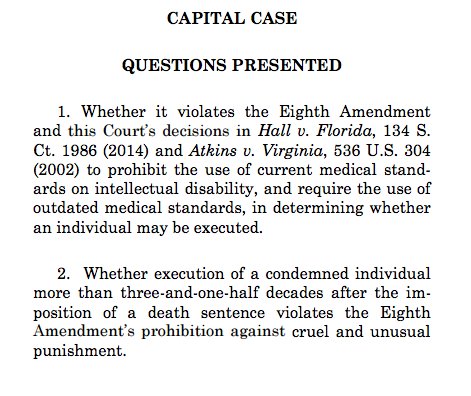
The orders today brought three "grants," two death penalty cases that have received some notice. One case case concerns how intellectual disability is proven in Texas but also includes a question about length of time on death row, a long term concern of Breyer. If solitary confinement is involved, that would also be a concern for Kennedy. The third is a racial gerrymander case; the two unanimous opinions (by Kagan/Sotomayor) appear pretty boring.

Update: Never mind. Corrected order; length of time not being decided. To be fair, as seen here, these "boring" opinions are of some importance at least in a baby step way.

Freedom Is A Mixed Bag


From an earlier shot of feasting on a carcass, the basic idea (think Bambi's mother being killed as a baby and being raised by the person who killed her) to another killed lion, this film is not for the faint of heart. Nor, if you look up and see what happened in a few years to Elsa. But, the sense of realism of animal life plus human sentiment helps make this film a classic.

Sunday, June 05, 2016

Weekend Politics

Yesterday, Clinton won all seven Virgin Islands delegates since Sanders did not meet the 15% threshold. There is a little over 100K people there and we apparently got control in large part because of WWI concerns. Clinton looks to get something like 60/40 in Puerto Rico, its delegate rules convoluted though prisoners can vote. A lot more disenfranchised there in November. Bankruptcy and double jeopardy rules to be decided by Supreme Court in June.

Saving Time


Someone brought up this name and happened to see the DVD at the library. OTOH, this trailer basically seems to sum up the film, plus doesn't seem that good. Will skip it.

Saturday, June 04, 2016

Racism and Ali

R.I.P. Muhammad Ali. This provides a good summary of why we should honor him. His fight for a draft deferral went to the Supreme Court (and was the subject of a HBO film). The backstory includes Justice Harlan at the last minute examining the facts and throwing the case his way. The Trump/Mexican thing is germane including why yes it's "racism." Comments there cover the gambit, including how word trolls aren't convincing.

Thursday, June 02, 2016

Kristol's Choice is so dumb, let's just deal with a side issue

Griswold and privacy specifically has been a popular topic for me but basically the opinion holds up. It is just that his Poe v. Ullman dissent was better by being a more comprehensive defense. The "penumbra" principle is fine too; it is just that a general right of privacy probably requires a bit more. I add more here including on the Third Amendment.

Wednesday, June 01, 2016

Court Stuff

Trump continues the theme from earlier in going after a judge in a fraud case, bring up his ethnicity. Odds and ends from the Supreme Court (one boring opinion), including Breyer/RBG focusing on geographical disproportionate death sentences. Local control, encouraged by the 6A (local juries), furthers this. But, death is different and "unusual" punishments are of special concern. A per curiam shows that. June here: big cases coming.

Update: More on the geographical point here. The counterarguments come off as exaggerated and it simply is not merely an "abolitionist" thing. It's a general rule. Also, if you can't trust someone who might be against a litigant's belief's, that applies to all beliefs including those you like. Gay judge? No "defense of marriage" litigants! Can't be the rule.

Wednesday, May 25, 2016

See You In June

Prosecutors Will Seek the Death Penalty for Dylann Roof for Charleston Black Church Massacre

Ugh. State is already seeking the death penalty. Question if the feds even should prosecute in a crime that is heinous but seems local (basically hate crime charges provide federal hook). There was already a big move by victims to forgive him and not dwell on revenge. Who knows the details, but there appears to have been an offer of a plea/life imprisonment on the table. Whole thing seems gratuitous even without double jeopardy concerns.

Anti-Abortion GOP Lawmaker’s Wife Goes Public About Own Abortion As A Teen

If you look past the pro-life language (it sounds like central casting), this account is in a fashion pro-choice. She made a bad "choice." She shows the problems of not having the support you need to make said "choice." She doesn't talk about criminalization. And so on. Various rather negative comments, not surprising, but look deeper please. And, I don't know what was really the right choice for her at the time. All teens don't abort.

Tuesday, May 24, 2016

Washington Primary

The particulars discussed here; Trump likely to win around 75%, being around 1200 in delegates. Kasich almost at Rubio's delegate count. Sigh. Is this thing over yet?! Two weeks?!

Update: Clinton did well in the likely more accurate/democratic primary but as noted in that link, didn't count. The "please Sanders (over the top baby?) when possible" point? Yeah. More: There were various unbound delegates and some have come out for Trump. So, he is over the top. Taking a few days off, but got to toss that in there.

Fun Guests Last Night ... Didn't Like the Bits


She was on Life Unexpected, a show that had potential but not quite good enough writing. Unreal might have been on my list if they stuck with Megyn Price (replaced after unaired pilot but might be on new sitcom) in a key role. Um. That top was a bit distracting. The first guest, even though I'm not a Game of Thrones fan, was fun too. She had fun with accents.

Monday, May 23, 2016

SCOTUS Watch

Orders continued to deal with juvenile sentencing and contraceptive mandate cases. Election law case disposed on standing. Alito/Thomas added a lot of material to both orders and opinions (two cases). Use of "amica curiae"; appointment covered here. Meanwhile, Clinton's anti-Heller comment framed as a potentially fairly narrow regulation issue.

Update: Here's a summary of all three cases that might be deemed "baby steps for racial justice." No concurring opinion (Marshall, Breyer/Souter noted support in the past) about ending peremptory challenges etc. As have I. That case is particularly about a unusual case involving a past era where such blatant gotchas were more likely. But, one step at a time.

Sunday, May 22, 2016

The Ghost and Mrs. Muir


Did this backwards -- back in the day, watched reruns of the t.v. show, then saw the movie and now read the book (almost a novella). All have their charms, each different in a fashion. The book has her stay alone, the movie has her find someone to love and the show had her more a regular part of small town life. Reruns on a classics channel and YouTube now.

Spotlight


Overall, liked this movie though it seemed a bit off at first -- like we were coming in a few minutes late to an ongoing investigation of the Church. But, that was okay and it was a good ensemble cast -- cf. this to The Big Short as a film, and you can see why it won an Oscar for Best Picture. Catholicism has a lot going for it, but it's pretty f-ed up too.

Saturday, May 21, 2016

Oklahoma Governor Vetoes Abortion Ban

Was blatantly unconstitutional including under Supreme Court precedent though could be attacked on monetary/policy grounds too. The governor used a crafty approach (use as policy warrants!) -- a narrow vagueness reason that would apply to any criminal bill and tacked on an op-ed to change the Supreme Court. Her chances of being Trump's v.p. is trending up.

Friday, May 20, 2016

It's hard sometimes to not say something stupid ... but let's try to respect those who usually do not

In a blog's comments, someone linked "oh fuck" to a notice of Morley Safer dying. I noted that given his age, retirement and health problems that it wasn't that though rest in peace etc. Get a reply about how nice it is I'm telling the person how to react (I'm merely stating my opinion, sorry, don't have some special powers here) to some person s/he admires. Like I'm a little shit. My comment was misguided and so be it. But, you know, I'm not a little shit and there's a way to say someone is wrong without doing that. Get the situation.

Thursday, May 19, 2016

SCOTUS Watch

A few more opinions of some mild interest. Two are cited here with the blogger getting something of a special citation. Sotomayor (with Breyer and Thomas) dissented in one statutory matter. A third offered Thomas for the third time today in some fashion not simply to go along with the majority. And, as noted here, I'm sympathetic with the 4-4 results in judicial moderation idea (Garland helps there), but still am a #DoYourJob person.

Update: In a sort of addendum to Glossip, an Oklahoma grand jury report on execution follies was released; Chris Geidner provided summary on Twitter about sixty tweets long. Also, this article suggests how far the Overton Window has shifted. Now is not a great time for it, but perhaps a strong liberal/libertarian nominee would be appreciated.

Wednesday, May 18, 2016

Primary Day

News of the day is that some Bernie supporters went overboard when their efforts to get a few more delegates in Nevada (which Clinton won a while back) went badly. Look like tools and makes party look bad too. HC wins Kentucky in a squeaker. Oregon allows Cruz/Kasich to obtain a few more delegates. Sanders looks to have won Oregon, 55/45 or so at this point.

Monday, May 16, 2016

SCOTUS Watch

The oral arguments are over; now it is time to clear the deck by the end of the term.

The fact that things other than normal decisions will matter even at this late in day -- thus even a full Court in May 2017 will matter -- was seen in the recent refusal to overturn a stay of execution (4-4).  Today is also a scheduled "orders day" and the continued low granting of new cases clearly grows out of the realization that a final settlement can be hard without a full Court. This includes various cases where the result is narrower than it might be to avoid division.  Some might like the resulting weaker results, but that doesn't erase the net effect of the whole thing.

The Supreme Court website, SCOTUSBlog and other places can be sought out to get information on the multiple opinions and orders handed down today.  Other than not taking a lot of things (Thomas dissented regarding a favorite target of Scalia et. al.), the opening gambit was a per curiam, which unsurprisingly -- the usual subject of such things and more often than not against the prisoner -- involving a federal habeas matter.  The technical question at hand was settled 6-2 with Sotomayor/RBG dissenting for the prisoner.

The "big" news of the day opinion-wise was that the Supreme Court (later orders applied it to other cases) punting on the contraceptive mandate case. They foreshadowed this result with a special order requesting further briefing that appeared to try to find a way to settle the matter.  A possible option was suggested in the request, which might not have been the best solution, but it would have at least settled the matter and probably would be mostly workable. Maybe, especially with only eight justices, the decision really wouldn't have done that -- it would have left things open for yet more objections. Now, it is up to the courts of appeals in the cases (most of which at first held against the challengers), and maybe we will see this back later.

Breyer and Kagan, for whatever reason, silently went along. SS/RBG wrote a short concurrence (everything was nine pages, pages of captions included) to remind that the Court's per curiam wasn't really deciding anything. The Court noted it wasn't saying anything to interfere with the government providing approved contraceptives without cost.  This is nice, but the ultimate problem here is that the exemptions will in some fashion "cost" something -- it's why they are exemptions, not standard practice.  And, this level of micromanaging for each potential issue imho is simply impractical.  In practice, certain views and subjects will obtain more concern, which results in religious freedom problems in itself. Religious freedom is a comprehensive thing.

Update: Upon reflection, a 4-4 evenly divided Court might have been the best approach.  Nearly all of the lower courts rejected the accommodations. Now, that is up in the air, Sotomayor's concurrence aside, one or more of them might take a "hint" from the request for further briefing etc. A split like that could have led to a few courts to accept the challenges (one or more currently; hard to keep track of all these lawsuits -- need a spreadsheet with these mass litigation efforts) but the government there might offer the tweak suggested in the order. OTOH, perhaps the parties would try to re-open things themselves but a 4-4 Court would suggest four justices didn't think further accommodation was necessary. Who knows.

There were other cases decided of more limited concern if having some importance in the long run given jurisdictional matters having a broad possible reach.  One case that might be most approachable for the average person since they might be familiar with the search engine involved appears to be fairly limited (Ginsburg/SS dissented, but RBG noted she agreed with much of the majority's position) without more. In reply to the link -- she's a good resource and pleasant Twitter presence (lots of tweets this morning) -- RBG notes how wrongful detail that wrongly pads one's resume can be a problem.  The case though very well might be the sort of overly easy case taken to draw boundaries without helping much long term. Sotomayor (a bit roving lately) concurred with Thomas in one of these opinions, maybe a first.

A couple other cases (with but one justice dissenting in one) helped start to clear the 30 or so cases still to be decided. One somewhat interesting involved using state letterhead when private parties are used to collect debts owed to the state.  This was unanimously found not to violate a federal law against deceptive debt collection practices.

Note: I added to my comment on the contraceptive mandate case and SCOTUSBlog has an interesting discussion of this one, which will logically get less attention today. The bit about the conservative appellate judge (probably on short lists for a Republican President) is interesting inside baseball; Sutton wrote the one appellate ruling against supporting SSM rights while also an earlier one accepting the constitutionality of PPACA.

Sunday, May 15, 2016

Logan's Run


I saw at least part of this on t.v. a long time ago but saw the whole film now. A future utopia limits life to 30; it takes place around the time of Star Trek. The best things are some of the sets etc. for mid-1970s; less so the logic and the fairly weak ending. [The computer blows up; how will they survive in a world they never saw? Hard to handwave.] Overall fairly fun.

Update: Checking, my question is addressed in the books, especially what sounds like a rather dark sequel. Michael York (Logan) is part of the DVD commentary track.

"The Death Penalty & the Dignity Clauses"

Interesting new paper connecting the use of "dignity" in current equal protection jurisprudence and the like with the death penalty. Justice Kennedy is particularly concerned with dignity, but as suggested by my reply, not just him. Open-ended things like "unreasonable" searches, "cruel" or what "equality" means require standards and "dignity" is a concept that is used here. Also, no, the 5A doesn't prove the death penalty is constitutional.

Saturday, May 14, 2016

Ladies of Leisure


Barbara great; love interest a bit blah, but overall, very good classic film.

Cancelled Shows


Amusing "Adam" from Rules of Engagement ["Jeff's" new show was cancelled; wasn't that good] played a very different role and from what I can saw, Connie Britton was great. But, did not get into this show after watching a bit when it started. Nice outfit.

Friday, May 13, 2016

Forgiving My Daughter's Killer

The story discussed in this book (their previous relationship with the daughter's teen bf makes it a bit different from something like this) is summarized in this article. The mother with her husband founded "a charitable fund to promote forgiveness and restorative justice practices," which is a type of restitution that has positive public policy implications beyond being a reflection of their faith. Justice and religious faith comes in various shades.

Wednesday, May 11, 2016

Missouri man executed for killing deputy, 2 others

After the Supreme Court without comment refused a final appeal based on a broad argument against the death penalty (unlike some arguments, okay this lost cause received no comment from Breyer et. al.), a rather unsympathetic character was executed. The death penalty doesn't just apply to such people and even there problems arise including the lightening strike effect where one or two random horrible miscreants are executed over others.

Update: In another case, where a lower court held up an execution, the justices split. Stay remains. The assumption would be if Scalia was still alive, the guy will soon be dead.

Nebraska / WVA Primary

Trump dominated Nebraska (about 60% / 90% vote count in) and West Virginia (75%) while Sanders has about 50% (rounding, 15% was "other") in WVA (Obama only received 60% in '12 vs. a felon at the time in prison). Yes, still keeping track. Meanwhile, found a copy of Trumbo (documentary was good) that wasn't scratched. A bit simplistic but enjoyed it.

Update: Cruz retains control of his delegates in key states to have some influence in the convention, apparently, and perhaps that Nebraska result (after Cruz suspends) suggests some voters not quite ready to just accept Trump too. Stages of grief and sure -- someone with around six hundred delegates should have a say. To be continued.

Monday, May 09, 2016

Mockingbird: A Portrait of Harper Lee

Charles J. Shields, with a fairly brief update that takes us to her death, provides a workmanlike biography of Harper Lee with a particularly interesting chapter (including this) on her trip with Truman Capote to research what later was In Cold Blood. There are no great reveals or unique special psychological insights but the basics are there in an easy to read fashion. Good details though story tapers off in the late 1960s.

Saturday, May 07, 2016

Bartolo Colón Homers


Too bad it wasn't at home but there was a lot of Mets fans on board and Gary Cohen and Howie on the radio were both real excited ... like many watching. So fun. Mets being the Mets, it was soon 4-3 and we sweated until a couple more homers in the 9th made it 6-3.

Guam Caucus (D)

Things were decided rather late for Republicans this year -- Indiana being deemed the presumptive end (though by delegates, it wasn't) and Sanders still is out there rallying the troops. This is as it should be with CA and various other places left to vote. It's a bit sad that Kasich (never having a real shot for some time anyway) didn't stay in. Guam today. Guam concern: unjust they cannot vote in November. Puerto Rico (6/5) has own issues.

Update: Clinton won.

Thursday, May 05, 2016

National Day of Prayer

Today is not merely Cinco de Mayo but also the National Day of Prayer. I think it a violation of the First Amendment to specifically favor "God in prayer and meditation at churches, in groups, and as individuals," but Obama tends to do things in an inclusive way.

Wednesday, May 04, 2016

Indiana For Trump ... Assumed Nominee Now

Trump is the chickens coming the roost for the Republican Party, even if some (but not THAT many) still are in the "Never Trump" camp. Indiana sealed the deal though its fifty or so delegates wouldn't have been enough either way. Kasich due to suspend now to totally settle the deal. Why not stay in to let dissenters vote for him? Bernie not ready, still talking "contested" convention. Kinda sounds like an ass at times, but hard to give up the ghost.

Update: To underline the point, Cruz losing does suggest that the few places left he seemed to be favored in would not vote for him as much. But, especially without the unbound delegates from PA, the math is still close on paper.

Tuesday, May 03, 2016

Bad Girls Young Women, Sex, and Rebellion before the Sixties


"In this innovative and revealing study of midcentury American sex and culture, Amanda Littauer traces the origins of the "sexual revolution" of the 1960s." The book is a bit too much of a college seminar sort of thing, trudge, but some interesting stuff.

Monday, May 02, 2016

SCOTUS Watch

A few orders and grants of mild interest. Breyer continued his concern for capital appeals that last decades. A statutory opinion split the justices various ways depending on how they looked at things, suggesting law is a bit messy. Another Sotomayor/Roberts pairing. Except for the possible order, justices now will work on their opinions for a couple weeks.

Sunday, May 01, 2016

The Car


The Svengoolie movie this week was this 1970s B-movie with various familiar faces about a demon car. It was overall a pretty fun "bad movie" and a good pick if a bit "modern" (had to black out a guy giving the finger!) given the regular picks. Good Sven bits.