About Me

My photo
This blog is the work of an educated civilian, not of an expert in the fields discussed.

Thursday, April 19, 2012

"Very Important" Voting Id Case

Election Law Blog cites an "very important" 9th Cir. en banc ruling regarding a voter id law with special emphasis on the citizenship issue, particularly since it "contains a major statement of what plaintiffs would need to show if they want to prove that a voter identification law violates section 2 of the Voting Rights Act."  An earlier summary of the litigation:
In this case Plaintiffs, registered voters in Arizona and voters' rights groups, challenged Proposition 200, a law that imposed new restrictions on voter registration and voting. Among these restrictions was the requirement that registrants provide proof of citizenship; the six forms of identification valid to prove citizenship are: (1) a state issued driver's license; (2) a U.S. birth certificate; (3) a U.S. passport; (4) a U.S. naturalization document; (5) another immigration document that proves citizenship; or, (6) a Bureau of Indian Affairs card number. When voting at the polls, voters must provide identification with their name, address and photograph, or two forms of identification with their name and address. Voter mail registration applications, prescribed by the U.S. Elections Assistance Commission, are no longer provided.

Plaintiffs claimed that the State of Arizona did not obtain preclearance to stop using the prescribed voter mail registration applications. Plaintiffs also alleged that the voter identification requirements disparately impact Latinos as Latinos are less likely to possess the forms of identification required to register to vote and cast a ballot. Finally, Plaintiffs asserted that the enforcement of these new voter identification requirements diverts funds from programs that would encourage voter turnout. Accordingly, Plaintiffs sought a Preliminary Injunction preventing the enforcement of these voter identification requirements.
The opinion notes a usual trend here -- absentee voting does not have such a requirement, using a signature check; it is unclear to me how this could not be done for in person voting, especially since it seems a lot easier to do (putting aside the lack of a real problem of fraud) it the other way.  For various reasons, many do not want to use absentee voting (sometimes, it is not an option for everyone; unclear if this is so here), but IF it was an option for everyone, that would temper the problem. The ruling held that for federal elections, federal law (statutory) required simpler rules, but it was okay for state elections. 

One problem, as noted in a brief, is the cost.  This is not a trivial matter for some people -- the costs offered ranged from $10 to $100 to even $380.  The specific id for voting might be free, but what is necessary to obtain such id is not.  And, when faced with this issue, some do logically think of this as a type of "poll tax," which violates the Twenty-Fourth Amendment (federal elections) and the Fourteenth Amendment (illicit classification) while some see some hints to an illicit racial classification as well (Fifteenth Amendment).  Federal law addresses the last concern, the problem a matter of proof and how much care we determine matters.  The other two are related and had logical force (imho) but has not been too successful in court.

Both sides relied on a ruling (Crawford) a few years back that split the Supreme Court in about three ways.  Stevens wrote the plurality for three that basically held that the "facial" challenge to a voter id law must fail because there wasn't enough evidence that voters as a whole were burdened and (even though nothing much was there) the state had enough of an interest to have the law to validate it.  Would more evidence change the equation?  Who knows, really?  The opinion in a footnote:
For most voters who need them [the id documents], the inconvenience of making a trip to the BMV, gathering the required documents, and posing for a photograph surely does not qualify as a substantial burden on the right to vote, or even represent a significant increase over the usual burdens of voting.
Hint, whenever a word like "surely" is used in cases of this nature, be on your guard. Particularly, when three justices dissented and argued that, yeah, there was such a burden of a fundamental right.  The opinion helped the voter id movement out by providing a sheen of respectability and noting that we shouldn't let the partisan nature of the law bother us (in another context, partisan or incumbent motivations have been used by Scalia to disparate campaign finance litigation; here, he rejected the limited nature of the controlling opinion). Some believe Stevens was being strategic here, getting as narrow a ruling as he could, others took him at face value, perhaps given his Chicago background or whatever.  Hard to tell, but either way, the dissents have the stronger case, and the matter begs for some in depth district court fact-finding.

The Crawford plurality if nothing else suggested the 1960s state poll tax case set up a too restrictive rule for burdens on voting, supporting a more balancing approach.  The panel here held that a voting id law "is not a fee imposed on voters as a prerequisite for voting" so it is not a "poll tax" and it is not "a burden imposed on voters who refuse to pay a poll tax" so does not meet the requirements of the state poll tax case. The case, though apparently we should not read it too broadly, held "affluence of the voter or payment of any fee an electoral standard" is an illicit voting requirement.  It seems a bit of sophistry to consider id laws merely a neutral voting requirement when in effect payment of a fee is required and "wealth" in this area (like getting lawyer for a felony) is not a licit barrier without some heightened need. There is no such need here. 

Crawford did hold that "evenhanded restrictions that protect the integrity and reliability of the electoral process itself" are legitimate and (as here) rejected a facial challenge, though leaving open (as here) as applied challenges that have better evidence. Also, as noted by the Election Law Blog, the federal statute being used here is stricter than is the case in some cases (e.g., the South Carolina law the Obama Administration opposes) where the burden of proof is on the state. The expert at that blog is against voter id laws as a whole, since the "evil" being targeted is at best small while the means uses at best is an unnecessary threat (even if small) against a fundamental right done in a a partisan way. 

Overall, the restrictions are not really "evenhanded" in practice and their need (or even usefulness) toward "integrity and reliability" is unclear.  After all, somehow, the feds can provide an easier path to voting as do quite a few states, a majority actually, this id regime quite recent. Throughout our history, in practice, what is "evenhanded" is a complex matter (see here, as to religious "neutrality") , particularly in the field of voting rights.  Identification is useful to have, though only johnny come lately in this respect for voting, but the proper path to take is to provide it for free if the alternative is in effect a class based voting requirement.

Well, it is only the 9th Circuit, and there is this big specter by some that the USSC might find the whole Voting Rights Act illicit because it isn't properly congruent or proportional or something.  So, "to be continued."

Chelsea Handler

Why she was in Hop, playing it totally straight, is unclear to me. It suggests the problem with the film: the whole scene was like ten minutes of filler. The "intervention" scene, however, was amusing. Good beginning at Easter Island. Lame ending & climax pretty weak.

Throwback Game

Lee went ten, Cain went nine.  Giants win 1-0 in 11. 

Wednesday, April 18, 2012

Holiday Movies

Hop was better than Despicable Me ("from the makers of") but not enough there for a full movie.  Turned off the latest Harold/Kumar (Xmas) movie after about twenty boring minutes.  If good stuff happened later, sorry, too long. Second one stunk, btw.

Economic Rights, yes, Libertarian Nirvana, No

The Hettingas’ collision with the MREA—the latest iteration of the venerable AMAA—reveals an ugly truth: America’s cowboy capitalism was long ago disarmed by a democratic process increasingly dominated by powerful groups with economic interests antithetical to competitors and consumers. And the courts, from which the victims of burdensome regulation sought protection, have been negotiating the terms of surrender since the 1930s.
This sort of thing is why the Dems tried to block Janice Rogers Brown (of the "Thomas is a bit too liberal" school of jurisprudence, apparently) from being appointed to bench.

My overall sentiment at the time was that I simply didn't trust President Bush ("this is horrible" ... yes Sandra), in particular, getting the sense from various accounts that he was playing hardball on judicial nominations. This was standard stuff from at least the Reagan Administration, if not before. Meanwhile, Democratic presidents of late were less ideological, as far back as Carter more concerned with diversity overall than ideological conformity. I was challenged on a Volokh Conspiracy blog (pre-Facebook) to prove this fact, the other side using the usual two-tier approach where they get to make various one-note claims with thinly disguised spittle while you need to prove general principles with footnotes. To be fair, one person used the "but he wasn't a pure knee-jerk idiot" approach. Sort of like, well the Astros do win sometimes so they are like the Yanks.*

Bush41 is the sort of approach that appeals here. You got your Souter AND your Thomas. Fair is fair there. Eventually, helped by winning the '06 elections, Bush was forced to tone back his approach. I realize, you know, that (favorite example) the Dems pushed Miguel (I heart Kagan) Estrada drop out, but Janice Rogers Brown et. al. did not. This was the result of the "Gang of 14" compromise in which only "extraordinary circumstances" would now (at least in their opinion) be the appropriate time to filibuster nominees. Goodwin Liu (Judge Liu / CASC) shows this includes "being mean to Alito." Anyway, the approach there was that most of the controversial nominees were confirmed, a few obscure ones were not, and Republicans still had the chance to block people like Victoria Nourse, who various conservatives/libertarians thought was unfair, but hey, we are still going to vote for the senators anyhow. Yes, yes. The Dems, when President Romney (no) is in place, will get to filibuster some too, just not as badly.

The opening quote is an excerpt from a rather blatant bit of pique (concurring, accepted the benighted Supreme Court required the unfortunate result regarding some dairy regulation) that was joined by another libertarian favorite while a third concurred separately to note that "well, I sympathize, but that was bit much." The "ugly truth" is that we never quite had "cowboy capitalism," even back in the days of yore. As noted by CJ Roberts in a recent opinion, government might have been smaller back in the late 19th Century true (comment about race relations omited, since the Rogers is black), but not that small. And, as noted by Walter Dellinger (ACA supporter, Clinton S.G.), you can support economic rights more than current doctrine without rejecting the idea that modern economic regulations further competition (if not the brand you like) and protect consumers.

The concurring opinion reads more like a libertarian tract than a reasonable criticism of a current aspect of modern day doctrine. As noted by an appellate judge who knows for what he speaks, concurring and dissenting opinions (there a certain category) has value. Even those like these that do not seem very judicial. Still, I think the value of economic liberty warrants a better voice. The Constitution has various protections, down to the Due Process Clause ("property"), which apply to all things, including things of an economic nature. Contraceptives can not just be owned, e.g., but bought. Economic matters are often more "public" than other matters and thus require (warrant) less judicial scrutiny, but even there, that is different than none. It is unclear how that helps this litigant though, except if you simply do not like the modern day regulatory state. Not that days of yore, back in the days of John Wayne and Clint Eastwood, lots of economic regulation would not exist as well. Note that Justice Harlan, not just Holmes, dissented in Lochner, the former quite willing to strike down some laws.

Anyway, good reading, including the "growling" reference.

 ---

* Not taking a certain Internet comic to heart, I take such things seriously, and spend lots of time checking up on things, at times going a bit crazy trying to find the right source material. On how Republicans are special here, the book Broken Branch (by a conservative and a right leaning centrist) is a nice source, though darn if it never tends to impress the "pox on both their houses" crowd that pushes my buttons.

It is almost amusing how we have some on the left upset that Obama doesn't do more to press the issue in the courts as well as wanting him to pick more left leaning judges (see Kagan) while others find it hard to accept that at the very least (putting aside if Bush did anything wrong) that Obama is less hard core on this issue than Bush/Reagan. Anyway, I defended filibustering then and push for reform now because I realize the tactic is in effect an emergency mechanism. It also didn't do that much then, push comes to shove.

If some Bush-like Democrat comes on the field and uses heavy-handed tactics when not even getting a popular majority of the vote, come back to me. Obama does not do this as a whole. The recess appointment issue is far from that -- ironically, he had to deal with (and did so sparingly even there) a recent Democratic precedent of phony sessions that were recesses in all but name. Even then, he only acted in an extreme case and long after it was clear the Republicans had any desire to actually full a position unless legislation that got through the filibuster laden Senate changed. Filibustering a judge -- a life term appointment at that -- didn't make some appellate court become nonfunctional.

As with my note earlier with fiscal responsibility, sorry, the allegation won't wash.

Republicans are not fiscally responsible

Another one bites the dust, along with military/diplomatic skills.

Atheists Are Cute

I was surprised to see "In God We Trust" in a local court room. Why the quotation marks? Is that new? Congress has God's back.

Tuesday, April 17, 2012

Frank Puts Foot In Mouth

He was wrong then and is now on the PPACA. I comment various times here. Also, the pride comment is off. Still, love ya. [On that front, note new book on side panel, an informative graphic novel that should be handed out free by Democrats.]

Monday, April 16, 2012

Literally via Sexy Librarian (aka Emily Brewster)

Via Twitter. On home page now.

Army Wives

Superior episode with various goings on at home and in the field, dealing with a rescue mission in Africa. Series should do more to show all the sides of things. Legal shows tend to be narrowly tailored, e.g.

Sunday, April 15, 2012

That Will Do Pig

The Mets had a bad few innings but a good series overall. Davis and Duda getting two hits today along with Pelfrey's six innings of one run ball almost made the loss okay. Acosta/Batista made it look ugly. After scoring three runs in 24 innings, the Phils were due.

Sunday TV

Chris Hayes had tax stuff and Romney's stance on poorer at home moms. MHP had some transgender stuff, reminding that Obama has done some real good in a workmanlike way. Mets slipped late, not sweeping, Pelfrey pitching okay and Batista a mess again.

Yeah, We Are

Today's news (somewhat hopeful) makes this more topical.

Rev. Joe

I was reading a book on God's place in film, not knowing most of the films cited, though Babette's Feast was one.  Some films lately, like The Wise Kids, aside we need a few more religious films. In fact, a religious epic is about due.  Where is the modern day Cecil DeMille?

Tax Day (Not Observed)

The Congress shall have power to lay and collect taxes, duties, imposts and excises, to pay the debts and provide for the common defense and general welfare of the United States; but all duties, imposts and excises shall be uniform throughout the United States
Don't worry.  Given it's a weekend, you have a couple more days (because people don't do Mondays that well?) because it falls on a Sunday.  This is just the traditional tax day, like when the day when Columbus discovered America for the Spanish doesn't always fall on a day best for sales.  Romney, for instance, apparently is having problems being on time.

Taxation is basic to society, though like various other things (like the mandatory coverage provision of you know what), many rather not think about that too much while enjoying the benefits.  Benefits that they often undersell.  I know someone, e.g., who has long felt only the rich and poor receive much of anything from the government. I note the person's husband worked for the government for quite a number of years.  Another person was upset about needing to pay taxes to a city where he worked but did not live as if his pay came (and the general well being of the surrounding area) is not reliant on just that urban area.  Of course, the felt idea taxes are too high (or low, as it might be) is a major political issue.

The basic legislative branch of Great Britain was created to my understanding centrally to control the power of the purse, still shown by the need for revenue bills to arise in the House of Representatives (along with the power to impeach, the basic power it has over the Senate).  "Taxation without representation" (now translated by the Tea Party as "taxation with representation"*)  is often what many think about when they consider why we declared independence. The power to tax effectively was a major reason we have our Constituent, the national government under the Articles of Confederation largely reliant to requesting states pay, instead of doing so directly.  And so on.

I never was really into fiscal policy, except to be concerned with certain ways the money was spent or broadly how it was collected. I guess, perhaps, if I had more money. Anyways, matters of tax and spending repeatedly are red flag issues for me even if the nuances of finance can go over my head (e.g., why exactly are things so much more money now, even on a relative basis? I guess it has something to do with the dynamics money supply and distribution). I personally think the PPACA is defensible as a tax.  Many experts agree with me though even Justice Ginsburg didn't seem game -- if the law is upheld (knock on wood), I can forsee this as a thing tossed in to unite people (though Breyer and maybe someone else might not agree).  The idea that if it is a tax, it is a "direct tax" (which I don't buy, along with four justices back in the 1890s, even as to income taxes of most types) is to me risible.  The brief linked quotes a few justices back in the 1790s on the point, and I too:

am inclined to think * * * that the direct taxes contemplated by the Constitution, are only two, to wit, a capitation, or poll tax, simply, without regard to property, profession, or any other circumstances; and a tax on LAND.
The law requires you to pay a "tax" based  on a certain "circumstance," namely what health insurance choices you make to address health needs that arise during various activities. A certain blindness is required to pretend this somewhat is a tax merely for breathing, though people apparently seriously believe that.  Well, people believe various silly (and some nefarious) things, so that is understandable on some level.  Employment is also a "circumstance" and a type of "profession" and thus income taxes are indirect taxes (unless on land or back in the day slaves) in my book too.  The Sixteenth Amendment, at any rate, doesn't empower Congress to tax incomes; it eases it along by not requiring apportionment.
The Constitution was framed under the dominion of a political philosophy less parochial in range. It was framed upon the theory that the peoples of the several states must sink or swim together, and that in the long run prosperity and salvation are in union and not division.
Taxes are "to pay the debts and provide for the common defense and general welfare," which is why a "tax penalty" can be in place only tangentially (if at all, really) to raise revenue.  We do not tax marijuana just to obtain revenue, but as a sort of "sin tax."  Tariffs encourage domestic manufacturers, even if foreign goods without tariffs might provide more revenue to the federal treasury.  Domestic manufacturing might also promote the common defense in that less reliant on foreign goods can lead to less foreign entanglements, including of the violent kind. 

Tax policy also is not merely a matter to obtain funds.  "Tax fairness" also can be important here, including a progressive tax system in which ability to pay is factored in.  Those who support a flat tax, e.g., to my knowledge do not merely imagine some sort of tithe system.  Certain basic things are exempted first, such as dependents. Flax taxes are regressive because those with more money have a lot more discretionary income.  Even if you do not need the money for immediate use, money might be needed for some later need that arises.  Those with, let's say Romney type money (see Chris Hayes today for his "at home moms are great, unless you are poor, where work is better" sentiments), need not worry even there.

Now, this is where I start to lose track of the policies, but even from personal experience, there are various nuances involved.  Tax time is for one a time when you realize it can matter where you live: certain urban areas will provide taxes on top of state and federal, while other areas can provide different types of taxes (such as property taxes).  There are also various exemptions to factor in, underlining that taxation is a major area for social engineering.  This is seen also in debates related to health care (including reproductive services), religious schooling and sexuality.

Many will not be thinking too much about these things, only what they have to pay or the money they receive back because of a form of governmental borrowing (or personal savings) where they collect an excessive amount and then pay you back the difference at the end of the year.  Still is a pretty important deal and perhaps we can think a bit about it along the way. 

---

* The name is open to ridicule, including the childish "Tea Bag" deal, which has an added childish sexual slang connotation. The most defensible connection is to the Tea Party of the 1770s, a result of a bit of special favoritism of the tea cartel of the day.  This connects to the bailout and so forth that helped certain corporate types of today, a symbol of overall separation of the government from the regular people.

Okay.  Still, the original Tea Party was part of a wider movement that also believed that far away government was violating local rights, including the fact that the colonies were not directly represented in the Parliament.  All of that is not present here. Also, special interests were favored for years.  Economic downturns do lead to protest movements, but the problem began during the late Bush presidency.  So, why do the Tea Party sorts seem only (I put aside outliers) to support Republicans? 

Writ large, the Republicans should piss them off more. A close look shows that the validity of their case is tainted by special pleading. 

Saturday, April 14, 2012

The Girl with the Dragon Tattoo

Wary about seeing this in the movies given its length, but though it feels a bit long, it is a good though not great crime/character film with the latter the reason to see it.  The final reveal feels a bit cheap but taking the time to tell the story does do wonders.  Mara good.

Friday, April 13, 2012

Rabbi's Cat 2

I am reading the sequel to the book on the side panel (the two were later made into an animated film) and it as amusing, humane and thoughtful as the first.  The author.

Rules of Engagement

Notable this week is a baby reference (via a surrogate) after several episodes without one and Jen having a bit more to do.  The "cooling spoon" is pretty neat sounding.  BTW, NCIS was decent.  I caught a few second season episodes lately -- pretty heavy-handed.

Thursday, April 12, 2012

Obama surrogate?

H/t.

Moderate Republicans: Disgusted

A "moderate" Republican law professor (she supports a strict separation of church and state AND thinks Bush v. Gore was rightly decided; she clerked for Justice O'Connor) is upset:
Truth be told, had Santorum not jumped into the presidential race, all of these somewhat hidden agendas likely would not have been revealed, and we might now just be talking about our disastrous debt situation and the economy.  It used to be that the Republicans were the go-to folks on those issues.  But at least while Santorum was on the national stage, their righteous focus was on their social religious agenda.  It is a sad fact that the Bush Administration undermined the Republican reputation for fealty to economic issues when it engaged in runaway spending, a good portion of which was to appease religious groups demanding federal funding. Where does that leave female moderates like myself who are concerned about what the future will be like for our children, both socially and economically?

Disgusted.
In effect, and Rachel Maddow noted this once perhaps to justify covering them so gleefully, Santorum along with others served a purpose (maybe, Huntsman should have staid in longer too?): they brought to the forefront what the ugly underside of the party is thinking.  "Gotcha" moments like this doesn't change that.  I think you are not quite the people to talk when referencing a somewhat misspoken tidbit of her wider remarks.

Females / moderates have one credible choice: vote Obama.


Wednesday, April 11, 2012

Trayvon Martin

Good announcement. Hopefully, the matter will be dealt with some care out in open court.  I wouldn't be surprised if this guy is not convicted, but let's see.  Too many assumptions made.

Mets ... Blah Again

No Cute Woodland Creatures?

H/t RH Reality Check.  Not bad really for 1946.

Tuesday, April 10, 2012

Mets 4-1 / First Messy Loss

Murphy flubs one that counts after his heroics last night, Mets don't hit much and Wright is out with a hurt pinky. The fill-ins did well and Gee pitched okay though. Shake it off and hope Santana pitches well.

Nuance Alert

Linda Greenhouse does what much reporting (in pretty one note fashion) did not -- see the nuance to the strip search ruling, suggesting maybe the same is true with the health care matter.

More Overkill on Obama SC Remarks

He isn't trying to pack the Court.  Blah.

NC "Marriage" Amendment

As with some past efforts, the upcoming vote goes beyond marriage, blocking the legislature (why do you hate democracy?) from recognizing, e.g., civil unions. This is anti-equality overkill and can be (successfully?) opposed on that ground alone.

Monday, April 09, 2012

Jewish Gospels

Sometimes, things to many appear to come out of left field, when they are most assuredly not.  Many might not be aware of the big picture, but it has a tendency to make things more complicated.  For me personally, it also makes things more interesting and reasonable. It doesn't solve everything, but it changes the equation.

Such is the case with the title book, which was referenced yesterday.  About half-way through the small volume.  The book argues that the idea of "Jesus Christ" would not have been novel by the time of his historical existence as well as when the gospels and the rest of the New Testament (a past book dealt with Paul) was written (into the 2nd Century). Others have noted that "miracles" have been done by others in the time, but many scholars suggest the Jesus Christ idea was much more novel.  The author here disagrees, pointing to more than one Jewish writing (e.g., Enoch) on the point that at times uses imagery quite familiar to Christians.

This is not to say that the concept would be widely accepted, much less than that Jesus himself played this role.  But, the idea was in the air by that time, perhaps centuries earlier (at least, in the 2nd Century B.C.E., when the book of Daniel appears to have been written and the "son of man" figure pops up).  "Christ' and "messiah" was a long held idea of some sort of savior, often purely human, ancient kings being "anointed ones" as well (the overall meaning of those terms, one Greek, the other Hebrew).  Ironically, "son of God" is more of an uncontroversial term here, a label often applied to let's say a David or some special representative of God.  After all, logically, are we not all "sons" and "daughters" of God in some sense?  We are, according to the Bible, in his image and likeness.

The terms, discussed in a somewhat repetitive section, ultimately came to be applied to the same person.* Still, the two terms (son of god/man) developed somewhat on different tracks first, one a human on earth given special authority (like an ancient king), the other coming from above, ultimately some though, to earth in the form of a man.  "Son of man" was a special term, one with special supernatural significance in which the human qualities of the figure were at times suggested to be just apparent.  The figure was ultimately a god figure, though it might have originally had a lesser implication in other references in the Bible (see here). 

Thus, though it sounds more banal, "son of God" in the gospels (with a special appeal to Daniel) is freighted with special significance.  If we take it as his own words, whenever Jesus asserts the authority as this figure, he is not merely an ordinary human being, but in some sense has special "god stuff."
Mark 2:23 And it came to pass, that he went through the corn fields on the sabbath day; and his disciples began, as they went, to pluck the ears of corn. 24 And the Pharisees said unto him, Behold, why do they on the sabbath day that which is not lawful? 25 And he said unto them, Have ye never read what David did, when he had need, and was an hungred, he, and they that were with him? 26 How he went into the house of God in the days of Abiathar the high priest, and did eat the shewbread, which is not lawful to eat but for the priests, and gave also to them which were with him? 27 And he said unto them, The sabbath was made for man, and not man for the sabbath: 28 Therefore the Son of man is Lord also of the sabbath.
First, this is an example where the author argues that Jesus is not really challenging Jewish law, if perhaps providing a disputed reading of what it means.  He points to a Jewish source, for instance, that took a related approach to the Sabbath. I can't really go hand to hand with a conservative Jewish scholar on the point, but the overall idea that Jesus' teachings were not supposed to be in violation of the law (Torah), but a richer application of it in various cases is fairly convincing.  We can apply similar themes in constitutional disputes and challenge similar claims that such and such person is trying to replace the law, instead of arguing a disputed take on it. Anyway, second, "the son of man" here also suggests the authority that figure was said to have over God's law and people.  Simply put, the term is not generic, but unique. 

To me, it is hard to be too determinative on the gospels and other matters given we have so little to go on, though some scholars seem to be able to get a lot out of the material, but so far the book is pretty interesting.

[Update: Another chapter uses a careful analysis of Jewish law to show that Jesus as kosher, a particular reference that is used to suggest otherwise argued to be confusing food that is always illicit and the proper preparation of food.  In effect, Jesus was the conservative on the issue while Pharisees were the "liberal" ones. Here, his approach seems somewhat more liberal, but in other cases (turn the other cheek etc.) not so much.  I wonder about his take on Acts 10, the book focusing on Mark, giving it a more Jewish friendly reading than some.  Luke, however, is seen as the more Gentile friendly evangelist. 

The last chapter argues the "suffering servant" aspect of Jesus is quite Jewish in nature, if again, a matter of dispute, particularly the specifics.  There is a dispute over whether its use in Hebrew scriptures was purely metaphorical for the Jewish people but he argues there was some broad agreement that the messiah was going to suffer.  Again, some accounts pattern the "Christian" doctrine believers are familiar with. Overall, "Christianity" was not as much a difference in kind but more akin to Catholicism v. Protestantism on some level.  Intriguing overall.]

---

* Likewise, the ancient sky god El and Yahweh (YHWH) were once two figures, the latter a more direct presence, like the one Moses experienced; in fact, the "pagan" Ba'al deity perhaps was but a form of Yahweh for other groups ... "monotheism" early on was met when one god had supremacy -- "no gods BEFORE me."

The Book of Daniel also expresses an idea found elsewhere that can be seen as germ of the Christian trinity, at least the Father and the Son:
Daniel 7:13 I saw in the night-visions, and, behold, there came with the clouds of the sky one like a son of man, and he came even to the ancient of days, and they brought him near before him. 14 There was given him dominion, and glory, and a kingdom, that all the peoples, nations, and languages should serve him: his dominion is an everlasting dominion, which shall not pass away, and his kingdom that which shall not be destroyed.
"Ancient of days," according to the book here is like El or some other older God figure. The terminology, down to "his kingdom," would be recognizable to Christians.  The third part, the Holy Spirit, could easily be added here, it having use in Judaism as a sort of divine force. 

Justice --> President?

Interesting discussion of justices with presidential aspirations.

Army Wives

A good episode about family: CJ dealing with illness with hers, Roxy having a birthday party for her son while another (whose fiance was killed in a previous mission) fills in for another sent overseas (a new army wife's husband goes too) so she can watch her child. And, more. A lot happened, balanced well. Overall, well put together / touching.

Sunday, April 08, 2012

Various

No hit broken up in the 7th.  None in Mets history yet.  I knew the talk by the announcers about pitch counts and defensive moves were academic.  No score yet mid-game for the Cubs.  Another bad (pitching) game for the Red Sox.  Another well pitched game for the Pirates.  Still chance to win.

A Philip Seymour Hoffman-like picture for the author of the book just cited.  Charles Darwin had a philosophy of not being publicly anti-religious, in part in respect to his wife, but some groups are less so.
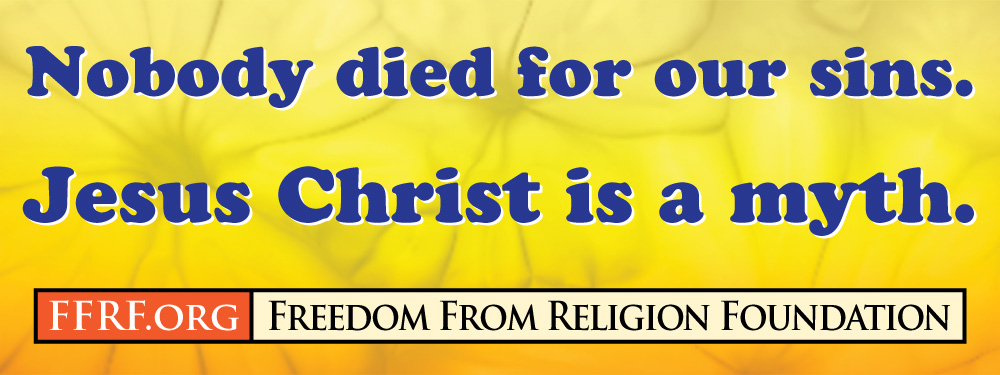
The back-story here is a bit more complicated though because the sign is in response to Christian displays in a public park, including one that says Jesus did die for our sins. Still, such "in your face" signage are somewhat counterproductive. On the merits, people have died "for our sins" in some sense unless the message is that "sin" itself doesn't exist.  I'm wary of the natural law from above implications of the word "sin" myself, but I'm not sure that is what the sign is supposed to be saying.

Isn't the point there to be rationalists, perhaps one who would use such logic to challenge the first sentence?  Anyway, when the no-hit bid was over, I switched to the Cubs game.  The Braves scored four on two hits.  A 7-0 laugher is now a more stressful 7-4 (two unearned). Niese had to handle a tough at bat with a few questionable calls both ways before giving up a hit.  He was up around 100 by then and then an error was made.  No outs, he was about done, but kept in for one more.  No go.

Red Sox up 9-7 now.  Pirates losing 4-1.  Cubs up 1-0.  Twins hitless through seven.  Just another Easter Sunday afternoon of baseball.  [Twins just got a hit.]

[Update:  Mets win 7-5.  Cubs hold on 4-3 (two unearned in 9th or the starter would have gone the distance -- apparently, about the only way for them to win so far).  Boston blew lead, 10-10 in 10th.  Pirates won.  Twins lost.  Meanwhile, Yanks now 0-3.  And, the afternoon continues.  One last update.  Boston blew a two run lead in the 11th, losing it 13-12. Their replacement "closers" have struggled thus far, each blowing it today.]

Food Matters

Chris Hayes dealt with the "pink slime" issue yesterday, having a guy I mentioned here on to talk about that and wider issues of healthy diets, while MHP today dealt with other matters of food justice.  Good stuff that should get more attention. Hopefully, with nuance.

A bit of nostalgia

But before taking a "mommy" sabbatical, Farrell played Regina Kostas, Ted Danson's love interest on the CBS sitcom "Becker," and alien hottie Jadzia Dax on "Star Trek: Deep Space Nine." Baker, meanwhile, was the iconic Trench Coat Guy on a long-running series of Sprint commercials.
 Sounds like a good team.

Rev. Joe (The Jewish Gospels)

This series of comments is but one time when I find it annoying when a complicated question is dismissed as simple. There is usually a mixture of truth on major issues of the day.  Religion often is the same way.  So far, this book nicely underlines the point.

Saturday, April 07, 2012

Messy isn't always bad

“I’m just saying that English may be a mess, but it’s a lovely, powerful mess.”

-- Kory Stamper
Yes, sexy nerd (we say this nicely), and such is the case with other things too, at times it seems constitutional law, no matter how some wish to "fix it up" or make it all smooth and shiny.

Friday, April 06, 2012

Kagan Shows She Is Pretty Good After All

Some didn't like when NY's accidental governor appointed Kirsten Gillibrand, but I thought she was fine and  turned out that way.  Others weren't pleased with Kagan's pick, including me really, but she was an unsurprising "Obama" sort and has shown some value too.

Rules of Engagement

A few laughs of the "yeah, that's funny" variety plus a lot of time wasting laziness (Jen really hasn't had much to do for some time).  Enough for an off 1/2 hour on a Thursday Night but at times barely.

Thursday, April 05, 2012

Winter's Bone

I tried to watch the film and read the book.  The lead actress (logical Hunger Games pick) was great and the writing poetic, but couldn't get into it.  Lots of atmosphere, not much actual story.  I'm also with those who found the ending made it something of a cheat. 

Mets win/are 1-0

Santana got in trouble in fifth but along with the bullpen a couple times, got out of it.  New bullpen looked good.  New CF got hurt.  Should be standard stuff toward a mid-70s win season.

DOJ Replies To Baby Judges

The reply is good stuff.  Thank goodness someone is a grown-up.

Mountains/Molehills

A lot of blather was made about Obama's remarks about the Supreme Court reviewing the PPACA. They were a bit sloppy but as a whole, especially as a politician making a case, not much "there."  The harping on "Lochner" v. "Lochner Era" especially is petty.  The concern he crossed some line or this matters much to me is ridiculous.

Wednesday, April 04, 2012

MLB Season To Begin (Except For M/As)

Last home Mets Spring Training home game was a 9th inning win (after a mid-game blown lead) by an Ike Davis HR.  Some minor leaguers blew the last ST game. Not a great record.  Now for real.

Perepolis Author Loved It

Amusing and humanistic look at the trials and tribulations of a rabbi and his cat in 1930s Algiers, though the cat stops talking half-way.

Tyranny In Action?

The dog squeeze toys are an interesting touch.

Tuesday, April 03, 2012

Robert F. Kennedy and the 1968 Indiana Primary

Martin Luther King Jr. was killed 4/4/68, and shortly afterwards, Sen. Kennedy famously gave "an impassioned, extemporaneous speech on the need for compassion in the face of violence." It and other matters are addressed in this interesting and still fairly topical book.

Arrest in PP Bombing Case

According to statistics gathered by the National Abortion Federation (NAF), an organization of abortion providers, since 1977 in the United States and Canada, there have been 17 attempted murders, 383 death threats, 153 incidents of assault or battery, and 3 kidnappings committed against abortion providers. Attempted murders in the U.S. included.
And, it continues.

Hyperbole

I think the strip-search ruling was incorrect, but "police state logic" is a bit much, especially since it did not give "free rein" or "radically" do anything.  Why not, e.g., note even Roberts and Alito reached out to narrow it? Hyperbole is not the way to address wrong-minded actions.

Rachel Maddow cited this ruling as another case of the "5-4" splits in the Supreme Court, highlighting the fact the person (in jail for days with the general population) was wrongly arrested.  The minority here did not have some "turns out he was innocent" rule that would bar requiring new inmates to have a shower (and allow prison guards to watch -- this was provided to show the unreasonableness of the more close-up search here) or be checked by doctors.  Even "more than once."

As to the "free reign" of the opinion, why not quote CJ Roberts:
I join the opinion of the Court. As with Justice Alito, however, it is important for me that the Court does not foreclose the possibility of an exception to the rule it announces. Justice Kennedy explains that the circumstances before it do not afford an opportunity to consider that possibility. Ante, at 18–19. Those circumstances include the facts that Florence was detained not for a minor traffic offense but instead pursuant to a warrant for his arrest, and that there was apparently no alternative, if Florence were to be detained, to holding him in the general jail population.
So, RM's dog walking violation very well might not be treated the same.  Justice Alito recognized the "undoubtedly humiliating and deeply offensive" of these strip searches, which might be why he went out of his way to comment on this matter. As noted by the SCOTUSBlog discussion linked yesterday, these qualifiers, these bits of judicial minimalism, very well might be why the ruling took so long to be handed down. Alito, notwithstanding his conservative cred, has shown concerned for privacy in the past.  His concurrence in the GPS case might be more inexact than the majority, but it would recognize violations of the Fourth Amendment even without a direct property violation.

Not denying the guy is repeatedly wrong (his performance during the PPACA orals left a lot to be desired), but like the knee-jerk "Thomas is a Scalia toadie" comments, Alito is not just some knee-jerk fascist either.  This matters.  The PPACA orals got some more attention because of the "controversial" nature of the President's comments on judicial activism and the obvious constitutionality of such an important law. Some think he was "throwing rocks at tigers," which seems a bit infantile.  Can we grow up here?  Is he not allow to speak about such a major issue during the election season because Kennedy et. al. might have hurt feelings?

[Update: Absurdity. It's not the 9th Cir., so it's okay, you know?]

Anyway, back to the ruling.  It earned some scorn, the Timothy McVeigh bit pretty blatant trolling ("People detained for minor offenses can turn out to be the most devious and dangerous criminals.")  Even there, was there any evidence he or the serial killer cited was hiding a razor blade where the sun doesn't shine?  The dissent cites a slew of authorities, including practice by the U. S. Marshals Service, the Immigration and Customs Service, and the Bureau of Indian Affairs, to support the "reasonableness" of the approach the four justices would use.  Still:
The case is limited to strip searches of those arrestees entering a jail’s general population, see 621 F. 3d 296, 298 (CA3 2010). And the kind of strip search in question involves more than undressing and taking a shower (even if guards monitor the shower area for threatened disorder). Rather, the searches here involve close observation of the private areas of a person’s body and for that reason constitute a far more serious invasion of that person’s privacy.  ...
The circumstances before the Court, however, do not present the opportunity to consider a narrow exception of the sort Justice Alito describes, post, at 2–3 (concurring opinion), which might restrict whether an arrestee whose detention has not yet been reviewed by a magistrate or other judicial officer, and who can be held in available facilities removed from the general population, may be subjected to the types of searches at issue here. 
The ruling is wrong but addresses a limited reach of cases and will not (unless they change their rules or in some cases, probably, state courts do not hold state constitutional guidelines are more strict) affect a lot of prisons in any immediate way.  The mind-set is troubling, but the opinion was written by the same person who addressed overcrowding in California.  Two Bush appointees went out of their way to send red flags to willing lower court judges of the ability to restrict its reach. Like Santorum speaking out against an explosion outside a Planned Parenthood Center, there are important limits placed here.

A bit quite unlike your garden variety "police-state." 

Monday, April 02, 2012

Back to the Files

Perhaps, one day, health care also will be deemed a basic right, one that follows this principle.
Part of a discussion some years back on "Economic Inequality / Governmental Responsibility." See also here.

Prison Strip Search Case

I agree with the dissent, but the ruling seems fairly narrow, especially with Roberts/Alito's separate attempts to underline said fact.  Listening to the orals, the somewhat fine line asked for was iffy.

Army Wives

The new wife dealing subplot was relieved a bit too fast.  The question of not telling parents about a student with HIV when there is a chance of blood being spilled and the emotions that arise is a serious one.  If a doctor's visit "just to be safe" is required, at least. 

Sunday, April 01, 2012

"We’re all going to die, Johnny. Hit the iron bell like it’s dinnertime.” Remember her from Air America?  I caught one of these once.

Rev. Joe

More seriously, today is Palm Sunday (for Catholics at least, you collect the palms, burn them & use the ashes for Ash Wednesday), and MHP had a "faith and policy" segment that in part addressed that. She had Rev. Serene Jones on in the past; see also, here.

Rev. Joe

I guess the day is an appropriate one for the Church of the Flying Spaghetti Monster, a healthy sacred meal (perhaps with broccoli, to be topical) appropriate.  Still, religion these days tend to be more about forces than old fashion creatures of yore.  I'm having broccoli with garlic bread later all the same.  Without being "mandated."

Saturday, March 31, 2012

Hayes and MHP

Interesting shows this morning (the "blessings of liberty" bit below hits upon Prof. Amar's 14A hook) with health care and women major foci.  Listening Ms. Kerber? Another good "Did She Say That."

Linda Kerber

Long term historian (re-reading Federalists in Dissent) is "liberating" herself from her position at IU.  Good luck!  I also enjoyed her No Constitutional Right to Be Ladies: Women and the Obligations of Citizenship and her "republican motherhood" idea was intriguing.

Paul Gross

Good in the '90s show Due South, recently I saw him in Slings and Arrows.  I saw him in a few movies, lately Gunless (overly coy satire) and the somewhat overly precious but decent ensemble piece Wilby Wonderful.  The comedy/drama Men with Brooms too had some charm. Aspen Supreme was a more forgettable effort.

Thursday, March 29, 2012

TV -- Nothing Special

Rules of Engagement was back, the "okay time-waster" Rob replacement away for now.  NCIS has a "very special episode" for the dear leader there.  Body of Proof was tedious again. Tone it down. Army Wives okay.  The Michelle Obama episode of iCarly was okay. 

One more PPACA Post For Now

It is time to move past the PPACA cases for the time being,* the next step the opinions in June, perhaps a separate volume for the various opinions likely to be in place there.  What is the under/over of the justices who will not have a single opinion? Three or so?  The contraceptives issue underlines that this doesn't mean some PPACA related subject will not arise before then. Chris Hayes will have a show on the matter this weekend.  Others will continue to talk about it.

My hope was that at least one conservative justice would be sane on the matter and vote to uphold the law.  Dahlia Lithwick and others think they have bigger game and/or Kennedy/Roberts are worried about the limited capital for judicial activism, so they will save their moves for other things. Who knows at this point.  One thing that many LOVE to bring up is the "notorious two-some" to underline the Court has no shame -- Bush v. Gore and Citizens United.  It's like the courts, you know, every other year decide elections and overturn seminal congressional legislation.

Bush v. Gore shocked some people, even those who knew the participants and saw them work for years (Rehnquist since Nixon days and before), because it was not "business as usual."  I was around then.  I don't speak from naivete here, I think.  It was a rather special case, a messy election, a virtual tie and chances are Bush would have won in the end.  Congress was split and the tie went to the state count, the state run by Republicans.  This doesn't make the ruling okay.

But, it doesn't make it overturning a major piece of legislation that was debated over a couple years etc. either.  In fact, cynics can look at insurance companies, who might be thought of as simpatico with conservatives.  They agreed to the law.  Of course, they can just toss out the whole thing.  Eh.  This Court, since the days of Rehnquist, don't like to toss the baby out with the bathwater.  They like to find some middle path, even if it isn't a great one. Kennedy probably would be loathe to toss out the whole thing.  The result doesn't help insurance companies, does it?

Take CU.  I don't think the result there is horrible, since I'm of a libertarian bent on First Amendment issues, and don't think there is a "corporation" exception there.  Also, that wasn't some unprincipled ruling on some level.  It was "activist," yes, but the four conservatives for years voiced their opposition on constitutional grounds.  Unlike Scalia voting to uphold the pot ban in Gonzalez v. Raich while finding this law so bad, they were consistent for years. Also, seriously, just what did the law do?  Money finds an outlet.  And, they didn't just knock the whole law down.  They upheld the disclose and disclaimer aspects plus the foreign money part, the former leaving open -- some real chance for regulation.  Campaign finance laws are not dead.

Maybe, I will no longer have much to hang on to if they overturn the PPACA as a whole.  I'll just have to wait for Republicans to get into office, so they can pass RomneyCare with the right magic "tax" word included, but with more anti-women measures and more watered down reforms than the 1970s era moderate Republican measure that was passed today (note, that I'm not saying it is Republican TODAY; this is akin to using the past to suggest the Democrats are the racist party) .  Other than the fact the ruling will be STUPID, one thing that will grate (I'll "actively" deal with it, while I "just exist")  will be the almost gleeful "told ya sos" by both sides.  One will the "great threat to liberty" brigade, the other will bring up the usual cases, the New Republic types tossing in Roe v. Wade.  And, some will calmly look from afar, with their comfortable health care, or perhaps, just dealing with the status quo the best they can. 

Then, it might be time to get the liquor. 

---

* I need to so that I can avoid analysts from Scotusblog, already subject to criticism from me for misstating what the law does, argue that "conservatives were well ahead in their explanations to the public for why their interpretation is the better one," though in a piece strongly criticizing a RNC twisting of oral audio.  It is arguable that the SG had some trouble on Tuesday (but see) and overall did well on some level. Still, "well ahead" is a bit much.  Anyway, Charles Fried, a "conservative," was no big fan of what they were doing, so let's use a bit of care. Or just move on.

Oops

Good Colbert interview with Emily Bazelon, SC suggesting at one point it is fun to one-up the S.G. (he did okay days one and three, really).  Well, I do know the justices (like Roberts on Lochner or Alito on insurance or ...) repeatedly were open to challenge by us peons.

Orals

The second day orals were a bit lackluster for the S.G., certain basics barely mentioned. This is really more for the viewers' benefit, the general public's instruction (justices too, if they were truly listening), though some rare oral could influence a vote or two.

"Supreme Court May Kill ObamaCare"

AOL News headline.  Murderers!

Wednesday, March 28, 2012

Bottom Line

The decision to pursue this litigation displays a calculated viciousness and cruelty that we have not seen in American politics in some time. It is like getting back at my enemy by hurting his children or his pets.
Cuts to the chase.   At best, it is a crude "defense of selfishness."

PPACA Day 3B (Medicaid)


I find this argument of "coercion" absurd (don't give us money if we don't like the strings!) and the concerns set forth are blatant political questions.  I know the SC is "political," but there should be a "limiting principle."  The SG ended on an eloquent basis, for what it is worth:
In a very fundamental way, this Medicaid expansion, as well as the provisions we discussed yesterday, secure of the blessings of liberty. And I think that that is important as the Court is considering these issues that that be kept in mind. The -- the Congress struggled with the issue of how to deal with this profound problem of 40 million people without health care for many years, and it made a judgment, and its judgment is one that is, I think, in conformity with lots of experts thought, was the best complex of options to handle this problem. ...
That this was a judgment of policy, that democratically accountable branches of this government made by their best lights.

Paul Clement replied that "can simply give the States an offer that they can't refuse" is a strange sort of "liberty," but (as with various other things this advocate so many think so great* said)  this isn't true. The states DO have the right to refuse. They just do not want to do so because the alternative is that they would have to handle the health needs of the poor (which they once largely did) alone or just watch them suffer.  Also, he argued that something that "forces somebody to purchase an insurance policy" isn't "liberty" either.  First, yet again, this is not what occurs here [truth is of limited value, but it remains of some].  Second, yes it is, if it is part of an overall system that benefits all.  One might say "forcing" people to pay taxes is a liberty threat too, if we -- like the "Tea Party" -- have a myopic view of how government works. 

Meanwhile, the SC handed down a few opinions that don't appear to be too important, but might be of interest in context. 

---

*  Check, e.g., here or various comments by Dahlia Litwick in the past etc.  This is not to say he isn't an excellent advocate overall, especially given the marathon here [he did one better than the S.G., the morning argument today left to an assistant of the S.G.].  But, and I listened to the orals here and others he made, and my impression was mixed.  The same would be said for his briefing.  Of course, he has to brief imho weak cases. 

And, overall, though I realize it is not the same, the merits repeatedly are crap (see also, his promotion of liberty by support of Gitmo detention without habeas or promotion of DOMA, which has an added federalism "benefit" of harming states who support SSM). His dry business like approach there has benefits but also (to be honest) aggravates, since the dispassionate promotion of crap leads to a lot of well you know. 

PPACA: Day 3A (Severability)

I'm inclined to see the reasonableness of the government's position, but found the "mandate only" discussion today rather reasonable too. (Sotomayor: let Congress decide!)  Might just be the approach taken.  The orals were impressive, particularly the appointed advocate for the third approach. [Update: Cf. here and here.]

Thought That

Scalia gets it wrong.  Not alone. 

Limiting Principle

The "limiting principles" are enumerated powers (not "plenary police power," plenary within the powers), politics, textual limits (Bill of Rights etc.) and implied limits (like forcing state legislators to pass laws).  Not enough? We can make some more up.  Still not enough?

Helpful Government

The local government has helped me in three respects recently: a refund for a transit card (though it took a while), friendliness at the court to deal with a matter and help with a library concern. Appreciated with the clear numbers of people involved here.

Eighteen Acres

Written by a Republican insider best known for her dislike of Sarah Palin, this involves a female President, her female chief of staff and the newswoman who is having an affair with the first husband. Pretty good but loses some steam by the time the Palin stand-in comes in. Could use a bit more bite at times, but easy reading.

Tuesday, March 27, 2012

PPACA: Day 2


The S.G. did start off badly, but got better.  Really, probably deserved better though.  I don't know why they needed two hours. It didn't seem like that much productive was done with the extra time.  Little on the tax power.  The "it is clearly a direct tax" argument was just tossed there.  No one really cared about the blatant b.s. that it was so crystal clear that Hamilton/Madison would have thought a tax based on income and choices you make regarding behavior is a tax "directly" on people.  The third advocate seemed particularly gratuitous.  The conservative four started at the S.G. early on with various talking points that were refuted ad nauseam various places long before now, Scalia really coming off as lame. 

Some thought Roberts (some real questions for the opponents) and Kennedy are goners, but I'm am not ready to sign them both off.  Sotomayor was helpful (Breyer was strongly pro-government here, rightly so, but on some level, who cares? we expect him to be).  Kennedy at one point noted -- perking up the S.G. on what I see as a core irony (among other things) -- that if the government could just do basically the same thing via the tax power, it makes some sense to give it flexibility. I still don't see what difference it makes if the same thing is done via a tax break. Why exactly will it concern people if not having insurance will cause the same monetary burden under a different name?  It's moronic really.

Ginsburg raised Social Security, noting many didn't want to be "mandated" to get that either. Alito badly played insurance analyst.  There was little evidence he was much of a "yes" vote.  Thomas didn't ask a question.  I think a supporter would be quite worried early on; things got more cloudy later on.  This makes tomorrow's severability argument (ninety minutes) of particular importance since if merely the individual requirement is overturned but not guaranteed issue, it would be limited f-up time. There are various methods used to spread the cost and insurance pressure might exactly result in Congress finding an alternative by 2014, even some form of tax measure that you know does the same thing with the right "magic words" used. 

I'm sort of with the person here in noting that part of what the confusion is about is that  -- as Sotomayor noted was noted by Marshall back in the early 19th Century -- the commerce power is plenary in itself.*  Trying to form a "limiting principle" is like trying to limit the war power (btw is a "police action" not really a "war" under that?)  by saying you need one or you will attack major nations that didn't attack you. This still isn't a "plenary police power," since it has to be tied to commerce, which this very well is.  Not that the S.G. didn't offer other limits, besides those found in the Constitution (Bill of Rights etc.) or political in nature. 

Anyway, things end up with the sleeper Medicaid issue. 

---

* So, it is not necessary to limit things to "cost shifting" for individual users of health care.  Health care is like 1/6 of the national economy and it affects things in any number of ways, though not all as directly as individuals purchasing care themselves.  It is folly to pretend that the feds do not have the power to act as they did here, even if (like defense) the result is a whole lot of regulations, potential or otherwise. 

Doubt

Good film.  Agree with various that Viola Davis had a great scene as the mother.  Good DVD extras. Ultimately, contrary to the opening sermon, you are still alone in a key fashion with your doubts. 

Nature Upon Us

A recent member of the family, Clyde is not a cat per se but cuteness in a cat vessel.  One family member has long been a "cat person."  Now, others are.  Soon the idea will be to just get cat presents for all.

Cats like dogs have a symbiotic relationship with humans though as thinking beings, we should respect that they are not mere playthings.  Justice Douglas saw the instrumental character of nature as a whole, and even his famous dissent arguing that standing should be given to inanimate objects was somewhat instrumental in nature:
So it should be as respects valleys, alpine meadows, rivers, lakes, estuaries, beaches, ridges, groves of trees, swampland, or even air that feels the destructive pressures of modern technology and modern life. The river, for example, is the living symbol of all the life it sustains or nourishes—fish, aquatic insects, water ouzels, otter, fisher, deer, elk, bear, and all other animals, including man, who are dependent on it or who enjoy it for its sight, its sound, or its life. The river as plaintiff speaks for the ecological unit of life that is part of it. Those people who have a meaningful relation to that body of water—whether it be a fisherman, a canoeist, a zoologist, or a logger—must be able to speak for the values which the river represents and which are threatened with destruction.
This -- in a fashion -- reflex what was done yesterday.  The USSC brought in an advocate for a side that neither the federal government or challengers wish to speak for.  This wasn't a matter of theoretical interest. The USSC wished to cover an argument that held that they didn't have the power to do something because that was allegedly what the law demanded to limit the breadth of judicial power.  Nature too has a value, but sometimes no one has its back.  This includes the animate parts.

This need not be a matter of "standing" as decided by the courts, but also an interest recognized by the people overall. For instance, having animal welfare groups given the power to carry out and protect the interests of animal welfare laws as "private attorney generals" do in some contexts.  Also, of course, there are groups in general interested in protecting the well being of nature, animals and so forth.  More power to them all.

I also would reference Nature's Justice, cited earlier, that includes discussions by William O. Douglas about how he believes nature has a cleansing function and also one that brings a certain degree of humility regarding our place in this world.  Like animals, I think we need to remember that it is not just about us.  Plus, there are various issues involved, ecological matters a balance of many things. For instance, at one point, he ironically suggests nuclear power would be a means to limit the use of other more ecologically threatening means of power. 

I live in the "urban jungle," but my opening standard "cat blogging" sentiment shows that "nature" has some place even here.  One part of that is the much maligned in some parts pigeon, which is after all just a plebeian word for a dove.  At a nearby park, I appreciate the goings on of our leading urban aviary member, them also have entertainment value in their own fashion.  For instance, a local store sells small bags of sesame sticks, a tasty and nutritious snack. Watching what occurs when you toss a piece or pieces out in pretty interesting.  And, like an advance party, one swoops in and then a few more.  See also, bread and pretzels. 

Anyways, read Douglas reference the NYC subway while waiting for one and though it has its ups and downs, a trip on a NYC bus or train has its pleasures as well.  A half-hour trip on the bus recently was nice with various urban scenes occurring outside.  Urban life might not be for him, but it is not that bad.  There are even some signs of nature.

Monday, March 26, 2012

Lost Girl

There was a marathon on late night over the weekend and I caught parts of a few episodes.  Seems promising. Has a core sexual theme given her nature and one episode I saw was fairly explicit for non-pay cable on that end, including a lesbian sex scene. 

CJ Roberts Makes Sense

“It’s a command. A mandate is a command. If there is nothing behind the command, it’s sort of, well what happens if you don’t file the mandate? And the answer is nothing. It seems very artificial to separate the punishment from the crime. … Why would you have a requirement that is completely toothless? You know, buy insurance or else. Or else what? Or else nothing.”
Yeah. It "doesn’t seem to make much sense."

Anti-Injunction Orals

I originally felt this was a means to punt the PPACA case for the time being, but apparently no one (including USSC) really wants that, and it overall is a matter of prudence. Okay. Some justices also didn't seem so keen that a "tax" was involved. The S.G. did a good job there.

SCOTUS Watch


Stay frosty thats what the preacher man said
Stay Frosty
his words still racket in my head
Can't control your future
cant control your friends
in a world without ends...
Stay Frosty!

-- Van Halen
"Stay frosty" (which I first recall hearing on the show Reboot) basically means to stay safe but also on guard for danger.  It came to me in another context; the song has a general value.

This is PPACA (as with "mandate," I'm not with the slang) week at the Supreme Court, today being a sort of prologue with tax injunction arguments being made.  Per Holmes quote, this is an important set of cases in respect to the breadth of the law and principles at stake, but  not so "great" in that the bottom line is that the law is clearly constitutional.  One would desire a closer case with less partisan corruption to settle such matters. OTOH, I'm sure you can show me many cases that are far from perfect in that respect, so you take what you get.
With 26 states challenging the president’s signature piece of legislation, it is not inappropriate for the Supreme Court to schedule six hours of argument to ensure all points are thoroughly considered and vetted, given the complexities of the statute and the number of claims made against it. But the strength of the challenges do not justify the length of the argument. The Constitution’s text and history, as well as Supreme Court precedent from the founding to the present, clearly support Congress’s authority to pass the Affordable Care Act, including its “individual mandate.”
The general sentiment at the NYT Room for Debate blog is that there is value in spending so much time on these issues, though Elizabeth Wydra sounds a bit conflicted and someone else sees it more cynically.  I myself think this is a major case and deserves extra time. Don't think six hours.  Does the injunction and severability issues really need so much time?  Particularly since, let's be honest, the former seems a bit of a loser? Abortion was handled via two cases in a couple hours okay enough and it too had both procedural and substantive issues.  But, the nation is split on this issue, at least the parties, so the die is really cast. 

Meanwhile, the Supreme Court handed down a couple opinions, one a brief unanimous one (if equally split, Roberts not participating, on one issue), the other something of a punt.  The latter involves:
Stepping into a significant test of the President’s foreign policy powers, the Supreme Court agreed on Monday to decide whether Congress had the authority to dictate how the Executive Branch makes out birth certificates for U.S. citizens born abroad — in this case, in Jerusalem, a city that the U.S. government does not recognize as an official part of Israel.  At issue is the validity of a nine-year-old law in which Congress aimed to acknowledge Jerusalem as the capital of Israel.
SCOTUS held (Roberts speaking for the Court, doing his Marshall impression, Breyer dissenting alone) that the lower court was wrong to hold this was a political question, remanding it for them to decide the merits.  Sotomayor (Breyer agreeing with her standards) thought the main opinion was a bit too permissive, but as with Alito (in a brief concurrence) thought it was not a problem here. Some might see this ruling being handed down today as a symbol that the courts have the power to decide what the law is, even in controversial cases.  Maybe.

I myself, though Sotomayor's opinion is interesting [e.g., political questions include those not "judicial" to the degree courts are not very able to decide them per traditional legal rules], am wary of the political question doctrine unless it clearly entails a question left to other branches. Thus, I'm with the Souter/White here.  This seems to be a clear case, particularly given the two branches disagree. Seems an apt tie breaker. Prudence is a central concern here and usually some other technique can be used to get to the same end.  Anyway, I think Breyer should have let the lower court make its case and then note his position on the political question issue.  He could have briefly noted, unlike Sotomayor, he was currently agnostic about it.

Anyway, interesting that Sotomayor and Breyer were somewhat more of a voice of "judicial restraint" today, though of course just what that means is usually up in the air.  And, limited win to a long active advocate.

Sunday, March 25, 2012

Rev. Joe

Good discussion of atheism on Chris Hayes and then the lady who said "I don't think Barack Obama's going to win the American Presidency in 2008" back in 2007.  Well, so did I. Just not on Bill Moyers.

Saturday, March 24, 2012

Stand Your Ground & Florida

I think this is helpful in spelling out what to me seems to be a complicated issue. How would the reckless use of force play out without the recent law?  The shooter is Hispanic. A Hispanic suspect would be treated badly in certain cases too.  Lot of questions.

Dharun Ravi Verdict

A local hate crime prosecution related to a gay man that committed suicide gave many pause, underlined by the opening segment on "Gay USA" this week.  The hosts are okay about hate crime laws per se, but find prosecution here very troubling.  I'm wary about both (Hayes today references this) though respect their arguments.

The Way

[The footnote has a spoiler as to a supporting character, though nothing that will ruin the film for you or anything.]
"The Way" takes place on the Camino de Santiago, a thousand-year-old pilgrimage route across France and Spain. [Martin] Sheen's character, Tom, is a doctor living a comfortable life in California who decides to make the trek after his son is killed in a freak storm while on the pilgrimage.
The Way is written/directed by Emilio Estevez (his son), who has a small role as the son of the leading character, and it is an impressive effort.  Estevez is probably best known The Breakfast Club and other like roles, but he has directed before, his film about Bobby Kennedy perhaps the best known. Still, mixed bag, and I didn't take him as a quality director or anything.  I saw parts of the BK film and it looked decent though. I don't believe I saw any other works by him (well, maybe, Men At Work, but didn't impress much), including various t.v. dramas he directed.  An aside there, television provides options for many to try directing (or producing and perhaps writing) out some. 

This film is probably the best work he done though and it is an impressive piece of work. He has a lot helping him, of course, from his father (best known for West Wing, his acting chops go way back), a killer setting, powerful themes and an excellent supporting cast.  Deborah Kara Unger is perhaps the best of the three pilgrims "Tom" here hooks up with,* but all are very good as are a few people met along the way, including a priest/cancer survivor and sympathetic police officer.  Good use - of all things - an Alanis Morissette song - and a comfortable pace. 
Sheen chimes in: "Unfortunately, so often, religions, vis-à-vis dogma, separate us. But spirituality unites us in our common humanity, and that is, I think, the major theme of the movie."
NPR article/interview.  As I have noted in the past, "religion" is one of those things that interests me, including how the term is used.  At one point, someone notes an important event he spoke about is not about "religion" at all, after Sheen's character notes he isn't a very religious person.  Me, I think it must be in context -- the sacred moment and the meaning given to it is eminently religious, but the quote (see also, the article cited in the opening) is telling all the same. The word has a certain implication, particularly an "institutional" one. 

Either way, though it might be a bit too long, overall an impressive film, the sort of "independent" film that one imagines that thing would entail. One last thing I would say is that the film felt shall we say "adult." These all were characters at least approaching middle age (the son was "almost 40" when he died) and was dealing with things related to that.  The film had a maturity that would impress certain viewers.  Surely, so does other films with younger actors, a few films about teens quite mature too. 

---

* The character starts off as a fairly angry sort and we learn that it was earned -- she had a bad marriage and when she found out that she was pregnant, had an abortion because she didn't want a child to come into the situation.  She was sad about it though, thinking of what might have been.  This is not novel.  It also doesn't mean she made the wrong choice or that she shouldn't have had the choice to make. 

Many understand this fact and it's appreciated, but it is sad that so many do not.  I heard this morning about how each Republican candidate for President was "pro-life," but so is Kerry -- he's a Catholic, and apparently follows that as his personal faith. The issue, however, and these hypocrites claim to defend it in other contexts, is if the state should prevent people from following their own path there. 

Anyway, one thing I have voiced is my annoyance that abortion is not addressed more in popular fiction, and I thought the incident was handled well here.  It was like many abortions -- a complex situation.  She wasn't raped.  She wasn't a teenager.  She wasn't sick.  It was a lousy situation, but she could have left him, etc.  Still, on the whole, she chose like some choose in cases others might not to have a child.  This is real life. 

Friday, March 23, 2012

Nature's Justice

Re-reading this Justice Douglas collection, he had a way with words, though a little sagebrush stuff goes a long way.  As to critics, yes, apparently an asshole, and somewhat a lazy opinion writer.  But, he often had the principles right, and as with privacy, a complete look at his writings suggest what more diligence could have offered.

"Obamacare" Adopted by Obama

[Today is the two year anniversary of the PPACA.]
I was never fond of that name -- the health care law, it seemed to me, was about us and our ability to seek quality care we can afford, not about the president -- and it's not like anyone was running around referring to Medicare as Johnsoncare or Social Security as FDR Security.
I agree but also understand Obama's strategy. Meanwhile:
From where I sit, there's no real doubt that he is. Much of the Affordable Care Act won't take effect until 2014 -- assuming it survives until then -- but several provisions that have already been implemented are having a positive impact.

The health care law (1) is combating fraud and abuse, which in turns saves Americans quite a bit of money; (2) has brought coverage to 2.5 million young adults; (3) is delivering major savings to seniors on prescription drugs; (4) is giving a boost to small businesses through ACA tax credits; (5) has slowed the growth of Medicare spending; (6) has provided new treatment options for cancer patients; and (7) has offered new coverage protections for those with pre-existing conditions.
There is a thought that the USSC conservatives will upheld the law for pragmatic reasons, in part since striking down Republican themed legislation is not the best use of limited capital and it will look too political.  I think that is a real reason to be reasonably hopeful of a 6-3 or more ruling upholding the law.  But, another theme is that the Dems need to do a better job defending the thing.  I saw them doing so yesterday on the television, for instance, and there is a lot of stuff there.

This matter has been getting loads of attention for a couple years now and the same few things keep on being focused upon, the same myths promoted.  It does get tiresome.  Some polls suggest "the people" are against the law.  They aren't.  They are against a misguided limited idea of it.  When the things covered are pointed out, there is strong support. Such basics tend to win out.